
Caregiver decision guide
Your Guide to Senior Home Care: Services, Costs, and How to Arrange Them
Learn about the types of home care services available for seniors, what they cost per year, how to vet providers, and how most families actually pay—since Medicare rarely covers daily assistance.
The first useful question is not whether your parent needs a “senior citizen home.” It is simpler and harder: how much help is actually needed this week, and what kind of help is it?
A parent who forgets one evening dose, needs help stepping into the shower, and has stopped cooking full meals does not automatically need the same service as someone recovering from surgery or someone who now needs supervision through the night. The wrong label can send a family down the wrong payment path, especially because Medicare treats skilled home health care very differently from daily hands-on custodial help.
Older adults themselves often want the home option. In a 2026 Pew Research Center report, 60% of older adults living at home said that if they could no longer manage on their own, they would want to stay home with help from a caregiver. Only 37% were extremely or very confident they could actually do that.[1] That gap is the planning problem: preference on one side, hours, safety, providers, and money on the other.

Start by naming the kind of help, not the agency
Families often use “home care,” “home health,” and “caregiver” as if they mean the same thing. Agencies sometimes make that confusion worse. Before calling anyone, separate the services into four plain categories.

| Type of care | What it usually means at home | When it fits |
|---|---|---|
| Home health care | Skilled, medical care such as nursing or therapy services, often ordered after an illness, injury, hospitalization, or change in condition. | A parent needs clinical care, monitoring, or therapy rather than only help with bathing, meals, or errands. |
| Personal care / home care aide | Hands-on help with activities of daily living such as bathing, dressing, toileting, transferring, and eating. | A parent is mostly staying home but cannot safely complete basic self-care alone. |
| Homemaker or companion services | Help with meals, light housekeeping, errands, transportation, reminders, and social contact. | The main risks are isolation, skipped meals, an unsafe house, or a spouse who needs practical relief. |
| Hospice care at home | Comfort-focused care for someone with a serious illness when the goal has shifted away from curative treatment. | The family needs symptom support, equipment coordination, and end-of-life care at home. |
The National Institute on Aging makes these distinctions because they change what families should ask for and what may be covered. Home health care is not the same as a personal care aide. Homemaker help is not the same as skilled nursing. Hospice is its own care model, not simply “more home care.”[2]
If you want a broader map of at-home service types before deciding what to price, see this overview of elderly home care options. But for the first round of calls, the table above is usually enough vocabulary to keep the conversation honest.
Before calling agencies, count the actual tasks
A vague request for “a little help” is difficult to schedule and easy to underbuy. A useful first assessment is less polished: write down what happened over the last seven days, who handled it, and whether it can safely continue that way.
- Activities of daily living: bathing, dressing, toileting, transferring, eating, and walking safely inside the home.
- Instrumental activities of daily living: meals, groceries, laundry, cleaning, transportation, phone calls, appointments, and bills.
- Fall risk: recent falls, near-falls, unsafe stairs, loose rugs, poor lighting, dizziness, or trouble getting up from a chair.
- Medication support: missed doses, duplicate doses, confusing pill bottles, new prescriptions, or side effects that no one is tracking.
- Supervision needs: wandering, stove safety, nighttime confusion, unsafe driving, or inability to be left alone for long stretches.
- Social isolation: long days alone, missed meals because no one visits, or a spouse who is the only regular contact.
- Caregiver availability: who can cover mornings, evenings, weekends, transportation, emergencies, and backup shifts when the first plan fails.
Falls and medication problems are common reasons families move from worry to action. The CDC reports that 1 in 4 older adults falls each year, and medication misuse sends more than 600,000 seniors to emergency rooms annually.[3] Social isolation is not a soft concern either; the National Academies linked social isolation with a 50% increased risk of dementia and a 29% increased risk of heart disease.[4]
This does not mean every older adult who lives alone needs paid care tomorrow. It means the care plan should match the actual risk. Two hours for lunch, laundry, and a walk is a different plan from morning bathing help, evening medication checks, and overnight supervision.
What home care costs when you turn hours into a year
The national median hourly rate for a nonmedical in-home caregiver is about $35, according to U.S. News reporting based on CareScout data.[5] That number is only a starting point. Costs tend to differ by region, with many South and Midwest markets priced differently from many Northeast and West Coast markets. Agency minimum shifts, weekend rates, overnight rates, and specialized needs can also change the bill.
Still, families need a first estimate. At $35 per hour, the math looks like this:
| Care pattern | Approximate hours | Approximate annual cost at $35/hour | What this level often covers |
|---|---|---|---|
| 2 hours a day | 14 hours/week | About $25,000/year | Meals, light housekeeping, bathing setup, medication reminders, companionship, or a daily safety check. |
| 5 hours a day | 35 hours/week | About $64,000/year | Morning routine, shower help, meal prep, errands, laundry, and relief for a spouse or adult child. |
| Around-the-clock care | 168 hours/week | Over $300,000/year | Continuous supervision or hands-on help across days and nights, usually requiring multiple caregivers. |
The 2-hour plan is often where families begin after the first scare. It may be enough if the older adult is safe alone most of the day but needs help with the parts of life that have become unreliable: showering, a real meal, laundry, transportation, or a daily set of eyes in the home.
The 5-hour plan is where the calendar becomes real. Someone has to decide whether the aide comes in the morning or afternoon, who handles evenings, and what happens on weekends. This is also where a spouse may finally get enough relief to sleep, attend appointments, or stop doing every transfer and every meal alone.
The 24/7 plan is a different financial category. It may still be the right choice for some households, especially when home is strongly preferred and resources are available. But it is no longer “a little help.” It is a private staffing arrangement wrapped around a home.
The 40-hour question
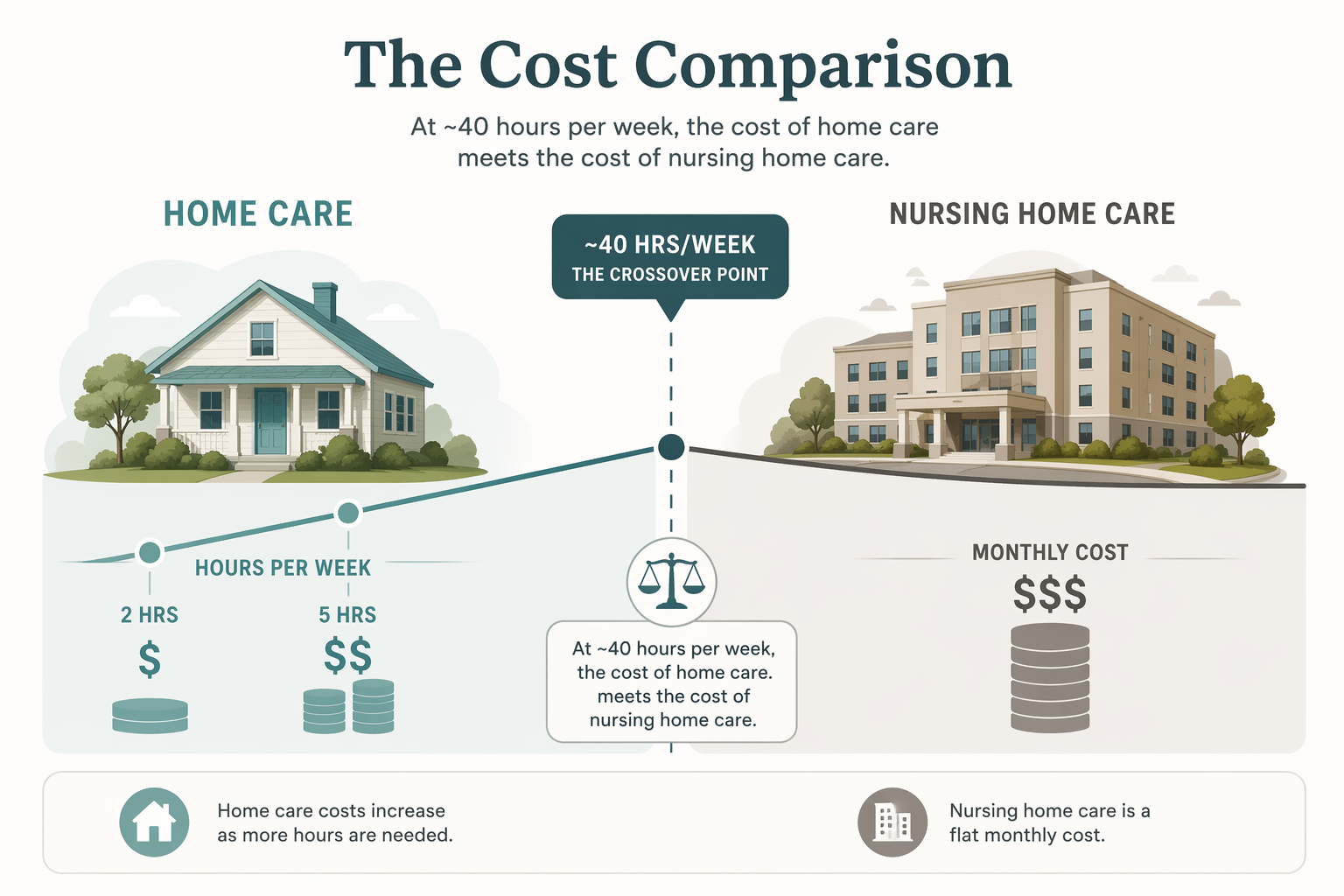
Published cost comparisons put the rough crossover point near 40 hours per week: home care is generally more cost-effective than a nursing home below that level, while the equation can flip as hours climb toward intensive coverage.[6] That is a calibration point, not a law. Local rates, whether family can cover some hours, whether nights are safe, and whether medical needs are present all matter.
The comparison becomes clearer beside facility costs. The cited U.S. News comparison places nursing home costs around $115,000 to $130,000 per year and assisted living around a $74,000 median.[6] A 35-hour weekly home care plan at the national median caregiver rate can sit below those nursing home figures. Full-time or near-full-time home coverage can exceed them quickly.
That does not make home care a bad plan. It means the family should not keep adding shifts without pausing to ask whether the setting still fits the level of risk. Paying for more hours can solve a scheduling gap. It cannot always solve unsafe wandering, repeated overnight falls, or a home layout that no longer works.
How families usually pay
Payment is where many families discover that the phrase “covered care” does not mean what they hoped. The practical order is usually private pay first, then a careful check of Medicare, Medicaid, veterans benefits, and any long-term care insurance.
Private pay
Most nonmedical daily help is paid out of pocket. Families use income, savings, help from adult children, or other private resources. This is why converting hourly care into monthly and annual numbers matters before signing an agency agreement.
If more than one adult child is involved, put the estimate in writing early. A private-pay plan is not only a care decision; it is a family finance decision. Someone will be asked to approve more hours after a bad week, and it is better if that person has already seen the math.
Medicare
Medicare may cover short-term skilled home health services when the requirements are met, but it generally does not pay for ongoing custodial help such as daily bathing, dressing, meal preparation, or supervision when that is the only care needed. The National Institute on Aging states this distinction plainly: Medicare does not pay for long-term care in the home when the care is primarily custodial.[2]
This is the mistake that costs families the most time. A doctor’s order for skilled home health after a hospitalization is not the same as coverage for an aide to come every morning indefinitely. For a deeper breakdown, read what Medicare actually pays for in home health care vs. home care and the companion guide to alternatives when Medicare will not cover custodial home care.
Medicaid HCBS waivers
Medicaid may help some eligible older adults receive home- and community-based services, often called HCBS waivers, but rules, waiting lists, covered services, and financial eligibility vary by state. This is not a single national home care benefit that works the same way everywhere.
A local Area Agency on Aging can be a useful starting point for state-specific navigation. This guide to senior health services coordination through Area Agencies on Aging explains how that kind of navigation can fit into the search.
VA benefits
Veterans and surviving spouses may have access to VA-related benefits or services that can help with care needs, depending on eligibility. The next step is not to assume coverage, but to confirm the veteran’s enrollment, service history, disability status if relevant, income rules, and available local programs.
Long-term care insurance
Long-term care insurance can help when a policy exists and the care need meets its benefit triggers. The problem is that many families assume a policy is hiding somewhere when it is not. Pew reported that only 21% of adults age 65 and older have long-term care insurance.[1]
If there is a policy, request the full contract and ask about elimination periods, daily or monthly benefit limits, inflation protection, covered providers, and whether family caregivers can be paid. If no policy exists, do not build the first care plan around one.
For a fuller payment decision tree, use this guide on how to pay for elderly home care through Medicare, Medicaid, VA benefits, and out-of-pocket options. Families also sometimes overlook smaller funding routes; this article on hidden money for family caregivers is worth reviewing before ruling out help.
How to arrange care without losing the thread
Provider searches become easier when the family separates clinical care from nonmedical help. If the need is skilled home health care, start with the discharge planner, physician, or Medicare-certified agencies and use Medicare Care Compare where relevant. If the need is personal care, homemaker help, or companionship, state licensing rules and agency screening become more important.
- Write the task list and the unsafe times of day before calling.
- Decide whether the need is skilled medical care, personal care, homemaker help, companionship, hospice, or a combination.
- For Medicare-certified home health, compare agencies through Medicare Care Compare and confirm what services are ordered and covered.
- For nonmedical home care, check your state licensing agency or consumer protection office for requirements, complaints, and agency status.
- Ask who supervises aides, how substitutes are handled, what training is required, and how care plan changes are documented.
- Ask whether the agency can handle the likely next step, such as more bathing help, weekend coverage, dementia supervision, or two-person transfers.
- Set a review date after the first two to four weeks instead of treating the first schedule as permanent.
The National Institute on Aging recommends asking direct questions when hiring in-home help, including what services are provided, how workers are trained, how emergencies are handled, and whether references are available.[2] The point is not to interrogate a good aide out of the room. It is to make sure the agency’s promises match the risk in the house.
For complex cases, a geriatric care manager can assess needs, coordinate providers, attend care meetings, and help adult children who live far away. Typical fees are around $100 to $200 per hour, and this help is generally private-pay rather than Medicare-covered. That cost can still be worthwhile when no one in the family can safely manage the moving parts.
The parent still has to accept the plan
The cleanest spreadsheet can fail at the front door. A parent may agree that help is needed and still dislike the idea of a stranger seeing the bathroom, touching laundry, or standing nearby during a shower. That hesitation is not just stubbornness. It is privacy, pride, and the fear that accepting one service means losing control over the next decision.
When safety allows, start with the least invasive task the parent can accept: meals, laundry, transportation, or a companion visit before bathing help. Let the older adult choose between workable options, such as morning or afternoon visits, a male or female aide when available, or which tasks happen first. Consent does not make every hard conversation easy, but it changes the tone from being managed to being included.
Spouses need the same respect. A husband who has been bathing his wife for months may want help and still feel protective of her modesty. A wife who handles every medication may fear that admitting exhaustion means she has failed. The care plan has to protect the person receiving care and the person already providing it.
When home care is no longer enough
Needing more than the first care plan is not a failure. It is information. The plan that worked after one fall may not work after three. The schedule that gave a spouse relief in March may be unsafe by June.
- Repeated falls or near-falls despite equipment, supervision, and home modifications.
- Unsafe wandering, leaving appliances on, or needing supervision that the current schedule cannot cover.
- Overnight care gaps, especially when confusion, toileting, transfers, or falls happen after bedtime.
- Medication errors that continue after pill organizers, reminders, or nurse involvement.
- A spouse or adult child caregiver who is no longer sleeping, working safely, or maintaining their own health.
- Home care costs approaching full-time coverage without a stable way to pay for it.
If the change is sudden, a short-term crisis plan may be more appropriate than rushing into a permanent decision. This short-term care decision guide for an elderly crisis can help families buy time safely. If the pattern is no longer temporary, review the signs a parent may need 24/7 care and reassess the setting, not just the next shift.
Home care works best when the needed hours, safety risks, caregiver capacity, and payment source still fit together. When they no longer fit, the responsible next step is not buying more hours blindly. It is a reassessment of the care setting and support plan.
References
- Most older adults who live at home want to age in place, but they aren’t entirely confident they’ll get to — Pew Research Center, Feb. 26, 2026
- Services for Older Adults Living at Home — National Institute on Aging
- Older Adult Falls Data — CDC
- Social Isolation and Loneliness in Older Adults: Opportunities for the Health Care System — National Academies of Sciences
- Senior Home Care: Aging in Place — U.S. News / CareScout, 2026
- Home Health Care vs. Nursing Homes: Costs & Levels of Care Comparison — U.S. News
Questions to bring to a clinician or OT
This is not medical, legal, or a family's final decision — only a framework. Bring these questions to a clinician, occupational therapist, or your local Area Agency on Aging.
Find Local HelpRelated reading
Noticed something outdated or inaccurate on this page? Flag a correction. We review every report against CDC, NIA, and AARP HomeFit guidance before updating a page.