
Caregiver decision guide
Overnight Dementia Care: When Home Care Is Enough vs. When It's Time for Memory Care
A decision-focused guide for family caregivers of older adults with Alzheimer's or dementia who are struggling with nighttime symptoms like sundowning, wandering, and sleep disruption. This article provides a framework for determining whether overnight in-home care is safe and sufficient, or whether it's time to consider memory care placement.

How Dementia Changes the Night: Sundowning, Circadian Disruption, and Sleep Fragmentation
Dementia does not pause when the sun goes down. For many people living with Alzheimer's disease and other dementias, the transition from day to evening marks the beginning of a period of heightened confusion, agitation, and restlessness known as sundowning. This is not a matter of simple insomnia or a bad mood — it is a neurobiological phenomenon rooted in the disease's progressive damage to the brain's internal clock.
The suprachiasmatic nucleus, the brain's master circadian pacemaker, degenerates as Alzheimer's advances. This disruption scrambles the body's natural sleep-wake cycle, leading to a pattern where the person may feel sleepy during the day but become increasingly alert, confused, and anxious from late afternoon through the night. According to the Mayo Clinic, sleep troubles affect up to 25% of people with mild to moderate Alzheimer's and about 50% of people with moderate to severe Alzheimer's. These numbers climb as the disease progresses, meaning that for many families, nighttime disruption is not a temporary phase but an escalating challenge.
What Sundowning Looks Like in Practice
Sundowning is not a single behavior but a constellation of symptoms that typically emerge in the late afternoon and persist into the night. The Alzheimer's Association describes it as increased confusion that people living with dementia may experience from dusk through night. Contributing factors include mental and physical exhaustion accumulated over the day, a disrupted internal body clock, low lighting that creates confusing shadows, and the caregiver's own end-of-day fatigue, which the person with dementia may sense as stress.
Common manifestations of sundowning include:
- Pacing, restlessness, and repetitive movements
- Verbal agitation, calling out, or repetitive questioning
- Attempts to "go home" even when already at home
- Paranoia or suspiciousness that was not present during the day
- Disorientation to time and place — not recognizing the bedroom as familiar
- Physical aggression or resistance to care, particularly during toileting or changing
For the family caregiver, these behaviors create a cascading problem. The person with dementia is not sleeping, which means the caregiver is not sleeping either. The Caregiver Action Network reports that approximately 70% of caregivers for people with dementia experience sleep problems, with 60% sleeping fewer than seven hours per night. Over weeks and months, this sleep debt accumulates, degrading the caregiver's physical health, emotional resilience, and decision-making capacity — which is precisely when the question of memory care placement begins to surface.
The Wandering Risk: Why Nighttime Is the Most Dangerous Time
Wandering is the most serious safety threat associated with nighttime dementia care, and it is alarmingly common. The Alzheimer's Association reports that 6 in 10 people living with dementia will wander at least once, and many do so repeatedly. When wandering occurs at night, the risks multiply: the person may be disoriented in the dark, unable to navigate familiar spaces, and at high risk for falls, exposure to cold, or getting lost outside the home.
The statistics are sobering. Nearly half of individuals who wander and are not found within 24 hours suffer a serious injury, according to data cited by the Alzheimer's Association. For nighttime wanderers, the danger window is even narrower — a fall in the dark on stairs, a stumble over a rug, or an exit through an unlocked door can lead to hip fracture, head injury, or hypothermia within minutes, not hours.
Signs That Wandering Risk Is Escalating
The Alzheimer's Association identifies several warning signs that a person with dementia may be at increased risk of wandering. Recognizing these early can help families implement safety measures before a crisis occurs:
- Forgetting how to get to familiar places within the home, such as the bathroom or bedroom
- Talking about fulfilling former obligations — going to work, picking up children from school
- Trying or wanting to "go home" even when already at home
- Becoming restless, pacing, or having difficulty locating familiar rooms
- Increased agitation during the late afternoon or evening (sundowning period)
The Alzheimer's Association advises that if the person is not found within 15 minutes, families should call 911 immediately. Many individuals who wander are found within 1.5 miles of where they disappeared, but the speed of response is critical. For families considering overnight care at home, the wandering risk is the single most important factor in determining whether a sleeping caregiver is adequate or whether an awake caregiver is essential.
Behavioral Strategies That Reduce Nighttime Symptoms
Before the question of professional overnight care or memory care placement arises, families should implement evidence-based behavioral strategies that can reduce the frequency and intensity of sundowning and nighttime agitation. These approaches do not eliminate the need for supervision in moderate to advanced dementia, but they can make the difference between a manageable night and a crisis.
The following table summarizes the most effective non-pharmacological interventions, drawn from the Alzheimer's Association and Mayo Clinic guidelines. For a deeper dive into each technique, including detailed implementation steps, see our companion guide on managing sundowning, wandering, and caregiver sleep deprivation.
| Strategy | What It Involves | Why It Helps |
|---|---|---|
| Consistent bedtime routine | Same sequence of activities at the same time every night — changing into pajamas, brushing teeth, reading a short story, dimming lights | Predictability reduces anxiety and reinforces the brain's fading circadian cues |
| Morning sunlight exposure | Spend 15–30 minutes outside in natural light within an hour of waking, or use a bright light therapy lamp (10,000 lux) for 30 minutes | Morning light exposure helps reset the circadian rhythm and improves nighttime sleep quality |
| Reduced evening stimulation | Avoid loud TV, heated arguments, caffeine after noon, and large evening meals. Offer a lighter dinner and limit fluids close to bedtime | Reduces sensory overload that can trigger sundowning agitation |
| Structured daytime activity | Engage in meaningful activities during the morning and early afternoon — walking, folding laundry, simple puzzles, listening to music | Physical and mental activity during the day promotes better sleep at night and reduces daytime napping |
| Limited daytime naps | Keep naps to 30 minutes or less, and avoid napping after 2:00 PM | Excessive daytime sleep fragments nighttime sleep and worsens sundowning |
| Well-lit evening environment | Turn on lights in the living areas and bedroom before dusk. Use nightlights in hallways and the bathroom | Reduces shadows and confusion that can trigger fear and disorientation |
These strategies work best when applied consistently and as a package rather than in isolation. A family that implements morning light exposure, a structured routine, and evening calm may see a meaningful reduction in nighttime symptoms. However, it is important to recognize that behavioral interventions have limits — they are most effective in early to moderate stages of dementia. As the disease progresses, the underlying brain damage may make these strategies insufficient on their own, which is when the decision about professional overnight support becomes urgent.
Environmental Safety: Creating a Dementia-Safe Nighttime Home
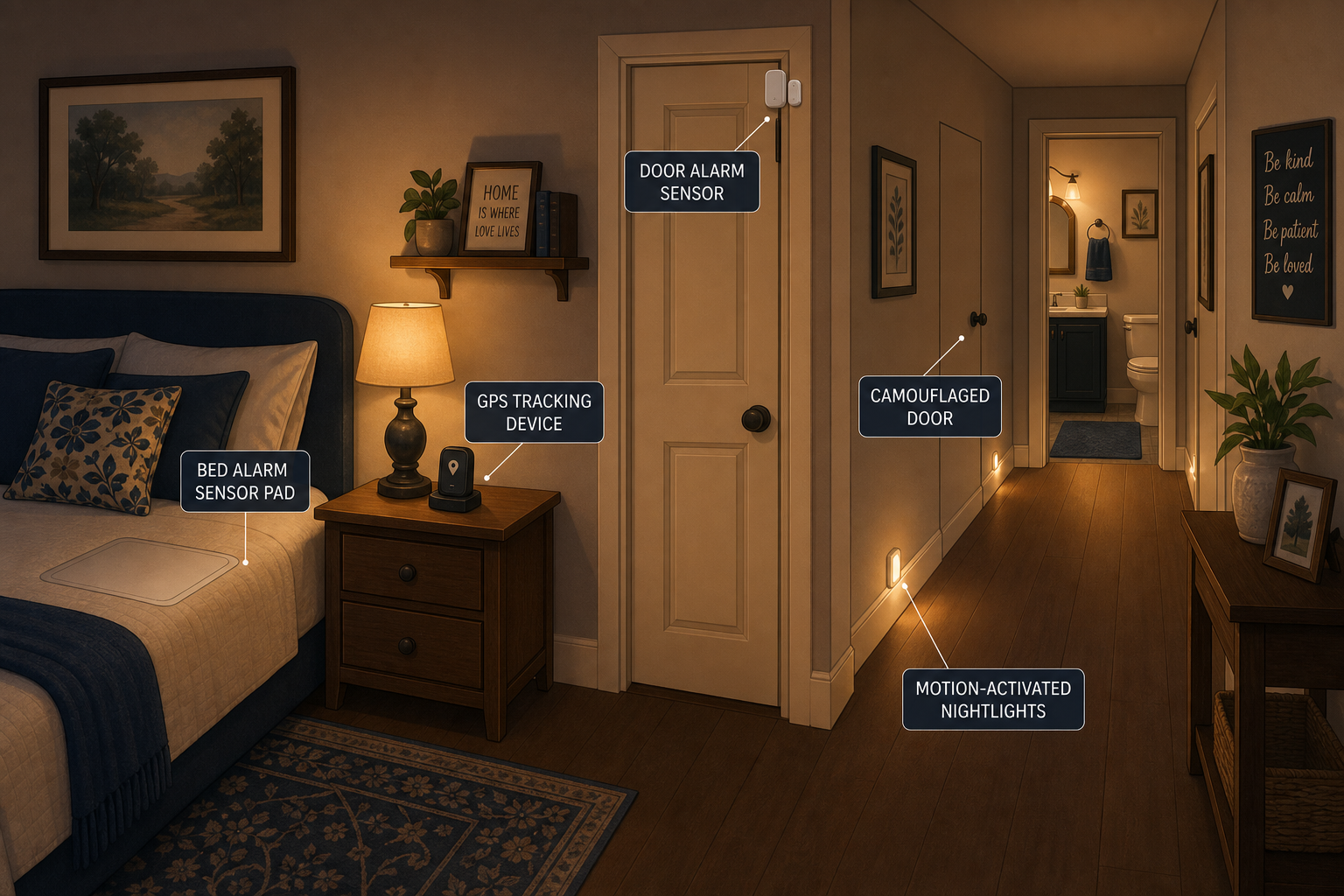
When behavioral strategies are in place but the person with dementia remains at risk for nighttime wandering or falls, environmental modifications become the next layer of defense. These measures do not replace supervision — they buy time and reduce the likelihood of injury when a caregiver is not immediately present.
The Alzheimer's Association recommends a layered approach to home safety for wandering prevention. The following measures are particularly important for overnight safety:
- Place deadbolts out of line of sight — install locks high or low on exterior doors, where the person is less likely to look
- Camouflage doors — paint doors the same color as the surrounding wall, or cover them with a curtain or removable mural to reduce the visual cue that triggers exit attempts
- Install warning bells or chimes above doors — these alert the caregiver when a door is opened
- Use pressure-sensitive mats at the bedside and in front of exterior doors — these trigger an alarm when stepped on
- Place motion-activated nightlights along the path from the bedroom to the bathroom — falls are more likely when the person gets up in the dark to use the toilet
- Secure dangerous areas — use childproof locks on cabinets containing cleaning supplies, medications, or sharp objects
- Consider a GPS tracking device — wearable GPS trackers can help locate the person quickly if they do manage to leave the home
The National Institute of Health (NIH) has found that most falls occur overnight and that falls during the evening are likely to result in more serious injury than daytime falls. This makes the bathroom-to-bedroom pathway a critical safety zone. A clear, well-lit path free of clutter, with a raised toilet seat or bedside commode, can significantly reduce fall risk.
The Awake vs. Sleeping Caregiver Distinction: The Critical Factor in the Placement Decision
This is the central decision point for families navigating overnight dementia care. The distinction between an awake overnight caregiver and a sleeping overnight caregiver is not a matter of preference — it is a safety threshold that determines whether home care is feasible or whether memory care placement should be considered.
The Geriatric Resource Centre defines two distinct models:
| Care Model | Caregiver State | Best For | Typical Cost |
|---|---|---|---|
| Sleeping overnight care | Caregiver sleeps in the home but can wake quickly if needed | Individuals who generally sleep through the night but may occasionally need help with toileting, repositioning, or reassurance | Approximately $200 per night |
| Awake overnight care | Caregiver remains alert for the entire shift (typically 8–12 hours) | Individuals who require frequent assistance, are at high risk of falls, or experience severe confusion, sundowning, or wandering | Approximately $250 per night |
| Live-in care | Caregiver lives in the home full-time, providing round-the-clock support | Individuals who need 24/7 supervision and assistance with most activities of daily living | $200–$350 per day |
For dementia with significant nighttime symptoms — sundowning, wandering, frequent waking, or agitation — a sleeping caregiver cannot provide adequate safety. The person with dementia may get out of bed, wander into the kitchen, attempt to leave the house, or fall in the bathroom without the sleeping caregiver being aware. Even the most devoted family caregiver cannot stay in a state of light sleep for an entire night, night after night.
This is where the awake caregiver model becomes the safety floor. An awake overnight caregiver can:
- Redirect the person back to bed when they get up to wander
- Soothe agitation and confusion during sundowning episodes
- Assist with bathroom trips to prevent falls
- Monitor for signs of pain, discomfort, or medical distress
- Respond immediately if the person falls or becomes injured
If the family cannot provide an awake caregiver themselves — because they need to sleep to maintain their own health and employment — and cannot afford to hire one at $250 per night (approximately $7,500 per month), then memory care placement may be the safer and more sustainable option. This is not a failure of the family; it is a realistic assessment of the limits of home care for advanced dementia.
The Sundowning-Wandering-Medication Triangle: When to Involve a Physician
When behavioral strategies and environmental modifications are not enough, families often wonder whether medication can help manage nighttime symptoms. The relationship between sundowning, wandering, and medication is complex, and it requires careful medical guidance.
The Mayo Clinic recommends that before considering sleep medications, families should first address other health conditions that may be contributing to nighttime disruption — depression, sleep apnea, restless legs syndrome, or pain from arthritis or other chronic conditions. Treating these underlying issues can sometimes resolve sleep problems without adding new medications.
When non-pharmacological approaches are insufficient, a physician may consider:
- Melatonin supplements — low-dose melatonin (3–5 mg) may help regulate the sleep-wake cycle with relatively few side effects
- Low-dose antipsychotics (e.g., quetiapine, olanzapine) — may be prescribed for severe agitation or psychosis, but carry significant risks including increased fall risk, sedation, and cardiovascular events
- Antidepressants with sedating properties (e.g., trazodone) — sometimes used off-label for sleep in dementia, with a lower side-effect profile than antipsychotics
- Benzodiazepines — generally avoided in older adults with dementia due to high risk of falls, confusion, and dependence
The sundowning-wandering-medication triangle means that families must consider all three elements together. A medication that reduces sundowning agitation may also reduce wandering risk — but it may also increase fall risk. A medication that helps the person sleep through the night may leave them groggy and more prone to falls during the day. The physician's role is to help families navigate these trade-offs, but the ultimate decision about whether home care is safe rests on the same question: can one awake caregiver manage the remaining behaviors safely?
The Decision Framework: Home Overnight Care vs. Memory Care Placement
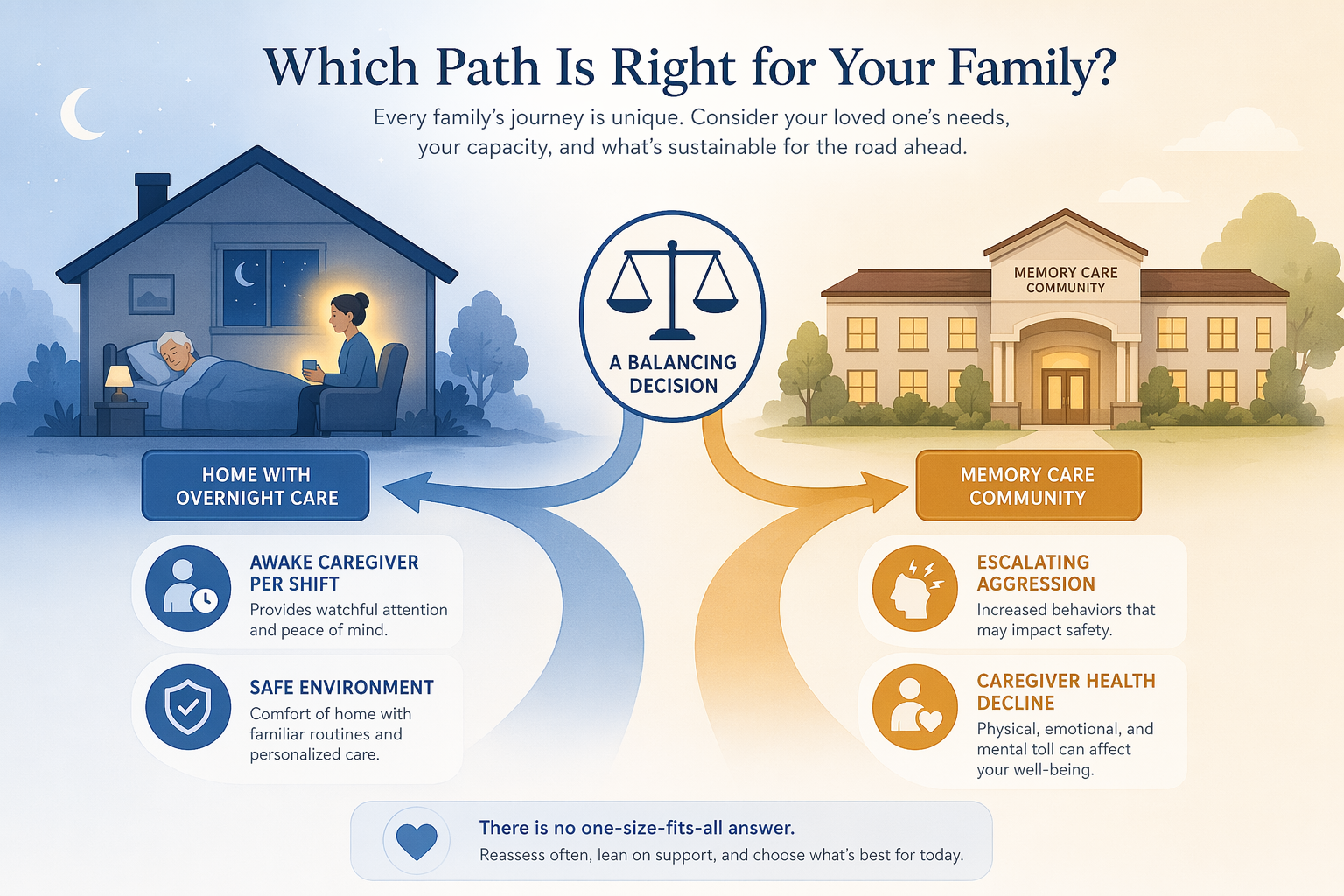
This framework is designed to help families move from emotional overwhelm to a structured decision. It is not a substitute for a conversation with the person's physician, a geriatric care manager, or a memory care placement specialist, but it provides a clear set of criteria to guide that conversation.
When Home Overnight Care Is Sufficient
Home overnight care — with an awake caregiver — is a viable option when all of the following conditions are met:
- One awake caregiver per shift can safely manage the person's nighttime behaviors — wandering can be redirected, sundowning agitation can be soothed, and falls can be prevented through attentive supervision
- The person's agitation does not escalate to physical aggression that puts the caregiver at risk
- The home environment has been modified with appropriate safety measures (door alarms, nightlights, bed alarms, secured exits)
- The family can afford the cost of awake overnight care ($250/night or approximately $7,500/month) or has access to funding sources such as VA Aid & Attendance benefits, long-term care insurance, or Medicaid HCBS waivers
- The family caregiver is able to get adequate sleep during the overnight caregiver's shift — at least 7 hours of uninterrupted sleep every third night, following the "every third night" rule from the Caregiver Action Network
When Memory Care Placement Should Be Considered
Memory care becomes the safer option when any of the following conditions are present:
- Nighttime behaviors escalate despite awake supervision — the person becomes physically aggressive, has frequent falls despite a caregiver being present, or attempts to leave the home repeatedly
- The family caregiver's health is declining from chronic sleep deprivation — the "every third night" rule is not being met, and the caregiver is experiencing symptoms of burnout, depression, or physical illness
- The cost of 24/7 awake care exceeds the cost of memory care — when the family needs awake care for all three shifts (day, evening, overnight), the monthly cost can exceed $15,000–$20,000, which is often higher than memory care placement
- The person's dementia has progressed to the point where they require skilled nursing care that cannot be provided at home — for example, difficulty swallowing, recurrent infections, or complex medication regimens
- The home environment cannot be made safe enough — for example, the home has stairs that cannot be blocked, or the person has figured out how to bypass all door alarms and locks
| Factor | Home Overnight Care Is Viable | Memory Care Should Be Considered |
|---|---|---|
| Wandering risk | Wandering is infrequent and can be redirected by an awake caregiver; door alarms and locks are effective | Wandering is frequent, persistent, or the person has figured out how to bypass safety measures |
| Sundowning severity | Agitation responds to soothing, redirection, and environmental adjustments | Agitation escalates to physical aggression or does not respond to non-pharmacological interventions |
| Fall risk | Falls are rare and the caregiver can assist with transfers and bathroom trips | Falls are frequent despite supervision, or the person has had a serious fall-related injury |
| Caregiver health | Caregiver is able to get adequate sleep during the overnight shift and maintain their own health | Caregiver is experiencing significant sleep deprivation, burnout, or health decline |
| Cost | Family can afford awake overnight care ($250/night) or has funding sources | Cost of 24/7 awake care exceeds memory care costs, or funding is unavailable |
| Medical needs | Medical needs can be managed with primary care and occasional specialist visits | Person requires skilled nursing care or has complex medical needs that exceed home care capacity |
For families who are not yet ready for full memory care placement but need immediate relief, respite care can serve as a middle ground. A short-term stay in a memory care facility — even for a few days or a week — can give the family caregiver time to rest, recover, and make a more considered decision about long-term placement.
For a broader exploration of the home-care-versus-memory-care threshold that applies to overall (not just overnight) care, see our companion guide on when in-home help is enough and when it's time for memory care. And for a comprehensive framework on transitioning from home care to facility care, read When Home Care Isn't Enough.
Questions to bring to a clinician or OT
This is not medical, legal, or a family's final decision — only a framework. Bring these questions to a clinician, occupational therapist, or your local Area Agency on Aging.
Find Local HelpRelated reading
Noticed something outdated or inaccurate on this page? Flag a correction. We review every report against CDC, NIA, and AARP HomeFit guidance before updating a page.