
Caregiver decision guide
Live-In Caregiver vs. 24/7 Shift Care: Understanding the Real Difference and Which One Your Parent Actually Needs
Many families use the terms 'live-in care' and '24/7 care' interchangeably, but they are fundamentally different arrangements with distinct costs, coverage models, and suitability. This guide clarifies the vocabulary confusion, compares both options side by side, and helps you choose the right model for your parent's needs.

The Vocabulary Problem: Why Families Confuse Live-In, 24-Hour, and Overnight Care
When a parent needs round-the-clock support, the first call to a home care agency often goes something like this: "I need a live-in caregiver, 24 hours a day." The agency representative nods, sends over a contract, and a caregiver arrives. But what the family thinks they are getting and what the agency is actually providing may be two entirely different things.
The terms live-in care, 24-hour care, and overnight care are used interchangeably by agencies, online resources, and families alike. Yet they describe fundamentally different arrangements — in cost, in the number of caregivers involved, in the caregiver's obligation to stay awake, and in the level of nighttime supervision the senior actually receives. According to PayingForSeniorCare, people commonly use 'live-in' and '24-hour' care to mean the same thing, but there are distinct differences that can make or break the safety and sustainability of a care plan.
The core distinction comes down to one question: Does the caregiver sleep while on duty? A live-in caregiver is entitled to an uninterrupted sleep period. A 24/7 shift caregiver is awake and on duty throughout their shift. That single difference cascades into everything else — cost, staffing, and suitability.
What Is a Live-In Caregiver?
A live-in caregiver is a single person who resides in the senior's home for a set period — typically 4 to 5 consecutive days — and is paid a flat daily rate rather than an hourly wage. The arrangement is built around the assumption that the senior is stable enough to sleep through the night without assistance.
Key Characteristics of Live-In Care
- One caregiver per shift. A single person stays in the home for the duration of their assignment. There is no rotation of staff during the day or night.
- Entitled to 8 hours of uninterrupted sleep. The caregiver must be provided a bed and allowed to sleep for a full 8-hour period. Some states require a minimum of 5 hours of uninterrupted sleep, but the industry standard is 8 hours.
- Entitled to a 4-hour daytime break. In addition to the sleep period, the caregiver receives a break during the day — often 4 hours — during which the senior is left alone or covered by another family member.
- Flat daily rate. According to Porchlight at Home, live-in care runs $200 to $350 per day, or $6,000 to $10,500 per month. This is significantly less than 24/7 shift care because only one person is being paid.
- Works 4–5 days per week. After their shift, the caregiver leaves and is replaced by another live-in caregiver or by family members for the remaining days.
Live-in care works best for seniors who are physically stable, able to sleep through the night with minimal interruption, and need daytime assistance with activities like bathing, dressing, meal preparation, medication reminders, and companionship. It is a popular choice for families who want to avoid assisted living but cannot afford the higher cost of round-the-clock awake care.
What Is 24/7 Shift Care?
24/7 shift care — sometimes called continuous care or awake care — uses a team of 2 to 3 caregivers who rotate through 8- to 12-hour awake shifts around the clock. No caregiver sleeps on the job. The senior has a fully awake, attentive caregiver at every hour of the day and night.
Key Characteristics of 24/7 Shift Care
- Multiple rotating caregivers. Two or three caregivers work staggered shifts to ensure continuous coverage. Common patterns include three 8-hour shifts or two 12-hour shifts.
- Caregivers are awake and on duty. There is no sleep period. The caregiver is paid an hourly wage for every hour of their shift, including overnight hours.
- Hourly pay structure. Because multiple caregivers are working hourly shifts, the cost is substantially higher. Porchlight at Home reports 24/7 shift care costs $450 to $700 per day, or $13,500 to $21,000 per month.
- No daytime break gaps. Unlike live-in care, there is no period during the day when the senior is left alone. The shifts overlap or transition seamlessly.
- Agency-managed scheduling. Most families use an agency to coordinate the shift schedule, as managing multiple caregivers independently is complex and carries employer responsibilities.
24/7 shift care is necessary when a senior requires active nighttime assistance — for example, someone with middle-to-late-stage dementia who wanders, a person who needs to be repositioned every two hours to prevent bedsores, or someone who is at high risk of falling when getting up to use the bathroom at night. It is also appropriate for post-hospital discharge recovery when a senior is medically unstable and needs frequent monitoring.
Live-In Care vs. 24/7 Shift Care: Side-by-Side Comparison
The table below lays out the operational and financial differences between the two models. Use it as a reference when speaking with agencies or evaluating your parent's needs.
| Dimension | Live-In Care | 24/7 Shift Care |
|---|---|---|
| Number of caregivers | 1 per shift (4–5 days) | 2–3 rotating caregivers |
| Caregiver sleep | 8 hours uninterrupted sleep (entitled) | No sleep; awake on duty |
| Daytime break | 4-hour break (senior left alone) | No break gaps; continuous coverage |
| Pay structure | Flat daily rate | Hourly wage for each caregiver |
| Daily cost | $200–$350 per day | $450–$700 per day |
| Monthly cost | $6,000–$10,500 per month | $13,500–$21,000 per month |
| Cost vs. live-in | Baseline | 2–3x more expensive |
| Nighttime supervision | None (caregiver asleep) | Full awake supervision |
| Best for | Stable seniors who sleep through the night | Seniors needing nighttime assistance or monitoring |
The cost difference is dramatic. Senior Helpers notes that a live-in caregiver's flat daily rate can be about half the cost of 24/7 care. The reason is simple: 24/7 care requires paying multiple people for every hour of the day, while live-in care pays one person a flat rate that accounts for their sleep and break time.
Which Model Does Your Parent Actually Need?
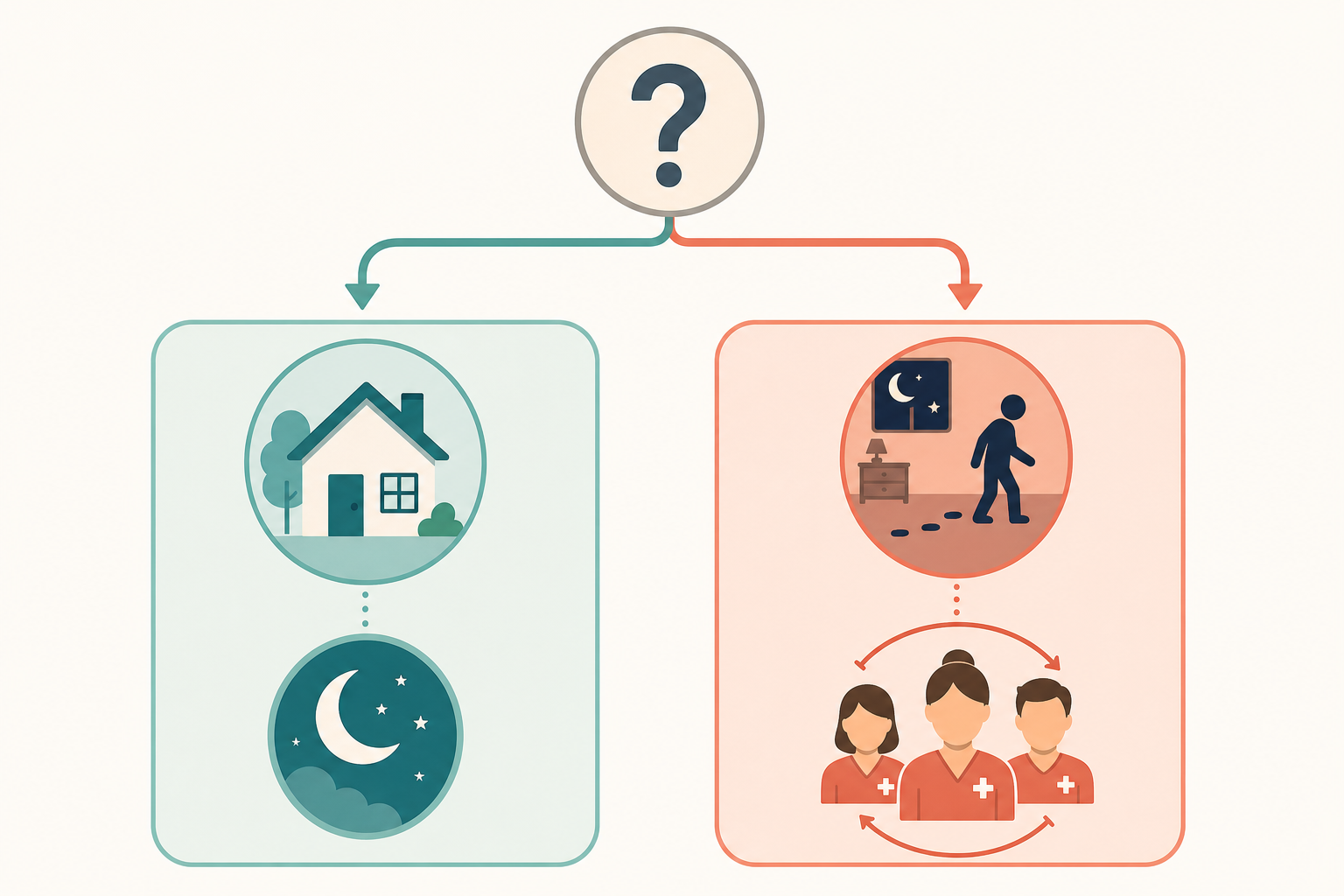
The decision between live-in and 24/7 shift care comes down to one factor more than any other: what happens at night. If your parent can safely and independently sleep through the night, live-in care may be sufficient. If they need help, monitoring, or redirection during the night, you need 24/7 shift care.
Ask These Questions to Decide
- Does my parent need help getting to the bathroom at night? If yes — even once or twice per night — a live-in caregiver who is asleep cannot provide that help. You need 24/7 shift care.
- Does my parent wander or become confused at night? Dementia-related nighttime wandering is a safety emergency. A live-in caregiver will not wake up reliably to prevent it. According to PayingForSeniorCare, if the senior needs nighttime assistance, 24-hour shift care with 2–3 rotating caregivers is needed.
- Does my parent need repositioning in bed? Seniors who are bed-bound or at risk of pressure ulcers need to be repositioned every 2 hours. This requires an awake caregiver.
- Is my parent stable during the day but needs standby assistance? If your parent is mobile, alert, and only needs help with daily tasks like bathing, cooking, and medication reminders, live-in care may be a good fit.
- Can my parent be left alone for 4 hours during the day? Live-in caregivers are entitled to a daytime break. If your parent cannot be left unsupervised for that period, you may need a second caregiver or a different arrangement.
Warning Signs You May Have Chosen the Wrong Model
Families often realize they have chosen the wrong model only after the caregiver has already burned out or a safety incident has occurred. Here are the red flags to watch for in the first few weeks.
- Rapid caregiver turnover. If you are on your third live-in caregiver in two months, the problem is likely not the individual caregivers — it is that the job demands awake overnight coverage that a live-in arrangement cannot provide. Caregivers who are woken repeatedly at night will quit.
- The senior is left alone during the caregiver's break. If your parent cannot safely be alone for 4 hours, a live-in arrangement is not appropriate. You may need a second caregiver for overlapping coverage.
- The caregiver appears exhausted or sleep-deprived. A tired caregiver is an unsafe caregiver. Fatigue leads to mistakes with medication, missed falls, and irritability that affects the quality of care.
- You discover the senior is awake and unsupervised at night. If you check the baby monitor or security camera at 2 a.m. and find your parent wandering the hallway while the caregiver sleeps, you have a model mismatch.
- The agency keeps sending replacement caregivers. Agencies may try to patch the problem by sending different staff, but if the underlying need is for awake overnight care, no amount of caregiver swapping will fix it.
For a deeper look at when it is time to transition to 24-hour care, see our guide: When Is It Time for 24-Hour Home Care? 10 Warning Signs and a Decision Framework for Families.
How to Ask Agencies the Right Questions to Get an Honest Match
Home care agencies are not always forthcoming about the limitations of live-in care — partly because the terminology is genuinely confusing within the industry, and partly because a live-in arrangement is easier to staff and sell than a 24/7 shift team. Your job is to ask the specific questions that force clarity.
Questions to Ask Every Agency
- "Does your live-in caregiver sleep for 8 hours uninterrupted, or are they expected to wake up if my parent needs help?" If the agency says the caregiver will wake up as needed, ask for that in writing. Most agencies will not guarantee it because it violates labor standards in many states.
- "What happens during the caregiver's 4-hour daytime break? Who covers that time?" If the answer is "the senior is on their own," confirm that your parent can safely be alone for that period.
- "How many caregivers will be involved in a 24/7 shift care plan?" A reputable agency will describe a specific rotation — for example, two 12-hour shifts or three 8-hour shifts. Vague answers like "we'll figure it out" are a red flag.
- "What is your policy if the senior needs help during the caregiver's sleep period?" Some agencies have a "wake-up clause" that allows the caregiver to be woken a limited number of times per night. Others strictly prohibit it. Know the policy before you sign.
- "Can you provide a written care plan that specifies the caregiver's sleep and break schedule?" A written plan protects both your family and the caregiver. It also forces the agency to be explicit about what is and is not covered.
- "What is the cost difference between your live-in daily rate and your 24/7 shift care hourly rate?" If the agency hesitates or gives a vague range, ask for a written quote for both models. Compare the numbers side by side.
If the cost of 24/7 shift care feels out of reach, explore hybrid models that combine technology with fewer human hours. Our guide on 24-Hour Care at Home for the Elderly: Can Technology Reduce the Cost and Human Hours? covers sensor-based monitoring, overnight safety devices, and other strategies that may reduce the number of paid caregiver hours needed.
Next Steps: Making Your Decision
Choosing between live-in care and 24/7 shift care is one of the most consequential decisions you will make as a family caregiver. The wrong choice leads to financial waste, caregiver burnout, and — most importantly — safety risks for your parent. The right choice creates a stable, sustainable care environment that allows your parent to age in place with dignity.
Here is a summary of the key takeaways:
- Live-in care is for seniors who are stable at night. It costs $200–$350/day but provides no awake overnight supervision.
- 24/7 shift care is for seniors who need nighttime assistance. It costs $450–$700/day but provides continuous awake coverage.
- The vocabulary is confusing, but the operational difference is clear. Do not let an agency's terminology obscure what your parent actually needs.
- Watch for warning signs in the first few weeks. Rapid turnover, caregiver exhaustion, and unsupervised nighttime activity all point to a model mismatch.
- Ask agencies the hard questions before signing. Get sleep policies, break schedules, and cost comparisons in writing.
For a deeper comparison of live-in care against a specific shift model, read Live-In Caregiver vs. 12-Hour Shifts: A Cost-and-Care Decision Framework for Families. And if you are concerned about the cost of 24/7 care, explore 24-Hour Care at Home for the Elderly: Can Technology Reduce the Cost and Human Hours? for strategies to reduce expenses without compromising safety.
Questions to bring to a clinician or OT
This is not medical, legal, or a family's final decision — only a framework. Bring these questions to a clinician, occupational therapist, or your local Area Agency on Aging.
Find Local HelpRelated reading
Noticed something outdated or inaccurate on this page? Flag a correction. We review every report against CDC, NIA, and AARP HomeFit guidance before updating a page.