
Sitter for Elderly with Dementia: When In-Home Help Is Enough and When It's Time for Memory Care
A structured decision framework for families caring for someone with dementia who are choosing between hiring an in-home sitter and transitioning to memory care. Covers safety risk assessment, the cost crossover point where 24/7 home care exceeds memory care, and a caregiver capacity check.

The Dilemma: Sitters or Memory Care?
In July 2022, a caregiver posted on the AgingCare.com forum with a question that haunts countless families: "My dad was diagnosed with dementia and has seemed to progress rapidly. Lately I believe it's too much. I don't know whether to hire sitters for him or if putting him in a memory care facility is what should be done." The responses that followed painted a familiar picture — the staggering cost of 24/7 agency care, the unreliability of sitters, the terror of nighttime wandering, and the relief that a secured memory care environment can bring.
If you are reading this, you are likely standing at that same crossroads. You want to keep your loved one at home for as long as possible, but the dementia is progressing, and you are starting to wonder whether a sitter is a genuine solution or just a temporary patch. The answer is not a simple yes or no. It depends on three factors that most families never evaluate systematically: the senior's safety risk profile, the cost crossover point where 24/7 home care becomes more expensive than memory care, and your own capacity as a caregiver.
This guide provides a structured framework to help you make that decision with clarity — not a generic pros-and-cons list, but a set of actionable thresholds you can apply to your specific situation.
Safety Risk Assessment: What a Sitter Can and Cannot Handle
The first question to answer is not about cost or convenience — it is about safety. Dementia introduces risks that a general companion or sitter may not be equipped to manage. The Alzheimer's Association explicitly advises families to ask potential providers whether they have experience working with someone with dementia and whether they are trained in dementia care. A sitter without that training cannot safely handle the following common behaviors:
- Wandering and exit-seeking: A person with dementia may attempt to leave the home at any hour, often without awareness of danger. A single untrained sitter cannot physically prevent exit-seeking or safely redirect the person without risking agitation or injury.
- Fall risk: Dementia increases fall risk due to impaired judgment, balance issues, and medication side effects. A sitter without training in safe transfer techniques may not know how to assist someone who is unsteady.
- Medication safety: Many dementia medications require precise timing and dosage. A companion sitter is typically not licensed to administer medications, and errors can have serious consequences.
- Kitchen and cooking safety: A person with dementia may forget that the stove is on, attempt to cook inedible items, or leave appliances running. A sitter must be vigilant and proactive — not just present.
- Agitation and aggression: Dementia can cause sudden mood shifts, paranoia, or physical aggression. A sitter without de-escalation training may respond in ways that escalate the situation.
Some of these risks can be mitigated with home modifications and a wandering safety plan. For example, installing door alarms, securing the stove with a knob cover, and removing tripping hazards can reduce the burden on a sitter. But other risks — particularly nighttime wandering and exit-seeking — require a secured environment that a single sitter in a private home cannot reliably provide. Memory care facilities offer 24-hour awake staff, secured entrances and exits, and staff trained specifically in dementia care techniques. If your loved one is actively attempting to leave the home or has fallen multiple times, a sitter is likely not enough.
The Cost Crossover: When Home Care Becomes More Expensive Than Memory Care
The most counterintuitive finding in this decision is that home care is not always cheaper than memory care — and in many cases, it is dramatically more expensive. The key variable is the number of hours of care needed per week.
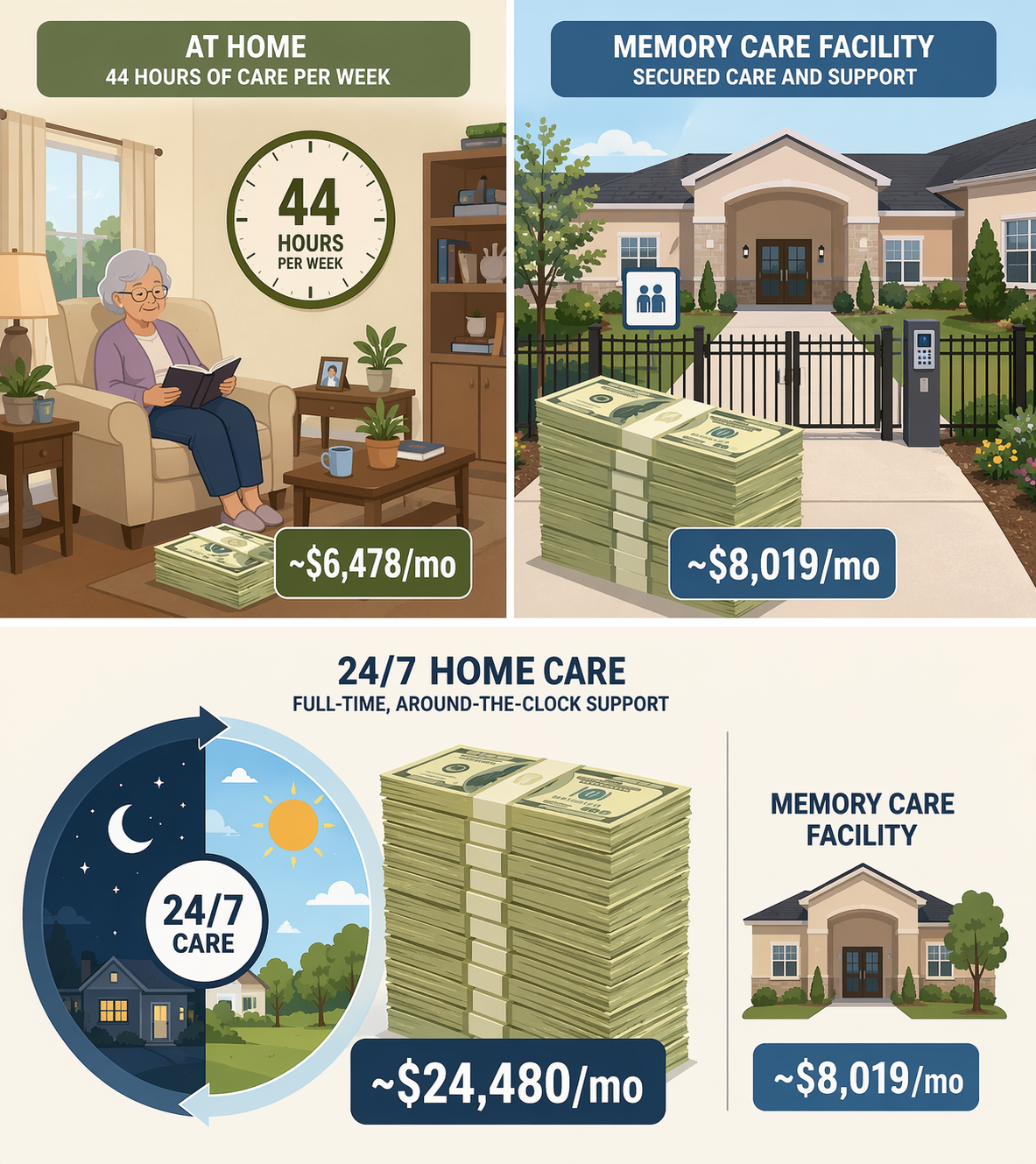
According to A Place for Mom's 2026 Costs of Long-Term Care and Senior Living Report, the national median cost for private nonmedical in-home care is $34 per hour. At 44 hours per week — roughly the equivalent of a full-time job plus overtime — the monthly cost is approximately $6,478. That is less than the national median for memory care, which SeniorLiving.org reports as $8,019 per month as of May 2026.
| Care Scenario | Hours/Week | Monthly Cost (National Median) | vs. Memory Care ($8,019/mo) |
|---|---|---|---|
| Part-time companion | 15 hrs/week | $2,208 | 73% less |
| Full-time home care | 44 hrs/week | $6,478 | 19% less |
| 24/7 home care (3 shifts) | 168 hrs/week | $24,480 | 3x more |
| Memory care facility | 24/7 | $8,019 | Baseline |
The crossover point is stark: as long as your loved one needs fewer than roughly 44 hours of care per week, home care is the more affordable option. But once the need escalates to 24/7 supervision — which is common in middle-to-late-stage dementia — the monthly cost of home care jumps to approximately $24,480. That is three times the cost of memory care.
For a real-world example of agency pricing, see our analysis of Home Instead Senior Care costs in 2026, which provides a concrete benchmark for what families actually pay for agency-provided home care.
Caregiver Capacity Check: Are You Reaching Your Limit?
The third factor is the one families most often ignore: your own physical and emotional capacity. The USC Leonard D. Schaeffer Institute for Public Policy & Government estimates that friends and family members provide $247 billion in unpaid dementia care in 2026. That is not a measure of love — it is a measure of economic sacrifice, and it often comes at the cost of the caregiver's own health.
Ask yourself these questions honestly:
- Are you sleeping less than 6 hours per night because your loved one is awake and wandering?
- Have you missed your own medical appointments, or postponed your own health concerns?
- Do you feel irritable, resentful, or emotionally numb toward your loved one?
- Have you withdrawn from friends, hobbies, or activities that used to bring you joy?
- Are you relying on alcohol, caffeine, or sleep aids to get through the day?
- Has your work performance declined, or have you considered quitting your job?
If you answered yes to two or more of these, you may be experiencing caregiver burnout. The Cleveland Clinic defines burnout as a state of physical, emotional, and mental exhaustion that can lead to serious health problems. Recognizing this is not a sign of failure — it is a sign that the current care arrangement is unsustainable.
For a deeper look at the signs that it is time for additional support, read our guide on overnight care red flags, which covers the specific indicators that nighttime supervision has become essential.
Decision Matrix: Action Thresholds for Choosing Between a Sitter and Memory Care
The following matrix combines the three factors — safety risk, cost, and caregiver capacity — into actionable thresholds. Find the row that best matches your situation.
| Safety Risk | Care Hours Needed | Caregiver Capacity | Recommended Action |
|---|---|---|---|
| Low (no wandering, no falls) | Under 44 hrs/week | Healthy | Hire a sitter as a bridge; reevaluate monthly |
| Low to moderate | Under 44 hrs/week | Showing early burnout signs | Hire a sitter for respite; begin memory care research |
| Moderate (occasional wandering, one fall) | 44 hrs/week | Healthy | Hire a sitter; implement home safety modifications; monitor closely |
| Moderate to high | 44–100 hrs/week | Showing burnout | Increase sitter hours; begin memory care tours this month |
| High (active exit-seeking, multiple falls) | 24/7 (168 hrs/week) | Any state | Memory care is the safer and more affordable option |
| High | 24/7 | Experiencing burnout | Prioritize memory care placement immediately; use respite sitter for transition |
The critical insight is this: if your loved one needs 24/7 supervision, memory care is not just safer — it is also substantially cheaper than round-the-clock home care. Many families assume that home care is always the more affordable option, but the data shows the opposite once the need becomes constant.

How to Use a Sitter as a Bridge: Transitional Respite While Evaluating Memory Care
Choosing memory care does not mean you must stop using sitters entirely. In fact, a sitter can be a strategic short-term tool during the transition period. Here is how to use sitter services effectively while you evaluate memory care options:
- Respite care: The National Institute on Aging describes respite services as short-term care for an older adult at home, in a facility, or at an adult day care center, lasting from a few hours to several weeks. Use a sitter for 8–15 hours per week to give yourself time to tour facilities, consult with professionals, and rest.
- Overnight coverage: If nighttime wandering is a concern but not yet constant, a sitter can provide overnight supervision while you sleep. This can extend the safe at-home window by weeks or months.
- Transition support: During the first few weeks after a move to memory care, a familiar sitter can visit the facility to provide continuity and comfort for your loved one.
Paying for sitter services can be challenging, but several funding sources may help. Medicaid Home and Community-Based Services (HCBS) waivers may cover in-home care for eligible individuals, though coverage varies by state. Some long-term care insurance policies help pay for companion visits and respite care. For a comprehensive overview of payment options, see our guide on how to pay for in-home care in 2026.
Next Steps: Making the Decision with Confidence
The decision between a sitter and memory care is one of the most consequential choices you will make in your caregiving journey. It is not a sign of failure to choose memory care — it is a sign that you are prioritizing safety and sustainability. Here is your action plan:
- Complete the safety risk assessment above. If your loved one is actively wandering, exit-seeking, or falling, a sitter alone is not a safe solution.
- Calculate your local cost crossover. Use the national medians as a starting point, but call local agencies and facilities to get real numbers for your area.
- Assess your own capacity honestly. Use the burnout checklist. If you are reaching your limit, acknowledge it and act.
- Use the decision matrix to identify your action threshold. If the matrix points toward memory care, begin touring facilities with a checklist.
- Consult with your loved one's primary care doctor and an elder law attorney. A doctor can provide a clinical assessment of safety risk. An elder law attorney can advise on Medicaid planning and asset protection.
- If you choose a sitter as a bridge, set a reevaluation date. Revisit the decision in 30 days. Dementia progresses, and what works today may not work next month.
The goal is not to keep your loved one at home at any cost. The goal is to find the safest, most sustainable care arrangement for both of you. Whether that means hiring a sitter for a few hours a week or transitioning to a memory care community, the right choice is the one that protects your loved one's safety and your own well-being.
Related reading
Noticed something outdated or inaccurate on this page? Flag a correction. We review every report against CDC, NIA, and AARP HomeFit guidance before updating a page.
Part of the Fall Prevention section.