Private Caregiver Legal and Financial Responsibilities: A Complete Guide for Family Employers
This guide explains the legal and financial obligations families take on when hiring a private caregiver, including IRS household employee rules, payroll taxes, insurance requirements, and recordkeeping. It is written for adult children who have decided to hire privately and need clear, actionable compliance guidance.
By Editorial Team
new caregiver
medication management
care coordination
first steps
ADLs
📄
A printable version of this guide is available. Use your browser's print function (Ctrl+P / ⌘P) to save or print.
Making the decision to hire privately means stepping into the role of employer — a shift that comes with specific legal and financial duties.
Are You Really an Employer? Understanding the IRS Household Employee Rule
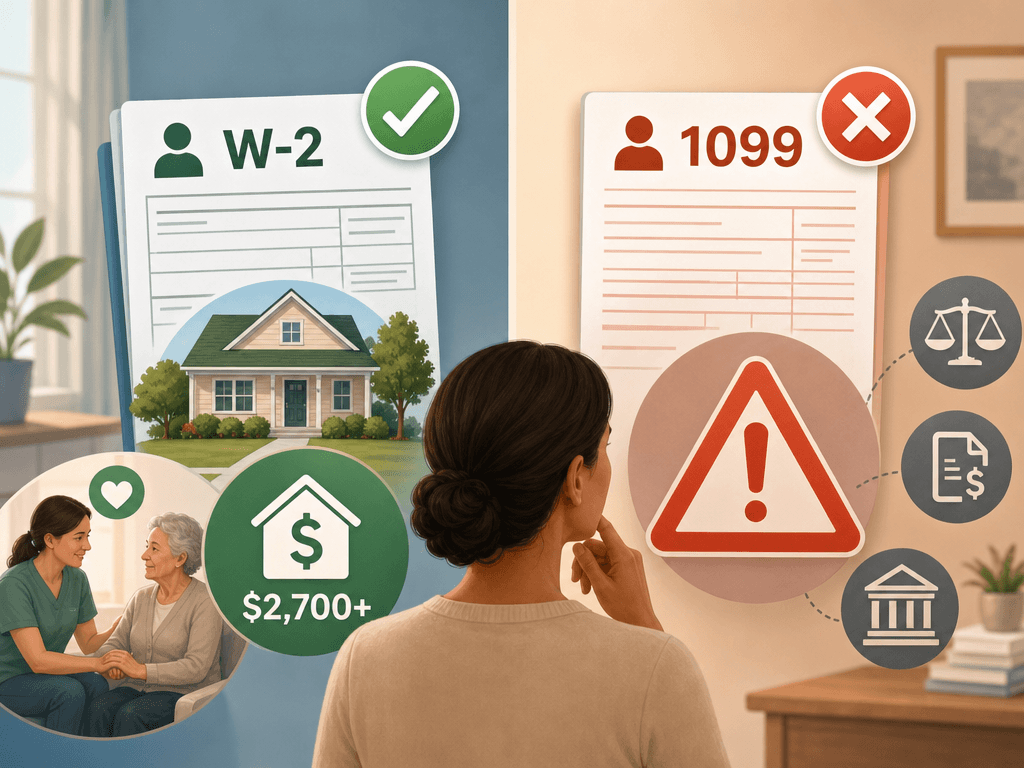
Most families who hire a private caregiver do not realize they have just become a household employer in the eyes of the IRS. The trigger is straightforward: if you pay a caregiver more than $2,700 in a calendar year, the IRS classifies that person as your household employee, not an independent contractor. This threshold, established in IRS Publication 926, applies regardless of whether the caregiver works full-time or part-time, and regardless of whether you consider the arrangement informal.
The distinction between a W-2 employee and a 1099 independent contractor is the single most consequential classification decision you will make. Misclassifying a caregiver as an independent contractor — paying them as a 1099 worker — is one of the most common and most dangerous mistakes families make. The IRS treats this as a compliance violation, and the consequences include back taxes, penalties, interest, and in severe cases, criminal liability.
Why does the IRS care so much about this distinction? Because household employees are entitled to the same employment protections as any other worker: Social Security and Medicare contributions, unemployment insurance, and workers' compensation coverage. When you classify a caregiver as a 1099 contractor, you avoid paying the employer share of these taxes — roughly 7.65% of wages — and you bypass the legal obligations that come with being an employer. The IRS considers this a form of tax avoidance, and it is a well-known audit trigger for families who hire private caregivers.
If you are still deciding whether private hire is right for your family, see our complete decision framework for a full comparison of private vs. agency options. But if you have already made the decision to hire privately, the following sections will walk you through every legal and financial obligation you now carry as a household employer.
The IRS household employee rule: pay a caregiver more than $2,700 in a year and they are your W-2 employee, not a 1099 contractor.
Step-by-Step Setup: EIN, State Registration, I-9, and W-4
Once you have accepted that you are now an employer, the next step is a straightforward but essential setup process. These four steps establish your legal standing as an employer and create the foundation for everything that follows — payroll, tax filing, and compliance.
1. Obtain an Employer Identification Number (EIN)
An EIN is the business equivalent of a Social Security number for your household employment. You need it to report taxes, open a payroll account, and file any employment-related documents. The application is free and can be completed online through the IRS website in about 15 minutes. You will receive your EIN immediately upon completion.
2. Register with Your State Revenue Department
If your state has an income tax, you must register as an employer with the state revenue department. This registration allows you to withhold and remit state income taxes from your caregiver's wages. Some states also require you to register for state unemployment insurance at this point. The process varies by state but typically involves an online application and a state-specific employer identification number.
3. Complete Form I-9 (Employment Eligibility Verification)
Form I-9 verifies that your caregiver is legally authorized to work in the United States. Both you and the caregiver must complete the form within three business days of the caregiver's start date. You are required to examine acceptable documents — such as a U.S. passport, permanent resident card, or a combination of a driver's license and Social Security card — and record the document information on the form. Keep the completed I-9 on file for the duration of employment plus three years after termination.
4. Have the Caregiver Complete Form W-4
Form W-4 tells you how much federal income tax to withhold from each paycheck. The caregiver fills out the form based on their filing status, number of dependents, and other adjustments. You use this information, along with the IRS withholding tables, to calculate the correct withholding amount for each pay period. The W-4 should be completed before the first paycheck is issued.
Payroll and Taxes Explained: What You Owe and How to Pay It
As a household employer, you are responsible for withholding certain taxes from your caregiver's wages and paying an equal amount yourself. Understanding these obligations is essential to avoiding surprises at tax time.
The table below breaks down the tax components you must manage.
Household employer tax obligations: Social Security and Medicare require equal contributions from both you and your caregiver; unemployment taxes are employer-only.
Tax Type
Employee Share (Withheld from Pay)
Employer Share (You Pay)
Total Rate
Social Security
6.2%
6.2%
12.4%
Medicare
1.45%
1.45%
2.9%
Federal Unemployment (FUTA)
0%
6.0% on first $7,000 of wages
6.0% on first $7,000
State Unemployment (SUTA)
0%
Varies by state
Varies by state
The combined employer share of Social Security and Medicare is 7.65% of the caregiver's gross wages. When you add the employee's share (also 7.65%, which you withhold from their paycheck), the total FICA tax is 15.3% of wages. This is the core payroll tax obligation that many first-time employers find surprising.
Federal Unemployment Tax (FUTA) is paid entirely by you as the employer. The rate is 6.0% on the first $7,000 of wages per employee per year. However, most states offer a credit that reduces the effective FUTA rate to 0.6% if you pay state unemployment taxes on time. State unemployment tax rates and wage bases vary widely by state.
How to File: Schedule H
Unlike a business, you do not file a separate employment tax return. Instead, you report your household employee taxes on Schedule H, which you attach to your personal Form 1040. Schedule H calculates the total Social Security, Medicare, and FUTA taxes you owe based on the wages you paid. You then include this amount as an additional tax on your personal return.
If you prefer to avoid a large lump-sum payment at tax time, you can adjust your personal withholding or make estimated quarterly payments. Many families find that increasing their own withholding is the simplest approach.
Payroll Service Options: DIY vs. Professional Help
Once you understand the tax obligations, the next question is whether to manage payroll yourself or hire a service. Both approaches work, but they require different levels of time commitment and comfort with tax forms.
DIY vs. payroll service: the trade-offs in time, cost, and complexity for household employer payroll.
Approach
What It Involves
Cost
Best For
DIY with Schedule H
Calculate withholding manually each pay period, file Schedule H with your personal tax return, make estimated payments if needed
Free (your time only)
Families comfortable with tax forms and willing to spend a few hours per quarter
Payroll Service
Service calculates withholding, files all tax forms, generates pay stubs, handles year-end W-2
$50–$75 per month
Families who want to avoid errors and save time
The DIY approach is entirely feasible if you are organized and comfortable with basic tax calculations. You will need to calculate Social Security and Medicare withholding for each pay period, track cumulative wages for FUTA purposes, and file Schedule H annually. The main risk is calculation errors, which can trigger IRS notices or penalties.
A payroll service, costing $50 to $75 per month, handles all of these tasks automatically. The service calculates withholding, files quarterly and annual tax forms, generates pay stubs, and produces the year-end W-2. For many families, the monthly fee is a small price compared to the potential cost of an IRS penalty or the time required to manage payroll correctly.
Insurance: Workers' Compensation, Liability, and Auto Coverage
Insurance is not optional when you employ a private caregiver. Three types of coverage are particularly important, and the requirements vary by state and situation.
Three essential insurance coverages for household employers: workers' compensation, general liability, and auto insurance.
Workers' Compensation Insurance
Workers' compensation insurance covers medical bills and lost wages if your caregiver is injured on the job. In most states, this coverage is required for household employers. However, some states exempt employers with fewer than a certain number of employees, while others require coverage regardless of the number of employees. You must check your state's specific requirements.
Without workers' compensation, you could be personally liable for medical expenses if a caregiver is injured in your home. A simple slip in the bathroom or a back injury while transferring your parent could result in thousands of dollars in medical bills — bills that workers' compensation would have covered.
Liability Insurance
Standard homeowner's or renter's insurance policies may not cover injuries to a household employee. You should check your existing policy to see whether it includes coverage for domestic workers. If it does not, you may need to add a rider or purchase a separate liability policy. Liability insurance for a household employee typically costs around $40 per month and covers on-the-job accidents that are not covered by workers' compensation.
Auto Insurance
If your caregiver will drive your parent to appointments, run errands, or use their own vehicle for care-related tasks, you need to address auto insurance. If the caregiver uses their own car, verify that their personal auto policy covers business use — many standard policies exclude coverage for driving as part of paid employment. If the caregiver will drive your vehicle, your policy should cover them as an occasional driver. In either case, a conversation with your insurance agent is essential before the caregiver begins driving.
Recordkeeping: What to Keep and for How Long
The IRS can audit your household employment records for up to four years after the tax return is filed. Proper recordkeeping is not just a best practice — it is your primary defense in the event of an audit.
Here is what you should retain and for how long.
Payroll records (pay dates, gross wages, withholding amounts, net pay): 4 years after the tax return is filed
Form I-9: 3 years after the date of hire or 1 year after termination, whichever is later
Time sheets or work logs: 4 years
Expense receipts (mileage, supplies, meals): 4 years
Employment contracts and any written agreements: 4 years after termination
Organize these records in a dedicated file — either physical or digital — and update it after each pay period. Digital records are easier to maintain and search, but ensure you have a reliable backup system. If you use a payroll service, they will typically maintain copies of all tax filings and pay stubs, but you should still keep your own records as a backup.
Common Mistakes That Trigger Audits or Penalties
The most dangerous mistakes are not the complex ones — they are the basic compliance failures that families make because they do not realize they are employers. Here are the most common errors and their consequences.
Misclassifying the caregiver as a 1099 independent contractor: This is the single most common and most expensive mistake. The IRS treats misclassification as a compliance violation, and the penalties include back taxes, interest, and fines. In severe cases, criminal penalties may apply.
Failing to obtain an EIN: Without an EIN, you cannot properly report employment taxes. The IRS may reject your Schedule H or assess penalties for incomplete filing.
Not paying unemployment taxes (FUTA and SUTA): These are employer-only taxes that many families overlook. Failure to pay can result in penalties and interest, and it may affect the caregiver's eligibility for unemployment benefits if they are laid off.
Skipping workers' compensation insurance: In states where it is required, failure to carry workers' compensation can result in fines, personal liability for medical bills, and even criminal charges in some jurisdictions.
Inadequate recordkeeping: If you are audited and cannot produce payroll records, time sheets, or tax filings, the IRS may estimate the taxes you owe — and their estimate is likely to be higher than what you actually owe.
The good news is that all of these mistakes are avoidable. The setup process is straightforward, and the ongoing compliance tasks become routine once you have a system in place. The families who run into trouble are almost always the ones who did not know they were employers in the first place.
Resources: Where to Find Official Guidance and Help
You do not need to navigate this alone. The following resources provide official guidance, state-specific information, and practical tools to help you meet your obligations as a household employer.
IRS Publication 926 (Household Employer's Tax Guide): The definitive federal guide covering all household employer tax obligations, including the $2,700 threshold, Schedule H instructions, and FUTA requirements. Available for free download on the IRS website.
IRS Form SS-4 (Application for Employer Identification Number): The online application for obtaining your EIN. Free and takes approximately 15 minutes.
U.S. Citizenship and Immigration Services (USCIS) Form I-9: The employment eligibility verification form, with instructions and a list of acceptable documents.
Your state's labor department or revenue department website: For state-specific employer registration, unemployment insurance requirements, and workers' compensation rules.
Payroll service providers: Companies like SurePayroll, Household payroll, and others specialize in household employee payroll. Costs range from $50 to $75 per month.
A tax professional or accountant: If your situation is complex — for example, if you have multiple household employees or are also claiming care-related tax credits — a professional can ensure you meet all obligations correctly.




Comments
Join the discussion with an anonymous comment.