
Caregiver decision guide
Senior Care Options in 2026: What's Changed and What Families Need to Know Now
The senior care landscape has shifted dramatically in the last few years. This guide helps progressive-learning adult children understand the key cost trends, new care models, and policy changes that matter most when updating a parent's care plan in 2026.

Why 2026 Is Different: The New Senior Care Landscape
If you last researched senior care options in 2022 or 2023, the numbers you remember are likely outdated — and in some cases, misleading. The cumulative effect of post-pandemic inflation, staffing realignments, and shifting occupancy rates has reshaped the cost structure of nearly every care type. Families who rely on cost assumptions from even two years ago risk underestimating their budget by 20–30%.
Several structural forces are driving this change. The 10,000 Baby Boomers who turn 65 every day — a pace that continues until 2030 — are creating sustained demand-side pressure across all care settings. At the same time, post-COVID staffing shortages have pushed labor costs higher, particularly for home care agencies and nursing facilities. And on the policy side, states are expanding Medicaid home- and community-based services waivers, which is slowly shifting where care dollars flow.
This guide is written for progressive-learning readers — adult children who already understand the basic care options and have been managing a parent's care for a while. Your task here is not to learn what assisted living is. It is to understand what has changed, what those changes mean for your family's plan, and how to adjust.
2026 Cost Snapshot: What You'll Pay for Each Care Type
The table below presents the national median costs for the nine major senior care categories. These are the figures you should use as a baseline when building a budget or comparing options. Pay close attention to the year-over-year change column — it reveals which categories are accelerating fastest and where rare cost decreases have appeared.
| Care Type | National Median Cost | Year-Over-Year Change | Annual Equivalent |
|---|---|---|---|
| Non-medical home care | $35/hour | +3% | $80,080 (44 hrs/wk) |
| Skilled nursing at home | $90/hour | N/A | $187,200 (40 hrs/wk) |
| Assisted living | $6,200/month | +5% | $74,400 |
| Memory care | $7,645/month | N/A | $91,740 |
| Nursing home (semi-private) | $9,581/month | +3% | $114,975 |
| Nursing home (private) | $10,798/month | +1% | $129,575 |
| Board and care (private) | $7,300/month | N/A | $87,600 |
| Board and care (shared) | $6,000/month | N/A | $72,000 |
| Adult day health care | $95/day | -5% | $24,700 (260 days) |
| Independent living | $3,523/month | N/A | $42,276 |
| Respite care | $150–$425/day | N/A | Varies |
| CCRC entrance fee | $100k–$2M | N/A | One-time |
| CCRC monthly fee | $3,000–$8,000 | N/A | $36,000–$96,000 |
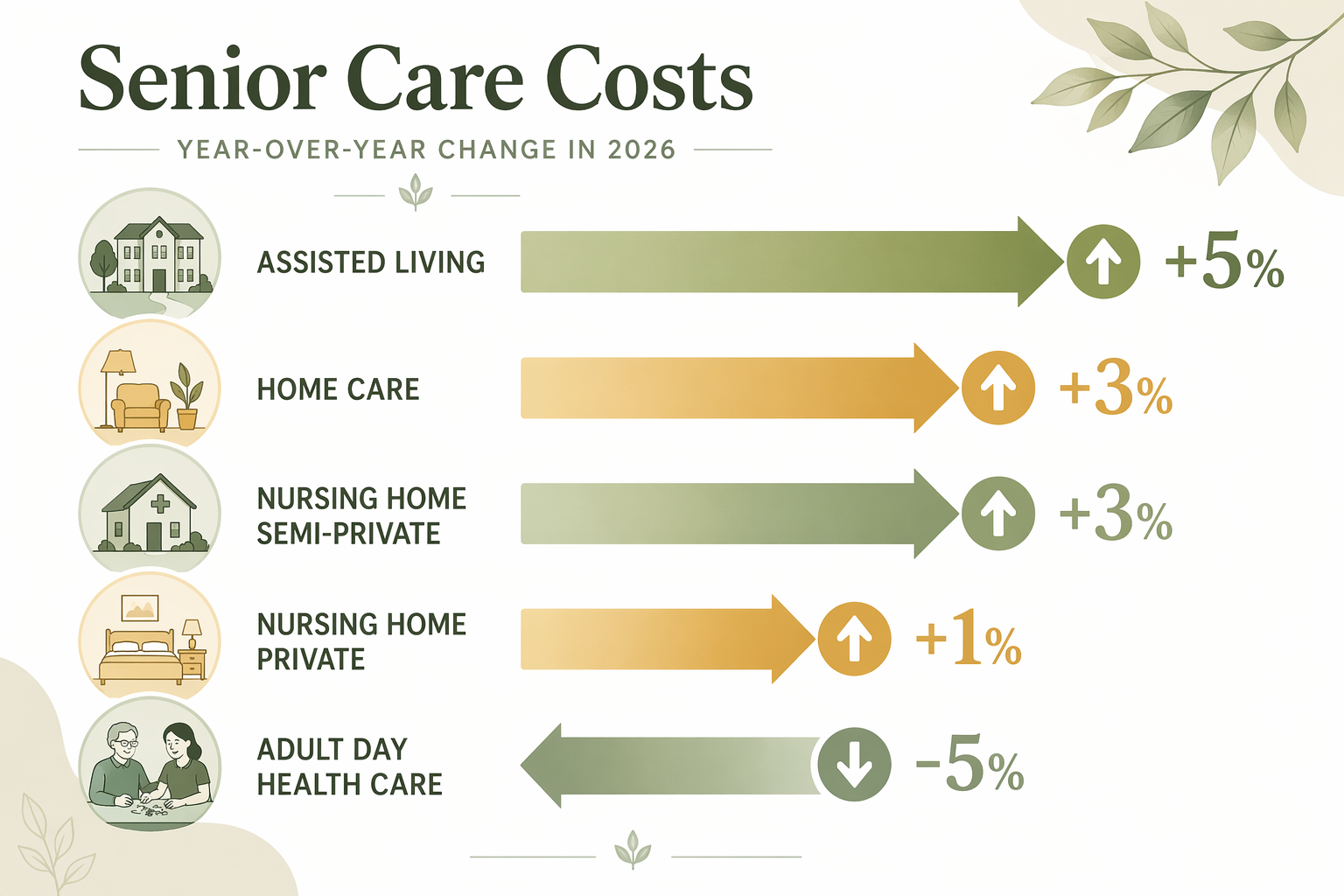
A few observations stand out immediately. Assisted living, at $6,200 per month, is now the fastest-rising major care category at 5% year-over-year growth. Non-medical home care, at $35 per hour, rose a more modest 3%, but the cumulative effect over multiple years is substantial: at 44 hours per week, home care now costs $80,080 annually — a figure that exceeds the annual cost of assisted living for many families.
The outlier is adult day health care, which actually declined 5% to $95 per day. This is a rare cost decrease in the senior care sector and may reflect increased supply or shifts in state funding for community-based programs. For families with a parent who is safe at home during non-caregiver hours but needs structured supervision during the day, adult day care is becoming a more attractive option.
Key Trends: Where Costs Are Rising (and Falling)
Understanding the direction of cost changes is as important as knowing the current price. A 5% annual increase in assisted living means today's $6,200 monthly rate could exceed $7,700 in five years — a reality that matters for families planning a multi-year stay. Here are the most significant trends the 2025 data reveals.
- Assisted living (+5% YoY): This is the sharpest increase among major care types. Driven by rising labor costs and occupancy recovery post-COVID, assisted living is becoming less accessible for middle-income families without long-term care insurance or substantial savings.
- Non-medical home care (+3% YoY): The increase is moderate, but the cumulative effect is significant. At $35/hour, a family paying for 30 hours of weekly care now spends $54,600 annually — up from roughly $50,000 in 2023.
- Nursing home semi-private (+3% YoY): Semi-private rooms rose to $9,581/month, reflecting ongoing staffing pressures in skilled nursing facilities. Private rooms rose only 1% to $10,798/month, suggesting that demand for private accommodations may be softening.
- Adult day health care (-5% YoY): The only category to see a decline. At $95 per day, adult day care remains the most affordable structured care option and may become an increasingly important part of the care continuum for families managing costs.
- Demographic pressure: With 10,000 Baby Boomers turning 65 daily until 2030, and 7 out of 10 people turning 65 expected to require some form of long-term care in their lifetime (according to HHS/ACL data cited by CareScout), demand-side pressure on all care options will continue.
These trends point to a widening gap between the most affordable options (adult day care, independent living) and the most expensive (nursing homes, home care at high hours). Families who can layer multiple lower-cost options — for example, combining adult day care with part-time home care — may find more sustainable arrangements than those who rely on a single care type.
Policy Changes That Affect Your Options and Budget
Beyond market forces, several policy developments in 2025 and 2026 are reshaping what families can access and how they pay for it. Understanding these changes is essential for accurate planning.
Medicare: Custodial Care Exclusion Remains Firm
Medicare still does not cover custodial long-term care — the type of assistance with activities of daily living (bathing, dressing, eating, toileting) that most seniors eventually need. This is not a new policy, but it is a persistent source of confusion for families. Medicare covers skilled nursing care only after a qualifying hospital stay and only for a limited duration. For ongoing custodial care, families must look to Medicaid, VA benefits, long-term care insurance, or personal funds.
State Medicaid Expansion for Home- and Community-Based Services
A growing number of states are expanding Medicaid waivers for home- and community-based services (HCBS), which allow seniors to receive care at home or in community settings rather than in nursing homes. These waivers can cover personal care assistance, adult day health care, home modifications, and respite care. The expansion is uneven — some states have robust programs with waiting lists, while others have limited offerings. Families should check their state's Medicaid website or consult with a local aging agency to understand what is available.
VA Aid and Attendance Benefits
For veterans and surviving spouses, the VA Aid and Attendance benefit provides monthly payments to help cover the cost of care. As reported by the American Council on Aging (via U.S. News), current maximum amounts are:
- Married veteran: up to $2,874/month
- Single veteran: up to $2,424/month
- Surviving spouse: up to $1,558/month
These figures may have been adjusted for 2026 cost of living. Families should verify current amounts against the VA's official benefit schedule before incorporating them into a care budget.
For a comprehensive overview of all payment sources — including Medicaid, VA benefits, long-term care insurance, reverse mortgages, and state-specific programs — see our guide on how to pay for elderly care. And for families who suspect they may be missing out on unclaimed benefits, our article on the $58 billion gap in unclaimed financial help is a must-read.
How to Verify Costs in Your State
National median figures are useful for broad planning, but senior care costs vary dramatically by state and even by region within a state. Assisted living in Manhattan, for example, can cost twice the national median, while the same level of care in rural Mississippi may be 30% below it. Using national medians alone can lead to significant budgeting errors.
Here is a simple process for finding accurate local cost data:
- Use the CareScout Cost of Care tool at carescout.com/cost-of-care. It provides state-by-state and metro-area medians for all major care types, based on the same survey data used in this article.
- Cross-reference with the Genworth Cost of Care Survey, which publishes its own state-level data. Note that different survey sources may produce slightly different estimates — for example, SeniorLiving.org's 2026 calculator cites Genworth data showing assisted living at $5,900/month and nursing home private at $10,965/month, compared to CareScout's $6,200 and $10,798.
- Check the LTC Fed cost tool at LongTermCare.gov, which provides state-specific data and allows you to project future costs based on inflation assumptions.
- Contact your local Area Agency on Aging (800-677-1116) for region-specific information on available services and typical costs.
Emerging Care Models Worth Knowing About
The post-COVID era has accelerated innovation in senior care. Several models that were niche a few years ago are now becoming mainstream options worth considering.
Short-Term Rehab as a Bridge
Short-term rehabilitation stays — typically 20 to 100 days following a hospitalization — are increasingly being used as a bridge between hospital and home. These stays are often covered by Medicare Part A (for qualifying stays) and provide physical therapy, occupational therapy, and skilled nursing care. For families unsure whether a parent can safely return home after a hospital stay, a short-term rehab stay provides a structured assessment period. If the parent regains sufficient function, they return home with home care support. If not, the family has time to arrange a longer-term placement.
Enhanced Assisted Living
Some assisted living facilities are now offering an "enhanced" tier of service that sits between traditional assisted living and skilled nursing. These units provide more intensive medication management, on-site nursing coverage for longer hours, and specialized programming for residents with complex medical needs. For families whose parent needs more than standard assisted living but does not yet require a nursing home, this option can delay or avoid a more expensive placement.
Board-and-Care Homes: A Post-COVID Rebound
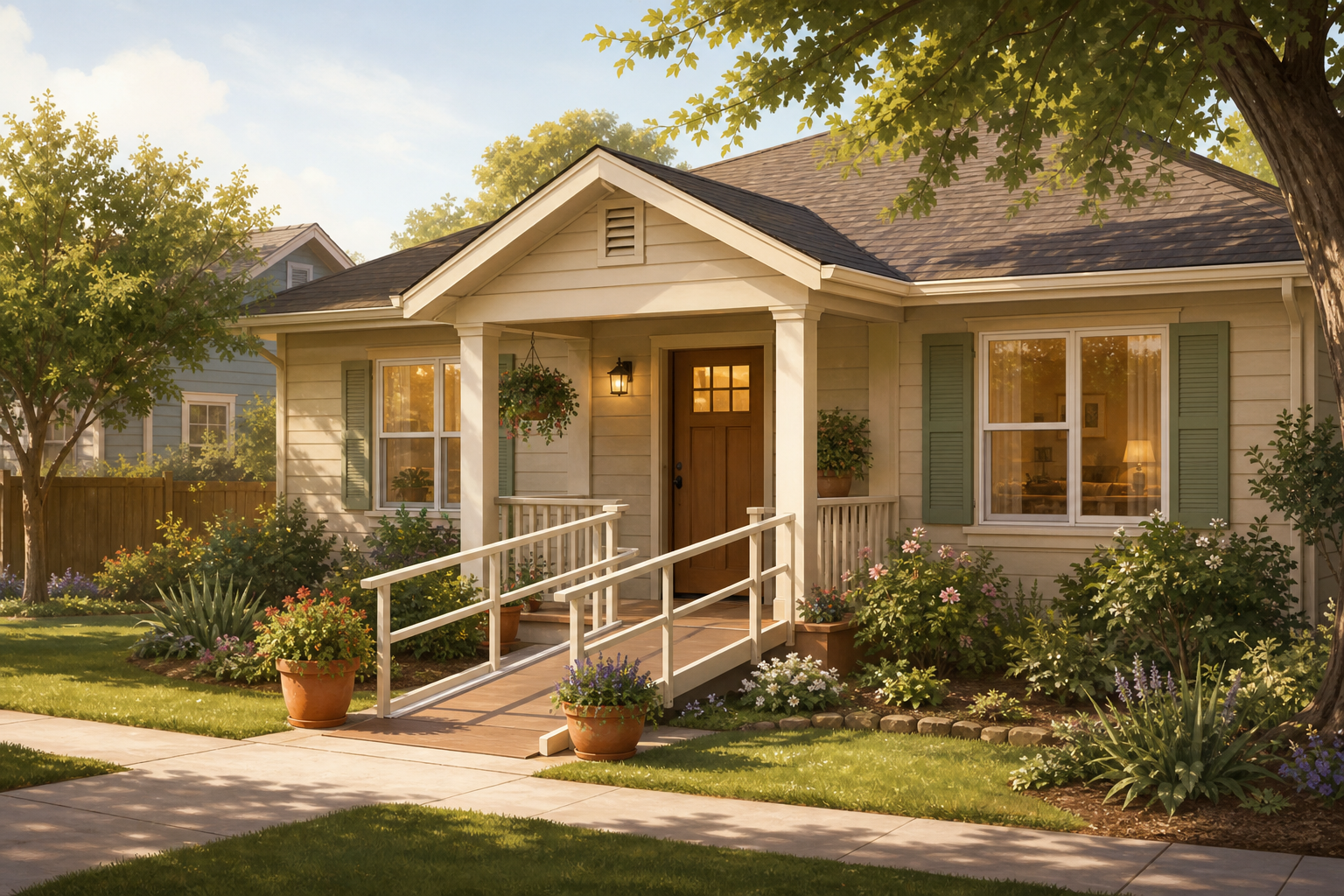
Board-and-care homes — small residential facilities typically housing 4 to 10 residents in a home-like setting — took a significant hit during COVID due to infection control challenges and occupancy declines. However, they are rebounding, and their limited shared-room supply is creating a tighter market. Private rooms in board-and-care homes now average $7,300/month nationally, while shared rooms average $6,000/month. For seniors who need help with activities of daily living but do not require 24/7 skilled nursing, board-and-care homes offer a more intimate, less institutional alternative to larger assisted living facilities.
For a deeper look at this option, see our guide on residential care homes. And for families exploring how to layer home-based interventions before considering a facility, our article on the layered home intervention path provides a structured framework.
What These Changes Mean for Your Family's Decision
The senior care landscape in 2026 is not the same as it was in 2022. Costs have risen 20–30% cumulatively across most categories. New models have emerged. Policy shifts are slowly expanding access to home- and community-based services. And demographic pressure will continue to drive demand for years to come.
For families, the implications are clear:
- Do not rely on cost data from even two years ago. The 2025 CareScout data is the most current national benchmark available, but you must verify local costs using state-specific tools.
- Reassess your care plan regularly. A plan that made financial sense in 2023 may no longer be sustainable. The 5% annual increase in assisted living means a three-year delay in planning could add $1,000+ per month to your costs.
- Consider layered approaches. Combining adult day care with part-time home care, or using short-term rehab as a bridge, can create more flexible and affordable care arrangements than committing to a single high-cost option.
- Explore all funding sources. VA Aid and Attendance, state Medicaid HCBS waivers, and long-term care insurance can significantly reduce out-of-pocket costs. The $58 billion in unclaimed benefits each year suggests many families are leaving money on the table.
- If assisted living is still too expensive after exploring all options, our guide on affordable alternatives offers practical strategies for finding lower-cost care arrangements.
Questions to bring to a clinician or OT
This is not medical, legal, or a family's final decision — only a framework. Bring these questions to a clinician, occupational therapist, or your local Area Agency on Aging.
Find Local HelpRelated reading
Noticed something outdated or inaccurate on this page? Flag a correction. We review every report against CDC, NIA, and AARP HomeFit guidance before updating a page.