Transfer Bench vs Shower Chair: Choosing the Right Bathing Safety Device for Your Parent
Choosing between a transfer bench and a shower chair depends on your parent's specific mobility limitations, not preference or cost. This guide provides a simple three-question framework to match the right device to their bathroom type and transfer ability, helping you avoid a false sense of safety.
By Editorial Team
new caregiver
experienced caregiver
long-distance caregiving
spousal caregiver
working caregiver
daily routines
medication management
personal hygiene
care coordination
first steps
ADLs
IADLs
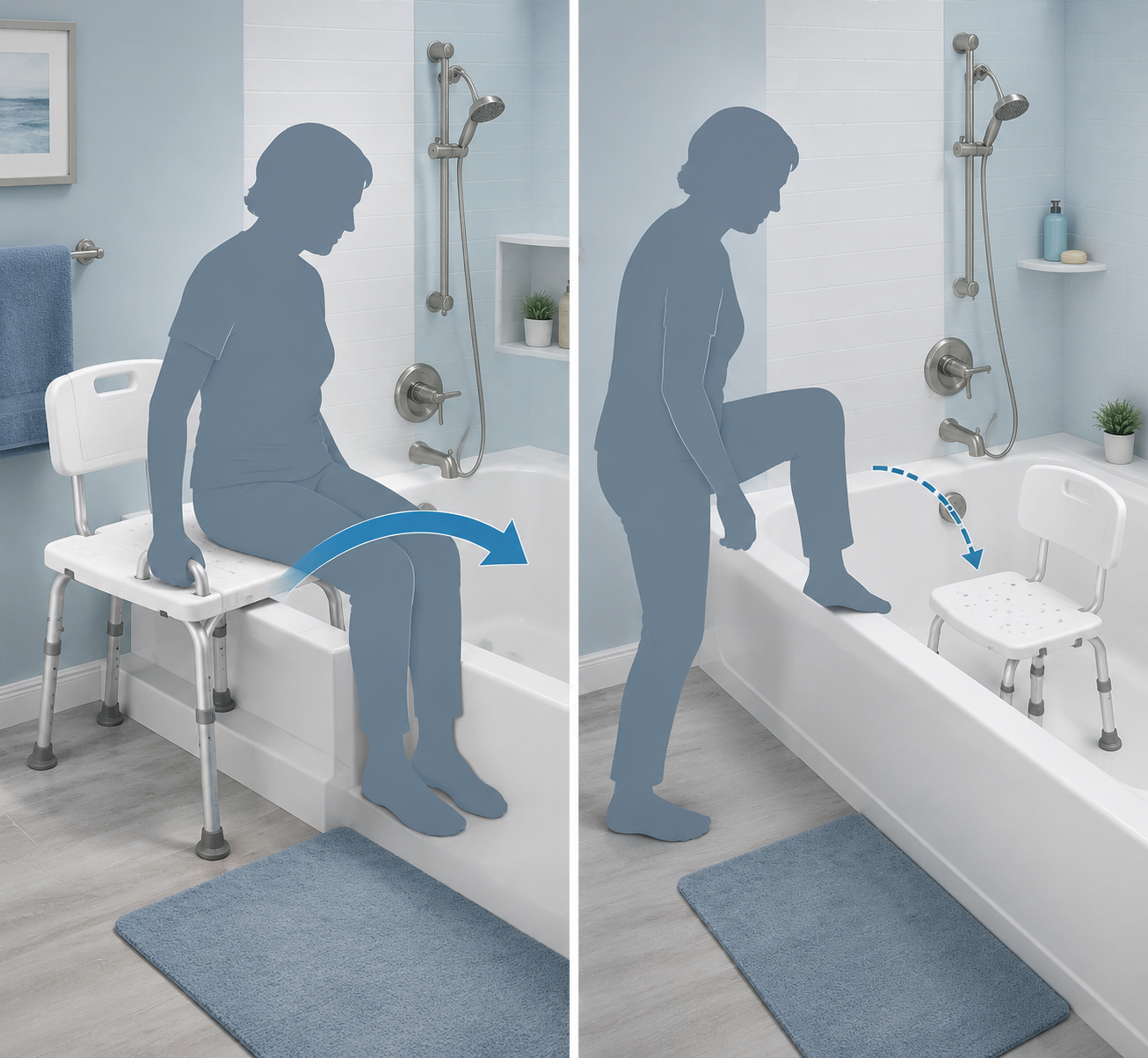
If your parent cannot safely step over the tub wall, a shower chair does not solve the problem. It gives them somewhere to sit only after they have already done the hardest part. In that situation, you are usually looking at a transfer bench, because the bench lets the person sit down outside the tub and slide across the edge instead of lifting a leg over it.
That distinction matters more than padding, brand, color, or whether a product listing says “senior shower seat.” Bathroom injuries are not rare, and the tub-shower area is one of the main trouble spots. The CDC’s most detailed published analysis of bathroom injuries is older, based on 2008 emergency department data, but it is still useful as a scale check: an estimated 234,094 bathroom injuries among people age 15 and older were treated in U.S. emergency departments that year; 81.1% were caused by falls, and 68.3% happened in or around the tub or shower. For adults 85 and older, the injury rate was 515 per 100,000, nearly nine times the rate for people ages 15 to 24.[1]
So this is not a choice between two styles of the same thing. A transfer bench and a shower chair are different tools for different parts of the bathing task.
The Mechanism Difference
A transfer bench straddles the tub wall. Two legs sit outside the tub, two legs sit inside, and the seat spans the barrier. Your parent backs up to the outside portion, sits while still on the dry bathroom floor, then slides across into the bathing area. That is the point of the device: it removes the standing leg-lift over the tub edge.[2]
A shower chair sits entirely inside the tub or shower. Your parent must step into the bathing area first, turn or position themselves, and then sit. It can be very useful once they are inside, especially if standing through a shower causes pain, fatigue, or light unsteadiness. But it does not make the tub wall disappear.[2]
Device
Where it sits
What it helps with
What it does not solve
Transfer bench
Across the tub wall, with legs inside and outside the tub
Sitting before entering and sliding over the tub edge
Severe transfer inability without additional help or equipment
Shower chair
Inside the tub or walk-in shower
Seated bathing after the person has already entered
Unsafe stepping over a tub wall
Start With Three Questions
Before comparing prices or reading reviews, stand in the bathroom and answer these in order:
Can your parent safely lift one leg over the tub wall while standing?
Is the bathing space a tub-shower combination, a walk-in shower, or something else?
Are they non-weight-bearing, under hip or knee precautions, recovering from stroke, or dealing with one-sided weakness?
1. Can they step over the tub wall safely?
This is the question that prevents the expensive mistake. Watch the motion in your mind: your parent stands on the bathroom floor, shifts weight to one leg, lifts the other leg high enough to clear the tub wall, places that foot onto a wet or soon-to-be-wet surface, then brings the second leg over. Somewhere in that sequence there may be a twist, a wobble, a reach for the towel bar, or a moment when no hand is on a real support.
If they can do that consistently, slowly, and with appropriate support, a shower chair may be enough. If they cannot, the shower chair is waiting on the wrong side of the problem.
A parent who says “I can stand for a minute” may still be unsafe crossing the tub wall. Standing briefly at the sink is not the same task as single-leg balance plus hip flexion plus a wet threshold. A parent who can walk down the hallway with a walker may still be unable to step sideways into a tub. A parent who can lift the right leg may not be able to lift the left, or may be unable to bear weight long enough on the surgical or weak side.
For a tub-shower combo, failure on this first question usually points toward a transfer bench. The person sits first, then moves across the barrier while seated. That does not make bathing risk-free, but it changes the most dangerous part of the task.
2. What kind of bathing space do they have?
In a tub-shower combination, the tub wall is the decision-maker. If your parent cannot clear it safely, a transfer bench is the category to consider first.
In a walk-in shower with a low or no threshold, the entry problem may be much smaller. A shower chair can be appropriate when the parent can get into the shower safely but cannot stand long enough to bathe, shampoo, rinse, and dry without fatigue or pain. In that case, paying for a transfer bench may add bulk without solving a real transfer problem.
There are awkward bathrooms where neither answer is clean: narrow door swing, toilet crowding the tub, vanity blocking the outside legs of a bench, or a sliding shower door track that interferes with placement. Those are not reasons to pretend a shower chair solves a tub transfer. They are reasons to measure carefully and, if the discharge plan is already complicated, ask an occupational therapist, physical therapist, or discharge planner to look at the actual bathroom setup.
3. Are there surgery, stroke, or weight-bearing restrictions?
Post-surgical instructions can sound deceptively simple: “use shower equipment,” “avoid unsafe transfers,” “maintain precautions.” None of that tells you whether your parent can get across the tub wall at home.
After hip replacement, hip flexion restrictions can make stepping over a tub wall unsafe or unrealistic. After knee surgery, pain, swelling, limited bending, or non-weight-bearing instructions can make the same movement a problem. After stroke, one-sided weakness can turn the tub edge into a barrier the stronger side cannot safely compensate for. Trualta’s caregiver guidance maps these situations toward a transfer bench when the barrier crossing is the unsafe part of bathing.[2]
If the parent is coming home from the hospital or rehab, this is also where equipment choice should connect to the rest of the discharge plan. A bench may address the tub transfer, while a walker, raised toilet seat, medication review, and hallway clutter are separate fall-prevention issues. If you are sorting several decisions at once, a broader post-hospital fall prevention plan can keep the bathroom purchase from becoming the only safety fix.
How Common Caregiving Scenarios Change the Choice
The same bathroom product can be right for one parent and wrong for another. The useful comparison is not “which seat is better,” but “which movement is unsafe.”
Hip replacement
For a parent recovering from hip replacement, a transfer bench is often the safer starting point in a tub-shower combo because it avoids the high leg lift over the tub wall. The issue is not whether they are motivated or careful. It is whether the required movement violates precautions or forces a risky balance strategy.[2]
A shower chair may still belong later in recovery, or in a walk-in shower, when the parent can enter safely but needs to sit while bathing. Early on, do not let the word “chair” fool you. If the chair is inside the tub, the parent still has to get there.
Knee surgery or non-weight-bearing status
A parent who is non-weight-bearing on one leg should not be treated like someone who is simply tired in the shower. The tub transfer asks them to balance, lift, and control body weight while one leg is restricted. A transfer bench gives them a seated route across the tub edge.
This is also the point where supervision matters. If the caregiver has to cue each movement, manage a handheld shower, keep the floor dry, and help with towels, the equipment should reduce the hardest transfer rather than add one more moment where everyone is bracing for a slip.
Stroke with hemiparesis
One-sided weakness changes bathing transfers quickly. A parent may look steady walking straight ahead but struggle when asked to lift the weaker leg, pivot, or coordinate a side step. Trualta specifically identifies one-sided weakness after stroke as a situation where a transfer bench may be appropriate because the bench removes the need to step over the tub wall.[2]
Do not judge this only by distance walked. Tub entry is a different movement pattern. If the weak side cannot reliably clear the wall, or if the stronger side has to do all the balancing while the parent reaches for whatever is nearby, the shower chair inside the tub is not enough.
Arthritis fatigue or chronic pain
This is where a shower chair earns its place. If your parent can enter the shower or tub safely but standing through the whole bath causes pain, limited stamina, or joint fatigue, a shower chair may be the simpler and appropriate choice. Trualta describes shower chairs as best suited for people who do not have trouble stepping into the shower or bathtub but need seated support once they are there.[2]
The chair should still be stable, properly sized, and rated for the user’s weight. Look for non-slip feet, a seat height that allows controlled sitting and standing, and a weight capacity that clearly exceeds the user’s body weight rather than barely matching it.[3]
Parkinson’s unsteadiness or vertigo
Parkinson’s symptoms and vertigo do not point automatically to one device. The deciding question is still the transfer. If the parent can enter a walk-in shower safely but becomes unsteady while standing to wash, a shower chair may be enough. If the parent freezes, turns poorly, loses balance with head movement, or cannot step over a tub wall reliably, a transfer bench is the safer category to consider.[2]
Also look beyond the equipment. Dizziness, sedation, blood pressure changes, and medication side effects can raise fall risk in the bathroom. A medication review for fall prevention will not replace the right shower seat, but it may explain why bathing has suddenly become more dangerous.
Cost Should Not Lead the Decision
Retail prices vary by seller, material, padding, backrests, armrests, and weight capacity. As a rough consumer range, shower chairs are often listed around $25 to $100 or more, while transfer benches are often listed around $50 to $300.[4]
That difference can matter when you are buying equipment quickly. Still, the cheaper item is not cheaper if your parent cannot use it safely. A $40 shower chair inside a tub does not help a parent who cannot cross the tub wall to reach it. Buy the category that matches the transfer, then compare models within that category.
For either device, the safety-related features matter more than comfort extras: correct height range, non-slip feet, stable frame, adequate seat width, and weight capacity. Padded seats, cutouts, and armrests can be useful, but they should not distract from fit and stability.
Medicare Coverage Is Usually Not the Rescue Plan
Standard Medicare Part A and Part B do not cover shower chairs or transfer benches as ordinary bathroom safety equipment. Some Medicare Advantage plans may offer over-the-counter allowances that can be used for certain bathroom safety products, but that depends on the specific plan and its rules.[5]
If you are checking benefits, ask the plan directly which items are eligible, where they must be purchased, whether a catalog or approved retailer is required, and whether a transfer bench is treated differently from a shower chair. Do that verification before assuming reimbursement.
The Annoying Setup Details That Matter
A transfer bench takes more room than a shower chair. Because part of the bench sits outside the tub, you need clear floor space next to the tub; Pelegon describes about 24 inches of clear space on the outside as a practical minimum. The bench can also create a gap in the shower curtain where water escapes, so families often need a split shower curtain or another water-control workaround.[6]
A shower chair is usually easier to fit inside a standard tub or walk-in shower. It does not extend into the room, and it is less likely to interfere with the toilet, vanity, or bathroom door. That convenience is real. It just does not change the entry requirement.
Measure before buying:
Tub height and inside tub width
Clear floor space outside the tub
Distance from tub edge to toilet, vanity, and door swing
Seat height range compared with your parent’s comfortable sitting height
User weight compared with the device’s stated capacity
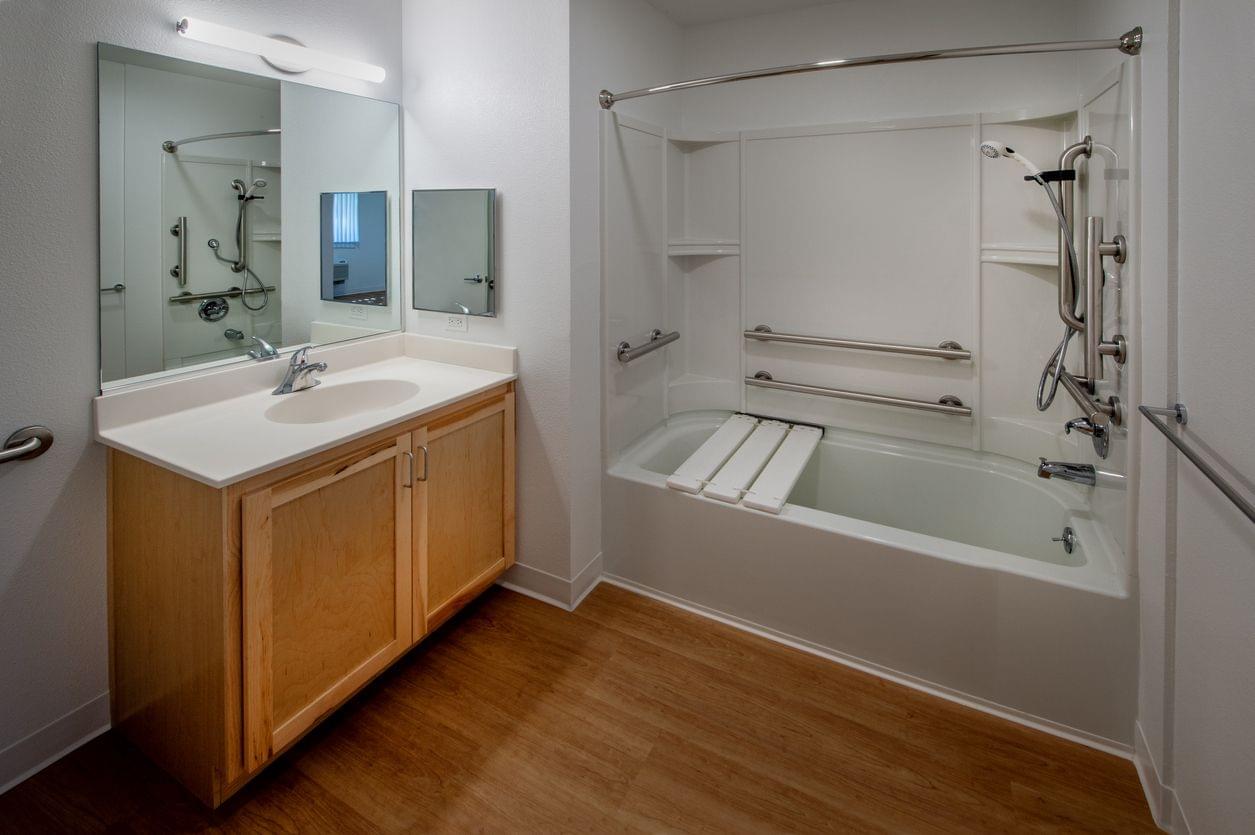
If there are no real grab bars, add that to the plan. A seat is not a handhold. Towel bars and sliding glass door tracks are not substitutes. Proper bathroom grab bar placement supports the transfer into and out of the bathing area, whether the seat is a bench or a chair.
When Neither Device Is Enough
A transfer bench reduces the need to step over the tub wall. It does not solve every transfer problem. If your parent cannot sit down safely, cannot scoot sideways, cannot follow cues, slides forward on the seat, or needs more physical help than one caregiver can safely provide, do not keep escalating the same purchase decision.
That is the point to involve an occupational therapist, physical therapist, home health clinician, or discharge planner. The answer may be caregiver training, a different bathing routine, a rolling shower chair in an accessible shower, a transfer board, sponge bathing for a limited recovery period, or a larger bathroom modification. Those options cost more and can be harder to arrange, but pretending that “some seat” is enough is how families end up with equipment in the bathroom and the same unsafe transfer.
If the bathroom itself cannot accommodate safe equipment, the issue has moved beyond choosing a chair. Broader aging-in-place readiness may need attention, especially after a fall, surgery, or new mobility diagnosis.
The Caregiver Decision
Choose a transfer bench if the parent has a tub-shower combo and cannot safely step over the tub wall, is non-weight-bearing, has hip or knee precautions, or has one-sided weakness that makes the leg lift unsafe.
Choose a shower chair if the parent can safely enter the tub or walk-in shower but needs to sit because of fatigue, pain, arthritis, mild unsteadiness, or limited standing tolerance.
Add grab bars and other supports when the transfer path needs them. Ask an OT, PT, or discharge planner for an individualized assessment when the parent cannot transfer safely even with a bench. The goal is not to buy a bathing seat quickly. It is to match the device to the movement your parent actually has to perform.

Comments
Join the discussion with an anonymous comment.