
Aging in Place Readiness Checklist: Is Your Parent’s Home Ready — and Are You?
A practical four-domain readiness assessment for adult children helping a parent evaluate whether aging in place is realistic after a fall or functional decline. Covers home safety, health and mobility, caregiver support, and financial preparedness — with actionable steps to close the gap between desire and readiness.
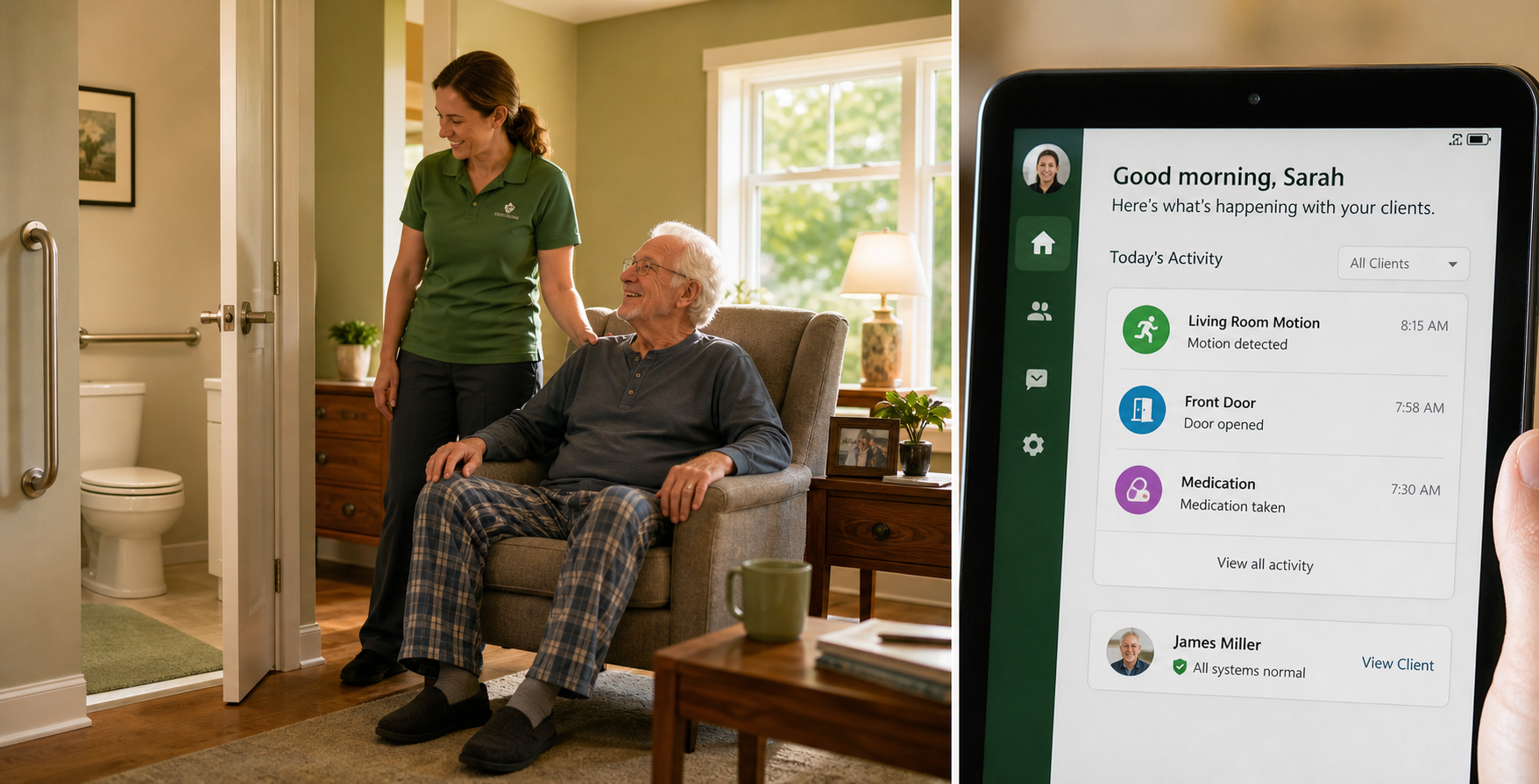
The Readiness Gap: Why Desire Doesn’t Equal Preparedness
The numbers are striking and, for many families, unsettling. A 2022 National Poll on Healthy Aging found that 88% of adults ages 50 to 80 consider it important to remain in their own home as they age. Yet only 34% say their home definitely has the features needed to support that goal. That gap — between what families hope for and what their homes can actually deliver — is the central challenge of aging in place.
The disconnect is not limited to home features. The same poll revealed that only 19% of older adults are very confident they can afford paid help if they need it. Among those who live alone — 28% of older adults — nearly half (48%) have no one who can assist with personal care tasks. These are not abstract concerns. They are the daily realities that determine whether a parent can safely remain at home after a fall, a new diagnosis, or a gradual functional decline.
This article provides a structured, four-domain readiness assessment designed for adult children in their 40s and 50s who are helping a parent evaluate whether aging in place is realistic — especially after a recent fall, a dementia diagnosis, or a noticeable decline in function. The four domains are: home safety, health and mobility, caregiver support, and financial preparedness. Each domain includes specific questions to ask, data to consider, and actionable steps to close the gap between desire and readiness.
The goal is not to discourage aging in place. It is to ensure that when a family makes that choice, they do so with their eyes open — and with a plan that addresses the risks before those risks become crises.
Domain 1: Home Safety Audit — What to Look for in Every Room
The physical environment is the most visible and often the most fixable domain. Yet the data suggests most homes are not ready. According to U.S. Census data cited by multiple sources, only 10% of homes meet basic criteria for aging in place. A separate analysis found that 9 in 10 U.S. homes are not equipped to accommodate an aging adult safely.
The 2022 NPHA survey asked older adults about specific home features. The results reveal a clear pattern: the most critical safety features are the least common.
| Home Feature | Percentage of Homes With It (NPHA 2022) |
|---|---|
| Main-floor bathroom | 88% |
| Main-floor bedroom | 78% |
| Wider doorways (36 inches or more) | 54% |
| Lever-style door handles | 32% |
| Zero-step entry (no stairs at entrance) | 19% |
A room-by-room walkthrough is the most effective way to identify hazards. Start with the bathroom — the most dangerous room in the house — and work through each area systematically.
- Bathroom: Check for a step-over tub edge, lack of grab bars near the toilet and shower, a round doorknob (hard to grip), and slippery floor surfaces. These are the highest-priority fixes.
- Bedroom: Ensure a clear path from the bed to the bathroom. A nightlight or motion-activated light is essential. The bed height should allow the person to sit and stand without strain.
- Stairs and hallways: Look for loose carpet, poor lighting, and lack of handrails on both sides. Contrast tape on the edge of each step can reduce missteps.
- Kitchen: Check that frequently used items are within easy reach — not on high shelves or in low cabinets. Lever-style faucet handles are easier to operate than twist knobs.
- Entryways: A step at the front door, even a single 4-inch rise, can become a barrier for someone using a walker or wheelchair. A portable ramp or a permanent zero-step entry may be needed.
The good news is that many of the most impactful safety upgrades are inexpensive. According to cost data from ElderLife Financial, low-cost modifications — grab bars, lever-style door handles, handheld showerheads, nonslip bath mats, toilet seat risers, and improved lighting — typically range from $25 to $500 and are often DIY-friendly. A single $200 grab bar installation could prevent a fall that leads to a $50,000 nursing home bill.
For families who identify major accessibility gaps — such as a bathroom that cannot accommodate a walker or a bedroom on the second floor with no safe alternative — the next step is to consult a Certified Aging-in-Place Specialist (CAPS). The 11 Red-Flag Signs Your Parent Needs a CAPS Specialist guide can help families determine when a professional assessment is warranted.
Domain 2: Health and Mobility — Assessing Your Parent’s Current and Future Needs
A home can be perfectly modified, but if the person living in it has health needs that exceed what home-based care can provide, aging in place may not be safe. This domain requires an honest assessment of your parent's current health status — and a realistic projection of how those needs are likely to change.
The prevalence of chronic conditions among older adults is high. The CDC reports that 78% of adults age 55 and older have at least one chronic condition, such as diabetes, heart disease, or arthritis. These conditions affect mobility, energy levels, and the ability to perform activities of daily living (ADLs) — bathing, dressing, eating, toileting, and transferring.
Cognitive decline is another critical factor. According to the NIH, 2 in 3 Americans experience some form of cognitive decline by age 70. This does not necessarily mean dementia, but it does mean that planning for aging in place must account for changes in memory, judgment, and decision-making ability over time.
Key questions to discuss with your parent and their healthcare provider:
- Can your parent walk safely without assistance? If they use a cane or walker now, will they need a wheelchair or scooter in the next two to five years?
- Are they able to get in and out of bed, a chair, or the bathtub without help? These transfer tasks are among the first to become difficult.
- Do they have a history of falls? A single fall doubles the risk of another. The CDC STEADI framework recommends screening all adults 65+ for fall risk at least annually.
- Are they managing multiple prescription medications? The CDC notes that nearly 35% of adults ages 60 to 79 take five or more prescription drugs, which increases the risk of adverse interactions and falls.
- Have they been evaluated for cognitive impairment by a primary care provider or neurologist? Early identification allows for better planning.
The critical insight here is that health needs are not static. A home that works today may become unsafe in six months. The best aging-in-place plans build in flexibility — wider doorways that can accommodate a wheelchair even if none is needed now, a first-floor space that can be converted to a bedroom, and bathroom modifications that anticipate reduced mobility.
Domain 3: Caregiver Support — Who Will Be There, and How Often?
The human side of aging in place is often the most overlooked — and the most consequential. A home can be fully modified and a parent's health may be stable, but if there is no one available to provide or coordinate care, the entire plan can collapse.
The NPHA data paints a sobering picture: only 67% of older adults have someone who can help them with personal care if needed. Among the 28% who live alone, nearly half (48%) lack any personal care support at all. This means millions of older adults are one hospitalization or one fall away from a crisis with no backup.
For families who do have a caregiver available, the burden is substantial. Research cited by Choice Mutual indicates that caregivers living with the care recipient spend over 37 hours per week on caregiving duties. Nationally, family caregivers provide an estimated $873 billion worth of unpaid labor each year.
Assess your family's caregiver situation honestly:
- Who lives nearby? Long-distance caregiving is possible but adds complexity. If the primary caregiver lives more than 30 minutes away, a backup plan for daily needs is essential.
- What is the primary caregiver's capacity? Are they working full-time? Raising children? Managing their own health issues? Caregiver burnout is a real and common outcome when one person carries too much of the load.
- Is there a plan for respite? Even the most dedicated caregiver needs breaks. Respite care — whether from other family members, friends, or paid services — should be built into the plan from the start, not added as an afterthought.
- What about professional in-home care? Home health aides can provide personal care, medication management, and companionship. The median monthly cost is $5,148 (Genworth 2021), which is a significant but often necessary expense.
Technology can also play a role in reducing caregiver burden. Passive home sensors, GPS trackers, and personal emergency response systems (PERS) can provide remote monitoring and alert families to potential issues without requiring constant in-person presence. These tools are especially valuable for long-distance caregivers and for families supporting a parent with early-stage cognitive decline.
Domain 4: Financial Preparedness — What Will It Really Cost?
Financial readiness is the domain where wishful thinking most often replaces realistic planning. The NPHA found that only 19% of older adults are very confident they can afford paid help. Yet the costs of aging in place — even without a move to a facility — can be substantial.
| Service or Modification | Typical Cost | Source |
|---|---|---|
| Home health aide (monthly median) | $5,148/month | Genworth 2021 Cost of Care Survey |
| Adult day services (monthly median) | $1,690/month | Genworth 2021 Cost of Care Survey |
| Assisted living facility (annual median) | $64,200/year | Choice Mutual / Genworth |
| Bathroom modification (grab bars, roll-in shower, widened door) | $8,000 (one-time) | Age Safe America |
| Stair lift | $2,500 – $8,000 | ElderLife Financial |
| Low-cost safety upgrades (grab bars, lever handles, lighting) | $25 – $500 | ElderLife Financial |
It is important to note that many of these costs are not covered by Medicare. Original Medicare (Parts A and B) does not pay for long-term personal care, home health aides, or most home modifications. Medicaid may cover some in-home care services through home- and community-based services (HCBS) waivers, but eligibility and coverage vary by state. The VA offers grants for home modifications through programs like the Specially Adapted Housing (SAH) grant and the Home Improvements and Structural Alterations (HISA) grant for eligible veterans.
Only 21% of adults 65 and older have long-term care insurance, according to a February 2026 Pew Research Center survey. For the remaining 79%, funding aging in place requires a combination of personal savings, home equity (through a reverse mortgage or home equity line of credit), family contributions, and public programs.
The financial domain is not just about what you can afford today. It is about what you can sustain over time. A home health aide at $5,148 per month adds up to nearly $62,000 per year — roughly the same as assisted living. Families need to model different scenarios: What if care needs increase? What if the primary caregiver can no longer provide unpaid help? What if a parent lives 10 or 15 more years? These are uncomfortable questions, but avoiding them does not make the costs disappear.
Bridging the Gap: An Incremental Action Plan
The four-domain assessment may feel overwhelming, but the goal is not to solve everything at once. The most effective approach is incremental: start with the highest-priority, lowest-cost actions, and build from there.
Here is a prioritized action plan based on the assessment framework:
- Complete the home safety audit. Identify and fix immediate fall hazards: install grab bars in the bathroom, add nonslip mats, improve lighting, and secure loose rugs. Most of these upgrades cost under $500 and can be done in a weekend.
- Schedule a medical checkup. Have your parent's primary care provider assess fall risk, review medications for side effects that increase fall risk, and screen for cognitive changes. Ask for a referral to an occupational therapist for a home safety evaluation.
- Map the caregiver network. Write down who can help, what they can do, and how often. Identify gaps. If the primary caregiver is a single adult child who works full-time, start exploring paid in-home care or adult day services now — before a crisis forces the decision.
- Run the numbers. Calculate the monthly cost of the care your parent currently needs, then model what it would look like if needs increase. Explore funding options: long-term care insurance (if they have it), VA benefits, Medicaid HCBS waivers, and home equity options.
- Address mid-range modifications. If the audit revealed issues like a step-over tub, narrow doorways, or stairs that will become a problem, begin planning for mid-range projects ($1,000–$10,000) such as a walk-in shower, stair lift, or modular ramp.
- Reassess regularly. Set a calendar reminder to revisit the four-domain assessment every six months or after any significant health event. Needs change, and the plan must change with them.
Even partial progress reduces risk. Research cited in The Evidence for Aging-in-Place Remodels shows that targeted home modifications can reduce falls by 39% and decrease the number of care hours needed by 42%. Every grab bar installed, every medication reviewed, and every caregiver conversation had is a step toward closing the gap between the desire to age in place and the reality of doing so safely.
Related reading
Noticed something outdated or inaccurate on this page? Flag a correction. We review every report against CDC, NIA, and AARP HomeFit guidance before updating a page.
Part of the Fall Prevention section.