When Is It Time for Home Care? Recognizing the Signs and Starting the Conversation with Aging Parents
For: adult childStage: early independence15 minutes📄 PrintableReviewed: 2026-06-20
When Is It Time for Home Care? Recognizing the Signs and Starting the Conversation with Aging Parents
Most families wait until a crisis to start home care. This guide helps adult children recognize early warning signs, conduct a structured assessment, and have a sensitive conversation with a parent before a fall or hospitalization forces the decision.
By Editorial Team
new caregiver
first steps
ADLs
IADLs
difficult conversations
📄
A printable version of this guide is available. Use your browser's print function (Ctrl+P / ⌘P) to save or print.
Proactive home care focuses on preserving independence and companionship, not managing a crisis.
The Cost of Waiting: Why Early Intervention Matters
Most families wait until a visible crisis — a fall, a hospitalization, a missed bill that leads to a shut-off notice — before they begin discussing home care. That delay has real consequences. The parent loses ground physically and emotionally, and the family scrambles to make decisions under pressure, often choosing the first available option rather than the right one.
The evidence for acting earlier is clear. Vicki Demirozu, a home care expert with 30 years of experience, notes that even small amounts of in-home care — such as help with meals or light housekeeping — can extend an older adult's independence. She also observes that families who start care proactively, before a crisis, experience smoother transitions. When care is already in place, a sudden change in health does not trigger a panicked search for services.
Social isolation is another powerful signal. A 2024 University of Michigan survey found that 34% of older adults reported feeling isolated from others in the past year. Isolation is not just uncomfortable — it is a health risk in its own right, linked to higher rates of depression, cognitive decline, and even mortality. When an older adult begins to withdraw, it often signals that daily tasks have become overwhelming or that mobility limitations are making social contact difficult.
Falls are the most dramatic sentinel event. The CDC's STEADI framework identifies a fall as a leading indicator that underlying needs exist — balance problems, muscle weakness, medication side effects, or home hazards — that home care services can address. A single fall often reveals a cascade of issues that have been developing for months.
Early Warning Signs: What to Look For
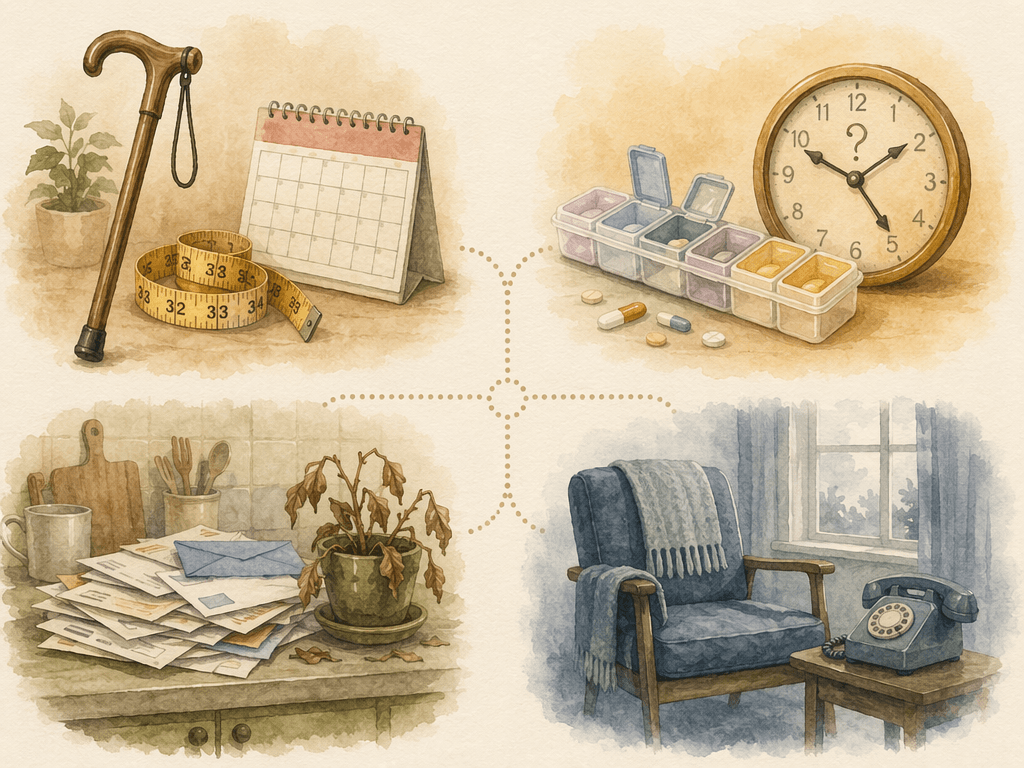
The National Institute on Aging (NIA) organizes warning signs into four domains: physical changes, cognitive changes, household changes, and social changes. Most families notice one or two signs — a parent who has lost weight, a kitchen that seems messier than usual — but miss the broader pattern. A structured approach helps you see the full picture.
Warning signs often cluster across multiple domains. A structured approach helps families see the full picture.
Physical Signs
These are often the easiest to spot, but they can be gradual. Look for:
Unexplained weight loss or poor appetite
Difficulty walking, climbing stairs, or getting out of a chair
Bruises or injuries that suggest unreported falls
Poor hygiene — unwashed clothes, unkempt hair, body odor
Changes in grooming habits, such as wearing the same clothes repeatedly
Cognitive Signs
Cognitive decline is often subtle at first and easy to rationalize. Watch for:
Missed medications or confusion about dosages
Repeated questions or stories within the same conversation
Difficulty following instructions or managing a simple recipe
Signs of unsafe cooking, such as scorched pots or a stove left on
Social Signs
Social withdrawal is one of the most overlooked warning signs because it is often attributed to personality or mood:
Declining invitations to family gatherings or social events
Stopping favorite activities — church, bridge club, walking group
Fewer phone calls or less interest in talking to friends and family
Expressions of loneliness or hopelessness
Reluctance to leave the house, even for necessary errands
Using the ADL/IADL Framework for a Structured Assessment
Once you have identified warning signs, the next step is a structured evaluation. The most widely used framework in elder care distinguishes between Activities of Daily Living (ADLs) and Instrumental Activities of Daily Living (IADLs). This framework gives you a common language to describe what your parent can and cannot do — and it helps you determine what kind of support is needed.
Activities of Daily Living (ADLs)
ADLs are the fundamental self-care tasks that a person must be able to perform to live independently. Difficulty with any of these signals a need for hands-on assistance.
The five core ADLs and what to look for when assessing your parent.
ADL
What to Observe
Level of Concern
Bathing
Is your parent able to get in and out of the shower or tub safely? Are they bathing regularly?
Difficulty here often means a shower chair, grab bars, or personal care assistance is needed.
Dressing
Can they select appropriate clothing and put it on without help? Do they struggle with buttons or zippers?
Struggling with dressing may indicate fine motor or cognitive decline.
Eating
Can they feed themselves? Have they lost weight because preparing food is too hard?
Weight loss combined with eating difficulty is a red flag.
Toileting
Can they get to the toilet on time and manage hygiene independently?
Accidents or difficulty with toileting require immediate attention.
Transferring
Can they get out of bed or a chair without help? Have they had any near-falls?
Transfer difficulty is a strong predictor of falls.
Instrumental Activities of Daily Living (IADLs)
IADLs are more complex tasks that support independent living in the community. Difficulty with IADLs often appears before difficulty with ADLs, making them an early warning system.
The five key IADLs and what to look for when assessing your parent.
IADL
What to Observe
Level of Concern
Medication management
Are they taking the right doses at the right times? Are old prescriptions piling up?
Medication errors are one of the most common and dangerous early signs.
Meal preparation
Are they eating balanced meals? Is the kitchen stocked with fresh food?
Skipping meals or relying on snacks often indicates cooking has become too difficult.
Housekeeping
Is the home reasonably clean? Are laundry and dishes being done?
A decline in housekeeping standards is often the first visible sign.
Transportation
Can they drive safely? Do they have alternative transportation if they stop driving?
Driving cessation without a plan leads to isolation.
Money management
Are bills paid on time? Is the checkbook balanced? Are there unusual purchases?
Financial confusion is a common early sign of cognitive decline.
If your parent needs help with one or two IADLs but no ADLs, they may benefit from a few hours of homemaker or companion care each week. If they need help with ADLs, they likely require personal care assistance. For a more detailed evaluation, see our guide on When Does an Aging Parent Need In-Home Services?, which provides a deeper decision framework.
How to Start the Conversation with a Resistant Parent
The most effective conversations about care happen in a calm, private setting — not in the aftermath of a crisis.
The conversation about home care is often the hardest part of the entire process. Many adult children delay it for months because they fear their parent's reaction — the accusation of meddling, the declaration that they are not needed, the guilt that follows. But the NIA offers a practical starting point: focus on a specific observation, not a general concern.
"Mom, it looks like you don't have much food in the house. Are you having trouble getting to the store?"
This approach works because it is concrete, not accusatory. You are not saying "you are failing." You are saying "I noticed this specific thing, and I am wondering if you need help with it." The conversation becomes a problem-solving discussion rather than a judgment.
Conversation Strategies That Work
Start with a specific observation, not a general concern. "I noticed the lawn is overgrown" is better than "I'm worried about you."
Frame it as a solution to a problem they have already acknowledged. If they have complained about not being able to reach high shelves, say: "What if someone came by once a week to help with that?"
Use "I" statements to express your feelings. "I worry about you when I see the stairs are getting harder for you" is less threatening than "You need help with the stairs."
Involve a third party. Sometimes a parent will reject the same suggestion from a child that they would accept from a doctor, a neighbor, or a clergy member.
Start small. Propose a trial run — two hours of help twice a week for a month — rather than a permanent arrangement. The word "trial" reduces the sense of permanence and threat.
The key is to have this conversation before your parent has already refused help. If you wait until they are resistant, you are already in a defensive position. For strategies to handle a parent who has already said no, see our guide on When Your Aging Parent Refuses Help, which provides phased scripts for handling resistance.
When to Involve a Professional: The Next Assessment Step
Your own observations and the ADL/IADL framework are powerful tools, but they are not a substitute for a professional assessment. Involving a healthcare provider or a geriatric care manager can provide an objective evaluation and open doors to services you may not know exist.
Who Can Help?
Professionals who can help assess your parent's needs and connect you to services.
Professional
What They Do
When to Involve Them
Primary care physician
Can assess overall health, review medications for fall risk, and refer to home health or social services.
At the first sign of functional decline. A simple conversation with the doctor can trigger a referral.
Geriatric care manager
Conducts a comprehensive in-home assessment, coordinates services, and monitors ongoing care.
When the situation is complex — multiple chronic conditions, family conflict, or when you live far away.
Home care agency
Provides a free in-home assessment to determine what level of care is needed and create a care plan.
After you have decided to move forward with services. The assessment helps match the right caregiver to your parent's needs.
Area Agency on Aging (AAA)
Offers free or low-cost assessments, information on local services, and eligibility screening for public programs.
At any point. AAAs are a gateway to community-based services and often have resources families do not know about.
The NIA recommends involving a healthcare provider when you notice changes in your parent's health, memory, or ability to manage daily tasks. A doctor can rule out treatable conditions — such as a urinary tract infection causing confusion — that may mimic the need for long-term care.
What Happens Next: Service Options Overview
Once you have completed the assessment and had the conversation, the next step is understanding what services are available. The range of options is broader than most families realize, and even a few hours of help per week can make a significant difference.
Home care (nonmedical): companionship, help with bathing and dressing, meal preparation, light housekeeping, transportation. This is the most common starting point.
Home health care (skilled medical): nursing, physical therapy, occupational therapy, wound care. Requires a physician's order and is typically short-term.
Adult day care: structured daytime programs that provide social activities, meals, and supervision. Gives family caregivers a break during working hours.
Meal services: programs like Meals on Wheels deliver nutritious meals to seniors who cannot shop or cook for themselves.
Transportation services: many communities offer senior-specific transportation for medical appointments and errands.
For a complete guide to layering these services — from free community programs to skilled nursing at home — see our Building Your Parent's Services Stack guide. It walks you through how to combine services to create a comprehensive support system.
Red Flags vs. Normal Aging: What's Concerning vs. What's Expected
One of the hardest parts of this process is knowing what is normal and what is a red flag. Many adult children dismiss genuine warning signs as "just getting older," while others worry about changes that are actually part of healthy aging. The table below can help you distinguish between the two.
A guide to distinguishing normal age-related changes from red flags that warrant action.
Domain
Normal Aging
Red Flag
Mobility
Walking a bit slower, needing a handrail on stairs
Repeated falls, inability to get up from a chair without help, fear of walking
Memory
Occasionally forgetting a name or misplacing keys
Getting lost in familiar places, missing appointments, repeating the same question within minutes
Household
Letting clutter build up for a few days
Spoiled food in the refrigerator, unpaid bills, unsafe conditions like a stove left on
Social
Preferring quiet evenings at home
Complete withdrawal from all social activities, no longer answering the phone, expressions of loneliness
Health
A few pounds of weight change over months
Significant weight loss over weeks, poor hygiene, untreated medical conditions
Driving
Driving a bit slower, avoiding night driving
Getting lost on familiar routes, new dents or scratches on the car, near-accidents
Printable Checklist for Families
Use the checklist below to track warning signs, conduct a basic ADL/IADL assessment, and prepare for the conversation with your parent. Print it out, keep it in a notebook, and update it over time. Patterns that emerge over weeks or months are more reliable than a single observation.
Warning Signs Tracker
Physical: weight loss, falls, poor hygiene, difficulty walking, unexplained bruises
Cognitive: missed medications, confusion about time or place, repeated questions, unpaid bills
Household: spoiled food, clutter, neglected maintenance, unsafe cooking, unopened mail
Social: withdrawal from activities, declining invitations, expressions of loneliness, fewer phone calls
ADL/IADL Quick Assessment
ADLs: Can they bathe, dress, eat, toilet, and transfer independently? Note any difficulty.
IADLs: Can they manage medications, prepare meals, keep house, arrange transportation, and handle finances? Note any difficulty.
If they need help with 1-2 IADLs: consider homemaker or companion care a few hours per week.
If they need help with any ADL: consider personal care assistance.
Conversation Preparation
Identify one specific observation to start the conversation (e.g., "I noticed the refrigerator is almost empty").
Choose a calm, private time — not during or immediately after a crisis.
Frame the conversation as problem-solving, not criticism.
Propose a small trial: two hours of help twice a week for one month.
Identify a third party (doctor, clergy, trusted friend) who can support the conversation if needed.
If you have decided that it is time to take action, the next step is building a comprehensive understanding of your role as a caregiver. Our stage-based guide for new caregivers walks you through what to expect in the coming months and how to build a sustainable caregiving approach.




Comments
Join the discussion with an anonymous comment.