
Clinical term
When 24-Hour Home Care Costs Less Than a Nursing Home — and When It Doesn't: A Family Decision Framework
The Cost Reality Most Families Don't Expect
When a doctor says your parent cannot go home without round-the-clock supervision, the first question that hits is almost never about care models — it is about money. Can we actually afford to keep Mom at home, or is a nursing home the only realistic option? The answer, backed by 2026 national data, is more nuanced than most families realize.
According to A Place for Mom's 2026 Cost of Long-Term Care and Senior Living Report, the national median cost of nonmedical home care is $34 per hour. For true 24/7 care — meaning two or three rotating caregivers providing awake, non-stop attention — that works out to roughly $24,733 per month. Compare that to the national median for a semi-private nursing home room, which the CareScout 2026 Cost of Care Survey puts at $9,581 per month. The gap is staggering — nearly $15,000 more per month for home care.
But here is where the picture gets more interesting. Full-time home care at 44 hours per week — roughly eight to nine hours of daily coverage — costs a median of $6,478 per month. That is actually less than the nursing home semi-private rate. The difference comes down to one critical variable: how many hours of care your parent truly needs each week.
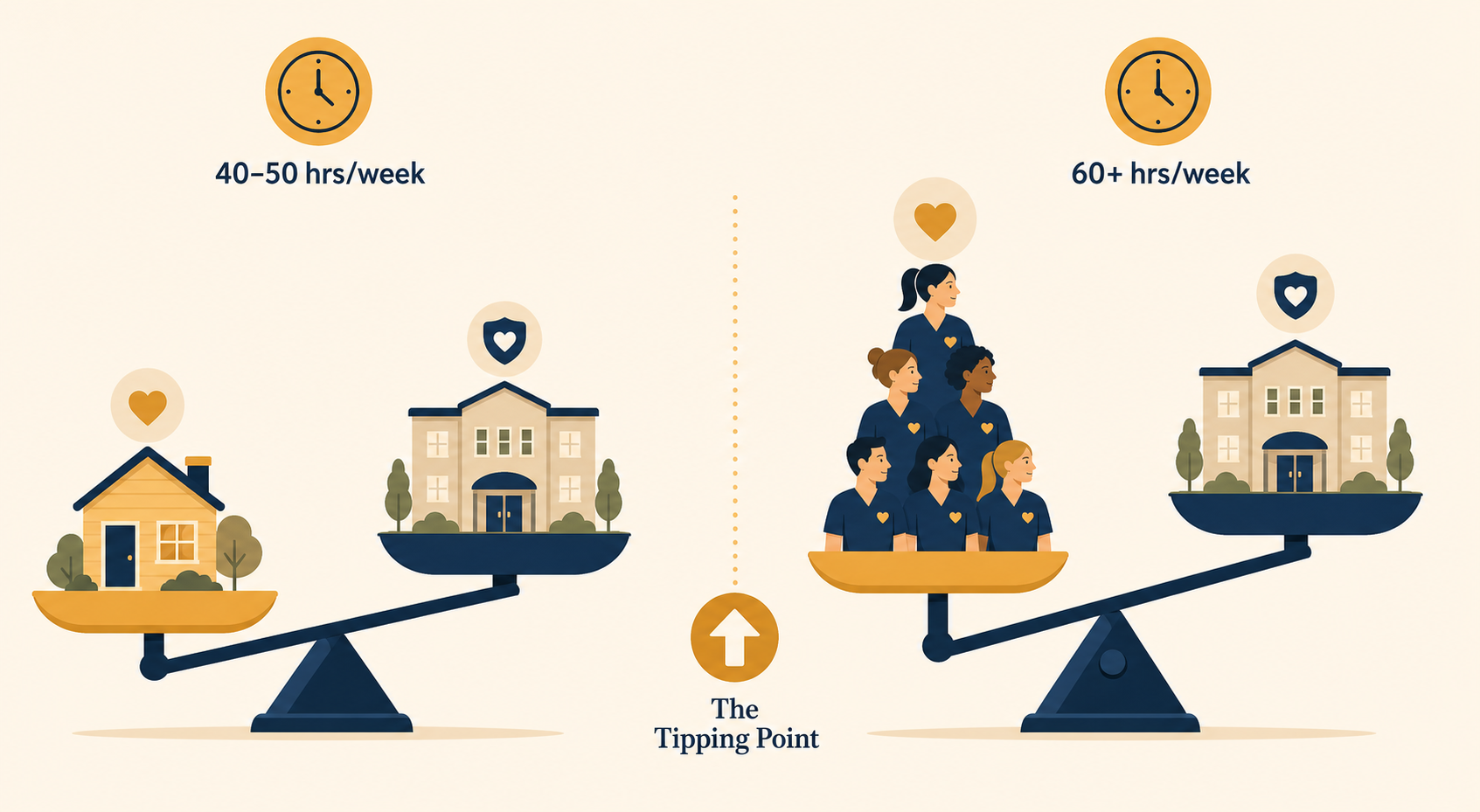
The Tipping Point: 40–50 Hours vs. 60+ Hours per Week
The financial math of home care versus a nursing home hinges on a single tipping point: the number of care hours required per week. When a senior needs fewer than 40 to 50 hours of care weekly, home care is almost always the cheaper option. Once the need crosses 60 hours per week — which is what true 24/7 awake coverage demands — home care becomes dramatically more expensive.
| Care Scenario | Hours/Week | Monthly Cost (National Median) | vs. Nursing Home Semi-Private ($9,581/mo) |
|---|---|---|---|
| Part-time home care | 20 hours | ~$2,945 | ~$6,636 less |
| Full-time home care | 44 hours | ~$6,478 | ~$3,103 less |
| Tipping point zone | 50 hours | ~$7,367 | ~$2,214 less |
| Intensive home care | 60 hours | ~$8,840 | ~$741 less |
| True 24/7 rotating-shift care | 168 hours | ~$24,733 | ~$15,152 more |
The reason for this steep jump is simple: true 24/7 care requires multiple caregivers working in rotating shifts. A single caregiver cannot legally or safely work 24 hours straight. Most agencies staff 24/7 care with two 12-hour shifts or three 8-hour shifts. That means you are paying for 168 hours of labor per week — not 40, not 50, but the full 168. At $34 per hour, the math becomes unavoidable.
What the Monthly Rates Actually Buy: Home Care vs. Nursing Home
Cost is only half the equation. The other half is what each option actually provides. A nursing home and a home care arrangement deliver fundamentally different bundles of services, and those differences matter for both your parent's quality of life and your family's peace of mind.
| What You Get | 24/7 Home Care (Rotating Shifts) | Nursing Home (Semi-Private Room) |
|---|---|---|
| Staff-to-resident ratio | 1:1 (one caregiver focused solely on your parent) | 1:8 to 1:15 per shift (varies by facility and state) |
| Living environment | Familiar home setting; no relocation stress | Shared room (typically 2 residents); institutional setting |
| Meals | Family manages groceries and meal prep, or caregiver assists | Three meals daily included; limited menu choices |
| Medical oversight | Nonmedical care only (bathing, dressing, companionship, medication reminders) | 24/7 skilled nursing staff on-site; medication administration; wound care |
| Social engagement | Depends on family and caregiver initiative; can be isolating | Structured activities, group dining, communal spaces |
| Scheduling flexibility | Full flexibility — care adapts to your parent's daily needs | Fixed facility schedule for meals, activities, and bedtimes |
| Overnight supervision | Awake caregiver present at all times | Staff on duty but not 1:1; call button for assistance |
The trade-off is clear: home care offers one-on-one attention in a familiar environment but lacks medical infrastructure, while a nursing home provides round-the-clock skilled nursing but in a shared institutional setting with far less individual attention. For a parent who needs medical monitoring — post-surgery wound care, insulin management, or frequent vitals checks — the nursing home's clinical capability may be non-negotiable regardless of cost. For a parent who needs supervision and assistance with daily activities but is medically stable, home care may deliver a better quality of life at a comparable or lower price.
Hidden Costs Families Overlook with Home Care
The hourly rate for a caregiver is the most visible cost, but it is far from the only one. Families who choose home care often encounter a second layer of expenses that can quietly shift the financial balance. According to A Place for Mom's analysis, these overlooked costs include family caregivers needing to take time off work or reduce their hours, plus out-of-pocket expenses for groceries, home maintenance, safety modifications, and travel.
- Lost wages from family caregiving: More than 48 million family members currently provide unpaid care in the U.S., contributing an estimated $600 billion worth of labor annually, according to SeniorLiving.org. If you or a sibling reduce work hours or leave a job to coordinate care, that lost income is a real cost — even if it does not appear on a bill.
- Home modifications: Grab bars, ramps, stair lifts, widened doorways, and bathroom safety equipment can run from a few hundred to several thousand dollars. These are one-time costs, but they are essential for safe aging in place.
- Increased household expenses: Having a caregiver in the home for 8 to 12 hours a day — or around the clock — means higher utility bills, more groceries, and potentially additional supplies like incontinence products or specialized nutrition.
- Care coordination burden: Managing multiple caregivers, scheduling shifts, handling payroll taxes (if hiring privately), and dealing with no-shows or last-minute cancellations is a part-time job in itself. The emotional toll of this coordination is harder to quantify but very real.
Live-In Care: The Middle Option That Changes the Math
Between part-time home care and the eye-watering cost of 24/7 rotating shifts lies a third option that many families do not know exists: live-in care. A live-in caregiver stays in the home for a 24-hour period but is not required to be awake and active for all 24 hours. Under federal Department of Labor guidelines, a live-in caregiver must receive a designated 8-hour sleep period and a bed to rest in. If the caregiver is interrupted during the sleep period to assist the senior, they must be paid for that time. This model typically provides about 16 hours of active care per 24-hour period.
Because live-in care involves only one caregiver per day rather than two or three rotating staff, it is substantially cheaper than true 24/7 care. While exact pricing varies, live-in caregivers often charge a flat daily rate rather than an hourly rate, which can bring the monthly cost closer to the $6,000–$8,000 range — competitive with or even below a nursing home.
| Care Model | Active Care Hours/Day | Caregivers per Day | Typical Monthly Cost Range |
|---|---|---|---|
| Part-time home care | 4–8 hours | 1 | $2,000 – $4,500 |
| Full-time home care | 8–12 hours | 1 | $5,500 – $8,000 |
| Live-in care | ~16 hours (with 8-hour sleep break) | 1 | $6,000 – $9,000 |
| 24/7 rotating-shift care | 24 hours (awake at all times) | 2–3 | $20,000 – $28,000 |
| Nursing home (semi-private) | 24/7 (shared staff) | N/A | $8,500 – $11,000 |
Live-in care works best when the senior can safely be left alone during the caregiver's sleep period — meaning they do not wander, do not have a history of nighttime falls, and do not require regular overnight medical attention. For seniors with dementia-related wandering, frequent nighttime bathroom needs, or conditions that require monitoring every few hours, live-in care may not be sufficient, and the rotating-shift 24/7 model becomes medically necessary even if it is financially painful.
Payment Sources Mapped to the 24-Hour Care Scenario
Understanding the cost is one thing. Figuring out how to pay for it is another. Here is how the major funding sources map to the specific scenario of 24-hour home care:
- Private pay (out-of-pocket): This is the most common way families pay for 24/7 home care. Most home care agencies require payment at the time of service, and long-term care insurance or Medicaid reimbursement often comes after the fact. If your family is considering 24/7 care, you need a clear picture of your monthly cash flow.
- Medicare: Medicare has limited coverage for home health services — it covers short-term skilled care (wound care, physical therapy, medication management) provided by a Medicare-certified agency, but it does not cover 24/7 nonmedical home care long-term. Medicare will not pay for a caregiver to stay overnight for supervision or companionship.
- Medicaid: Medicaid covers home care costs in many states, but eligibility and benefits vary widely. About 62% of nursing home residents use Medicaid to pay for their care, according to SeniorLiving.org. For home care, Medicaid waiver programs (Home and Community-Based Services waivers) can cover in-home care, but waitlists are common and eligibility is income- and asset-based.
- VA Aid and Attendance: Veterans and surviving spouses who qualify for the VA's Aid and Attendance benefit can receive monthly payments to help cover the cost of in-home care. The amount depends on the veteran's service-connected disability status and care needs.
- Long-term care insurance: If your parent has a long-term care insurance policy, check whether it covers in-home care and what the daily or monthly benefit cap is. Many policies cover home care at a lower rate than nursing home care, but the specifics depend on the individual policy.
Scenarios Where Each Option Makes Financial Sense
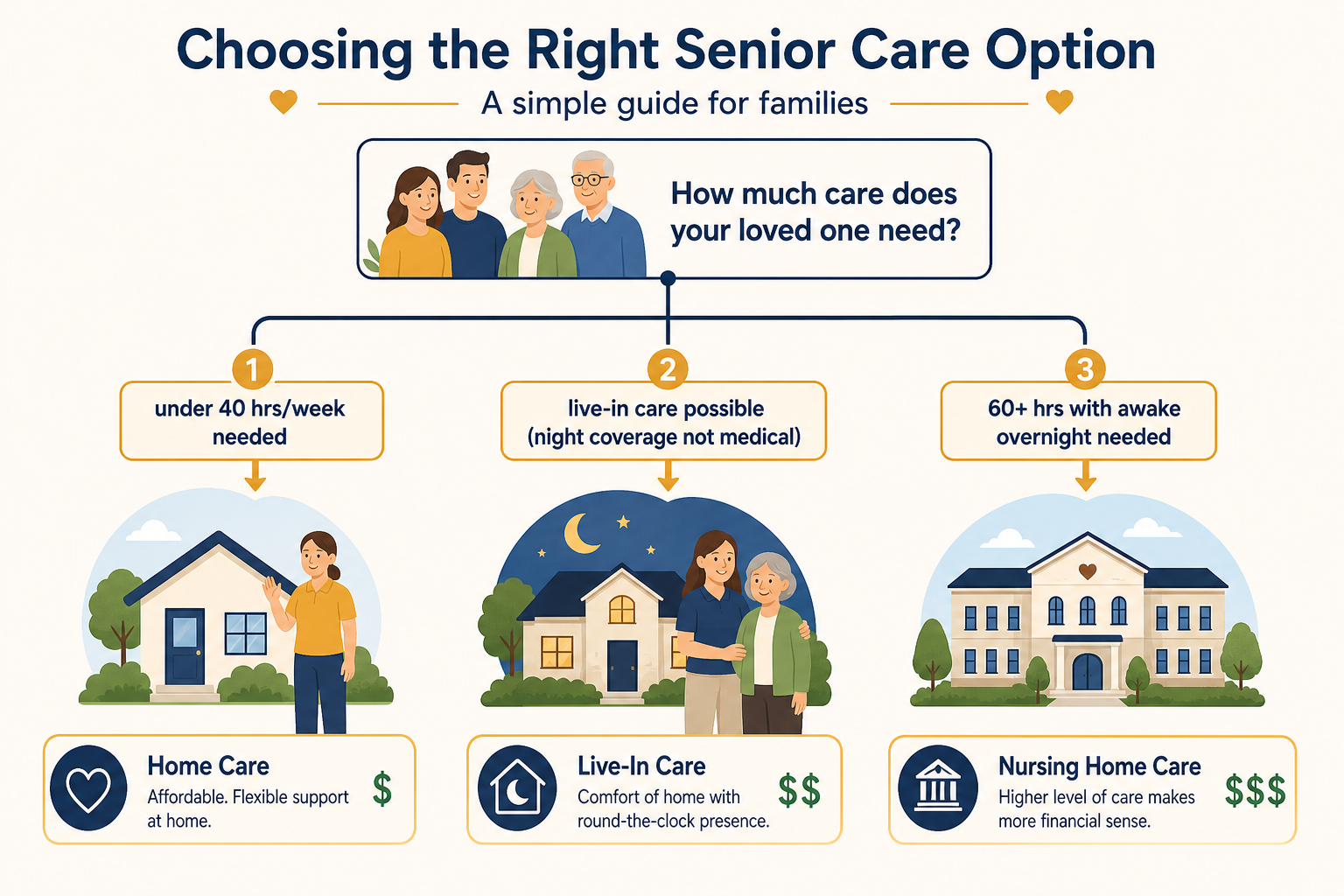
Every family's situation is different, but the decision framework boils down to three common scenarios. Use these as a starting point for your own calculations.
- Scenario 1: Under 40–50 hours per week → Home care is cheaper. If your parent needs 8 to 10 hours of daily care — help with morning routines, meals, and evening settling — but can safely be left alone overnight, home care at 44 hours per week (~$6,478/month) is significantly cheaper than a nursing home ($9,581/month). This is the most common scenario for seniors who are medically stable but need assistance with activities of daily living.
- Scenario 2: Live-in care is feasible → Most cost-effective middle path. If your parent can be left alone during an 8-hour sleep period — no wandering, no nighttime medical needs, no fall risk — a live-in caregiver provides nearly round-the-clock coverage at a cost that is often competitive with or below a nursing home. This is the sweet spot for many families: your parent stays home, gets extensive daily support, and you avoid the $24,733/month cost of rotating-shift 24/7 care.
- Scenario 3: 60+ hours per week with awake overnight needs → Nursing home is likely more affordable. If your parent requires awake overnight monitoring — due to dementia-related wandering, frequent bathroom trips with fall risk, or medical conditions that need regular checks — the cost of 24/7 rotating-shift care (~$24,733/month) far exceeds a nursing home's semi-private room ($9,581/month). In this scenario, the nursing home is not only more affordable but also provides the 24/7 skilled nursing staff that may be medically necessary.
The decision between 24-hour home care and a nursing home is never purely financial — it involves your parent's medical needs, their preferences, your family's capacity to coordinate care, and the emotional weight of each choice. But understanding the cost tipping point gives you a concrete starting point for the conversation. Run the numbers for your specific market, talk to your parent's doctor about what level of overnight supervision is truly required, and explore the live-in care option before assuming that 24/7 home care is out of reach.
Browse more in the Glossary.