
Clinical term
Senior Care Options: Home Care, Assisted Living, or Nursing Home — A Stage-Aware Guide for Families
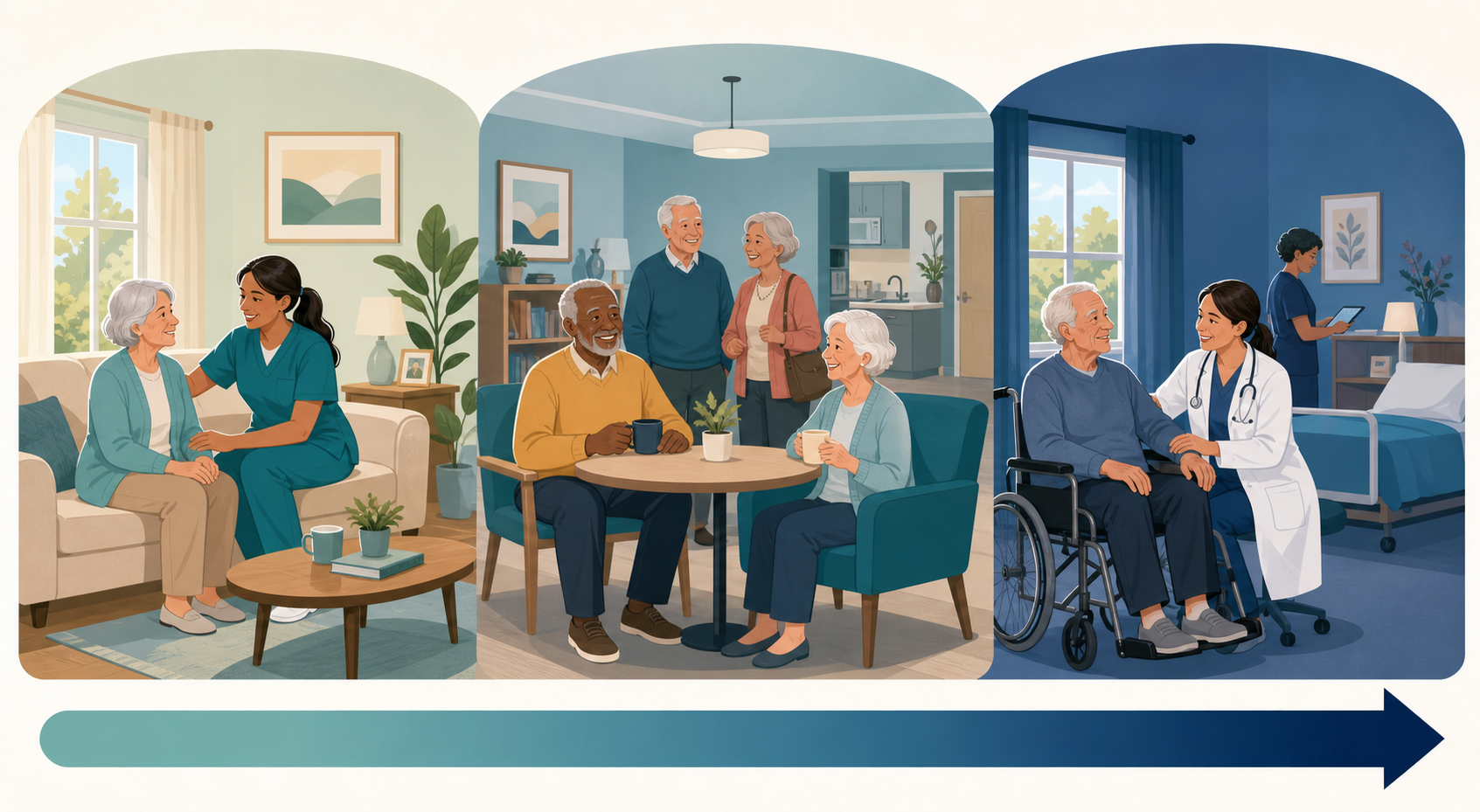
The Three Most Commonly Confused Senior Care Options — and When Each Is Appropriate
Families evaluating care for an aging parent often encounter three terms used almost interchangeably in casual conversation: home care, assisted living, and nursing home. They are not the same thing, and choosing incorrectly — or delaying a decision because the distinctions are unclear — can lead to unnecessary expense, inadequate support, or a crisis move that could have been avoided.
Home care refers to a paid caregiver who comes to the older adult's residence. It splits into two subtypes: non-medical home care (help with bathing, dressing, meal preparation, light housekeeping, and companionship) and home health care (skilled nursing, physical therapy, wound care ordered by a physician). The key distinction: home health care requires a doctor's order and is typically short-term, while non-medical home care is custodial — it supports daily living but does not provide medical treatment.
Assisted living is a residential setting where residents live in private or semi-private apartments and receive help with activities of daily living (ADLs), meals, housekeeping, and social activities. It is designed for people who need regular assistance but do not require 24-hour skilled nursing care. Staff are available around the clock, but the level of medical oversight is lower than in a nursing home.
A nursing home (also called a skilled nursing facility, or SNF) provides 24-hour supervised care with licensed nurses on staff. It is appropriate for individuals with complex medical needs, significant mobility limitations, or advanced cognitive decline who cannot be safely cared for in a less intensive setting. Nursing homes offer both short-term rehabilitation stays (often after a hospitalization) and long-term custodial care.
| Option | Living Arrangement | Level of Care | Medical Oversight | Best For |
|---|---|---|---|---|
| Home Care | Older adult's own home | Non-medical or skilled (short-term) | Minimal to moderate (home health only) | Those with a safe home environment and moderate needs |
| Assisted Living | Private/semi-private apartment in a residential community | Personal care, meals, activities, medication reminders | On-site staff, no 24-hour nursing | Those who need daily help but not complex medical care |
| Nursing Home (SNF) | Shared or private room in a licensed facility | 24-hour skilled nursing, rehabilitation, full personal care | Licensed nurses on staff 24/7 | Those with complex medical needs or advanced dementia |
The decision is not a one-time preference. It is a stage-of-need decision that will likely shift over time as your parent's functional status, cognitive health, and your own caregiving capacity change.
A Decision Framework Based on ADL Dependency, Cognitive Status, and Caregiver Availability
Rather than starting with a list of facility names or a generic checklist, begin with three concrete assessments: your parent's functional status (measured by the Katz Index of Independence in Activities of Daily Living), their cognitive status (early, middle, or late-stage dementia or another condition), and your own availability as a caregiver.
The Katz Index evaluates six core ADLs: bathing, dressing, toileting, transferring (moving from bed to chair), continence, and feeding. A person who needs help with three or more of these is generally a candidate for residential care or very intensive home care. A person who needs help with one or two may be manageable with home care, especially if a family caregiver is available and willing.
Cognitive status changes the equation dramatically. A person with early-stage dementia may live safely at home with supervision and reminders. Someone in the middle or late stages — who may wander, become agitated, or fail to recognize safety hazards — often requires a secured environment that home care alone cannot reliably provide. Memory care units within assisted living facilities or dementia-specialized nursing home wings are designed for this population.
| Factor | Home Care Likely Works | Assisted Living Likely Works | Nursing Home Likely Needed |
|---|---|---|---|
| ADL dependency | 0–2 ADLs needing help | 2–4 ADLs needing help | 4+ ADLs or total dependence |
| Cognitive status | Early-stage or intact | Early to middle-stage dementia | Middle to late-stage dementia with safety risks |
| Caregiver availability | Family caregiver available 20+ hrs/week | Limited family caregiver availability | No family caregiver or caregiver burnout |
| Medical needs | Stable, no daily skilled care | Medication management, stable conditions | Complex medical needs, wound care, rehab |
| Safety at home | Safe home environment, low fall risk | Home unsafe or socially isolated | 24-hour supervision required |
If you need a structured process for evaluating facilities and matching care levels, the Senior Care Options: A Practical 3-Step Decision Framework for Families Facing a Crisis provides a step-by-step approach that complements this stage-aware framework.
2026 Cost Comparison: The Break-Even Analysis That May Surprise You
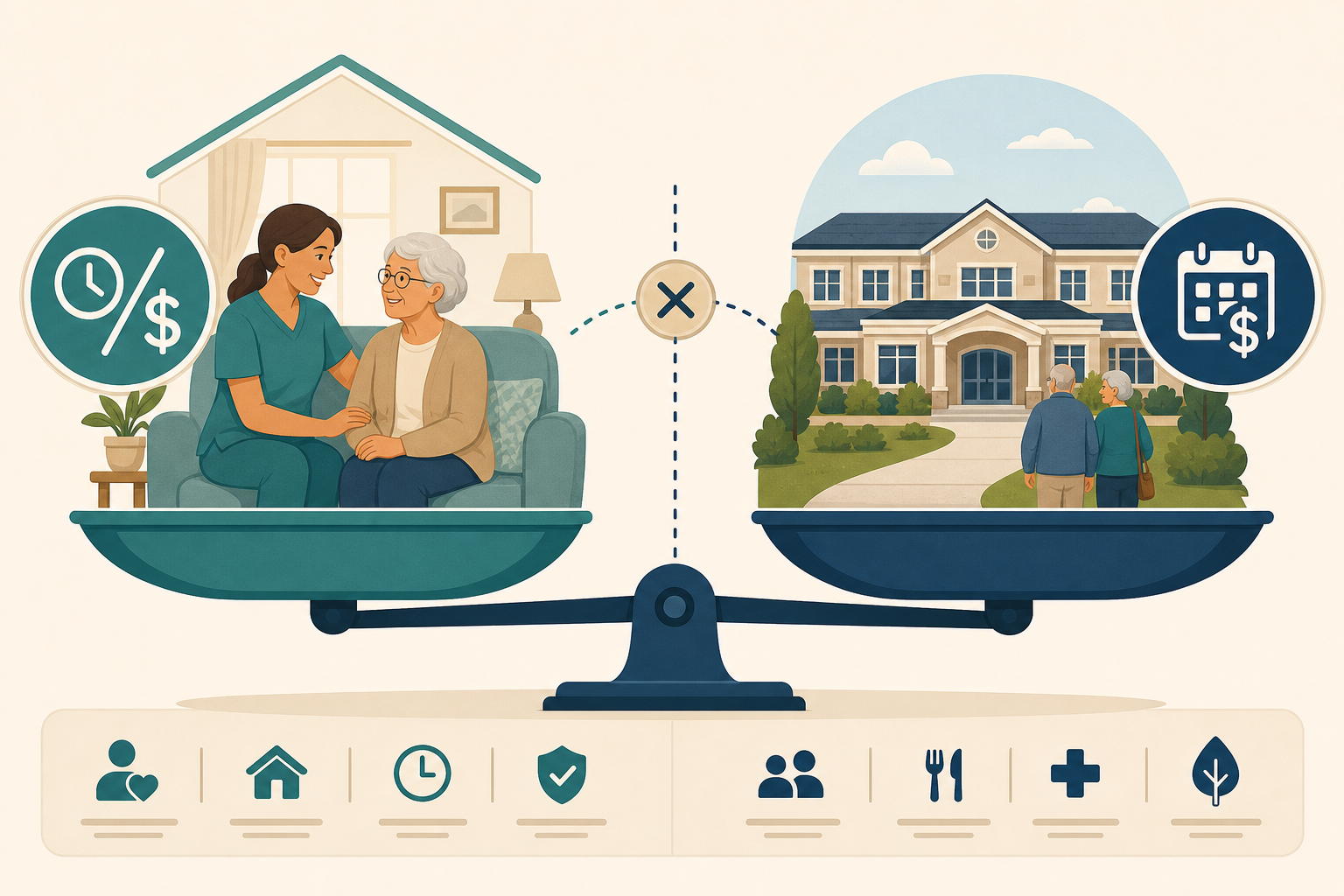
Here is the counterintuitive reality that many families discover too late: the option with the highest hourly rate — home care at a national median of $35 per hour (CareScout 2025 Cost of Care Survey, cited by U.S. News) — can become the most expensive overall when care needs exceed roughly 40 hours per week. At that threshold, assisted living at a median of $6,200 per month becomes the more cost-effective choice.
The math works like this: 40 hours of home care per week at $35/hour costs $1,400 per week, or approximately $6,067 per month. That is nearly identical to the $6,200 monthly median for assisted living — but assisted living includes rent, meals, activities, and 24-hour oversight. Home care at 44 hours per week (a common threshold for families trying to avoid residential placement) costs approximately $80,080 per year, according to U.S. News, which is more than assisted living and approaches the cost of a semi-private nursing home room.
| Option | National Median Cost (2026) | Annual Estimate | What's Included |
|---|---|---|---|
| Home care (non-medical) | $35/hour (CareScout 2025) | $36,400 (20 hrs/wk) to $80,080 (44 hrs/wk) | Caregiver time only; no rent, meals, or utilities |
| Adult day services | $95 per 8-hour day (U.S. News) | ~$24,700 (5 days/wk) | Social activities, meals, basic health monitoring |
| Assisted living | $6,200/month (CareScout) | $74,400/year | Rent, meals, activities, personal care, 24-hour staff |
| Nursing home (semi-private room) | $9,581/month (CareScout) | $114,972/year | Room, board, 24-hour skilled nursing, rehabilitation |
| Nursing home (private room) | $10,798/month (CareScout) | $129,576/year | Same as semi-private with private accommodation |
This analysis does not mean home care is a bad choice. For families needing 20–30 hours of help per week — a common scenario where a spouse or adult child works during the day and needs coverage — home care is often the most practical and cost-effective option. The key is to calculate total weekly hours honestly, including overnight needs, and compare the all-in monthly cost against residential alternatives.
How Each Option Is Paid For: Medicare, Medicaid, Long-Term Care Insurance, VA, and Private Pay
One of the most persistent misconceptions families carry is that Medicare will cover the cost of long-term care. It will not — at least not in the way most people assume. Understanding what each payment source actually covers for each of the three options is essential to making a realistic financial plan.
| Payment Source | Home Care | Assisted Living | Nursing Home |
|---|---|---|---|
| Medicare | Covers only short-term, medically necessary home health care (skilled nursing, PT, OT) through a Medicare-certified agency. Does NOT cover custodial home care (bathing, dressing, meals). | Does NOT cover room and board. May cover some short-term skilled services if provided in the facility. | Covers up to 100 days per benefit period for skilled nursing or rehabilitation after a qualifying hospital stay (3+ days). Days 1–20: full coverage. Days 21–100: daily copay. Requires Medicare-certified SNF. |
| Medicaid | Coverage varies by state. Some states offer home and community-based services (HCBS) waivers that pay for in-home care for eligible low-income individuals. | Coverage varies by state. Some states cover assisted living through HCBS waivers or state-specific programs. Eligibility and services differ significantly. | Covers long-term custodial nursing home care for eligible low-income individuals after spend-down of assets. The primary payer for long-term nursing home stays in the U.S. |
| Long-Term Care Insurance | Covers if the policy includes home care benefits. Typically requires a waiting period and ADL-based eligibility trigger. | Covers if the policy includes assisted living benefits. Policies vary widely in daily/monthly benefit amounts and elimination periods. | Covers if the policy includes nursing home benefits. Most traditional policies cover SNF stays. Newer hybrid policies may have different terms. |
| VA Aid & Attendance | Can be used to pay for in-home care for eligible veterans and surviving spouses. Requires medical assessment and financial eligibility. | Can be used to pay for assisted living for eligible veterans. Benefit amount depends on need and marital status. | Can be used to pay for nursing home care for eligible veterans. VA also operates its own nursing homes (Community Living Centers). |
| Private Pay (Out-of-Pocket) | Full cost paid by the family. Most common payment method for non-medical home care. | Full cost paid by the resident or family. Most assisted living residents pay privately. | Full cost paid by the resident or family until eligible for Medicaid (after spend-down). |
For families navigating the full financial landscape, The Hidden Costs of Senior Health Services: A Complete Financial Roadmap for Family Caregivers provides a comprehensive guide to out-of-pocket costs, long-term care insurance evaluation, and state-specific Medicaid planning.
Red Flags and Green Flags for Each Option
Once you have identified which option fits your parent's current stage of need, the next step is evaluating specific agencies or facilities. The following quick-reference checklist can help you distinguish a well-run operation from one that may put your parent at risk.
Home Care Agencies
- Green flags: Transparent pricing with no hidden fees; consistent caregiver assignments (not a different person every shift); thorough background checks and training for all caregivers; a written care plan that is updated at least monthly; clear communication protocols for family members.
- Red flags: High caregiver turnover (ask how long the average caregiver has been with the agency); unwillingness to provide references from current clients; vague answers about what happens if a caregiver calls in sick; no written care plan or a plan that is never updated; pressure to sign a long-term contract.
Assisted Living Facilities
- Green flags: Staff-to-resident ratios that allow for meaningful interaction (ask for specific numbers during the day, evening, and overnight); a published activities calendar that actually reflects what happens; residents who look engaged and well-groomed; transparent pricing that clearly separates base rent from care tiers; a nurse on-site during business hours and staff available overnight.
- Red flags: Strong smell of urine or heavy air fresheners (a common masking tactic); staff who seem rushed or dismissive; unwillingness to provide a copy of the resident agreement or fee schedule before a deposit; high staff turnover (ask the administrator how long they have been there); a one-size-fits-all care plan that does not assess individual needs.
Nursing Homes
- Green flags: Current Medicare and state inspection reports available for review; residents who are clean, comfortable, and responsive; staff who know residents by name and interact warmly; a clear infection control protocol; a registered nurse on duty 24/7; a low-pressure tour that answers all your questions.
- Red flags: Recent inspection citations for serious deficiencies (available on Medicare's Nursing Home Compare website); residents left in bed or in wheelchairs without engagement; staff who cannot or will not answer questions about staffing ratios; a high number of temporary or agency staff; pressure to admit quickly without a thorough assessment.
Questions to Ask During Facility Tours and Agency Interviews
When you tour a facility or interview a home care agency, you are not just a visitor — you are an evaluator. The following questions are designed to surface the information that matters most for safety, quality of life, and financial predictability.
For Home Care Agencies
- What training and background checks do your caregivers complete before assignment?
- What happens if my regular caregiver is sick or on vacation? Will I meet the backup caregiver in advance?
- How do you handle medication reminders? Can caregivers administer medications (if state law allows)?
- What is your emergency response protocol if a caregiver arrives and finds the client unwell or has fallen?
- How often is the care plan reviewed and updated? Who is involved in that process?
- Can you provide three references from current or recent clients with similar care needs?
For Assisted Living Facilities
- What is your staff-to-resident ratio during the day, in the evening, and overnight? (Ask for actual numbers, not ranges.)
- How do you assess a new resident's care needs, and how often is that assessment updated?
- What is the process if a resident's needs increase? Is there an additional cost, and how is it determined?
- How do you handle medication management? Who administers medications, and what training do they have?
- What is your policy on wandering or exit-seeking behavior for residents with dementia?
- Can I see a copy of the resident agreement and the full fee schedule, including all potential add-on charges?
For Nursing Homes
- What is your licensed nurse-to-resident ratio on each shift? What is your CNA-to-resident ratio?
- What is your staff turnover rate for nurses and CNAs over the past 12 months?
- Can you show me your most recent state inspection report and any plans of correction?
- How do you prevent and manage pressure ulcers (bedsores)? What is your current rate?
- What is your policy on physical restraints and antipsychotic medications?
- How do you handle hospitalizations? Do you have a hospital readmission reduction program?
The Socioeconomic Reality: How Income Shapes Your Options
A February 2026 Pew Research Center survey of 8,750 U.S. adults found that 10% of all U.S. adults are caregivers for a parent age 65 or older. But the distribution is not equal: 39% of lower-income adults with an aging parent are caregivers, compared to 23% of middle-income adults and just 16% of upper-income adults.
This disparity has direct implications for the care options available to families. Lower-income families are more likely to rely on unpaid family caregiving — often at significant personal cost to the caregiver's own health, finances, and career. The same Pew survey found that 47% of women caregivers report a negative impact on their emotional well-being, and 38% report a negative impact on their physical health.
If your family has limited financial resources, the practical range of options narrows. Home care and assisted living are primarily private-pay services. Nursing home care is the only option with a broad Medicaid safety net — but qualifying for Medicaid typically requires spending down assets to a very low threshold, and not all nursing homes accept Medicaid patients. Understanding these constraints early allows you to plan realistically rather than discovering them in a crisis.
Browse more in the Glossary.