
STEADI: Intervene
Neighborhood Fall Safety Tips for Older Adults Living Alone
Outdoor falls were nearly half of the recorded falls in a Boston study of older adults — and most neighborhood hazards are fixable. This block walk-through helps older adults living alone and their families check each zone, fix what's fixable, and route the rest to the right city line.
For an active older adult living alone, the fall-safety walk should not stop at the front door. The risky spot may be the porch step, the lifted sidewalk slab two houses down, the curb ramp at the corner, or the uneven patch between the bus stop and the pharmacy.
That is why neighborhood safety tips for older adults living alone need to be more specific than “watch your step.” In the MOBILIZE Boston Study, which followed community-dwelling adults age 70 and older enrolled from 2005 to 2007, 46.7% of 1,122 located falls occurred outdoors. Among those outdoor falls, the most common locations included sidewalks at 23%, yards or gardens at 14%, streets or curbs at 14%, outside stairs at 13%, and parking lots at 6%.[1]
That finding is not a national rate, and it should not be treated as one. It is still useful because the locations are so ordinary. They are the same places a person may pass while getting mail, catching the bus, walking to a store, or crossing to a clinic parking lot. CDC fall-prevention guidance frames falls as preventable safety events, not an unavoidable part of aging, which is the right mindset for this kind of walk-through.[2]
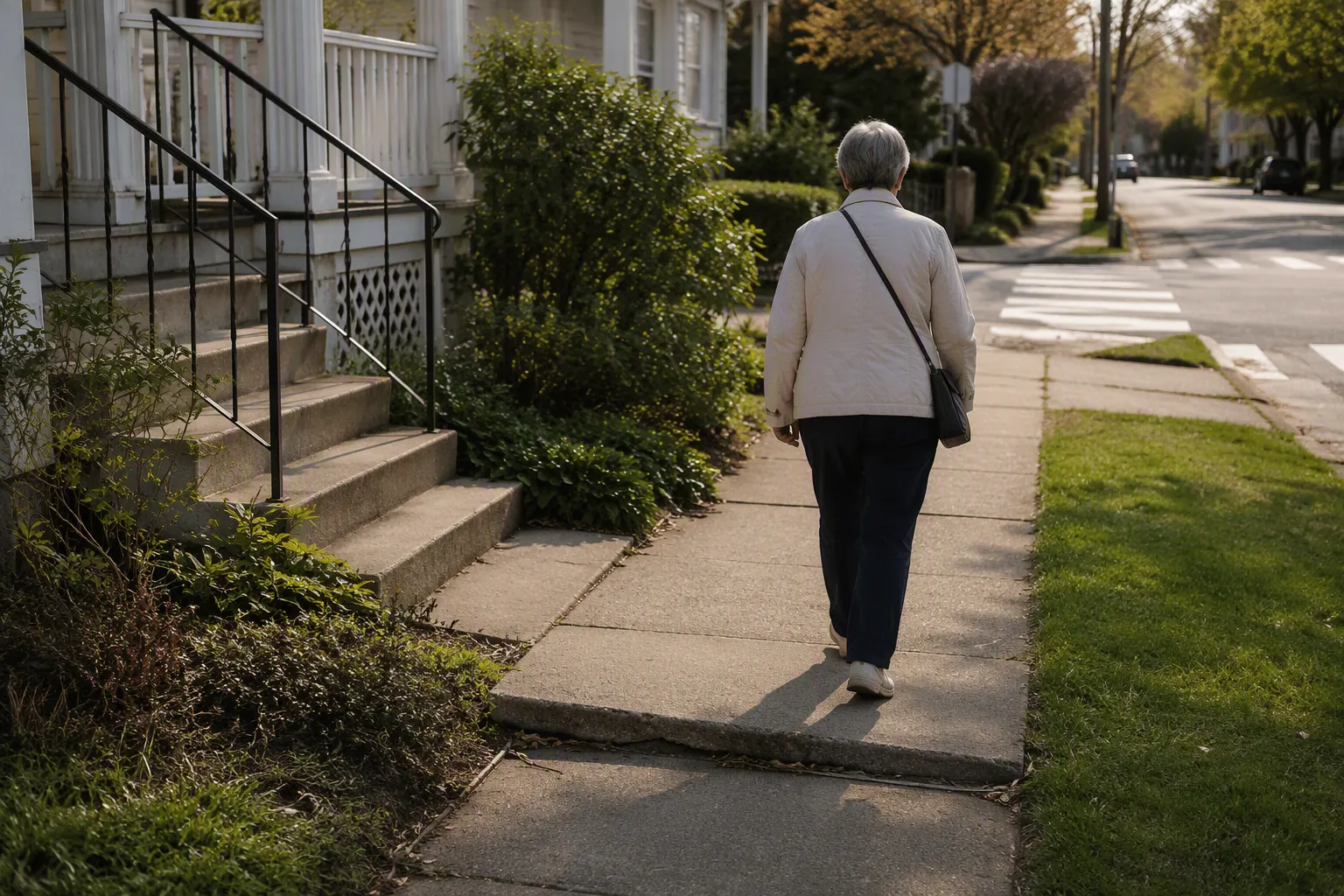
Do the walk in daylight if possible. If the older adult usually walks alone, bring a neighbor, family member, or check-in partner for the first inspection. Carry a charged phone, share the route with someone, and stop the checklist if anyone falls, feels suddenly unsteady, or appears injured. A printed route map and a few photos are often more useful than a lecture.
| Zone | What to look for | What to do today | Who gets the problem if it is not yours to fix |
|---|---|---|---|
| Front walk, porch, outside steps | Loose mats, poor lighting, missing or shaky railings, uneven step edges, clutter near the door | Clear the path, improve lighting, use the rail, move deliveries and planters out of the walking line | Landlord, property manager, condo board, homeowner, or family helper |
| Sidewalk path | Cracks, holes, raised slabs, tree-root heaves, grass edges, wet or possibly icy pavement, dark stretches | Choose the smoothest side, slow down at transitions, use a flashlight or reflective gear in low light, change the route if needed | City non-emergency line, public works department, local reporting app where available, or adjacent property owner if local rules assign maintenance there |
| Curb and crossing | High curbs, broken curb ramps, short crossing time, turning traffic, faded markings, no sidewalk on one side | Wait for a fresh walk signal, scan left-right-left, use pedestrian islands when available, face traffic if there is no sidewalk | Public works, transportation department, city council office, or disability access office where available |
| Mailbox, bus stop, store entry, parking lot | Sloped pavement, puddles, gravel, curb edges, poor lighting, door thresholds, crowding near entrances | Stand back from curb edges, avoid shortcuts over grass or medians, use the safest marked path, ask for help carrying bags | Postal property contact, transit agency, store manager, property manager, parking-lot owner, or city department |
Start where the home meets the sidewalk
The first zone is the short strip everyone stops noticing: the front walk, porch, stoop, exterior stairs, and the place where packages or trash bins collect. This is still part of the neighborhood route because it controls whether the older adult leaves the home with both hands free, good footing, and enough light to see the next step.
Look for loose doormats, uneven pavers, broken concrete at the bottom of steps, planters that narrow the path, and railings that move when weight is placed on them. Check the lighting at the time the person actually leaves or returns. A porch that looks fine at noon may be a guessing game after dinner.
The same day fix is usually simple: move objects out of the walking line, secure or remove loose mats, keep the handrail side clear, and place deliveries where they do not block the door swing or stair landing. If the railing is loose, the step edge is broken, or the exterior light is not working in a rental or managed building, send the request to the landlord, property manager, condo board, or maintenance office. A photo with the exact location is harder to dismiss than “the steps are bad.”
If you are doing a larger living-alone safety sweep, keep the outdoor walk separate from indoor fire and escape planning. A good companion project is the Fire Safety and Escape Checklist for Seniors Living Alone, but do not let smoke alarms and exit routes crowd out the sidewalk work. These are different hazards with different owners.
Sidewalks deserve the longest look
NCOA’s neighborhood fall-prevention checklist tells walkers to watch for cracks, holes, uneven areas, and sidewalks pushed up by tree roots. It also recommends using sidewalks as the safest path where they are available, navigating grass slowly, being extra careful in stormy weather, and choosing well-lit routes with a flashlight or reflective vest in the evening.[3]
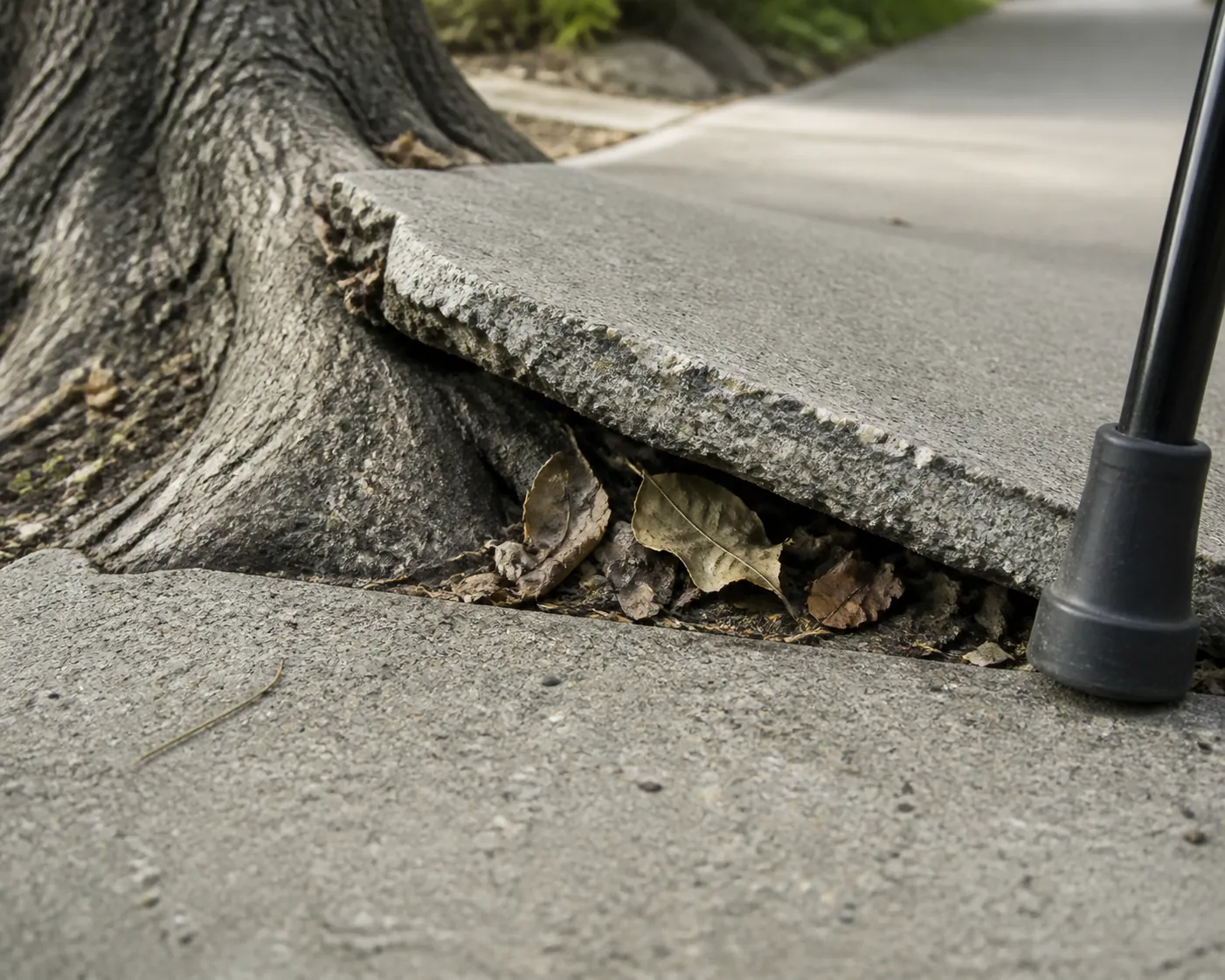
Walk the usual route slowly, not the ideal route on a perfect day. Start at the door and continue to the mailbox, corner, parking area, or bus stop. Take pictures from two angles: one close enough to show the crack or raised edge, and one wide enough to show the address, tree, curb, or nearby sign. If a city crew, landlord, or property manager has to find the hazard, the wide photo matters.
- Raised slab or tree-root heave: mark it on the route, avoid it immediately, and report it if it is in a public sidewalk or managed walkway.
- Crack, hole, or missing chunk of pavement: decide whether the older adult can safely step around it every time. If not, choose a different route until it is repaired.
- Grass edge beside the sidewalk: treat it as a transition, not a shortcut. Grass can hide holes, sprinkler heads, mud, and uneven ground.
- Wet-looking pavement: slow down and test footing carefully. In cold weather, assume a shiny patch may be ice until proven otherwise.
- Dark stretch: walk it at the actual evening hour, not just in daylight. If it cannot be avoided, add a flashlight, reflective vest, or a companion walk.
Do not make “step around it” the permanent plan for a hazard the person passes every day. A workaround is acceptable while a repair request is pending; it is not a repair. If the safer route adds distance, check whether that extra distance is realistic in heat, rain, darkness, or after a medical appointment when the person may be tired.
Vision belongs in this part of the walk. NCOA states that people with vision problems are more than twice as likely to fall.[3] If the older adult misses curb edges, misjudges shadows, hesitates at patterned pavement, or says the sidewalk “moves” in low light, make an eye-care appointment part of the fall-prevention plan. This guide to signs of vision loss in the elderly can help families notice changes that show up first during errands, not in the living room.
Curbs and crossings: protect the minutes that matter
A curb is a small height change with traffic pressure attached. That makes it different from a hallway threshold. The older adult may be watching the signal, listening for a car, managing a cane or shopping bag, and trying not to be the person who “holds everyone up.” That pressure can turn an ordinary crossing into a rushed one.
NHTSA’s older-adult pedestrian guidance is practical here: wait for a fresh green or walk signal to maximize crossing time, look left-right-left even on one-way streets, use pedestrian islands when available, and walk facing traffic if there is no sidewalk.[4]
On the route walk, stand at the corner and time the experience in ordinary terms. Does the person reach the far curb without rushing when starting at the beginning of the walk signal? Is the curb ramp aligned with the crosswalk, or does it send the walker into a rough patch? Is there a place to wait that is flat and wide enough for a cane, walker, or shopping cart? Are drivers turning across the crosswalk before the person has cleared it?
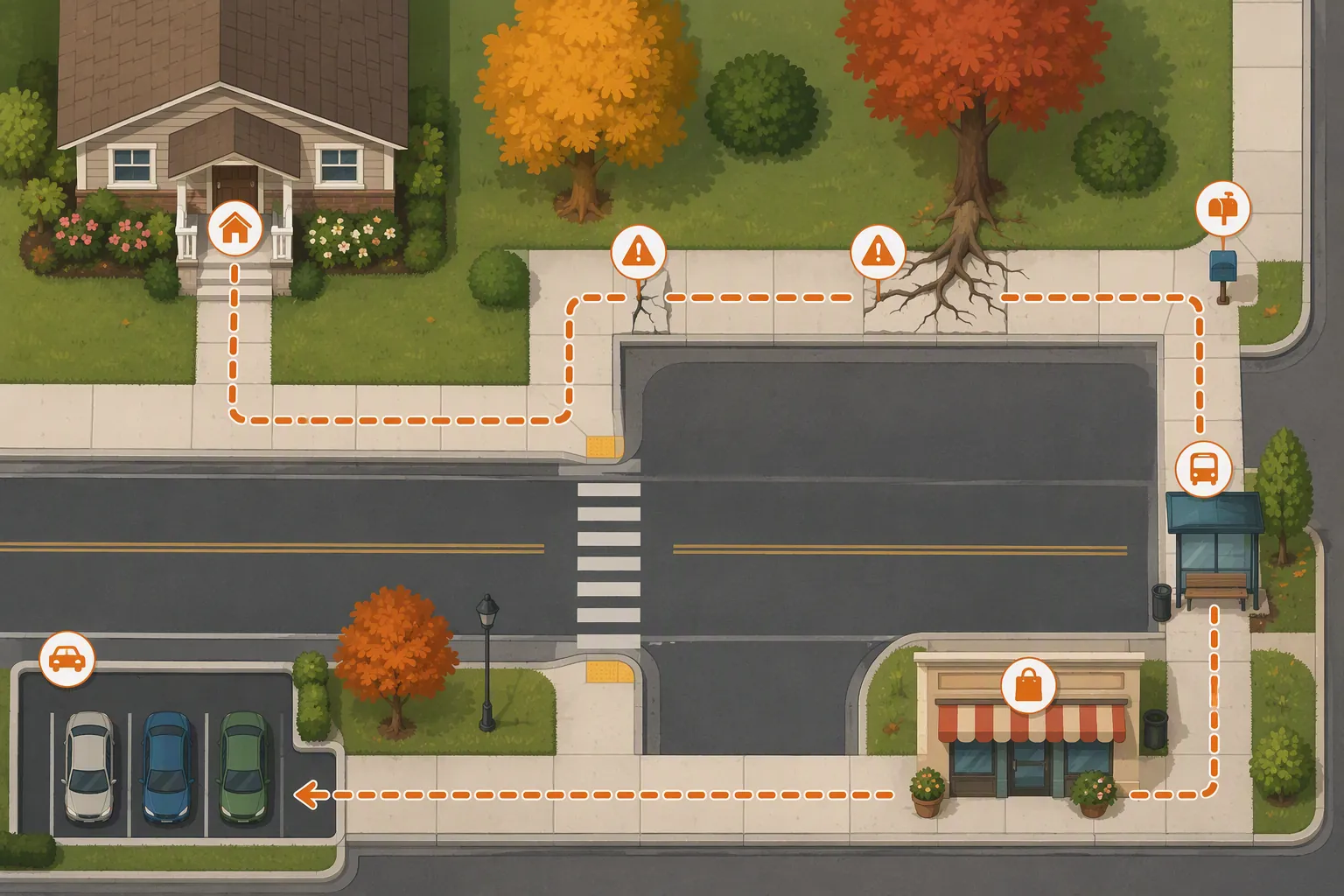
The same-day fix may be behavioral: wait for the next fresh signal instead of stepping off late, use the marked crosswalk even if it is a few steps farther, cross to a pedestrian island rather than trying to clear a wide street in one push, or avoid a corner where turning traffic repeatedly crowds the walker. If there is no sidewalk, NHTSA’s guidance to face traffic gives the walker a better view of approaching vehicles.[4]
The repair path is different. A broken curb ramp, missing curb cut, signal that does not allow enough crossing time, or faded crosswalk belongs with the public works or transportation side of local government, not with the older adult’s balance exercises. If a clinician has already raised gait, balance, or endurance concerns, fold the crossing into a broader plan such as a fall prevention action plan using the CDC STEADI framework.
The errand stops count too
A neighborhood route is not just pavement between two points. It includes the places where the older adult stops, turns, reaches, waits, and carries things. Those moments change balance.
Mailbox
Check the approach to the mailbox in the weather and footwear the person actually uses. Is there a slope, gravel strip, grass rut, puddle, or curb edge right where the person stands? Can the box be reached without twisting or stepping backward? If the mail area is in a managed building, report loose mats, burned-out lights, or uneven flooring to the property manager. If the box is outdoors and the approach is unsafe, ask about relocating the box or changing the walking path before the next icy morning or heavy rain.
Bus stop
At the bus stop, look for the waiting place, not only the bus sign. A safe stop has enough level space to stand back from the curb, a clear path from the sidewalk to the boarding point, and lighting if the person rides early or late. If the stop forces people to wait on grass, a slope, broken pavement, or the edge of traffic, document it and contact the transit agency or city transportation department.
Store or clinic entry
Store and clinic entries often combine glare, wet mats, automatic doors, curb cuts, and people moving in different directions. Check whether the entrance has a level approach, whether mats lie flat, and whether shopping baskets or signs narrow the walking line. A store manager, clinic administrator, or property manager owns many of these fixes. The older adult should not have to step over a curled mat every time prescriptions are picked up.
Parking lot
Parking lots accounted for 6% of outdoor falls in the MOBILIZE Boston located-falls data, which is not the largest category but is still enough to deserve attention on a real errand route.[1] Look for potholes, loose gravel, sloped pavement, wheel stops, puddles, and the place where the person moves from passenger seat to walking path. If bags are involved, plan where they will be carried, set down, or transferred before walking across traffic lanes.
Add the weather and low-light layer without rewriting the whole route
The route does not need a separate safety plan for every season, but it does need a second look when conditions change. NCOA specifically calls out stormy weather, well-lit routes, flashlights, and reflective vests for evening walking.[3] That belongs on the same route map: where is the first place water pools, where does the sidewalk stay dark, and where does glare make a curb edge disappear?
In cold weather, treat wet pavement as a possible ice patch until the footing is clear. In summer, heat can change the decision too; a longer detour may be safer underfoot but unrealistic during a heat wave. If the route depends on a cane, check the rubber tip before bad weather. A worn tip can turn a small slick spot into a serious problem.
For hot-weather errands, pair this route walk with a heat wave safety checklist for elderly parents. The question is not only “Can this person walk there?” It is “Can this person walk there safely under the conditions that will exist when the errand actually happens?”
When the route exposes a gait, balance, or device-fit problem
Sometimes the hazard is the sidewalk. Sometimes the walk reveals that the person’s cane is the wrong height, the walker catches on curb ramps, the person tires before the return trip, or a step-down causes repeated hesitation. Do not turn that into blame. Treat it as information.
Ask a clinician whether a physical therapy or occupational therapy assessment would help with gait, balance, route practice, or assistive-device fitting. If the person already uses a cane, walker, or rollator, the outdoor route is the real test. A device that works in a hallway may behave differently on a cracked sidewalk, curb ramp, or bus-stop slope. This self-advocacy guide for fall-prevention questions has useful language for asking directly about fall risk and support needs.
Make a repair trail, not a worry list
At the end of the walk, sort every problem into one of three places: fix today, avoid for now, or report for repair. That sorting is what keeps the list from becoming another reason to stay inside.
- Fix today: move planters, clear leaves, improve porch lighting, secure a mat, carry a flashlight, use a different bag, or choose the smoother side of the street.
- Avoid for now: skip a cracked sidewalk segment, use a different corner, cross at a signal with more time, or ask someone to walk along until the route is repaired.
- Report for repair: broken sidewalk slabs, tree-root heaves, failed curb ramps, missing curb cuts, poor lighting on public paths, unsafe bus-stop pavement, or signal timing that does not allow a normal crossing.
Reporting channels vary. Some cities use 311; others use a non-emergency line, public works department, transportation department, landlord portal, property manager, transit-agency form, or a local reporting app. Use the channel that matches the owner of the hazard. A lifted public sidewalk usually does not belong in the same inbox as a loose apartment handrail, and a dangerous bus-stop pad may need the transit agency rather than the landlord.
Send the report with the exact address or nearest intersection, photos, the direction of travel, and a plain description: “raised sidewalk slab at the northeast corner,” “curb ramp broken at crosswalk,” “walk signal too short for older pedestrians starting on fresh signal,” or “bus stop waiting area has uneven pavement.” Keep the confirmation number if one is provided. If the hazard is in a rental or managed building, ask for a repair date in writing.
Some fixes are larger than one work order. If the danger is built into the route — no curb cut where people actually cross, a signal that repeatedly strands slower walkers, or a bus stop that forces people onto grass — bring the documentation to the city transportation office, public works department, disability access office, neighborhood association, or elected representative. The neighborhood is not fully under one person’s control, but it is still inspectable, reportable, and often fixable.
References
Related reading
Noticed something outdated or inaccurate on this page? Flag a correction. We review every report against CDC, NIA, and AARP HomeFit guidance before updating a page.
Part of the Fall Prevention section.