
How Hazardous Air Quality Increases Fall Risk and What to Do
Learn why poor air quality raises fall risk in older adults and what specific precautions — beyond staying indoors — can reduce dizziness, improve balance, and keep your parent safe during hazardous air days.
When an air quality alert hits your phone, getting an older parent indoors is the right first move. It is not the whole fall-prevention plan. On hazardous air days, the risk often moves with them into the house: the short walk to the bathroom after feeling lightheaded, the dim hallway because the curtains are closed against smoke, the parent who skips the cane because “I’m only going to the kitchen,” the extra trips to check windows, pets, mail, or medication.
The main question behind hazardous air quality precautions for elderly parents is not only how to protect their lungs. It is how to keep them steady while their breathing, balance, stamina, and usual movement patterns are under stress. AirNow identifies older adults as a group at higher risk from particle pollution because they are more likely to have heart or lung disease and because aging can make the body less able to compensate during pollution exposure.[1] CDC wildfire smoke guidance also advises people at higher risk, including older adults, to reduce smoke exposure and follow medical instructions during wildfire events.[2]
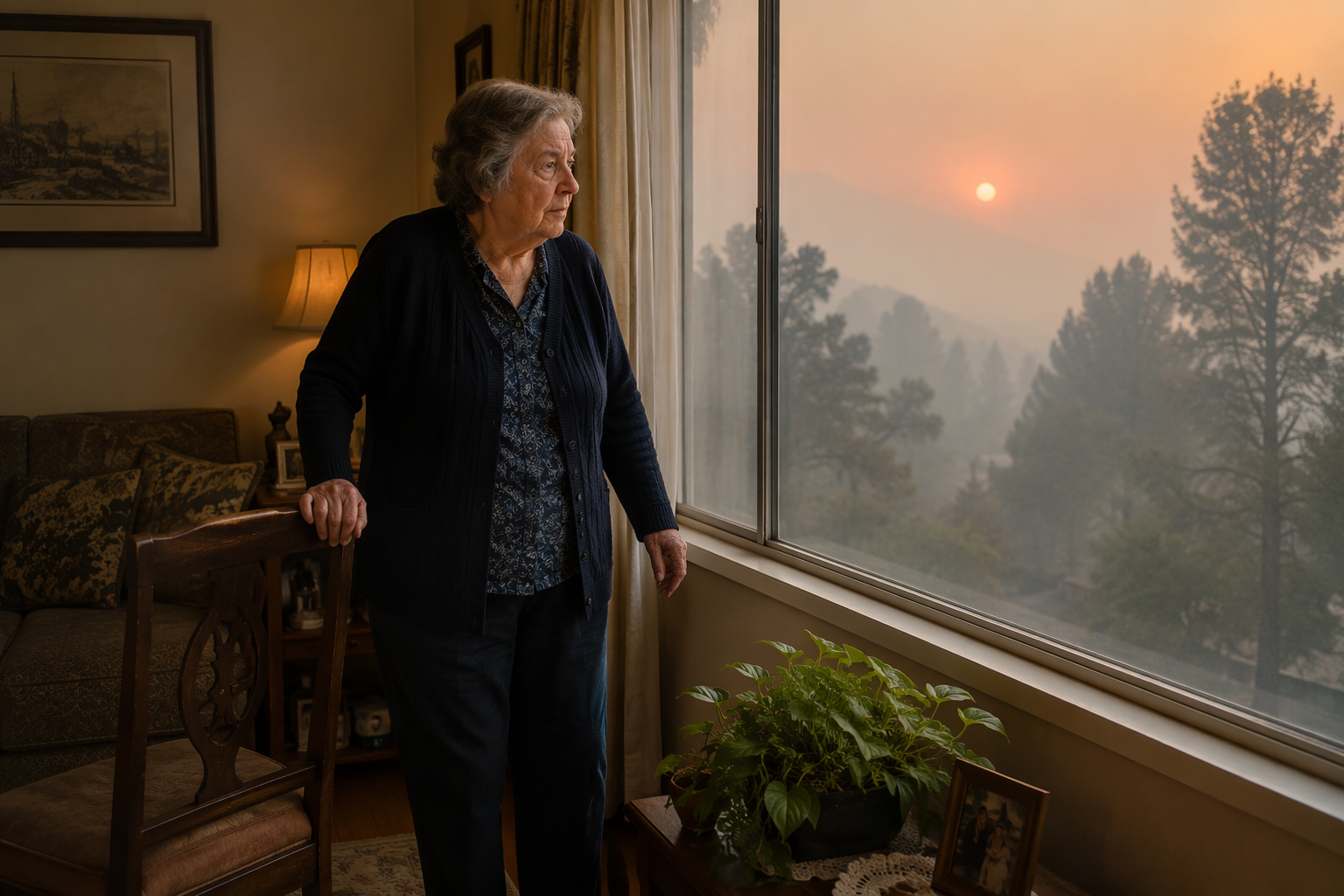
For a caregiver, the useful reframing is simple: poor air can shrink a parent’s safe movement zone. A parent who normally walks to the mailbox may need to skip it. A parent who usually gets up at night without help may need the hallway light on and the walker parked where it can actually be reached. A parent who says they feel “a little dizzy” needs that symptom treated as a fall-risk signal, not as a passing complaint.
Why Poor Air Quality Can Become a Fall Problem
Most public warnings are written around exposure: check the air quality, stay indoors, reduce exertion, keep indoor air cleaner, and seek medical advice for concerning symptoms. Those steps matter. NCOA, the American Lung Association, AARP, CDC, and AirNow all emphasize reducing exposure during poor air quality or smoke events, especially for older adults and people with chronic health conditions.[1][2][3][4][5]
But fall risk changes through what happens after the warning. Fine particle pollution and ozone can contribute to symptoms such as dizziness, lightheadedness, shortness of breath, and breathing strain in susceptible older adults.[3][4] Those symptoms can change how safely someone stands, turns, transfers from a chair, climbs stairs, or walks to the bathroom. If the home is not adjusted for a day of reduced stamina and reduced outdoor movement, “staying inside” can still leave too many chances for a fall.
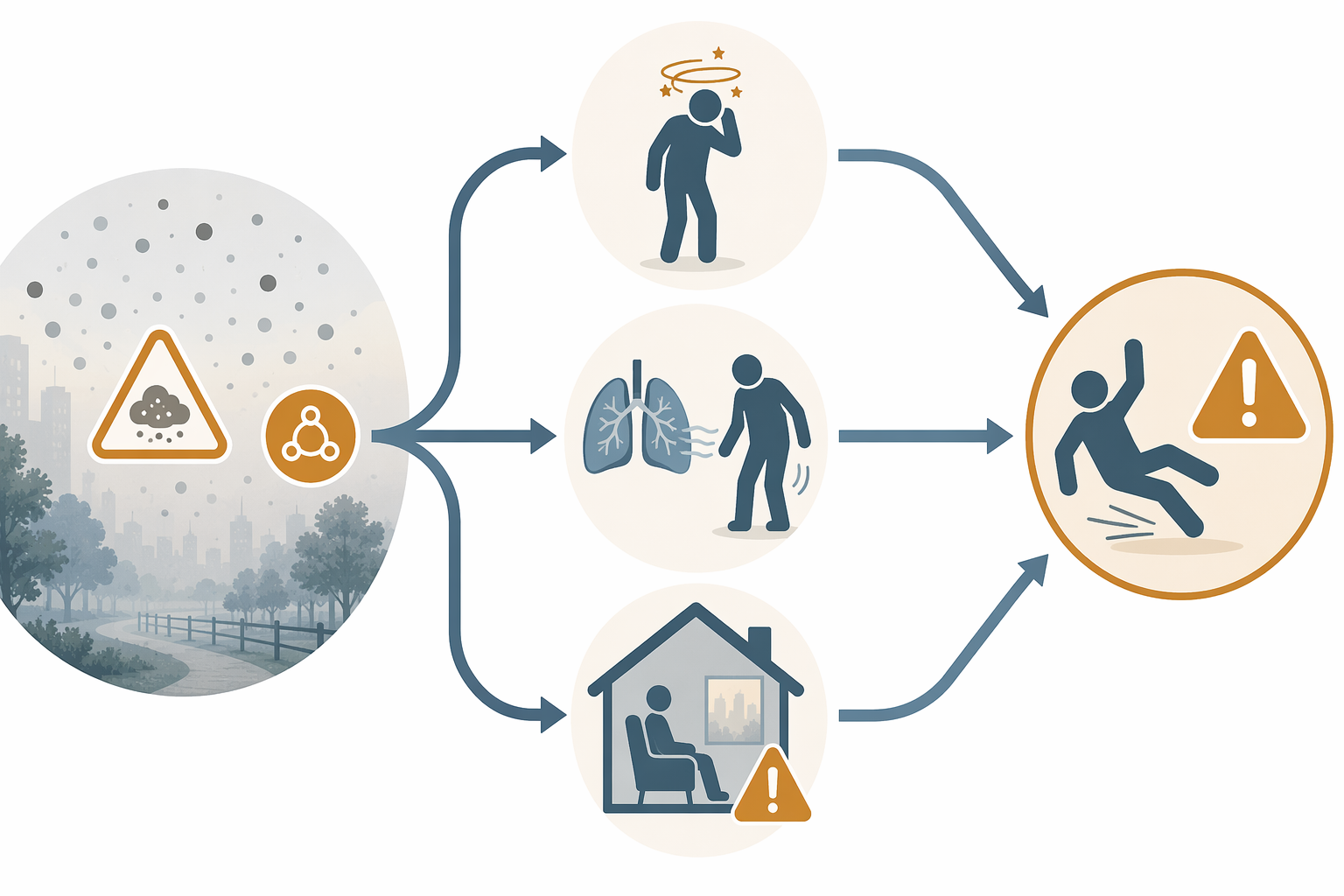
There are three practical pathways to watch: dizziness, oxygen and breathing strain, and indoor confinement without safety changes. They overlap in real life. A parent may be slightly breathless, avoid their usual walk, sit for hours, then stand quickly in a dark room and feel unsteady. The fall risk is not caused by one neat factor; it builds from several small losses of margin.
Dizziness Is Not a Minor Detail
Dizziness deserves more respect in the fall-prevention conversation. A 2024 systematic review and meta-analysis of 29 studies with more than 103,000 participants found that dizziness was associated with 63% higher odds of any fall and 98% higher odds of recurrent falls.[6] That does not mean every dizzy spell causes a fall. It does mean a caregiver should not wave off “I feel lightheaded” during a smoke or ozone alert just because the parent is already sitting safely in the living room.
The meta-analysis looked at dizziness from all causes, not specifically dizziness caused by air pollution.[6] That boundary matters. Still, when hazardous air is known to worsen symptoms such as lightheadedness or breathing discomfort in vulnerable people, and dizziness itself is strongly associated with falls, the home plan should change for the duration of the alert.
The action is not complicated, but it has to happen before the next transfer or bathroom trip. Ask directly: “Do you feel dizzy, lightheaded, unusually tired, confused, or short of breath when you stand?” If the answer is yes, reduce unnecessary walking, keep a mobility aid within arm’s reach, turn on lights before movement, and consider having someone nearby for transfers. If symptoms are new, severe, worsening, or concerning for that parent’s medical history, contact a clinician or follow the emergency plan already given by their healthcare team.
For a parent who has already fallen or nearly fallen during a poor-air day, the next step is not only cleaning the air. Review what happened after the symptom started: where they were going, whether they stood quickly, whether the room was dim, whether the walker was in another room, and whether bathroom access was safe. If there has already been a fall, this post-fall care guide can help organize what to watch for after the immediate event.
Breathing Strain Can Make Ordinary Movement Less Safe
Poor air quality does not have to produce dramatic symptoms to affect movement. Shortness of breath, chest tightness, coughing, fatigue, or lower oxygen saturation can make standing and walking less stable. A person who is working harder to breathe may rush to sit down, skip the walker, grip furniture instead of a rail, or misjudge how far they can safely go.
Older lungs may have less reserve even in people who do not think of themselves as “lung patients.” All Seniors Care, citing Health Canada, notes that aging is associated with reduced lung capacity, which can make seniors more sensitive to poor air quality.[7] NCOA also frames poor air quality as a broader health threat for older adults, connecting it not only with lung disease but also with heart disease, cognitive decline, and osteoporosis.[3] Those conditions matter in fall prevention because they can affect stamina, judgment, balance, bone strength, and recovery after a fall.
This is where a pulse oximeter can either help or confuse. If a parent has been told by a clinician to monitor oxygen saturation, follow that individualized plan. Do not invent a new threshold from an article. Instead, treat the device as one piece of context: is the reading different from their usual, are they more breathless than normal, are they confused, pale, weak, or unable to walk safely? The fall-prevention response is to reduce exertion and supervise movement while the medical question is being sorted out.
On hazardous air days, errands should be judged by exertion and consequence. The mailbox can wait. Trash can wait. A non-urgent trip to the porch can wait. Stairs should be limited when possible, especially if the parent is short of breath or lightheaded. If they must move, make the route shorter, brighter, and supported.
The Evidence Connecting Air Pollution and Falls Is Growing
The direct air-pollution-to-falls evidence is still developing, but it should not be ignored. A 2025 study conducted in China reported that moderate-to-high PM2.5 exposure was associated with increased falls risk, particularly among adults over 60 and people with cognitive impairment.[8] That is an important signal for caregivers, especially because cognitive impairment can already make it harder for a parent to recognize danger, use a device consistently, or remember a temporary safety rule.
The limitation is just as important: the study was conducted in China, so its findings should not be pasted directly onto every U.S. household, housing type, wildfire pattern, or caregiving situation.[8] It also does not prove that one AQI reading caused one individual fall. The safer conclusion is narrower and still useful: PM2.5 exposure has been associated with falls risk in older adults, and that association fits with known symptom pathways caregivers can act on today.
What to Change at Home During a Hazardous Air Day
The best precautions combine air-quality steps with fall-prevention steps. If the plan only says “stay indoors,” it leaves too much room for a parent to keep moving through the house as if nothing has changed.
| Caregiver Goal | What It Looks Like in the Home |
|---|---|
| Reduce exposure | Check AirNow or local alerts, keep windows and doors closed when advised, follow wildfire smoke guidance, and use cleaner indoor air strategies when available. |
| Reduce exertion | Cancel non-urgent outdoor trips, avoid unnecessary stairs, postpone chores that trigger breathlessness, and move frequently used items closer. |
| Stabilize movement | Keep canes, walkers, glasses, shoes, and phones within reach; ask about dizziness before standing; slow down transfers. |
| Make indoor routes safer | Turn on hallway and bathroom lights, clear clutter, secure cords, improve bathroom access, and keep the safest path open. |
Start with exposure because breathing strain can trigger the rest of the problem. Use AirNow or local alerts to decide whether outdoor activity should be reduced.[1] CDC wildfire smoke guidance advises people to stay indoors and keep indoor air as clean as possible during smoke events, with special caution for people at higher risk.[2] The American Lung Association and AARP also emphasize limiting exposure, keeping indoor air cleaner, and paying attention to symptoms during poor air quality or wildfire smoke events.[4][5]
Then remove the errands that create the fall opportunity. A parent does not need to walk to the curb to “get a little air” when the alert says the air is the hazard. If mail, plants, pets, or trash require attention, assign the task to someone else or delay it. If the parent lives alone, the check-in call should cover not only “Are your windows closed?” but also “Do you need anything moved closer so you don’t have to make extra trips?”
Next, set up the rooms where falls actually happen. The bathroom route matters more than the living room where everyone is sitting during the phone call. Turn on lights before dusk. Clear the path from the chair to the bathroom and bedroom. Put the walker where the parent stands up, not across the room. Check that bathroom floors are dry and that grab bars, if present, are reachable. If you are deciding whether equipment is helping or creating clutter, this guide to home safety products for seniors can help separate useful supports from products that do not fit the home.
If your parent has mild cognitive impairment or dementia, do not rely on a one-time reminder. The 2025 PM2.5 study found the association with falls risk was especially notable among people with cognitive impairment.[8] In practical terms, a parent may remember that the air is bad but forget the temporary rule about not going outside, using the walker, or calling before stairs. Put the rule where the action happens: a note on the door, the walker parked in front of the favorite chair, the porch light left off if that discourages unnecessary trips outside, or a scheduled call before the usual evening routine.
A Short Safety Plan for the Day of the Alert
A useful hazardous-air-day plan should be short enough to use while you are standing in the kitchen with your phone in your hand. It should cover breathing, movement, and symptoms in the same routine.
- Check the alert source: Use AirNow or local public health guidance before deciding on outdoor activity.
- Close the obvious exposure gaps: Follow smoke or poor-air guidance for windows, doors, outdoor exertion, and cleaner indoor air.
- Ask the fall-risk questions: “Are you dizzy, lightheaded, more short of breath, unusually tired, or confused when you stand?”
- Shrink the route: Keep the parent on one level if possible, delay errands, and move water, medication, phone, glasses, and mobility aids within reach.
- Prepare the bathroom path: Turn on lights, clear clutter, dry floors, and make sure grab bars or stable supports can be reached.
- Escalate when symptoms warrant it: Call a clinician or emergency services for new, severe, worsening, or concerning breathing problems, chest symptoms, confusion, fainting, weakness, or fall symptoms.
For a more complete home review, use a structured tool such as the CDC STEADI home fall prevention checklist. A printable fall prevention handout for seniors can also help if multiple family members are sharing check-ins. If poor-air days are becoming frequent enough that your parent is walking less or losing confidence indoors, review ways to support mobility at home rather than treating each alert as an isolated inconvenience.
The point is not to turn the house into a clinic every time the AQI rises. It is to recognize that the parent who is safest on a normal Tuesday may be less steady on a smoky, breathless, low-energy Tuesday. During hazardous air, breathing precautions and fall precautions belong in the same plan.
References
- Older Adults and Air Quality — AirNow.gov
- Safety Guidelines: Wildfires and Wildfire Smoke — CDC
- Protecting Yourself from Poor Air Quality — NCOA
- Protecting Yourself from Poor Air Quality — American Lung Association
- How to Protect Yourself Against Wildfire Smoke — AARP
- Dizziness and future falls meta-analysis (2024)
- Breathe Easy: Protecting Seniors from Poor Air Quality — All Seniors Care
- Ambient air pollution and falls risk study (2025)
Related reading
Noticed something outdated or inaccurate on this page? Flag a correction. We review every report against CDC, NIA, and AARP HomeFit guidance before updating a page.
Part of the Fall Prevention section.