
How to Advocate for a Fall Risk Assessment at Your Parent's Next Doctor Visit
Many older adults who fall never tell their doctor, and most physicians only screen if the patient brings it up. This guide shows family caregivers how to use the CDC STEADI framework to ensure their parent receives a proper fall risk assessment and a documented Fall Plan of Care during a Medicare wellness visit.
The awkward moment usually comes before the doctor has even sat down. Your parent says, “I’m fine,” even though you know there was a stumble in the bathroom, a hand grabbed hard against the kitchen counter, or a new habit of avoiding the basement stairs. You are sitting there with ten minutes of appointment time, a parent who may feel embarrassed, and a physician who has blood pressure, refills, labs, pain, sleep, and half a dozen other problems to cover.
This is where fall prevention programs for older adults can either become useful clinical care or disappear into a vague instruction to “be careful.” Less than half of older adults who fall tell their healthcare provider, and more than 60% of physicians screen for fall risk only if the patient expresses concern, according to CDC STEADI background materials citing Stevens and Jones research.[1] That means the caregiver who names the fall plainly is not being dramatic. They may be supplying the missing piece that lets the visit move from reassurance to assessment.

Use STEADI as the Map, Not as a Diagnosis
The CDC’s STEADI framework gives families a legitimate way to talk about fall risk without pretending to be clinicians. STEADI was launched by the CDC in 2012 and is based on the American Geriatrics Society and British Geriatrics Society clinical practice guideline. Its three steps are Screen, Assess, and Intervene.[2]
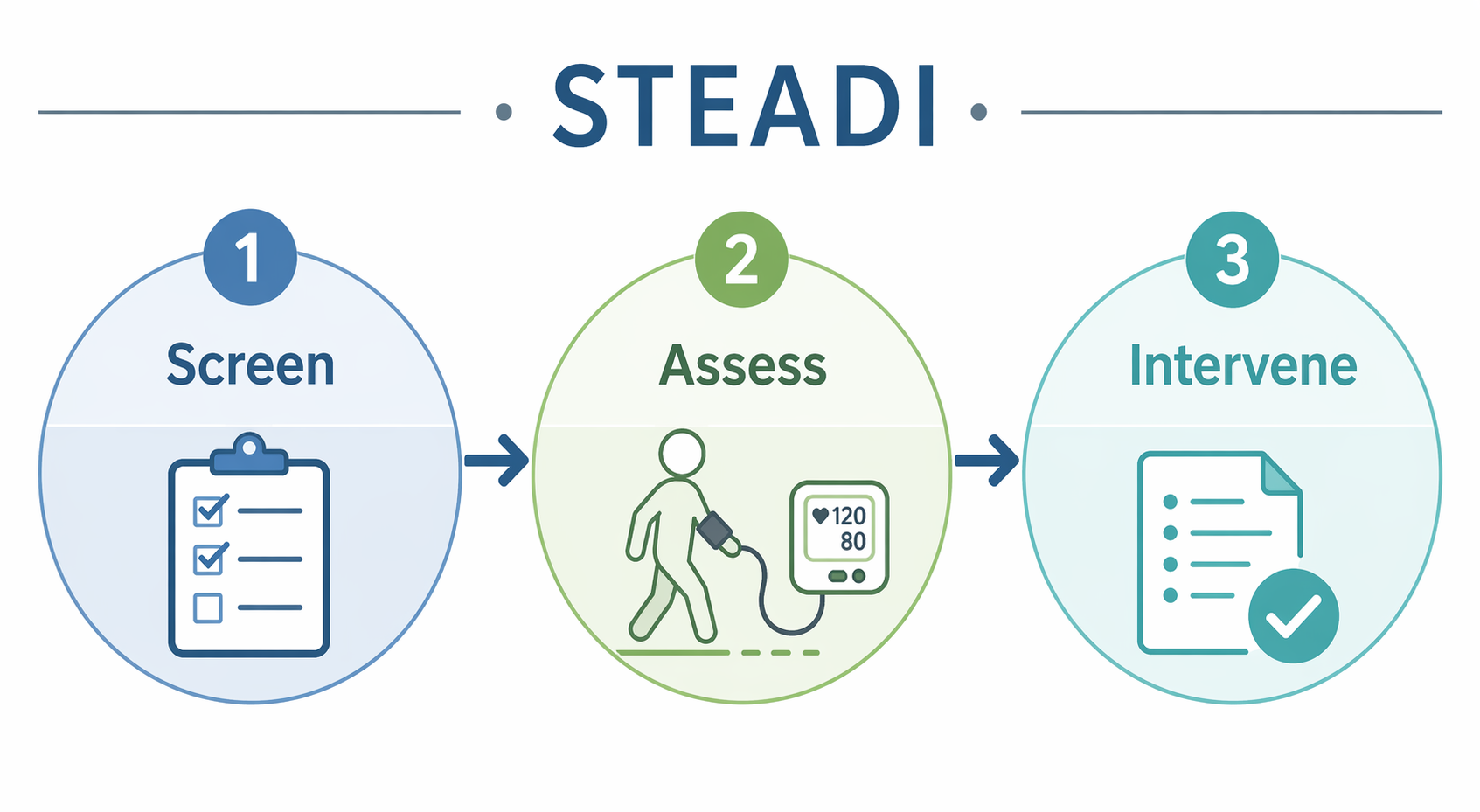
For a caregiver, the point is not to walk into the exam room and announce a treatment plan. The point is to keep the visit from stopping too early. A proper fall-risk conversation should not end with “use your cane” or “watch the stairs.” It should move through a screen, then an assessment of the positive findings, then a written plan for what happens next.
| STEADI step | What it means in the visit | What a caregiver can ask |
|---|---|---|
| Screen | The clinician checks whether your parent is at increased risk for falls. | “Can we do a fall-risk screen today? She had a fall recently and has been less steady.” |
| Assess | The clinician looks for reasons behind the risk, such as gait, balance, blood pressure changes, medications, vision, or home hazards. | “If the screen is positive, what are we checking to understand why?” |
| Intervene | The clinician documents next steps, referrals, follow-up, and responsibilities. | “Can we leave with a written Fall Plan of Care?” |
Before the Visit, Bring the Evidence Your Parent May Not Volunteer
Preparation does not need to become a family investigation. What helps most is a short, factual account of what changed. The doctor needs to know whether there was a fall, a near-fall, a new fear of falling, a change in walking, or a new pattern of avoiding ordinary activities.
Write down the events in plain language. “Fell while turning from the toilet to the sink.” “Nearly fell getting out of bed.” “Stopped using the front steps.” “Says the room spins when standing.” “Started a new blood pressure medicine before the dizziness began.” These details are more useful than a general statement that your parent is “getting weaker.”
- Falls, near-falls, or times your parent had to grab furniture or a wall to stay upright
- Whether the fall involved dizziness, faintness, pain, rushing to the bathroom, poor lighting, footwear, alcohol, or a missed assistive device
- Medication changes, especially blood pressure medicines, sleep aids, sedating medicines, or anything started shortly before the unsteadiness
- Vision changes, foot pain, numbness, weakness, or new difficulty rising from a chair
- What your parent says they have stopped doing because they are afraid of falling
If you are new to caregiving and this is one of the first medical visits where you are stepping in, it can help to read a broader orientation such as the first 30 days caregiver guide. The fall-risk visit still needs its own focus, but it usually sits inside a larger shift in family responsibility.
During the Visit, Say the Fall Out Loud
A parent may minimize the fall for understandable reasons. They may be embarrassed, afraid of losing independence, or convinced that one fall “doesn’t count.” The doctor may also be moving quickly through the visit agenda. That combination is how the most important fact can stay invisible.
Use direct, neutral language early. “Before we move on, I need to mention that Mom fell in the bathroom last month.” Or: “Dad has not fallen to the ground, but he has had several near-falls and is now avoiding the stairs.” Then stop talking long enough for the clinician to respond. The goal is not to take over the appointment. It is to make sure the risk is on the clinical agenda.
If the clinician does not start a fall-risk screen, ask for one. The CDC STEADI materials describe screening tools and clinical checks that can be used in primary care, including the Stay Independent checklist, the Timed Up and Go test, orthostatic blood pressure, and medication review in the Annual Wellness Visit context.[2]
Screening Questions to Ask Without Sounding Like You Are Diagnosing
- “Can we complete a fall-risk screen today, such as the Stay Independent checklist or your clinic’s usual tool?”
- “Should we do a gait and balance check, such as a Timed Up and Go test?”
- “Can you check blood pressure sitting and standing? She gets lightheaded when she stands.”
- “Can someone review whether any of these medicines could be contributing to dizziness, sedation, or low blood pressure?”
- “Does his vision, footwear, foot pain, or walking aid need to be evaluated as part of this?”
Those questions work because they name clinical tasks, not conclusions. You are not saying, “This medication is the cause,” or “Her balance problem is neurological.” You are asking the clinician to check the categories that commonly belong in a fall-risk assessment.
If the Screen Is Positive, Do Not Let the Visit Stop There
A positive screen should lead to the next step. In STEADI, screening identifies risk; assessment looks for the reasons behind that risk; intervention turns the findings into action.[2] This distinction matters in real appointments. A parent can screen positive because of poor balance, medication side effects, dizziness on standing, vision problems, unsafe footwear, pain, weakness, home hazards, or several of these at once.
The caregiver’s job is to ask what is being assessed, not to demand that every possible test happen in one visit. A rushed clinic may need to split the work across referrals, follow-up appointments, pharmacy review, physical therapy, occupational therapy, or vision care. That can still be a real plan if the next steps are documented and assigned.
| Concern raised in the visit | Assessment or next step to ask about |
|---|---|
| Unsteady walking or slow rising from a chair | Gait and balance testing; physical therapy referral |
| Lightheadedness when standing | Orthostatic blood pressure check; medication and hydration review |
| Multiple prescriptions or recent medication changes | Medication review for fall-risk-increasing drugs |
| Vision changes or trouble seeing steps and thresholds | Vision evaluation or eye-care follow-up |
| Difficulty bathing, toileting, dressing, or moving around the home | Occupational therapy referral and home-safety evaluation |
| Fear of falling or reduced activity | Evidence-based exercise or balance program referral |
Some families will discover at this point that fall risk is part of a bigger care decision. If the assessment suggests your parent may not be safe alone for long stretches, the next conversation may be about supervision, paid help, or whether the fall pattern signals a need for 24/7 home care. That is a hard turn, but it is better made from a documented assessment than from family arguments in the hallway.
Leave With a Fall Plan of Care
This is the part I would not leave to memory. A Fall Plan of Care is the practical endpoint of the visit: what was found, what will be done, who is responsible, and when follow-up happens. “Be careful” is not a plan. “Use the walker” may be advice, but it is incomplete if no one checks whether the walker fits, whether your parent will actually use it, and whether the bathroom still requires a dangerous turn.
The evidence is strong enough to take this seriously, but not so strong that it should be treated like a promise. In a New York health system STEADI implementation, 90% of older patients were screened for fall risk at least once, 61% of at-risk patients received a Fall Plan of Care, and patients with a plan were 0.6 times less likely to have a fall-related hospitalization.[3] That is a meaningful association in a real health system. It does not mean paperwork itself prevents every fall. It means documented care planning appears to matter.
Before leaving, ask to see or receive the plan in the after-visit summary, patient portal, referral paperwork, or written instructions. If the clinic uses different language, that is fine. The important question is whether the plan is specific enough for someone at home to act on.
- Referral to physical therapy for strength, gait, or balance work
- Referral to occupational therapy for daily activities, bathroom safety, transfers, or home function
- Medication follow-up with the prescribing clinician or pharmacist
- Plan for orthostatic blood pressure, dizziness, vision, foot problems, or pain that may be contributing to falls
- Recommendation for an evidence-based exercise or balance program
- Home modification or home-safety referral when the environment is part of the risk
- A follow-up date or clear instruction for when to report another fall, near-fall, medication problem, or new symptom
For home changes, the doctor’s plan may be the bridge to the next layer of work. A clinical note can help justify an occupational therapy evaluation, equipment discussion, or a more systematic review of priorities like entries, bathrooms, stairs, lighting, and transfer points. For that broader work, use a separate aging-in-place home modification priority guide instead of trying to turn the medical appointment into a room-by-room inspection.
Ask About Programs, Not Just Exercises
A clinician may recommend “exercise,” but families need to know what kind and where it happens. STEADI’s intervention step can include referrals to community programs, PT or OT, medication management, and home modifications.[2] The community connection is where plans often become fragile: the doctor says the right thing, but no one knows which program exists locally, whether transportation is possible, or who is supposed to make the call.
Ask whether your parent is appropriate for evidence-based fall prevention programs such as Stepping On, Otago, or Tai Chi for Arthritis. The National Council on Aging and CDC community prevention materials identify evidence-based falls prevention programs and community interventions that can support older adults outside the clinic.[5][6]
The useful question is not “Should Mom exercise?” It is “Which program or referral fits her risk, mobility, transportation, and willingness to participate?” A parent who is afraid to fall may need supervised physical therapy before a group class. Another parent may do well in a community balance program if someone helps with registration and rides for the first few weeks.
If you are trying to understand what services might support your parent after the assessment, a broader aging-in-place services guide can help you sort clinical, home-based, transportation, and community supports without mixing them all into one appointment.
Where Medicare Fits Into the Conversation
Medicare coverage should not be the first thing you talk about in the exam room, but it affects what families can actually do next. Fall risk screening is available at no cost during the Welcome to Medicare visit and Annual Wellness visits. Physical therapy, occupational therapy, and durable medical equipment may be covered when medically necessary.[4]
Medicare Advantage plans may offer supplemental benefits related to fall prevention, but those details vary by plan and year.[4] Ask the clinic what is being ordered and why, then check the plan’s current benefit documents or call the plan before assuming that a grab bar, walker, home assessment, or community program will be covered.
For families trying to place this visit inside a larger budget, senior health care cost context for 2026 may help. The key inside the appointment is still clinical: get the risk assessed and the medically necessary next steps documented.
If You Cannot Attend the Appointment
Long-distance caregivers have a harder version of the same problem. You may know about the fall because a neighbor called, while the parent insists it is not worth mentioning. If you cannot be in the room, send a short note through the patient portal before the visit if your parent has authorized access. Keep it factual and brief: what happened, when it happened, what changed afterward, and what you are asking the clinician to address.
If portal access is not available, ask your parent to bring a printed note, or ask whether the clinic can receive caregiver information before the visit. Privacy rules may limit what the clinic can tell you without permission, but they generally do not prevent you from giving the clinic relevant information. The clinician still has to make their own assessment; your role is to make sure the fall history reaches the person doing it.
After the Visit, Track the Plan Like Any Other Medical Order
A Fall Plan of Care can fail quietly after the appointment. The referral is placed, but no one schedules. The medication review is recommended, but the prescribing specialist is never contacted. The home modification is discussed, but the family argues for weeks about whether it is necessary. This is where caregivers often become project managers, whether anyone names that role or not.
- Confirm that referrals were actually sent.
- Schedule PT, OT, pharmacy, vision, or follow-up appointments before the paper disappears.
- Put the plan in one shared place, especially if siblings or paid caregivers are involved.
- Ask your parent what part of the plan they are willing to start first.
- Report new falls, near-falls, dizziness, medication side effects, or refusal to use equipment back to the clinician.
This is also the point where families may need shared vocabulary. “Aging in place” can mean very different things to a parent, an adult child, a clinician, and an insurance plan. A plain aging-in-place glossary can reduce some of that confusion, but it does not replace the medical plan.
A Caregiver’s Realistic Boundary
You cannot perform a clinical fall risk assessment from the passenger seat, and you cannot guarantee that every fall will be prevented. You also cannot force a proud parent to describe every embarrassing stumble exactly as it happened.
What you can do is close a known communication gap. Say the fall or near-fall out loud. Ask whether the visit is moving through Screen, Assess, and Intervene. Leave with a documented plan that names referrals, follow-up, and responsibility. That is a more useful standard than a warning everyone forgets by the parking lot.
References
- About STEADI, CDC.
- STEADI - Older Adult Fall Prevention, CDC.
- Implementation of the Stopping Elderly Accidents, Deaths, and Injuries Initiative in Primary Care: An Outcome Evaluation, The Gerontologist, 2019.
- Does Medicare Cover Fall Prevention?, Healthline.
- Evidence-Based Falls Prevention Programs, National Council on Aging.
- Community-Based Fall Prevention Programs, CDC.
Related reading
Noticed something outdated or inaccurate on this page? Flag a correction. We review every report against CDC, NIA, and AARP HomeFit guidance before updating a page.
Part of the Fall Prevention section.