
Bathroom Remodel for Elderly Safety: Why 40% of Repeat Fallers Have No Modifications and How to Close the Gap
A peer-reviewed study reveals that 40% of older adults who have fallen repeatedly have no bathroom safety modifications, with stark racial disparities. This article examines the evidence gap and provides actionable steps for families and healthcare professionals.
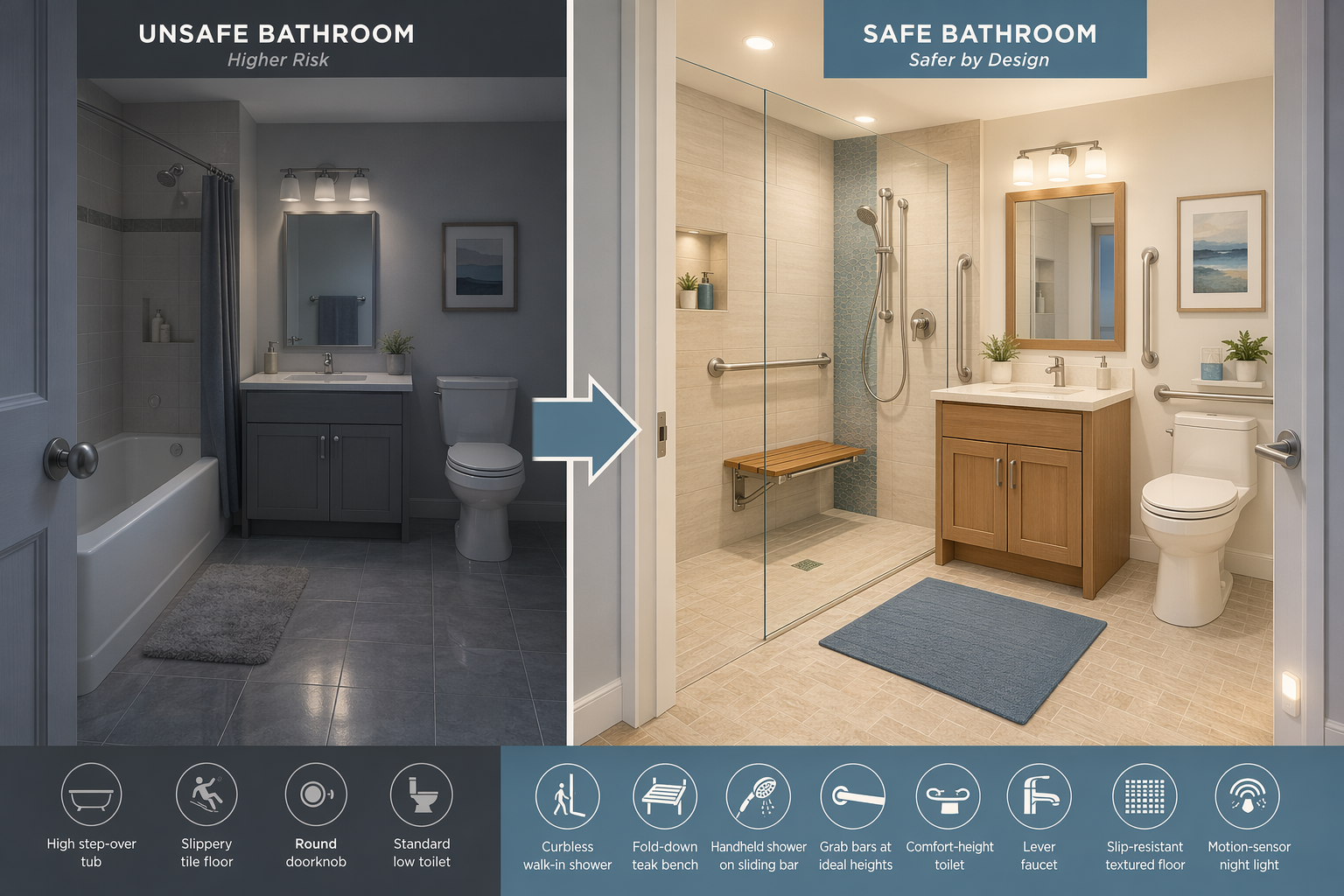
The Bathroom Fall Problem: More Than a Statistic
Every year, more than one in four older adults falls. The CDC reports that falling once doubles the chances of falling again, and these incidents lead to roughly 3 million emergency department visits and about 1 million hospitalizations annually. While the numbers are staggering, they often obscure a more troubling pattern: where falls happen and who is protected when they do.
Roughly 50 to 60 percent of falls occur inside the home, and the bathroom is consistently identified as one of the highest-risk zones. Wet surfaces, hard flooring, low toilet heights, and the need to transfer in and out of a tub or shower create a perfect storm of hazards. The standard response from safety advocates has been to recommend grab bars, shower seats, non-slip flooring, and better lighting. Yet a 2022 peer-reviewed study published in the Journal of the American Geriatrics Society reveals a stark disconnect between what the evidence recommends and what actually exists in the homes of older adults who have already fallen.
Researchers analyzed data from 2,404 Medicare beneficiaries aged 65 and older who had experienced at least one fall, drawn from the 2016 Medicare Current Beneficiary Survey. They found that only 55.5 percent of these individuals had any bathroom modifications — either grab bars or a shower seat. That means 44.5 percent of older adults who had already fallen had no bathroom safety equipment at all. This is not a problem of ignorance about what works; it is a problem of access, awareness, and systemic gaps in how home safety resources are distributed.
This article does not rehash the general room-by-room checklist or the phased cost guide already available on this site. Instead, it focuses on a specific, data-driven question: who is being left behind, and why? The answers — drawn from the Ng et al. study and supporting research — point to a crisis of equity and a clear call to action for families and healthcare professionals alike.
The Repeat-Faller Gap: 1.9 Million People Without Protection
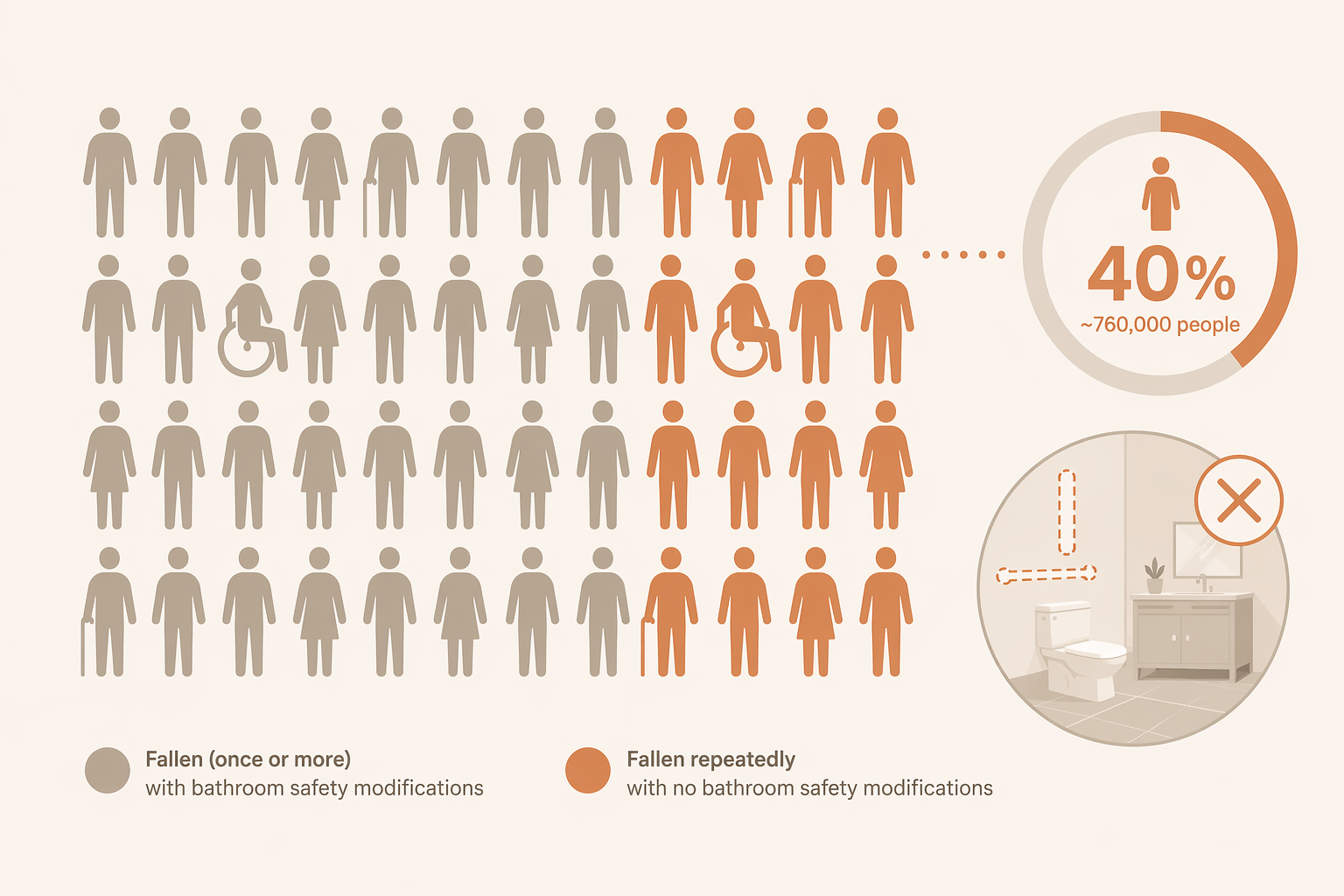
The most alarming finding from the study concerns those at the highest risk: repeat fallers. Among the 50.1 percent of the sample who had experienced two or more falls, a full 40.2 percent had no bathroom modifications whatsoever. Extrapolated to the national Medicare population, that represents approximately 1.9 million older adults who have fallen repeatedly and still lack basic bathroom safety equipment.
This is a critical gap because the clinical trajectory of falls is not linear. A single fall often marks the beginning of a downward spiral. The CDC notes that falling once doubles the risk of falling again, and each subsequent fall carries a higher probability of serious injury, hospitalization, and loss of independence. The bathroom, where slippery surfaces and awkward transfers are unavoidable, becomes a recurring danger zone.
The study's finding that 40.2 percent of repeat fallers have no modifications suggests that the current system for delivering home safety interventions is failing the very people who need them most. A single fall should trigger a home safety assessment and modification plan. Instead, the data shows that millions of older adults are falling, falling again, and still navigating bathrooms without the most basic protective equipment.
Racial and Ethnic Disparities in Bathroom Modifications
The Ng et al. study also uncovered stark racial and ethnic disparities that demand attention. After controlling for demographic, health, and socioeconomic factors, non-Hispanic Black beneficiaries had 62 percent lower odds of having bathroom modifications compared to non-Hispanic White beneficiaries (odds ratio 0.38, p < 0.001). Hispanic beneficiaries had 36 percent lower odds (odds ratio 0.64, p = 0.039).
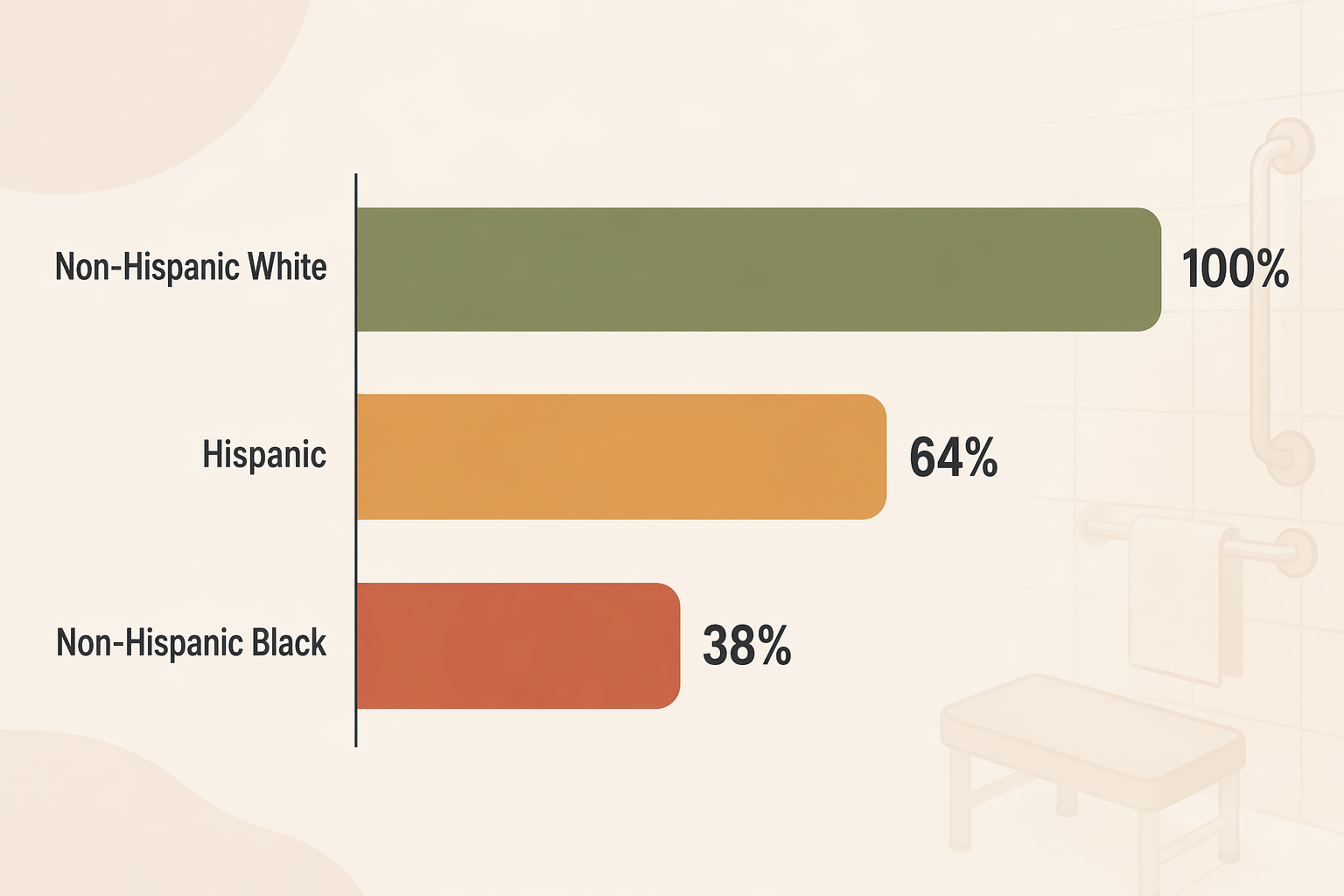
These disparities are not explained by differences in fall frequency or health status alone. The study controlled for age, sex, education, income, urban/rural residence, number of falls, ADL limitations, and chronic conditions. The persistence of the disparity after accounting for these factors points to deeper systemic barriers.
What Drives the Disparity?
While the study did not directly measure the causes of the disparity, the research literature and community health data suggest several contributing factors:
- Housing stock and rental limitations: Older adults in rental housing often cannot make structural modifications without landlord permission. Minority communities are disproportionately represented in rental housing, and landlords may resist installing grab bars or modifying bathrooms.
- Access to culturally competent information: Fall prevention messaging and home modification resources may not reach communities where English is not the primary language, or where healthcare communication has historically been mistrusted.
- Financial barriers: Even with Medicare coverage for some durable medical equipment, the out-of-pocket costs for bathroom modifications — grab bars, shower seats, non-slip flooring — can be prohibitive for households with limited disposable income.
- Healthcare system bias: Studies have documented disparities in how fall risk assessments and home safety recommendations are communicated to patients of different racial and ethnic backgrounds. If a physician does not explicitly recommend a grab bar or shower seat, the modification is far less likely to be installed.
Who Gets Modifications? The Conditions That Predict Action
Understanding who currently has bathroom modifications — and why — provides a roadmap for closing the gap. The Ng et al. study identified several conditions and experiences that are associated with higher odds of having modifications. These findings can help families and healthcare professionals identify individuals who are most likely to benefit from an intervention.
The Dose-Response Relationship of ADL Limitations
The strongest predictor of having bathroom modifications was the number of activities of daily living (ADL) limitations an individual experienced. The relationship followed a clear dose-response pattern: as functional limitations increased, so did the likelihood of having modifications. This makes intuitive sense — people who have more difficulty with bathing, toileting, and transferring are more likely to seek out or be prescribed safety equipment.
| Number of ADL Limitations | Odds Ratio (OR) | Interpretation |
|---|---|---|
| 1–2 ADLs | 2.11 (p < 0.001) | More than double the odds of having modifications vs. no ADL limitations |
| 3–4 ADLs | 3.73 (p < 0.001) | Nearly 4x the odds |
| 5–6 ADLs | 4.72 (p < 0.001) | Nearly 5x the odds — the strongest predictor in the study |
This finding has a practical implication: families should not wait until an older adult has significant functional decline before installing bathroom modifications. The data shows that people with even one or two ADL limitations are already at elevated risk, yet many of them do not have modifications. Proactive installation — before a crisis occurs — is far more effective than reactive installation after a fall.
Fear of Falling as a Driver of Action
Fear of falling was also associated with higher odds of having modifications, but the relationship was incremental. Compared to those with no fear of falling:
- Moderate fear: OR 1.44 (p = 0.011) — 44% higher odds of having modifications.
- Very/extreme fear: OR 1.55 (p = 0.007) — 55% higher odds.
Fear can be a motivator, but it is an unreliable one. Many older adults underreport their fear of falling or normalize it as a part of aging. The data suggests that by the time fear becomes "very" or "extreme," the person has likely already experienced significant functional decline or a serious fall. Relying on fear as a trigger for action means waiting until the problem is acute.
Medical Conditions That Predict Modification Need
Two specific medical conditions were independently associated with higher odds of having bathroom modifications:
- Myocardial infarction (heart attack): OR 1.43 (p = 0.020). A history of heart attack was associated with 43% higher odds of having modifications. This may reflect post-cardiac rehabilitation home safety assessments or greater engagement with the healthcare system.
- Urinary incontinence: OR 1.29 (p = 0.039). Incontinence was associated with 29% higher odds of having modifications. The need for frequent, urgent bathroom trips — especially at night — increases fall risk, and this may prompt families or clinicians to install safety equipment.
These findings highlight a pattern: the healthcare system tends to respond to acute events (a heart attack, a fall, a diagnosis of incontinence) rather than preventing them. The goal should be to identify individuals with these risk factors and install modifications before a fall occurs.
What the Evidence Says Works: Grab Bars and Shower Seats
The Ng et al. study defined bathroom modifications as the presence of either grab bars or a shower seat — two interventions with a strong evidence base. This is not an arbitrary choice. Multiple peer-reviewed studies, including work by Bakk et al. and Gitlin et al., have demonstrated that these two modifications are among the most effective for reducing bathroom fall risk.
Grab bars provide stable support during the most dangerous bathroom activities: stepping into and out of a tub or shower, rising from the toilet, and maintaining balance on wet surfaces. Shower seats reduce the need to stand on a slippery surface, which is the single most hazardous activity in the bathroom. Together, they address the two primary mechanisms of bathroom falls: loss of balance during transfer and loss of footing on wet surfaces.
The study's finding that only 55.5 percent of fall-experienced beneficiaries had these two basic modifications suggests that even the most well-supported interventions are underutilized. The gap is not about a lack of effective tools; it is about a failure to deliver those tools to the people who need them.
Closing the Gap: Action Steps for Families and Healthcare Professionals
The evidence is clear: bathroom modifications reduce fall risk, yet millions of older adults — especially repeat fallers and people of color — lack even the most basic protections. Closing this gap requires action at multiple levels. Here are concrete steps for families and healthcare professionals.
For Families
- Initiate the conversation proactively. Do not wait for a fall. If your parent has any ADL limitations, a history of heart attack, or urinary incontinence, the time to install grab bars and a shower seat is now. Use the data from this study as a conversation starter: "The research shows that people with your health history are much more likely to need bathroom modifications."
- Assess the bathroom yourself. Look for the hazards identified in the study: no grab bars near the toilet or shower, no shower seat, slippery flooring, low toilet height, poor lighting. Our Bathroom Safety Checklist for Seniors provides a zone-by-zone assessment tool.
- Find culturally competent contractors. If your family is part of an underserved community, seek contractors who understand the specific needs and preferences of your cultural context. Area Agencies on Aging can often provide referrals.
- Explore funding sources. Medicaid waivers, VA grants (SAH and HISA), and nonprofit programs like Rebuilding Together can cover some or all of the cost of bathroom modifications. Do not assume you cannot afford it until you have explored these options.
For Healthcare Professionals
- Screen for bathroom modification status as part of every fall risk assessment. A simple question — "Do you have grab bars in your shower or near your toilet?" — can identify the gap. The CDC STEADI model recommends this as part of the intervention step.
- Be aware of the disparity. Non-Hispanic Black and Hispanic patients are significantly less likely to have bathroom modifications. Explicitly ask about home safety and offer resources in the patient's preferred language.
- Write a prescription for home modifications. In many healthcare systems, a physician's recommendation for a grab bar or shower seat can trigger insurance coverage or referral to an occupational therapist for a home assessment.
- Connect patients to community resources. Area Agencies on Aging, local chapters of Rebuilding Together, and faith-based organizations often provide free or low-cost home modification services for underserved populations.
The Bottom Line: Why This Gap Matters
Home modifications are not a luxury. They are a proven, cost-effective intervention that can provide an additional 5 to 10 years of independent living for older adults. Yet the data from Ng et al. reveals a system that is failing the people who need it most: 1.9 million repeat fallers without bathroom modifications, and stark racial disparities that leave Black and Hispanic older adults far less protected than their White counterparts.
Closing this gap is not just a matter of equity — though it is certainly that. It is a matter of preventing hundreds of thousands of additional falls, injuries, hospitalizations, and deaths. Every bathroom modification installed is a fall that does not happen, a hip that does not break, an emergency department visit that is not needed.
For families, the message is clear: do not wait for a second fall. For healthcare professionals, the message is equally clear: ask about bathroom modifications, especially for patients from underserved communities. And for policymakers, the data demands a systemic response — funding for home modification programs, culturally competent outreach, and policies that make it easier for older adults to age safely in place.
Related reading
Noticed something outdated or inaccurate on this page? Flag a correction. We review every report against CDC, NIA, and AARP HomeFit guidance before updating a page.
Part of the Fall Prevention section.