
Should My Aging Parent See an Occupational Therapist or a CAPS First? — A Fall Prevention Decision Guide
After a parent falls, many families call a contractor first. This guide explains why an occupational therapy home assessment should come before any home modifications, and how the OT-to-CAPS sequence leads to safer, more cost-effective outcomes.
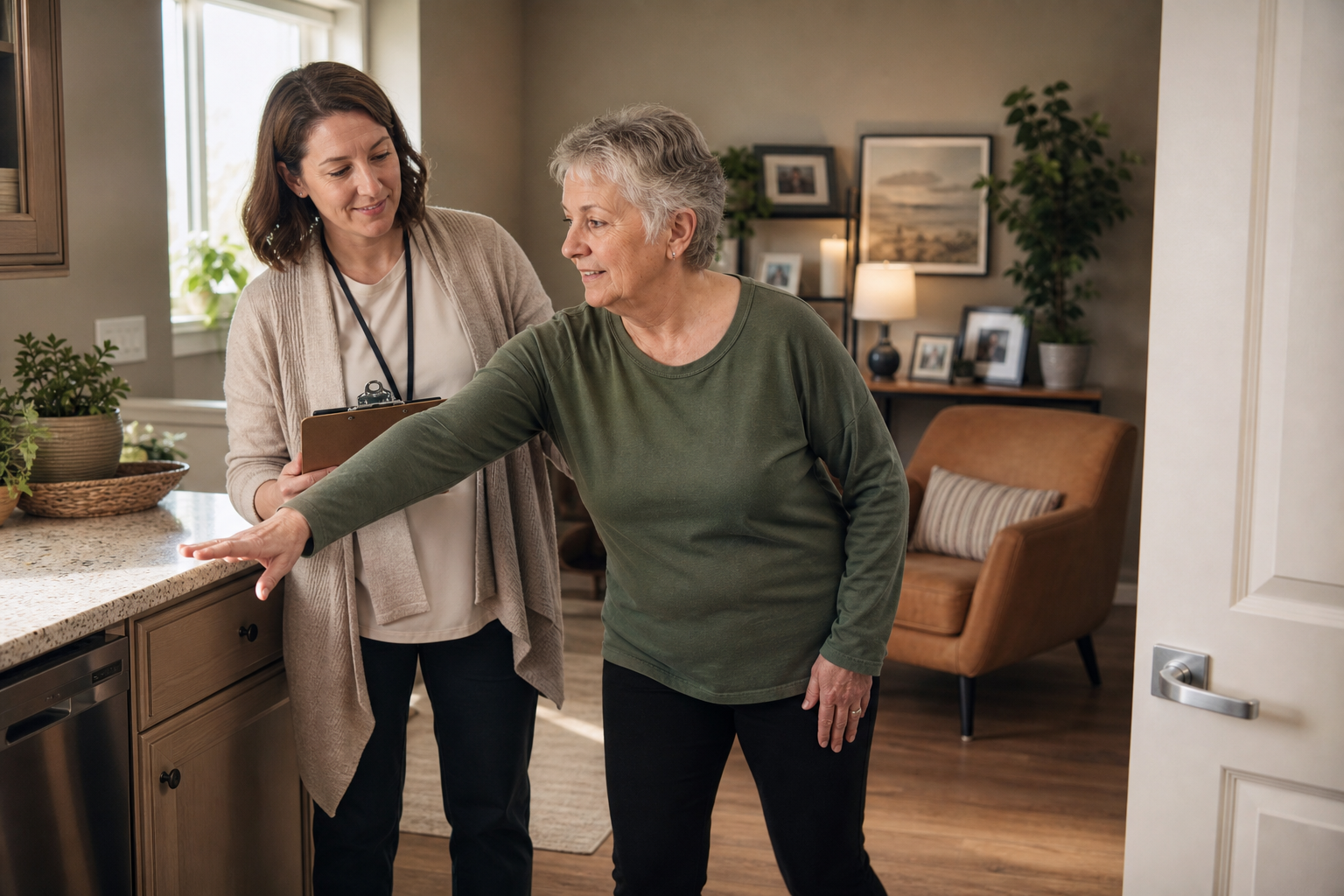
The Post-Fall Moment: Why the Wrong First Call Costs Time and Money
Your parent has just fallen. You are shaken, they are bruised, and the house suddenly feels like a minefield. In that moment, the instinct is to act — to call someone who can fix the environment. For most families, that means reaching out to a contractor or a Certified Aging-in-Place Specialist (CAPS) to install grab bars, add lighting, or widen doorways. It is a natural response, but it is often the wrong first move.
The problem is straightforward: a contractor or CAPS professional evaluates the house, not the person. They can tell you where a grab bar should go, but they cannot tell you whether your parent has the strength, balance, or cognitive awareness to use it safely. Without understanding the individual's functional limitations, you risk spending thousands of dollars on modifications that miss the real problem — or worse, create new hazards.
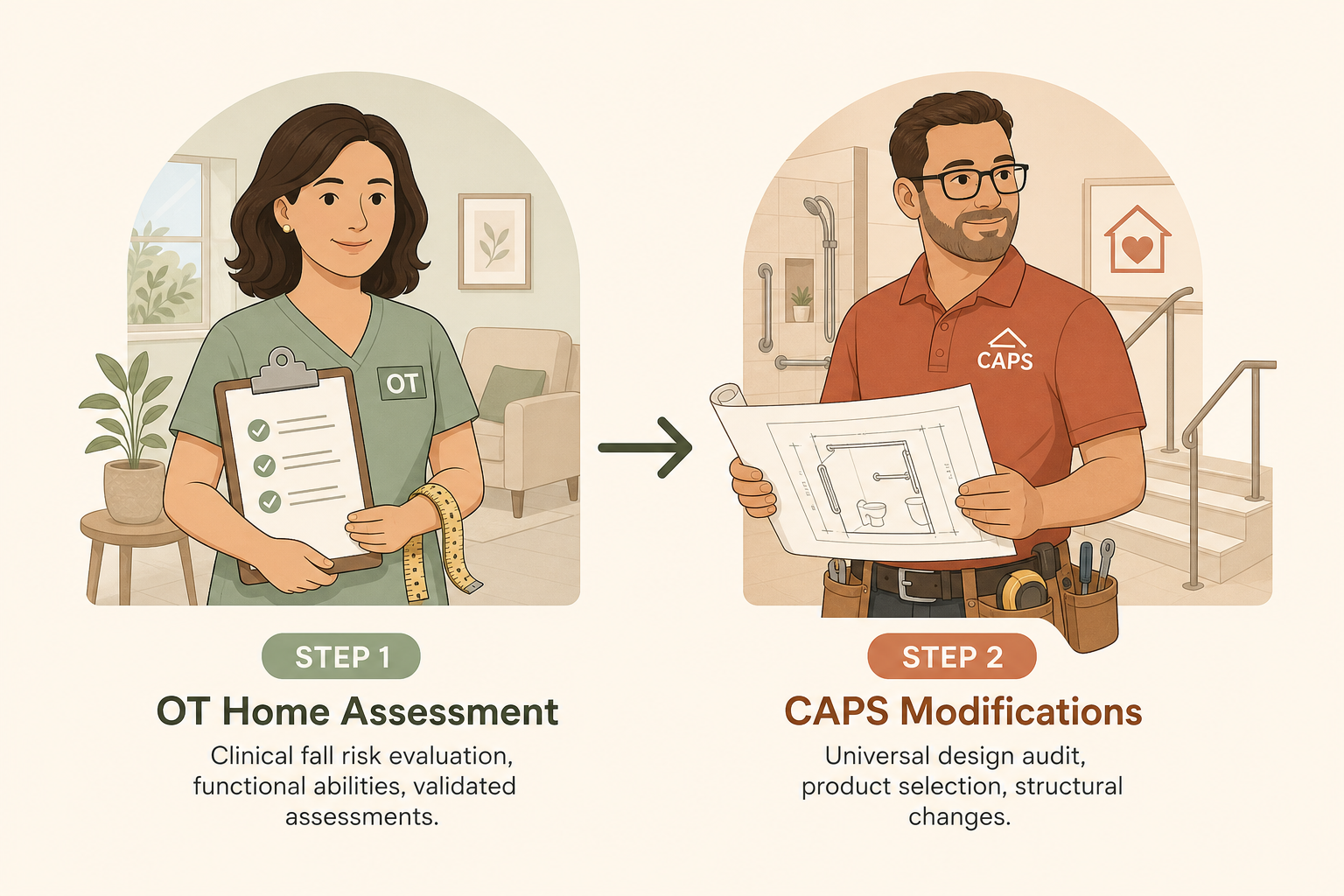
The correct sequence is clinical assessment first, then renovation. An occupational therapist (OT) evaluates the person's functional abilities, fall risk factors, and how they interact with their home. Only after that assessment should a CAPS professional design and execute the physical modifications. This article walks you through why that order matters, what each professional does, and how to find the right people for each step.
If you need immediate steps to take while you arrange professional assessments, start with our . It covers the quick fixes you can make tonight.
What an Occupational Therapy Home Assessment Actually Covers
An occupational therapist is a licensed healthcare professional trained to analyze how a person's physical, cognitive, and sensory abilities interact with their environment. When they conduct a home assessment, they are not simply checking for loose rugs and poor lighting. They are evaluating the person's capacity to perform daily activities safely.
OTs use validated clinical tools that CAPS professionals typically do not administer. These include:
- The Tinetti Performance-Oriented Mobility Assessment — evaluates gait and balance to quantify fall risk.
- The Falls Efficacy Scale — measures a person's confidence in performing daily activities without falling, which is a strong predictor of future falls.
- The Home Assessment Profile (HAP, Chandler et al., 2001) — a structured tool for identifying environmental hazards relative to the individual's functional status.
- The Home Environmental Assessment Protocol (HEAP, Gitlin et al., 2002) — assesses physical and social environmental factors that affect safety and independence.
- The Safety Assessment of Function and the Environment for Rehabilitation (SAFER-HOME, Chui et al., 2006) — evaluates person-environment fit across multiple domains.
These tools allow the OT to identify specific deficits — reduced lower-body strength, poor balance, vision changes, or cognitive decline — that a home inspection alone would never reveal. The OT then recommends interventions that address those deficits, which may include exercise programs, adaptive equipment, task modification strategies, and specific environmental changes.
What a CAPS Assessment Covers — and What It Misses
A Certified Aging-in-Place Specialist (CAPS) is a credential offered by the National Association of Home Builders (NAHB). The program consists of three courses covering marketing and communication, design concepts, and technical solutions for aging-in-place modifications. CAPS professionals are typically contractors, remodelers, or designers who have learned how to make homes safer and more accessible.
A CAPS assessment focuses on the physical structure of the home. Their evaluation typically includes:
- Universal design audit — checking door widths, threshold heights, turning radii, and lever-style handles.
- Product selection — recommending specific grab bars, shower seats, stair lifts, and ramps based on the home's layout.
- Structural feasibility — assessing load-bearing walls, electrical capacity, and plumbing for planned modifications.
- Cost estimation — providing detailed quotes for materials and labor.
What a CAPS assessment does not include is clinical evaluation. A CAPS professional is not trained to administer the Tinetti, the Falls Efficacy Scale, or any of the validated OT tools. They cannot assess whether your parent's medication regimen increases fall risk, whether their vision is adequate for safe navigation, or whether their cognitive decline requires different types of environmental cues.
For a detailed walkthrough of what a CAPS engagement looks like from start to finish, see our guide: .
Why the Sequence Matters: Clinical Data First, Then Renovation
The CDC STEADI (Stopping Elderly Accidents, Deaths & Injuries) model provides a clear framework: Screen, Assess, Intervene. The first two steps — screening for fall risk and assessing modifiable risk factors — are clinical activities. The intervention step may include environmental modifications, but only after the clinical picture is clear.
When you skip the clinical assessment and go directly to a CAPS, you are intervening without a diagnosis. The result is modifications that may be well-designed but poorly targeted. For example:
- Installing grab bars in the shower is useless if the person lacks the upper-body strength to use them — they need a strengthening program first.
- Widening doorways for wheelchair access is premature if the person's balance can be improved with physical therapy and a walker.
- Adding stair lighting does not address the underlying vision or vestibular issues that make stairs dangerous.
The OT-first, then CAPS sequence ensures that every dollar spent on modifications addresses an actual functional limitation. The OT provides the CAPS with a clinical roadmap: this person needs a roll-in shower because they cannot step over a 6-inch threshold, and they need a grab bar at 34 inches because their shoulder range of motion is limited. The CAPS then executes that roadmap with precision.
For a broader view of how fall prevention services fit together, see our .
The Evidence: What the CAPABLE Program Teaches Us
The strongest evidence for the OT-first model comes from the CAPABLE program (Community Aging in Place, Advancing Better Living for Elders). CAPABLE is a 4- to 5-month program that integrates an occupational therapist, a registered nurse, and a handy worker to help low-income older adults age in place safely.
The results are striking. Research from the CAPABLE National Center shows that the program provides more than a six-to-one return on investment: roughly $3,000 in program costs per participant yielded more than $30,000 in savings in medical costs. In a population of low-income older adults on Medicaid and Medicare, 75% of participants improved their self-care over five months. The program also reduced hospitalization and nursing home stays, improved medication management, strength, balance, mobility, and home safety.
The CAPABLE evidence directly supports the argument that combining clinical assessment with targeted home modifications produces better outcomes than modifications alone. It also demonstrates that the OT's role is not just assessment but also coaching — teaching the older adult how to use their environment safely and build strength and confidence.
For a deeper dive into how the CAPABLE program works and how to access it, read our full article: .
Real-World Case: Beth's Multi-Generational Home
To see how the OT-first, then CAPS sequence works in practice, consider the case of Beth, described in an occupational therapy and CAPS case study. Beth lived in a multi-generational home with her husband, her adult daughter, and her grandchildren. After a series of near-falls in the bathroom, the family was considering a full bathroom renovation.
An OT conducted a home assessment using validated tools and identified that Beth's primary limitations were reduced lower-body strength, impaired balance during transfers, and difficulty stepping over the existing bathtub threshold. The OT also noted that Beth's medication regimen included a diuretic that increased her urgency to reach the toilet quickly — a clinical factor no home inspection would have caught.
Based on the OT's recommendations, a CAPS professional designed a fully accessible bathroom with a roll-in shower, grab bars placed at the specific heights Beth needed, a raised toilet, and a turning radius of at least five feet for potential future wheelchair use. The modifications followed the seven principles of Universal Design (Mace, 1997) and were integrated into the home's existing aesthetic.
The result: Beth could bathe safely without assistance, her fall risk decreased, and the family avoided the cost of a more extensive renovation that would have addressed the wrong problems. The OT's clinical assessment ensured that every modification served a specific functional need.
How to Find an Occupational Therapist Who Does Home Assessments
Not all occupational therapists perform home assessments. You need to find one who specializes in home safety and fall prevention. Here is how to start:
- Search the American Occupational Therapy Association (AOTA) directory for practitioners who list home modifications or environmental assessment as a specialty.
- Ask your parent's primary care physician for a referral to an OT who does home safety evaluations — Medicare Part B often covers these assessments when ordered by a physician.
- Contact local home health agencies — many employ OTs who perform in-home assessments as part of their standard services.
- Look for OTs who also hold the CAPS credential — these professionals understand both the clinical and the construction side of aging in place.
When you contact a potential OT, ask these questions:
| Question | Why It Matters |
|---|---|
| Do you perform in-home fall risk assessments? | Some OTs only work in clinical settings and do not visit homes. |
| Which assessment tools do you use? | Look for mention of Tinetti, Falls Efficacy Scale, HAP, HEAP, or SAFER-HOME. |
| Do you provide a written report with recommendations? | You need documentation to share with a CAPS or contractor. |
| Do you coordinate with contractors or CAPS professionals? | An OT who works with builders will make the transition smoother. |
| What is your fee and does insurance cover it? | Medicare Part B may cover the assessment if ordered by a physician. |
The cost of a home safety assessment by an OT typically ranges from $300 to $1,000, depending on your location and the complexity of the evaluation. Some of this cost may be covered by Medicare or private insurance if the assessment is deemed medically necessary.
How to Find a CAPS Who Works Collaboratively with OTs
Once you have the OT's assessment report, you need a CAPS professional who can execute the recommendations. The key is finding someone who understands the value of the clinical assessment and is willing to work from the OT's roadmap.
Here are green flags to look for:
- The CAPS asks whether you have an OT assessment report before providing a quote.
- They have experience collaborating with OTs and can describe past projects where they worked from clinical recommendations.
- They are willing to adjust their design based on the OT's specific measurements and recommendations.
- They provide a detailed written estimate that aligns with the OT's recommendations.
And red flags to watch for:
- The CAPS offers to conduct a "fall risk assessment" without any clinical credentials.
- They dismiss the need for an OT evaluation and insist they can handle everything.
- They recommend a standard package of modifications without asking about the person's specific abilities or medical history.
- They pressure you to sign a contract immediately.
Checklist: What to Ask Each Professional Before Hiring
Use this checklist to evaluate both the OT and the CAPS before you commit to working with them. Print it out, take it to your consultations, and compare responses.
| For the Occupational Therapist | For the CAPS Professional |
|---|---|
| Do you have experience with geriatric fall prevention? | Do you have experience working from OT assessment reports? |
| Which validated assessment tools do you use? | Can you provide references from past aging-in-place projects? |
| Will you provide a written report with specific recommendations? | Do you provide a detailed written estimate with itemized costs? |
| Do you coordinate with contractors or CAPS professionals? | Are you willing to adjust your design based on the OT's recommendations? |
| What is your fee and is it covered by insurance? | What is your fee structure — hourly, flat rate, or percentage of project cost? |
| How long does the assessment take? | How long will the modifications take to complete? |
| Do you offer follow-up visits to evaluate the effectiveness of modifications? | Do you handle permits and inspections? |
For a complete cost breakdown of common home modifications and what to expect financially, see our . And for a broader framework on building an aging-in-place services plan, visit our .
The post-fall moment is stressful, but it is also an opportunity to make decisions that will keep your parent safe for years to come. Start with the clinical assessment. Let the OT identify the real problems. Then bring in the CAPS to solve them. That sequence — clinical first, renovation second — is the difference between modifications that look right and modifications that actually work.
Related reading
Noticed something outdated or inaccurate on this page? Flag a correction. We review every report against CDC, NIA, and AARP HomeFit guidance before updating a page.
Part of the Fall Prevention section.