
How an Aging-in-Place Specialist Prevents Falls: Evidence, Modifications, and When to Call One
Generic fall prevention lists aren't enough. Learn how a Certified Aging-in-Place Specialist (CAPS) provides an individualized, evidence-based home assessment to reduce fall risk — backed by research showing modified homes can cut falls by nearly 40% and hospitalizations by 3% per quarter.
The Fall Problem: Why Generic Lists Aren't Enough
Every year, 14 million older adults — roughly one in four Americans aged 65 and older — experience a fall. That is not a statistic from a single study; it is the CDC's baseline finding, repeated across multiple surveillance cycles. In 2021 alone, falls caused 38,000 deaths in this age group and sent 3 million people to emergency departments. The financial toll is staggering: non-fatal falls cost the U.S. healthcare system $80 billion annually as of 2020, with 67% of that burden falling on Medicare.
These numbers are projected to worsen. Researchers estimate that by 2030, the annual cost of treating fall injuries among older adults will exceed $101 billion. The average inpatient stay for a fall-related injury costs $18,658; a single emergency department visit averages $1,112. And falling once doubles the risk of falling again.
Confronted with these numbers, most family caregivers do what any reasonable person would do: they search online for a fall prevention checklist. They print out a list of tips — remove throw rugs, install grab bars, improve lighting — and try to apply it to their parent's home. This approach is not wrong, but it is incomplete. A generic checklist cannot account for the specific way a person moves through their own home, the particular balance challenges they face, or the subtle environmental hazards that a standardized list might miss. It is a starting point, not a solution.
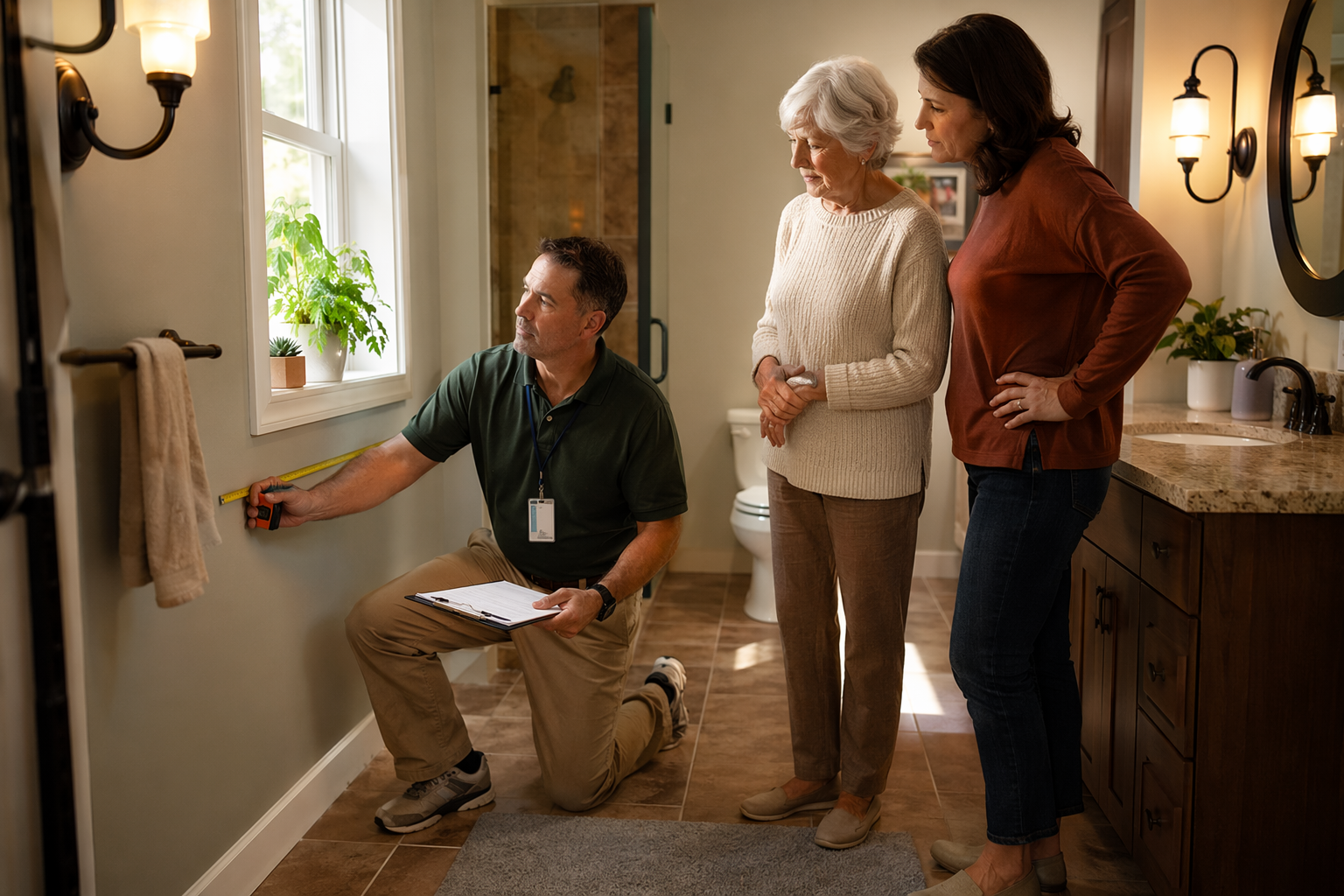
This is where a Certified Aging-in-Place Specialist (CAPS) enters the picture. Unlike a printable checklist, a CAPS professional conducts an individualized, evidence-based home assessment that targets the specific environmental hazards responsible for the majority of senior falls. The difference is not just thoroughness — it is a fundamentally different approach to the problem.
What Makes a CAPS Assessment Different from a DIY Checklist
A DIY checklist asks a single question: "Is this hazard present?" A CAPS assessment asks a more complex set of questions: "How does this person move through this space? What are their specific balance, strength, and vision limitations? Which environmental features pose a risk for this individual, given their unique functional profile?"
To answer these questions, CAPS professionals use standardized assessment tools that go far beyond a printed list. Two of the most common are:
- The Housing Enabler — a validated instrument that evaluates the fit between a person's functional capacity and their physical environment. It scores barriers room by room and generates a prioritized list of modifications based on the individual's specific needs.
- The Westmead Home Safety Assessment — originally developed for occupational therapy use, this tool systematically evaluates fall hazards across the home, with particular attention to the bathroom, stairs, and bedroom — the three most common locations for falls.
These tools allow a CAPS to identify hazards that a checklist would miss. For example, a checklist might say "install grab bars in the shower." A CAPS assessment would determine the exact placement, angle, and load rating of those grab bars based on the older adult's height, reach, balance, and typical transfer patterns. A checklist might say "improve hallway lighting." A CAPS would measure the actual foot-candle levels at floor height and recommend specific fixture types and placements to eliminate shadow patterns that can cause missteps.
The assessment itself typically costs between $300 and $1,000, depending on the size of the home and the complexity of the evaluation. Hourly consultation rates range from $75 to $200 per hour. For context, a single fall-related emergency department visit costs $1,112 on average, and an inpatient stay costs $18,658. The assessment is, in most cases, a fraction of the cost of the fall it may prevent.
The Evidence: What Research Says About CAPS-Guided Modifications
The case for CAPS-guided home modifications is not theoretical. A 2025 systematic review of 20 studies on home modifications for aging in place found that 13 of those studies — 65% — confirmed the effectiveness of home modifications in reducing falls, improving functional independence, and generating cost savings. The review identified bathroom modifications, grab bars, and stair railings as the most consistently impactful interventions across all studies.
The population-level data is particularly compelling. A 2022 UK study tracking 657,536 older adults found that home adaptations reduced fall-related emergency admissions by 3% per quarter. That may sound modest, but at scale it translates to thousands of prevented hospitalizations and millions in avoided healthcare costs.
Program-level results are even more striking:
- The Safe at Home program (2024) reported that 79% of participants had no falls after completing their home modifications. Fear of falling also decreased significantly, as measured by the Falls Efficacy Scale (FES).
- The Home Hazards Removal Program (HARP) found that home modifications reduced falls by 39% in the experimental group compared to the control group.
- A 2019 study by Carnemolla et al. found that home modifications reduced weekly care hours by 42%, with informal care dropping by 46% and formal care by 16%.
The cost-effectiveness data is equally persuasive. A New Zealand modeling study (Wilson et al., 2017) found that home modifications were cost-effective at NZD $5,480 per quality-adjusted life year (QALY) — well below the threshold typically used to determine whether a health intervention provides good value.
Room-by-Room: What a CAPS Will Recommend (and What It Costs)
After completing the assessment, a CAPS will provide a prioritized list of modifications tailored to the older adult's specific needs and the home's existing layout. While every plan is individualized, certain modifications appear consistently across CAPS recommendations because they address the most common fall hazards.
The table below summarizes the most frequently recommended modifications, organized by room, along with typical cost ranges. These figures are based on industry data from the National Association of Home Builders and CAPS practitioner surveys.
| Room / Area | Recommended Modification | Typical Cost Range |
|---|---|---|
| Bathroom | Grab bars (toilet and shower) | $100 – $300 |
| Bathroom | Walk-in tub or curbless shower | $5,000 – $15,000 |
| Bathroom | Raised toilet seat or comfort-height toilet | $150 – $500 |
| Bathroom | Non-slip flooring | $500 – $2,000 |
| Stairs | Handrails on both sides | $200 – $600 |
| Stairs | Stairlift | $3,000 – $5,000 |
| Entryway | Wheelchair ramp | $1,500 – $5,000 |
| Entryway | Widened doorways (32 inches minimum) | $500 – $2,000 per doorway |
| Kitchen | Pull-out shelves and lower countertops | $1,000 – $5,000 |
| Kitchen | Lever-style faucets | $100 – $300 |
| Throughout | Improved lighting (motion-sensor night lights, brighter bulbs) | $100 – $500 |
| Throughout | Lever-style door handles (replace knobs) | $50 – $150 per handle |
For a detailed walkthrough of bathroom-specific modifications — including shower conversions, toilet height adjustments, and sink accessibility — see our guide: Bathroom Remodel for Elderly Parents: A Family Caregiver's Crisis Guide from Fall to Finish.
When to Call a CAPS vs. an Occupational Therapist vs. Your Parent's Doctor
One of the most common questions family caregivers ask is: "Who should I call first?" The answer depends on what kind of problem you are trying to solve. Each professional addresses a different layer of fall risk.
- A primary care physician addresses medical fall risk factors: medication side effects, vision changes, balance disorders, and chronic conditions like neuropathy or orthostatic hypotension. If your parent has had a recent fall, a medical evaluation should be the first step to rule out underlying health issues.
- An occupational therapist (OT) assesses the individual's functional abilities — strength, balance, coordination, and the ability to perform daily tasks safely. An OT can recommend adaptive strategies, assistive devices, and behavioral changes. They are the right choice when the primary concern is how the person uses their body, not the home itself.
- A CAPS focuses on the home environment. They are the right choice when the primary concern is the physical layout of the home — stairs without railings, bathrooms without grab bars, doorways too narrow for a walker, poor lighting, or hazardous flooring. A CAPS assessment is particularly valuable after a fall has already occurred, when environmental hazards are suspected as a contributing factor.
In practice, these roles overlap. Many CAPS professionals have backgrounds in occupational therapy or construction, and the best outcomes often come from a coordinated approach: the physician identifies the medical risks, the OT recommends the functional adaptations, and the CAPS implements the environmental modifications. But if you had to choose one professional to call after a fall when environmental hazards are the obvious concern, start with a CAPS. The home assessment is the most direct path to identifying and fixing the physical causes of falls.
Next Steps: From Assessment to Action
A CAPS assessment is not a one-time event — it is the beginning of a process. After the assessment, you will receive a prioritized modification plan that tells you exactly which changes to make, in what order, and at what estimated cost. Some modifications are immediate and inexpensive (grab bars, better lighting, lever handles). Others require planning and budgeting (stairlifts, bathroom remodels, ramp installation).
The key is to treat the assessment as an investment, not an expense. With 65% of studies confirming the effectiveness of home modifications in preventing falls, and with programs like Safe at Home showing that 79% of participants had no falls after modifications, the evidence is clear: a CAPS-guided approach is one of the most effective tools available for keeping an older adult safe at home.
If you are ready to move from assessment to action, the next logical step is to create a timeline and budget for implementing the recommended modifications. Our step-by-step guide can help you plan the process: From Crisis to Plan: A 30-Day Timeline for Setting Up Aging in Place Services After a Parent's Fall or Diagnosis.
Related reading
Noticed something outdated or inaccurate on this page? Flag a correction. We review every report against CDC, NIA, and AARP HomeFit guidance before updating a page.
Part of the Fall Prevention section.