
STEADI: Intervene
How to Build a Power Outage Plan for Elderly Parents
For an aging parent on refrigerated medication or an electric medical device, a multi-hour power outage can escalate from nuisance to medical emergency. Get the before/during/after plan: what to stock, register for, and rehearse — plus the numeric stay-or-go thresholds that keep a multi-day outage manageable.
If your parent’s power is already out, this is not the page to read first. Use Your Parent’s Power Is Out — What to Check First for the first few minutes: lights, falls, oxygen, temperature, medication, and who needs to be called now. This article is for the calmer hour before anything happens, when you can still write the phone numbers down, test the batteries, and decide exactly when “we’ll wait a little longer” stops being safe.
A power outage plan for elderly parents has to start with the specific thing in that house that cannot simply wait: refrigerated insulin, an oxygen concentrator, a stair lift, a medical-alert base station, poor night vision, a walker route through a dark hallway, or a body that does not tolerate heat or cold well anymore. The plan is not a neat binder exercise. It is a way to make sure the person sitting in the dark at 9 p.m. does not have to remember what everyone meant to do.
The scale is large enough to justify the work. AARP, citing the 2023 American Housing Survey, reported that about 14.5 million U.S. households have electricity-dependent medical devices. Among 33.9 million households that lost power during a 12-month period, about 70% said at least one outage lasted six hours or longer.[1] Those numbers do not tell you what will happen on your parent’s block. They do explain why a plan that only says “keep a flashlight nearby” is too thin.
The Whole Plan on One Page
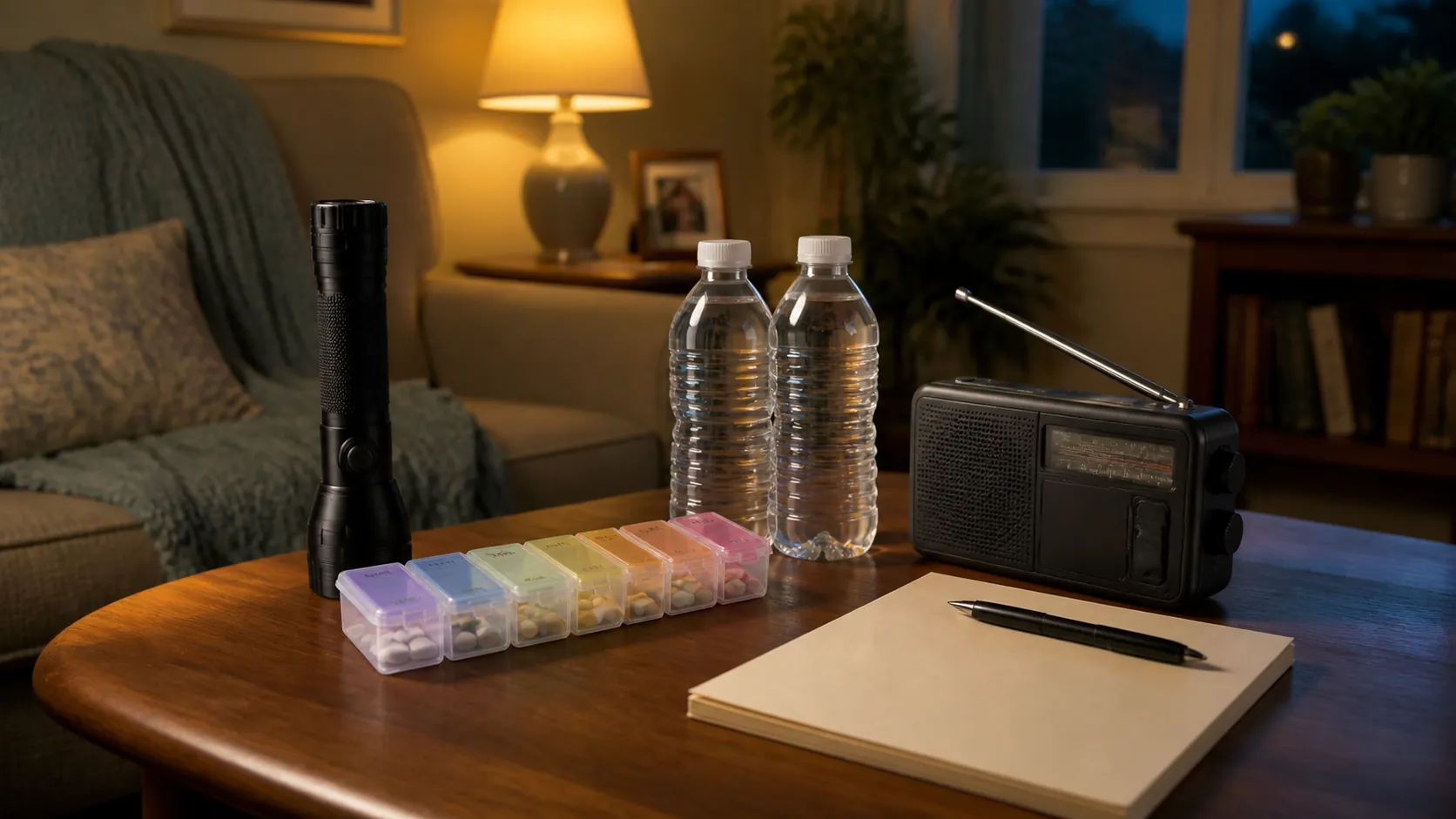
Before you buy anything, sketch the plan in three parts. Keep the final version on paper in your parent’s home, not only in your phone.
| When | What the plan must answer |
|---|---|
| Before the outage | What is stocked, what is charged, which devices need backup, who is registered, who checks in, and when relocation begins. |
| During the outage | Who confirms safety, what gets switched to backup power, what temperatures and batteries are tracked, and who compares the outage estimate with the stay-or-go rules. |
| After power returns | Which food and medication must be discarded or reviewed, what supplies were used, what failed, and what changes before the next outage. |
The written version should be short enough for a tired caregiver to use without hunting through paragraphs. A good plan names the object, the location, the person responsible, and the trigger: “Portable oxygen battery, hall closet, checked by Dana, relocate if utility estimate is longer than remaining battery time.”
Build the 72-Hour Supply Around Your Parent, Not Around a Generic Kit
FEMA’s older-adult preparedness guidance starts with the right basic idea: plan for several days of supplies, including water, nonperishable food, medication, a flashlight, radio, and mobility or medical needs.[2] For an older parent, the ordinary kit is only the first layer. The second layer is everything that keeps that particular person from falling, missing medication, overheating, getting too cold, or losing a device they depend on.
- Water: store at least one gallon per person per day, and include extra if heat, medical needs, or hygiene needs make that realistic.[2]
- Food: choose shelf-stable foods your parent can actually chew, digest, and prepare without electricity; include a manual can opener.
- Light: place a flashlight where the hand naturally goes — bedside table, favorite chair, bathroom path, walker basket — not just in a kitchen drawer.
- Communication: include a battery-powered or hand-crank radio, charged power banks, written phone numbers, and a plan for phones that rely on cordless bases or cellular backup.
- Mobility: keep the walker, cane, transfer belt, wheelchair charger, stair-lift key or instructions, and a backup route on the same floor if stairs become unusable.
- Health paperwork: include a current medication list, allergies, diagnoses, device settings, pharmacy, prescribers, insurance cards, advance directive location, and emergency contacts.
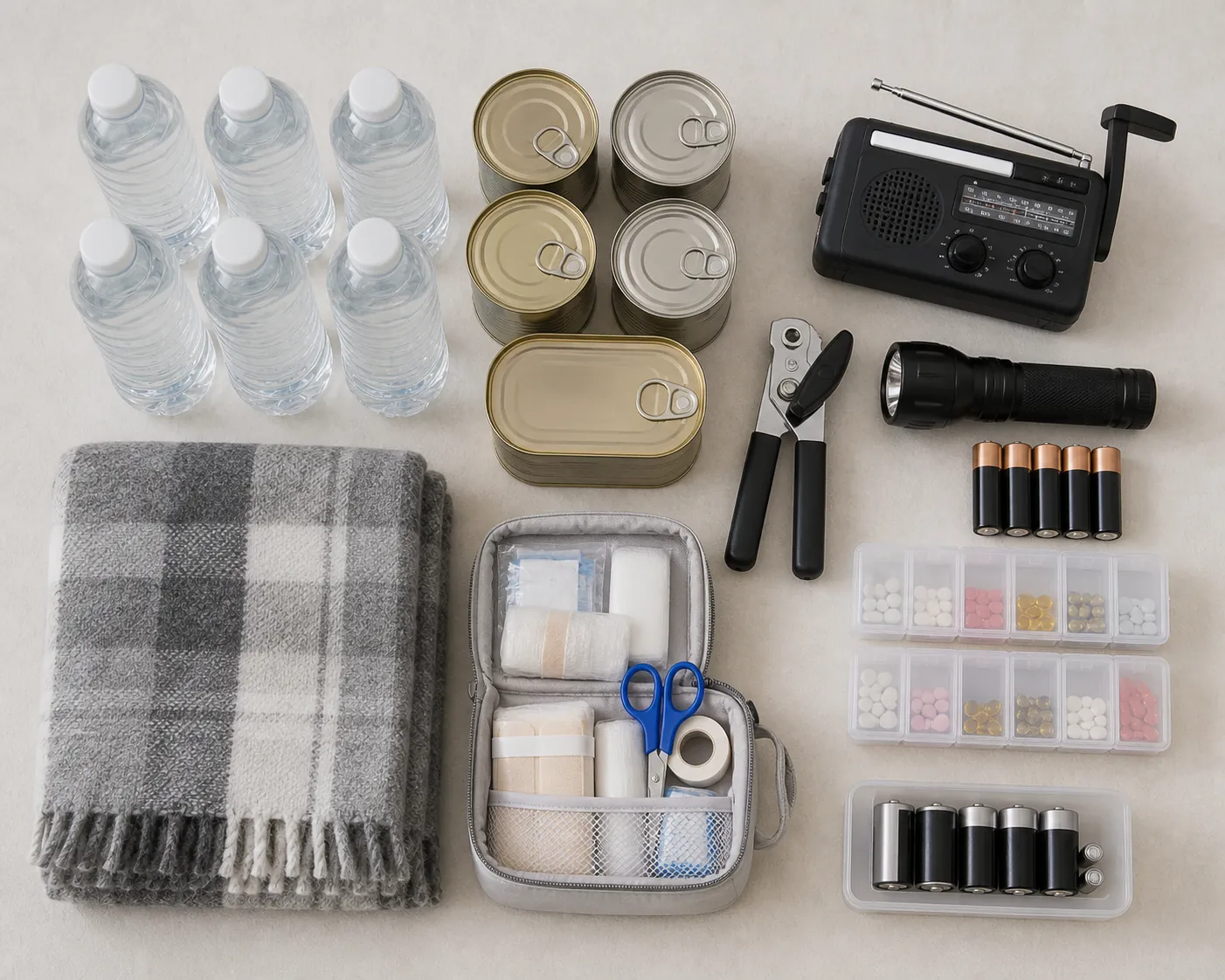
Do not store the whole kit in one heroic tote that your parent cannot lift. Put supplies where they will be used: water near the main sitting area, flashlight by the bed, medication information near the medication itself, and a relocation bag by the exit. The goal is not a pretty kit. The goal is fewer steps in the dark.
Medications Need Their Own Outage Plan
Medication planning is where vague preparedness advice becomes dangerous. A pill organizer is helpful, but it does not answer what happens to refrigerated medication, emergency refills, or a pharmacy that is also without power.
Put a refrigerator thermometer in the refrigerator and freezer before the outage. The CDC says an unopened refrigerator keeps food safe for about four hours, a full freezer for about 48 hours, and a half-full freezer for about 24 hours. Food that has reached 40°F or higher should be discarded.[3] Those food numbers also give you a practical reason to stop opening the door “just to check.” The thermometer is what lets you check intelligently when power returns.
For refrigerated medication, use the label and the pharmacist first. CDC guidance says refrigerated medication should be thrown away if the power has been out for a day or more unless the drug’s label says otherwise, and it should be replaced as soon as possible.[3] Insulin has more specific FDA guidance: unopened insulin should be stored around 36°F to 46°F, insulin may be kept at 59°F to 86°F for up to 28 days, and frozen insulin should not be used.[4] If you have seen looser temperature claims online, use the FDA labeling standard and the prescribing clinician or pharmacist rather than a single-source rule.
- Write down which medications require refrigeration and which do not.
- Ask the pharmacist what to do after a 12-hour, 24-hour, and multi-day outage for each refrigerated medication.
- Keep the pharmacy number, prescriber number, after-hours clinic number, and insurance refill line on paper.
- For diabetes supplies, include the American Diabetes Association’s 1-800-DIABETES help line in the plan, and ask about early-refill options during declared disasters.[5]
- If relocation is likely, keep a small insulated medication bag ready, but do not improvise with ice packs against medication unless the pharmacist says that medication can tolerate it.
List Every Device That Quietly Depends on Electricity
Start with the obvious devices, then walk the house and add the less obvious ones. Oxygen concentrator. CPAP or BiPAP. Hospital bed. Recliner lift chair. Stair lift. Power wheelchair or scooter. Medical-alert base station. Cordless phone. Internet router. Garage door opener. Refrigerator for medication. The problem is not only whether the device has a battery. It is whether anyone knows how long that battery lasts under real use.
For oxygen, the American Lung Association advises working with the oxygen supplier so the home has stand-alone tanks that do not rely on electricity, and making sure portable oxygen concentrators have extra batteries and car chargers.[6] Write down the flow setting, tank duration at that setting, battery duration, supplier emergency number, and whether your parent can safely use the equipment without hands-on help.
Medical-alert systems deserve the same suspicion. Many base stations have backup batteries, but runtime varies by vendor; many are described in the 20-to-30-hour range, while some vendors claim longer. Cellular and cordless-phone-dependent systems can still fail when batteries, towers, routers, or base units go down. This is also a good time to review whether an older medical-alert device depends on aging cellular networks; the site’s 2G shutdown caregiver action plan is a useful companion if the equipment has not been updated in years.
Stair lifts are another place to avoid false confidence. Manufacturers commonly report battery operation for a limited number of trips during an outage; for example, Harmar says some models may provide up to 60 trips, while other vendor-reported ranges are far lower.[7] Treat those as manufacturer figures, not a promise for your parent’s installed lift, battery age, stair length, and usage. The plan still needs a same-floor sleeping and toileting option if the lift cannot be trusted through the outage.
| Device or dependency | Write this on the plan |
|---|---|
| Oxygen concentrator | Backup tank location, tank duration, portable battery duration, car charger location, supplier emergency number. |
| CPAP or BiPAP | Battery model, tested runtime, whether skipping use is medically acceptable, clinician number. |
| Stair lift | Battery status, expected trips, manual instructions, same-floor fallback. |
| Medical-alert system | Base-station battery duration, cellular or landline dependency, test schedule, backup caller. |
| Refrigerated medication | Refrigerator thermometer location, medication label instructions, pharmacist number, relocation bag. |
| Phone and internet | Corded phone if landline works, charged power banks, written contacts, neighbor contact. |
Register, But Do Not Outsource the Plan to the Utility
Enroll in the utility’s medical baseline, medical certificate, life-support, or outage notification program if your parent qualifies. These programs can improve alerts, documentation, and outreach. They do not guarantee priority power restoration, and they do not replace backup power, relocation plans, or human check-ins. AARP’s reporting on medically vulnerable households makes the same practical point: registries are uneven, and backup planning still has to assume outages may last longer than the battery.[1]
Utility medical programs vary widely. AARP reported large differences in participation, from roughly 244,000 participants in PG&E’s Medical Baseline program to about 555 Austin Energy registrants at the time reported.[1] That gap is not a reason to skip registration. It is a reason to confirm your parent is actually enrolled and that alerts go to the right person.
- Register with the electric utility and keep confirmation in the paper plan.
- Ask what alerts the program provides and what it explicitly does not provide.
- Add outage-reporting numbers, account number, medical-program number, and online outage-map instructions.
- If the utility uses planned safety shutoffs, write down how much warning is typical and who receives the alert.
- Update the registration when the device, address, phone number, or account holder changes.
Make the Check-In Network Specific Enough to Work
A check-in plan that says “someone will call Mom” is how three people assume someone else called. Give the job a name, a time, a backup person, and a script. The first call is not a social call. It is a safety check.
- Caller one: confirms power status, whether anyone fell, whether oxygen or other medical devices are running, indoor temperature, phone battery, and whether refrigerator and freezer doors are staying closed.
- Caller two: takes over if caller one does not reach the parent within the agreed window.
- Local contact: has a key or access code and can check the home if calls fail.
- Transportation contact: knows whether they are taking the parent to a relative, hotel, cooling center, warming center, or emergency department.
- Medical contact: knows the device settings, medication concerns, and which clinician or supplier to call.
Write the script in plain language: “Are you on battery or wall power? How many oxygen tanks are left? What does the thermostat say? Did you open the refrigerator? Are you dizzy, confused, very cold, very hot, short of breath, or unsteady?” During a real outage, the person trying not to be a bother may understate the problem. The script gives the caller permission to be respectfully nosy.
Set the Stay-or-Go Rules Before Anyone Is Tired
Relocation is hardest when everyone waits until it is already obvious. A parent may not want to leave. A sibling may think the power will be back soon. A neighbor may say the next street has lights. None of that should be the deciding rule. The plan should say which numbers end the debate.

| Trigger | Decision |
|---|---|
| Utility restoration estimate is longer than available medical-device backup time | Relocate while transportation, phone battery, and caregiver judgment are still good. |
| Remaining device battery is below one usable runtime window | Move to the backup location or a medical setting; do not spend the last battery deciding. |
| Oxygen backup cannot cover the expected outage | Use the supplier emergency plan, then relocate according to the clinician or supplier instructions. |
| Refrigerated medication has crossed the label, pharmacist, CDC, or FDA safety guidance | Call the pharmacist or prescriber and arrange replacement; relocate if medication access depends on power. |
| Indoor heat or cold is becoming medically unsafe | Move to a safer temperature environment rather than waiting for symptoms to become severe. |
| The parent cannot safely toilet, transfer, sleep, or move around on the darkened floor plan | Relocate or bring in hands-on help; do not count on memory, balance, or furniture-walking. |
For battery-dependent medical equipment, PowerOutage.us recommends comparing the restoration estimate with backup duration and acting before the remaining battery is exhausted.[8] Put that comparison directly in the plan: “If the outage estimate exceeds oxygen backup time, leave.” If the utility gives no estimate, use the known battery or tank duration as the controlling number.
Temperature gets its own threshold because older adults can get into trouble before the house feels extreme to someone younger. CDC describes hypothermia as a medical emergency when body temperature falls below 95°F, and heat stroke as a medical emergency in which body temperature can rise to 106°F or higher within 10 to 15 minutes.[9][10] Those are medical emergency facts, not home thermostat targets. For home planning, use your parent’s medical history, local heat or winter guidance, and clinician advice to decide when to relocate before symptoms become dangerous. If you also maintain seasonal plans, connect this one to your heat dome fall-prevention checklist and winter weather safety checklist.
Food safety should also be pre-decided. If the refrigerator has been unopened, the working food-safety window is about four hours. A full freezer is about 48 hours; a half-full freezer is about 24 hours. Food at 40°F or above gets discarded.[3] That is not wastefulness. It is one less argument after the lights come back.
If You Use a Generator, Plan for Carbon Monoxide Before the Outage
A generator can keep critical equipment running, but it can also create a second emergency. CDC and Ready.gov both warn that generators, grills, and camp stoves must be used outdoors and kept at least 20 feet away from windows, doors, and vents; a gas oven should never be used to heat the home.[3][11] Put those rules on the generator tag itself, not only in the binder.
- Install working carbon monoxide alarms with battery backup on each level and near sleeping areas.
- Store outdoor-rated extension cords where the generator is stored.
- Label which devices the generator may power and which it may not.
- Decide who is physically able to move, fuel, and start it safely.
- If the answer is “probably Dad,” and Dad is the vulnerable person, the generator is not a complete plan.
Rehearse the Annoying Parts
A rehearsal does not need to be dramatic. Once or twice a year, pick a quiet afternoon and walk through the first hour of an outage. Do not turn off medically necessary equipment just to practice. Read the labels, find the switches, confirm the numbers, and test what can be safely tested.
- Have your parent find the nearest flashlight from bed and from the favorite chair.
- Call the check-in person and use the script once, so it does not feel strange later.
- Confirm that the medication list matches the bottles in the house.
- Look at every battery indicator: phone, power bank, oxygen backup, stair lift, medical alert, wheelchair, scooter.
- Open the relocation bag and remove anything expired, missing, too heavy, or no longer medically accurate.
- Walk the nighttime route to the bathroom and remove rugs, cords, clutter, and furniture edges that become hazards when lights fail.
This is also where broader home-safety work connects. If the outage plan exposes a risky bathroom path, loose rug, or impossible stair situation, fold that into an aging-in-place modification checklist instead of treating it as an outage-only problem.
During the Outage, Use the Plan Instead of Rewriting It
The during-outage job is deliberately shorter: confirm safety, switch to backups, track the numbers, and decide whether to stay. If no one has checked the home yet, use the first-check crisis guide first. Once everyone is safe, return to the written plan.
- Confirm no fall, injury, breathing problem, confusion, dangerous heat, or dangerous cold is already happening.
- Switch medical devices to the planned backup source and write down the start time.
- Keep refrigerator and freezer doors closed; do not repeatedly inspect food or medication.
- Check indoor temperature and the parent’s symptoms, not just the thermostat.
- Run the check-in script and assign one person to track utility estimates.
- Compare the restoration estimate with oxygen, device, phone, and medical-alert battery time.
- Keep generators, grills, and camp stoves outdoors and at least 20 feet from windows, doors, and vents.[3][11]
- Relocate when the written threshold is met; do not spend the last safe hour negotiating.
After Power Returns, Do the Cleanup While the Failure Is Still Fresh
Power returning is not the end of the plan. It is when people are most tempted to declare everything fine and leave the next caregiver the same problem.
- Check refrigerator and freezer thermometers before deciding what to keep; discard food that reached 40°F or higher.[3]
- Review refrigerated medications using the label, pharmacist, CDC guidance, and FDA insulin guidance where relevant.[3][4]
- Replace used water, food, batteries, oxygen supplies, generator fuel, and printed forms.
- Recharge every device and power bank before putting it away.
- Write down what failed: phone died, neighbor did not answer, flashlight was missing, stair lift battery was weaker than expected, medication bag was not ready.
- Change the plan within 48 hours, while everyone still remembers the uncomfortable details.
If the outage was tied to a larger hazard, connect the lessons to the plan that fits the next emergency: tornado preparedness, flood evacuation, wildfire smoke and evacuation, or fire escape planning. Power failure is often only one piece of the day.
What the Finished Plan Should Say
When you are done, the plan should fit on a few pages and answer these questions without interpretation: who checks in, who has a key, what gets powered first, how long each battery or tank lasts, which medications need temperature decisions, where the relocation bag is, which pharmacy and supplier answer after hours, and exactly when staying home ends.
That last line is the one worth writing clearly. Not “leave if it gets bad.” Write: “Leave if the utility estimate is longer than oxygen backup,” or “Leave before the final battery window begins,” or “Leave if indoor temperature is unsafe for her heart condition,” or “Leave if the refrigerator medication cannot be kept within pharmacist guidance.” A caregiver can act on that at 9 p.m. A parent trying not to be a bother can understand it. A sibling can disagree with it, but at least the plan has already made the decision.
References
- Medically Vulnerable Power Outage Alerts, AARP
- Older Adults, Ready.gov
- What to Do to Protect Yourself During a Power Outage, CDC
- Information Regarding Insulin Storage and Switching Between Products in an Emergency, FDA
- Managing Insulin in an Emergency, CDC
- Power Outage Preparation for People Who Use Oxygen, American Lung Association
- Product Buyer’s Guide: What Happens to My Stairlift in a Power Outage?, Harmar
- Medical Device Power Outage Checklist, PowerOutage.us
- About Hypothermia, CDC
- About Heat and Your Health, CDC
- Power Outages, Ready.gov
Related reading
Noticed something outdated or inaccurate on this page? Flag a correction. We review every report against CDC, NIA, and AARP HomeFit guidance before updating a page.
Part of the Fall Prevention section.