
STEADI: Intervene
Can Container Gardening Prevent Falls in Seniors?
Container gardening can help older adults with limited mobility stay active and reduce fall risk — but the garden zone must be fall-proofed first. See what published research actually shows about gardening and falls, then use a dimensioned checklist for paths, containers, pacing, and body mechanics.
Published research does connect gardening with better balance, faster gait speed, and fewer reported falls in older adults. The important word is connect. The strongest fall-related finding is observational, so it cannot prove that gardening itself prevented falls. It may also be true that older adults who already move better are more likely to keep gardening.
That still leaves a useful answer for container gardening for seniors with limited mobility: yes, it can be a sensible fall-prevention activity when the setup removes the parts of gardening most likely to cause trouble. Containers bring the work up off the ground, reduce deep bending, and avoid kneeling on uneven soil. They keep the routine alive without pretending that a yard, patio, or porch is automatically safe.
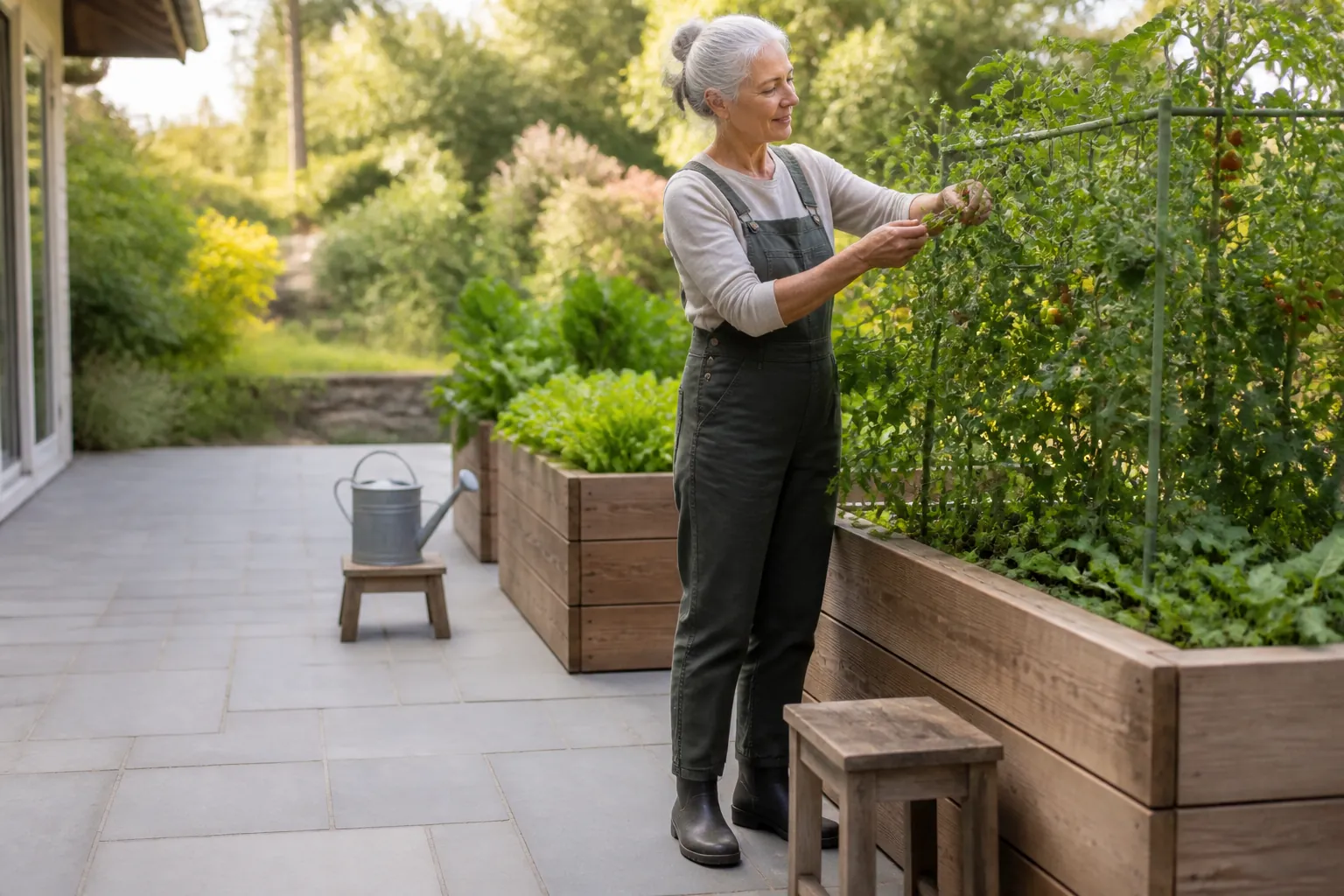
What the evidence actually says about gardening and falls
The most directly relevant study is Chen and Janke’s analysis of Health and Retirement Study data. It included 3,237 adults age 65 and older: 1,585 gardeners and 1,652 nongardeners. Gardeners reported significantly better balance and gait speed, fewer chronic conditions and functional limitations, and significantly fewer falls in the prior two years than nongardeners. The authors proposed gardening as a possible activity for future fall-prevention programs, which is a careful conclusion rather than a promise.[1]
The limitation matters. This was a cross-sectional, observational analysis, and the verified source available here is the peer-reviewed abstract through an institutional repository. It shows an association between gardening and better fall-related measures. It does not show that assigning a person to garden would reduce their future fall rate.
A broader meta-analysis helps explain why the finding is plausible. Soga, Gaston, and Yamaura reviewed 22 studies with 76 comparisons and found a significant positive overall health effect associated with gardening, with an effect size of 0.42 and a 95% confidence interval of 0.36 to 0.48. The review reported benefits including reduced depression, anxiety, and BMI, and it cited earlier work suggesting that older adults could reach at least 30 minutes of moderate activity on most days through daily gardening.[2]
That review also reported publication bias using Egger’s test, although positive effects persisted after trim-and-fill adjustment.[2] In plain terms: the research base leans encouraging, but it is not clean enough to turn gardening into a guaranteed fall-prevention prescription. This is the same evidence problem seen with many pleasant balance activities: better balance scores are meaningful, but they are not the same as proven fall reduction. For a close comparison, see Can Low-Impact Dance Really Improve Senior Balance?.
Smaller intervention studies add another useful point: the session does not have to be heroic. In one gardening intervention, 24 elderly women completed 15 twice-weekly gardening sessions of about 50 minutes and significantly improved waist circumference, aerobic endurance, hand dexterity, and cognitive function. The 26-woman control group lost lean mass, and depression scores rose from the normal range into the moderate range.[3]
A 2024 crossover randomized trial looked at a much smaller task: 10 minutes of watering indoor plants. In 100 women with a mean age of 68.3, the watering session significantly lowered systolic and diastolic blood pressure and anxiety compared with playing a computer game.[4] That study was conducted with a Chinese female nursing-home sample, so it should not be stretched to all older adults. Still, it supports a practical idea: short, repeatable plant-care sessions can count as meaningful activity, especially for someone who cannot safely manage a long outdoor session.
Why containers change the fall-risk equation
Traditional gardening often asks for exactly the movements that become risky after a fall: stepping onto soft or uneven ground, kneeling, twisting, reaching forward, and getting back up while holding a tool or plant. The hazard is not the tomato plant. It is the repeated transition between standing, bending, crouching, and walking on a surface that may shift underfoot.
Container gardening can remove much of that. A pot, planter box, or garden table placed on a firm patio lets the work happen at a predictable height. The senior can water, pinch herbs, deadhead flowers, or check soil without kneeling in a bed. A caregiver can also control the work zone: the walking route, the tool location, the hose, the stool, the lighting, and the escape path back indoors.
That is the reason containers belong in a fall-prevention conversation. They make the activity easier to repeat safely. They do not make the space safe by themselves.
Before the first session: fall-proof the garden zone
Do the safety pass before buying plants. If the zone cannot be made stable, reachable, and easy to exit, the gardening plan is not ready. The right test is simple: could the older adult walk to the container, do a five- to ten-minute task, and return indoors without stepping over, bending for, or rushing after anything?
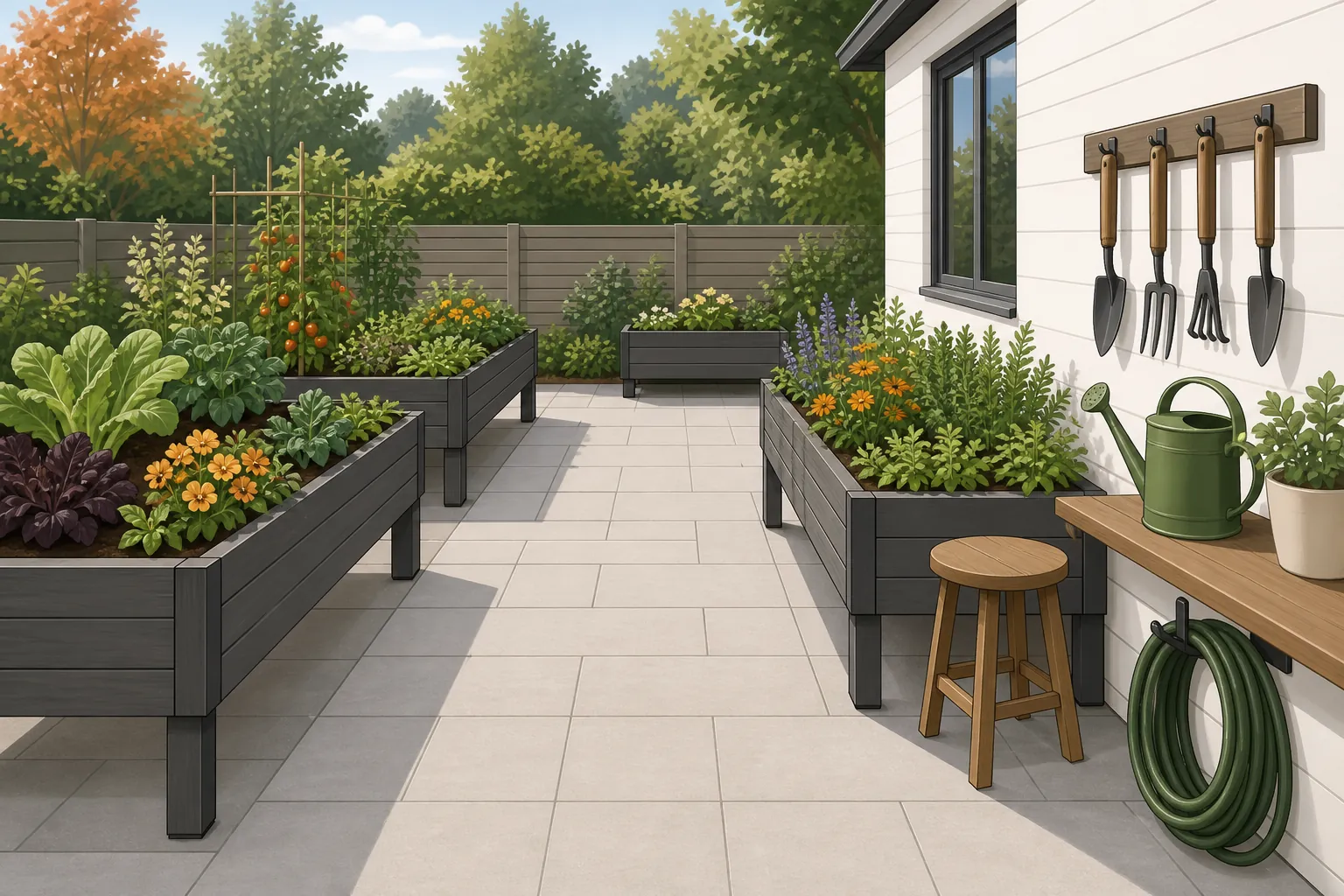
| Zone item | Safer standard | Why it matters |
|---|---|---|
| Path width | Use the widest practical route. Accessible-gardening guidance commonly points to at least 3 feet for mobility access, and 4 feet where wheelchairs or carts need room. | Narrow routes force side-stepping, turning, and brushing against containers. |
| Grade | Keep routes level when possible. One OT-informed guide recommends grades of 5% or less. | A mild slope can become difficult when carrying water or turning around. |
| Surface | Choose firm, stable surfaces such as concrete, brick, or interlocking pavers. Avoid loose gravel and unanchored paving stones. | Shifting surfaces punish weak ankles, slower reaction time, and walker or cane use. |
| Stairs and thresholds | Add handrails or a ramp where porch stairs or level changes block safe access. | The riskiest part of the session may be getting to the plants, not tending them. |
| Container placement | Place containers along the route, not in the route. Leave room to turn without backing up. | Backing up while holding a watering can is a preventable fall setup. |
| Tools | Keep tools on a wall rack, shelf, apron, or cart—never scattered on the ground. | Picking tools up from the floor or patio can cause loss of balance. |
| Water source | Use a lightweight watering can, drip line, or hose kept neatly coiled away from the walking path. | Hoses are useful until they become trip lines. |
| Phone | Carry a phone on the body, not on a table across the patio. | If a fall happens, the phone has to be reachable from the ground. |
| Rest point | Use a stable chair or stool with feet flat on the ground. Avoid lightweight stools that tip when leaned on. | Resting should lower risk, not add another unstable object. |
| Lighting and weather | Garden only when the route is dry and well lit. | A safe patio in morning light may not be safe at dusk or after rain. |
The width numbers vary because sources aim at different users and garden types. Eartheasy’s OT-informed accessible gardening guide recommends paths at least 3 feet wide, grades of 5% or less, and firm non-gravel surfaces.[5] University of Georgia Extension says paths should be at least 12 inches, ideally 18 to 24 inches, with 4 feet needed for wheelchairs or carts.[6] GardenTech gives 4 feet as a minimum pathway width for accessible gardens.[7] For an older adult with limited mobility, the safer choice is not the narrowest number that appears in print. It is the route that allows the actual person, with their cane, walker, cart, or helper, to move without shuffling sideways.
AARP’s gardening safety guidance is useful here because it focuses on ordinary hazards people tolerate for years: porch stairs without adequate support, loose gravel, unanchored paving stones, tools on the ground, and phones left out of reach. AARP recommends fixing porch stairs with handrails or a ramp, avoiding loose gravel and unanchored stones in favor of more stable surfaces, carrying a phone on the person, and using a carpenter’s apron so tools do not have to be retrieved from the ground.[8][9]
If the garden is outside a door used in wet weather, pair this setup with an exterior fall-hazard audit. The same problems that cause rainy-day falls—slick thresholds, poor lighting, uneven walking surfaces, missing rails—can turn a good container garden into a bad route. For a deeper pass on those hazards, see rainy-day fall prevention.
The pass-or-fix decision
Before the first gardening session, walk the route with empty hands. Then walk it while carrying the lightest watering can the person expects to use. Watch for hesitation, extra reaching, toe-catching, furniture grabbing, or a turn that requires backing up. Those are not personality quirks. They are setup failures.
- If the person needs to step over a hose, move the hose or change the watering system.
- If tools are below knee level, raise them to a shelf, rack, apron, or waist-height cart.
- If the surface shifts underfoot, change the surface before adding more containers.
- If the route depends on a single handhold that is not fixed, install a real rail or choose another location.
- If the person cannot turn around without stepping backward, widen the work area or reduce the number of containers.
Container height helps, but footing matters more
Raised container height is useful because it reduces bending and kneeling, but do not turn the setup into a measuring contest over planter legs. Published guidance does not use one universal height. UGA and Eartheasy discuss 24-inch working heights in accessible raised-bed contexts, the University of Minnesota discusses 27 inches for some raised beds, GardenTech describes 24- and 30-inch options, and Eartheasy notes 34 inches where knees need to fit underneath.[5][6][7][10]
Use height as a fit issue. A seated gardener needs knees, feet, and the chair or stool to fit without leaning forward. A standing gardener needs the plant close enough to reach without bending from the waist. For a fuller setup discussion on raised beds, container height, and ergonomic tools, use the site’s gardening tips for seniors with mobility limitations as the companion guide.
Make the routine short enough to stay steady
A safe container garden should not require one exhausting weekly rescue mission. It should be built around short visits: water, check soil, remove one or two dead leaves, harvest a few herbs, go back inside. The person should finish while still steady, not after they have proved they can push through fatigue.
Containers also create a scheduling issue. North Carolina State Extension notes that raised beds, containers, and garden tables can dry out quickly and may need more frequent watering. University of Minnesota Extension also notes that raised beds dry out more quickly than in-ground beds.[11][10] More frequent watering is not a reason to avoid containers, but it is a reason to plan the routine instead of waiting until plants wilt and someone rushes outside.
- Water at a set time of day when the path is bright and dry.
- Use smaller watering cans or partial fills instead of one heavy trip.
- Keep a backup plan for hot days, rain, dizziness, or fatigue: skip the session, ask for help, or use a drip system.
- Avoid “just one more thing” tasks that require bending, reaching behind a planter, or walking to another part of the yard.
- Stop before legs feel shaky. Shakiness at the end of a pleasant activity is still a fall warning.
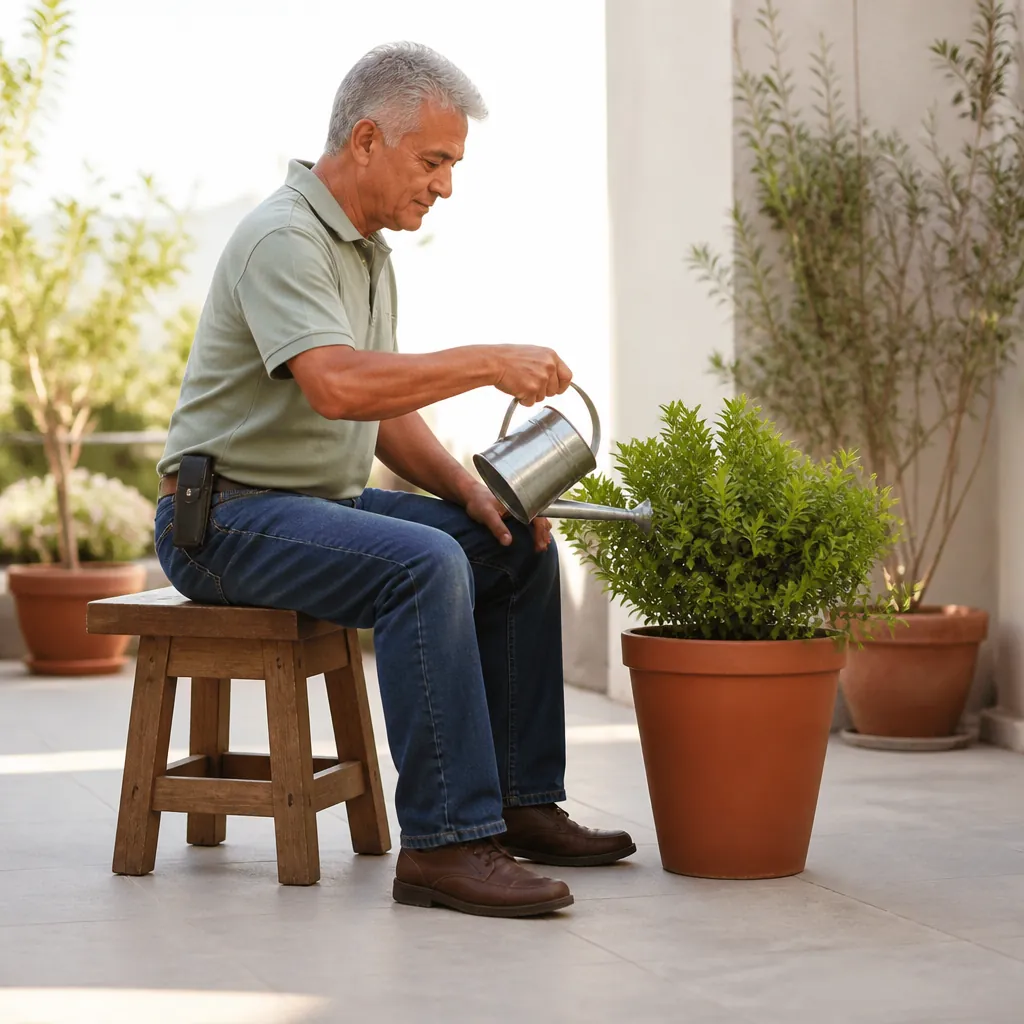
Body mechanics that keep the task boring and safe
Good body mechanics are not fancy. They are the rules that keep an ordinary task from becoming a fall event.
- Face the container directly. Twisting while reaching is harder to recover from than a straight reach.
- Keep both feet planted before watering, pruning, or harvesting.
- Move the pot closer instead of leaning farther, unless the pot is too heavy to move safely.
- Use a stable stool only if sitting and standing from it are both easy. If standing up requires pulling on a planter, the stool is not safe for that setup.
- Do not retrieve dropped tools immediately if doing so requires a deep bend. Use a grabber, ask for help, or pick it up later from a safer position.
- Do not carry soil bags, large pots, or full watering cans during the regular gardening session. Those are setup jobs.
The caregiver’s job is not to take the garden away. It is to remove the avoidable surprises: the pot that blocks the turn, the trowel on the patio, the hose across the door, the bag of soil left where a foot naturally lands.
When to pause and check with a clinician
This article is general safety information, not medical advice. Container gardening is still physical activity, and an older adult should check with a clinician before starting or restarting if there are new balance problems, a recent fall, fainting or dizziness, new weakness, new shortness of breath, or medication changes that may affect alertness, blood pressure, or steadiness.
If a fall has already happened, do not treat gardening as the fix. First address the fall itself, the injury risk, and the home hazards that may still be present. For next steps after a fall, use the site’s fall-prevention guidance on how to stay healthy and independent after 70.
The practical answer is bounded: gardening may be a useful, repeatable activity associated with better fall-related measures, and containers can remove major garden hazards. Start only after the route, surface, tools, water, phone, and rest point are ready.
References
- Gardening as a potential activity to reduce falls in older adults, Taipei Medical University repository, 2012
- Gardening is beneficial for health: A meta-analysis, Preventive Medicine Reports, 2017
- Gardening provides substantial human health benefits, ASHS
- Effects of indoor horticultural activities on the physical and psychological health of older people in nursing homes: A randomized controlled crossover trial, Hong Kong Journal of Occupational Therapy, 2024
- Wheelchair Gardening Tips, Eartheasy
- Raised Garden Bed Dimensions, University of Georgia Extension
- Gardening for Everyone: Creating Accessible Gardens, GardenTech
- 5 Tips for Accessible Gardening, AARP
- 7 Essential Tools for Gardeners With Limited Mobility, AARP
- Raised bed gardens, University of Minnesota Extension
- Accessible gardening: Raised beds, containers, and garden tables, NC State Extension
Related reading
Noticed something outdated or inaccurate on this page? Flag a correction. We review every report against CDC, NIA, and AARP HomeFit guidance before updating a page.
Part of the Fall Prevention section.