
STEADI: Intervene
How to Prevent Falls on Ice for Older Adults
A practical five-layer plan for keeping older adults upright on ice-covered walkways — surface prep, proper footwear and traction aids, the penguin walk, balance conditioning, and a rehearsed post-fall response — with the CDC and winter-injury evidence behind each layer.
The safest time to plan for ice is before the first glazed walkway. Once an older adult is already standing beside a car with a walker, one foot on packed snow, and the porch light behind them, the choices are much narrower. Preventing falls on ice for older parents and neighbors is not one trick. It is a small system: make the walking surface less treacherous, put traction under the feet, rehearse how to move on ice, build balance before winter, and agree on what happens if the fall still occurs.
That system matters because the consequences are not small. The CDC reports that more than 1 in 4 adults age 65 and older falls each year; falls lead to about 3 million emergency department visits and about 1 million hospitalizations among older adults in the United States, and 37% of older adults who fall report an injury that required medical treatment or limited activity for at least one day.[1] Falls are also the leading cause of traumatic brain injury in older adults, and the CDC advises that an older adult who hits their head in a fall should see a doctor right away, especially if they take blood thinners.[1]
Winter adds its own pattern. In a preliminary, not-peer-reviewed Truveta analysis of electronic health record data from December 2019 through March 2023, falls involving snow or ice accounted for about 13.1 emergency department visits per 10,000 ED visits during winter months, and the rate was roughly three times higher in freezing-winter states. In that same preliminary, not-peer-reviewed analysis, adults 65 and older accounted for 23% of snow- and ice-related falls, and about 22.5% of those visits involved a strain, sprain, fracture, or dislocation.[2] Those numbers should not be treated like final national surveillance, but they fit what families already recognize: icy falls arrive in clusters, and the injuries are often predictable.
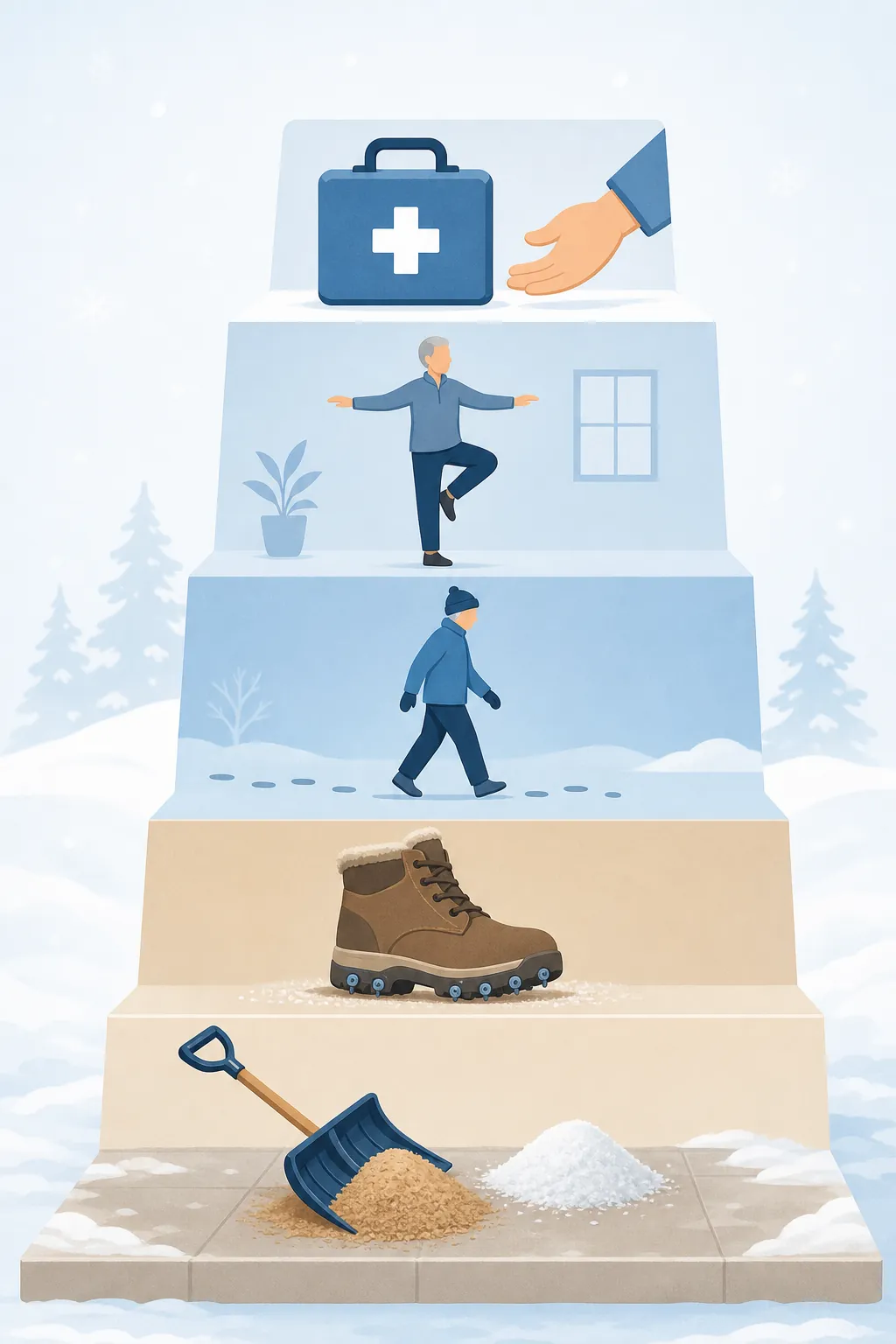
Start with the route, not the front door
The first layer is the least glamorous one: decide which path the older adult will actually use, then prepare that path before it freezes. Not every sidewalk, driveway edge, garage step, and side entrance deserves equal effort. Pick the route from car to door, mailbox to door, trash bin to door, or building entrance to parking spot, then make that route the priority.
Before a storm or freeze, put ice melt, sand, or a grit source where the person who will use it can reach it without crossing the hazard first. The National Council on Aging recommends treating outdoor surfaces with ice melt or sand and notes that lightweight clay cat litter can be carried and tossed ahead for extra traction.[3] That last detail matters for someone who cannot shovel, cannot lift a heavy bucket, or lives where a maintenance crew may not arrive before a morning appointment.
Clear the walking route before slush refreezes into ridges. Watch the places where a walker or cane tip lands: the bottom of steps, the strip beside a parked car, curb cuts, shaded concrete, and the threshold where wet boots meet a smooth indoor floor. A walkway can be “mostly clear” and still be unsafe if the only icy patch is exactly where the person has to turn, reach for a railing, or lift a foot over a door sill.
For broader storm preparation, keep that work in a separate checklist instead of trying to solve every weather problem at the doorway. A fall-focused severe-weather plan can live in a dedicated severe-weather safety checklist, while the ice-fall plan stays focused on the few yards where the fall is most likely to happen.
Footwear and traction aids: the layer families overestimate most often
A winter boot that feels warm in the house is not automatically a safe boot on ice. The question is not whether it looks sturdy. The question is whether it grips, stays on securely, works with the person’s walking pattern, and will actually be worn when the errand feels quick.
A footwear review in Annals of Geriatric Medicine and Research notes that a majority of older adults wear ill-fitting shoes, and that 48% to 90% of older adults’ shoes show wear. The same review describes fall-prevention footwear features that include a rubber outsole with tread, a secure closure, a low heel of roughly 4 cm or less, and an ankle collar.[4] For winter, those features become a screening tool: if the sole is smooth, the heel is high or narrow, the shoe slips at the heel, or the closure cannot be tightened over winter socks, the boot is asking the person’s balance system to do too much.
| Check | What to look for | Why it matters on ice |
|---|---|---|
| Outsole | Rubber sole with visible tread, not a polished or worn-smooth bottom | The sole is the contact point before any gait trick can help |
| Fit | Heel stays seated; toes are not cramped; socks do not make the boot sloppy | A loose boot adds a second sliding surface inside the shoe |
| Closure | Laces, straps, or another closure the person can fasten securely | A boot that cannot be tightened often gets worn half-secure |
| Heel and ankle | Low, broad heel; ankle collar that does not fight the person’s motion | A higher or unstable heel makes a small slip harder to recover from |
| Wear | Flattened tread, uneven heel wear, cracked sole, or loss of grip | Old favorite boots can become indoor slippers with winter styling |
Removable traction aids, including ice cleats or studded devices, deserve more respect than they sometimes get, but they are not a magic purchase. They have to fit the boot, stay attached, be easy enough to put on with cold hands, and come off before walking across slick indoor flooring unless the device is designed for that transition. They also have to be socially tolerable. If an older adult hates the look, cannot bend to put them on, or forgets them in the car, the best-rated traction aid has done nothing.
The most useful cleat evidence is practical because it looks at use, not just ownership. A 2022 BMJ Injury Prevention study of Swedish municipal ice-cleat distribution programs for adults age 65 and older found that distribution was associated with a 7.5 percentage-point increase in cleat use, and the increase was 17.3 percentage points where one pair per older adult resident was distributed.[5] That does not mean every person who receives cleats will wear them, and it does not compare every product type. It does show that getting traction aids into older adults’ hands can change behavior when access is one barrier.
A separate Swedish study in Gothenburg linked a studded-footwear subsidy for older residents with reduced emergency department visits for ice-related fall injuries.[5] That is stronger than a seasonal reminder taped to the refrigerator, but still not a reason to stop clearing the walkway. Traction aids reduce one failure point. They do not fix a hidden curb under snow, a rushing caregiver, poor lighting, or a walker whose rubber tips are packed with ice.
Walking aids need the same winter check. Cane tips, walker tips, and wheels should be inspected before the season, not after the first slide. If a cane or walker is part of daily mobility, the winter plan should include whether its tips are in good condition, whether any ice attachment is appropriate, and whether the device can be used safely on the chosen route. This is a good place to involve a physical therapist, occupational therapist, or mobility specialist rather than improvising with equipment that changes how the person bears weight.
The penguin walk is a skill, not a slogan
“Walk like a penguin” can be useful if it means specific body mechanics. It is not enough if it is shouted across a driveway after the person has already stepped onto ice. The older adult needs to rehearse the movement on a safe surface first, with the same coat, boots, cane, purse, or car keys they will use outside.
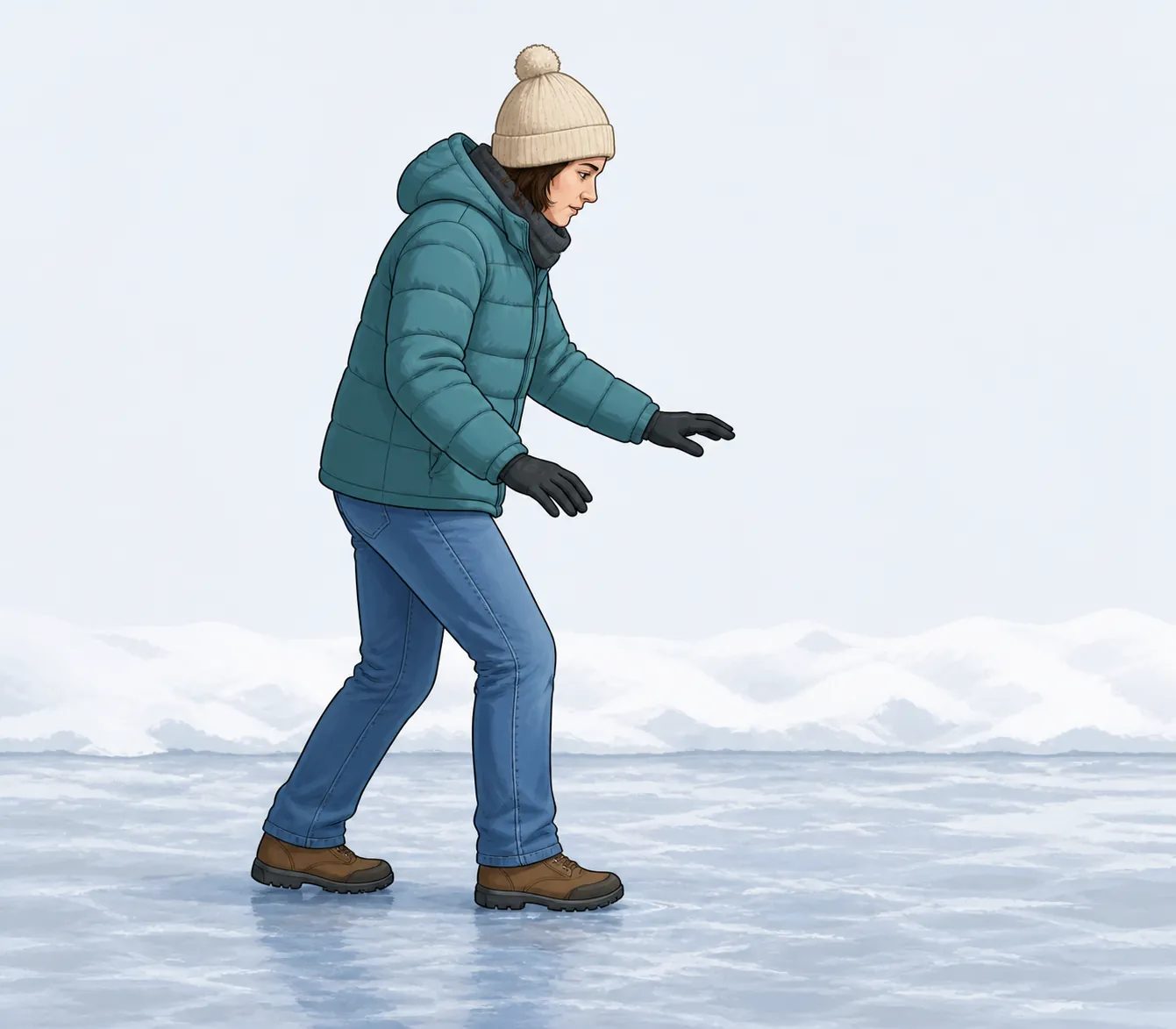
The common teaching points are consistent: take short, slow, shuffling steps; turn the toes slightly outward; keep the feet flatter than usual; bend the knees a little; keep the hands out of pockets; and keep the weight over the front leg instead of leaning backward. McFarland Clinic teaches short shuffling steps, feet slightly apart, knees loose, arms out for balance, and weight centered over the feet.[6] Vancouver Coastal Health similarly advises walking slowly, taking small steps, keeping hands free, and using a wide stance on ice.[7]
The hands-out-of-pockets detail is not decoration. If both hands are trapped in coat pockets, the person loses balance reactions and may not be able to use a railing, cane, car door, or caregiver’s forearm at the moment they need it. The better setup is boring: gloves on, phone and keys secured, bag cross-body or left behind, and one hand available for a rail or aid.
Curbs and vehicle exits need their own rehearsal because they are not normal walking. At a curb, sidestepping down may be safer than stepping forward if the person can keep a hand on support and place the whole foot carefully. At a car, the safer pattern is usually to turn the body first, place both feet on the ground, pause, then stand with support instead of twisting, rising, and stepping all at once. If the weather is bad enough that this sequence feels impossible, that is a go/no-go decision, not a character test. A separate bad-weather outdoor safety plan can help families decide when to cancel, delay, or ask for help.
A cue only works if the person can remember it under stress. Practice should be short and concrete: stand at the door, put on the actual boots, step onto a dry practice area, and repeat “small steps, flat feet, hands free.” If the older adult uses a cane or walker, rehearse with it. If they get flustered when watched, practice without an audience and make the environment do more of the work.
Balance work has to begin before the sidewalk is slick
Balance conditioning is not a same-day rescue. It is a pre-season layer that gives the person a better chance of recovering from a small slip before it becomes a fall. The CDC’s STEADI materials encourage older adults to talk with a healthcare provider about fall risk and use evidence-based steps such as reviewing medicines, checking vision, and doing strength and balance exercises.[8]
For a healthy, active older adult, balance work might mean a structured community exercise class or a home program prescribed by a physical therapist. For someone with neuropathy, dizziness, Parkinson’s disease, stroke history, severe arthritis, recent surgery, or repeated falls, it should not be guessed from an online video. The right question for the clinician is practical: “What does this person need to practice so they can manage a short icy walk from car to door, and what should they avoid?”
Reactive strength matters too. Ice does not ask for a graceful yoga pose; it asks whether the ankle, hip, and trunk can respond when the foot moves unexpectedly. That work takes time. Starting in late summer or fall gives the person a better chance to build capacity before winter errands, holiday outings, medical appointments, and community events start stacking up. For longer outings, the same logic applies to seating, rest breaks, footwear, and exit plans; those details fit well in a separate guide to staying safe at community events.
If a fall happens anyway, the plan should already be known
Even a good system can fail. Ice hides under powder. A boot catches. A walker tip skids. A person hurries because the wind hurts their face. The post-fall plan is not pessimism; it is what keeps a fall from turning into a longer emergency on frozen pavement.
The first rule is not to yank the person up. Check for head strike, confusion, severe pain, deformity, bleeding, shortness of breath, inability to bear weight, hip or wrist pain, and whether the person takes blood thinners. A head strike in an older adult deserves urgent medical guidance, especially with blood thinner use, because falls are a leading cause of traumatic brain injury in this age group.[1]
Cold exposure changes the urgency. The Merck Manual notes that when an older adult remains on the floor or ground after a fall, complications can include dehydration, hypothermia, pneumonia, rhabdomyolysis, and pressure sores; it also notes that fewer than half of older adults who fall tell their doctor, even though one fall doubles the chance of another.[10] Outside in winter, a long wait is not just uncomfortable. It can become part of the injury.
Families should decide in advance who gets called, where the phone is carried, when 911 is used, and what the older adult should do if alone. A wearable alert device, charged phone, neighbor contact, or scheduled check-in may be the difference between a frightening fall and a dangerous long lie. For the detailed first-15-minutes sequence, safe get-up cautions, and lift-assist decisions, use the sidewalk-specific protocol in What to Do After a Parent Falls on a Sidewalk.
Damage reduction if the slip has already started
No one should tell a frail or medically complex older adult to practice falling without professional guidance. Still, it helps caregivers understand why certain instincts cause injury. Harvard Health describes safer falling principles such as leaning forward, bending the knees, protecting the head, and trying to land on fleshy areas rather than reaching out with stiff arms.[9] That last point lines up with what families often see after ice falls: the hand shoots out, the wrist takes the force, and a quick errand becomes a fracture.
This is not a substitute for prevention. It is damage reduction for the split second when prevention fails. The more useful version is to remove the need for heroics: hands free, shorter steps, cleared route, traction underfoot, and no rushing across a glazed surface to prove independence.
A simple winter commitment
Before winter, choose the walking route and prepare the surface supplies. Check the boots, replace worn soles, and test traction aids before they are needed. Rehearse the ice-walking pattern, the curb step, and the car exit with the actual coat, gloves, walking aid, and bag. Start balance and strength work early enough for it to matter. Agree on the post-fall response, including when to seek urgent medical care.
None of these layers has to be perfect to be useful. The point is that one missed patch of ice should not be the only thing standing between an older adult and a serious injury. This article is educational and is not a substitute for medical advice; people with recent falls, dizziness, blood thinner use, major mobility changes, or complex medical conditions should involve a qualified healthcare professional in their fall-prevention plan.
References
- Facts About Falls | Fall Prevention | Injury Center | CDC. CDC.
- Winter falls and injuries. Truveta.
- Winterize to Prevent Falls. National Council on Aging.
- Footwear Design for Older Adults: Evidence-Based Guidelines to Improve Foot Health and Reduce Fall Risk. Annals of Geriatric Medicine and Research.
- Municipal ice cleat distribution programs to older adult citizens and associations with ice cleat use: a cross-sectional study. Injury Prevention.
- Walk Like A Penguin: Tips to Avoid Falls on Ice and Snow. McFarland Clinic.
- Prevent slips and falls. Vancouver Coastal Health.
- STEADI - Patient Resources. CDC.
- How to fall without injury. Harvard Health.
- Falls in Older Adults. Merck Manual.
Related reading
Noticed something outdated or inaccurate on this page? Flag a correction. We review every report against CDC, NIA, and AARP HomeFit guidance before updating a page.
Part of the Fall Prevention section.