
STEADI: intervene
How to Prevent Falls in a Parent With Pancreatic Cancer
Fatigue, muscle loss, chemotherapy neuropathy, and multiple medications make an older parent with pancreatic cancer much more likely to fall at home. This guide covers the highest-risk moments, the home changes and mobility supports that cut that risk, and when to escalate to medical or home-care help.
The dangerous moment may not look dramatic. Your parent stands up from the couch after chemo, pauses, reaches for the wall, then says they are fine. Or they come home after pancreatic surgery with discharge papers that say “activity as tolerated,” but the walker bumps the bathroom doorway and the toilet suddenly feels too low. When you are supporting an elderly parent with pancreatic cancer, fall prevention is not a generic senior-safety add-on. It has to be managed beside the oncology plan, because the body you are making the house safe for may be changing week by week.
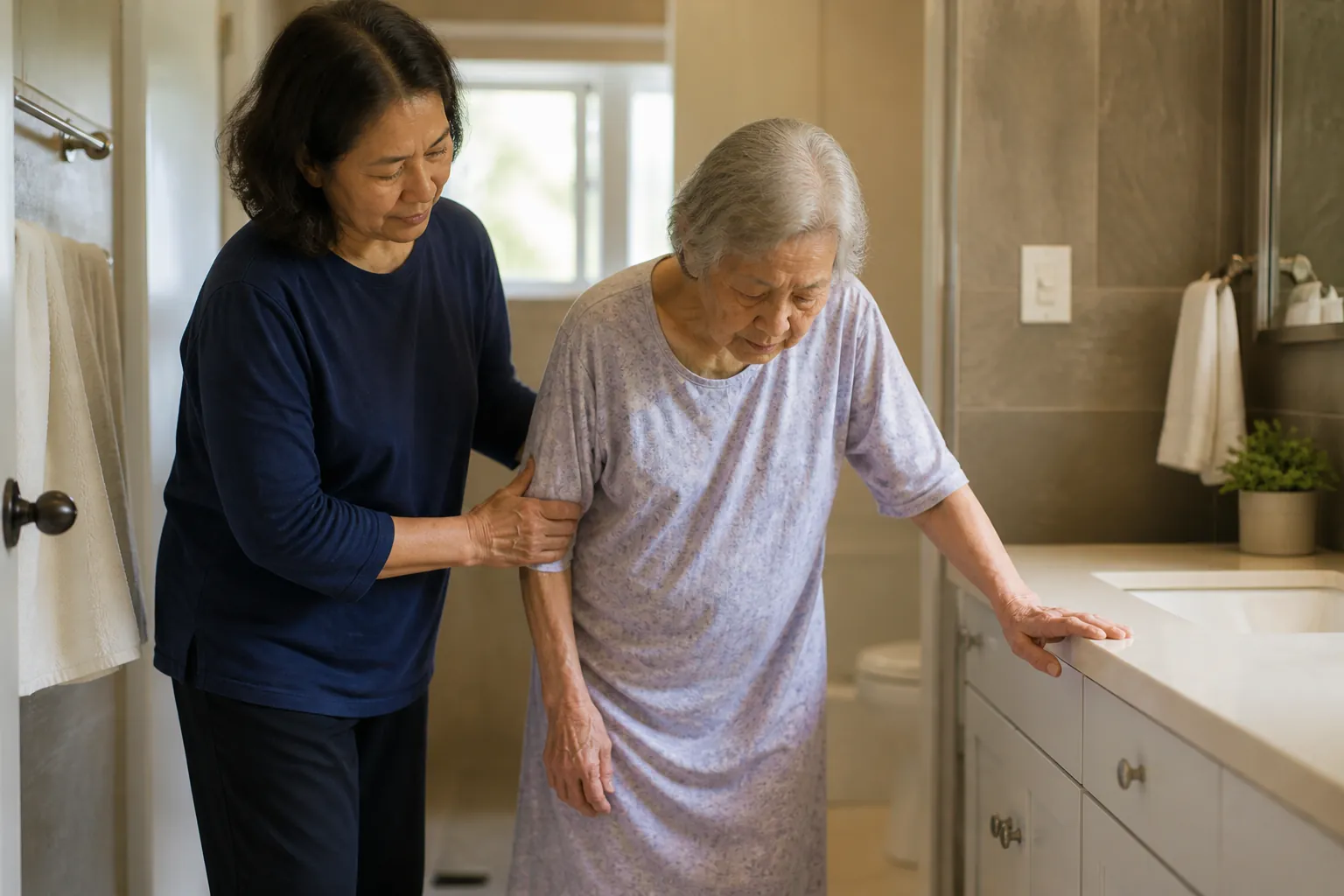
This article is for home-safety planning and caregiver decision-making, not a substitute for medical advice. A fall, near-fall, sudden weakness, dehydration concern, fever, medication reaction, or new confusion should be handled with the oncology team, primary-care clinician, home health nurse, or emergency services as appropriate.
Why pancreatic cancer makes home movement risky so quickly
Pancreatic cancer often starts in an age group where falls are already a serious concern. SEER reports a median age at diagnosis of 71. About 70% of new cases occur in people 65 and older, with 32.7% in ages 65–74, 25.9% in ages 75–84, and 11.4% in people over 84. SEER also estimates 67,530 new U.S. cases in 2026 and reports a 13.7% five-year relative survival rate for pancreatic cancer overall.[1]
Those numbers matter at home because the person being discharged or starting treatment is often already older, then gets hit with several fall risks at the same time. A parent may not have one obvious symptom that screams “fall danger.” Instead, the pieces stack: fatigue, muscle loss, reduced appetite, dehydration, medication changes, neuropathy, and post-surgical weakness. The result is a parent who can still look familiar at the kitchen table but no longer has the reserve to make a safe bathroom trip at 2 a.m.
Fatigue changes judgment and timing
PanCAN names fatigue as the number-one challenge reported by caregivers. That sounds simple until you watch it change how a person moves: they stand before they are ready, skip the walker because the bathroom is “just there,” sit too fast, or lean on a towel bar because it is the closest thing to grab.[2]
Fatigue also shortens the safe window. A parent may walk steadily at 10 a.m. and shuffle by late afternoon. They may manage the bedroom hallway before treatment and need an arm afterward. Fall prevention has to account for the worst part of the day, not the best demonstration your parent can give when the nurse or visitor is watching.
Weight loss and muscle loss reduce the margin for error
Johns Hopkins explains that pancreatic cancer can release compounds that break down muscle and fat, contributing to weight loss, muscle loss, and fatigue.[3] In the house, that can show up as a parent who can still take steps but no longer has the strength to recover from a small stumble. A rug edge, a wet bathroom floor, or a low chair that used to be annoying can become enough to cause a fall.
This is why weight and strength changes should trigger a home-safety review, even if no one has fallen yet. The question is not only “Can Mom walk?” It is “Can she stand up from the toilet without pulling on the sink, turn safely in the bathroom, and get back to bed when she is tired?”
Neuropathy can make the floor harder to read
Some pancreatic cancer treatment regimens carry substantial toxicity. ASCO Daily News, discussing treatment in older adults with metastatic pancreatic cancer, notes that in NAPOLI-3, 71% of patients had grade 3 or higher treatment-related adverse events. It also notes that neuropathy from regimens such as FOLFIRINOX can impair balance.[4]
Neuropathy is not just “tingling.” If your parent cannot feel the floor clearly, they may misjudge the edge of a bath mat, the transition into a shower, or the last stair. They may look down more, move more stiffly, or widen their stance. Those changes are easy to dismiss as caution, but they are also signs that the home may need more support points and fewer decisions underfoot.
Medication burden can turn a normal walk into a risky one
A 2016 review in the World Journal of Gastroenterology cites research finding that 80% of newly diagnosed cancer patients age 65 and older were taking five or more medications.[5] For a pancreatic cancer caregiver, the medication list on the refrigerator is not just paperwork. Pain medicine, sleep medicine, anti-nausea drugs, blood pressure medication, diabetes medication, laxatives, and new post-operative prescriptions can all affect steadiness, alertness, urgency, or bathroom timing.
The practical move is to ask for a fall-risk medication review whenever the list changes, not only at the annual primary-care visit. Bring the actual bottles or a current list to oncology and primary care. Ask which medicines may cause dizziness, sleepiness, low blood pressure, diarrhea, constipation, urgent bathroom trips, or nighttime confusion. The goal is not to stop medications on your own. It is to make sure someone is looking at the whole list through the lens of falls.
Surgery can send families home before the house is ready
After pancreatic surgery, discharge destination changes sharply with age. The same 2016 review reports that the share of patients who could not be discharged straight home after pancreatic surgery was 10.6% for ages 65–69, 19.2% for ages 70–79, and 36.7% for ages 80 and older.[5]
That gradient is a warning for families. If your parent does go directly home, the home should not be treated as unchanged territory. Stairs, toilet height, shower transfers, bed height, chair arms, and the route from bed to bathroom all need to be tested against the body that is coming home now, not the parent who was walking independently a month ago.
Start with the moments most likely to cause a fall
A whole-house checklist is useful, but in the first days after diagnosis, chemo, or discharge, the fastest gains come from naming the riskiest moments. Do not start with every drawer, rug, and closet. Start with the five times someone is most likely to lose balance, rush, or reach for the wrong thing.
| High-risk moment | What to watch for | First home-safety response |
|---|---|---|
| Getting up after chemo, pain medicine, or a long nap | Pausing, swaying, grabbing furniture, saying “I’m fine” while not moving | Have the walker or cane within reach, add a stable chair with arms, and build in a sit-before-standing routine |
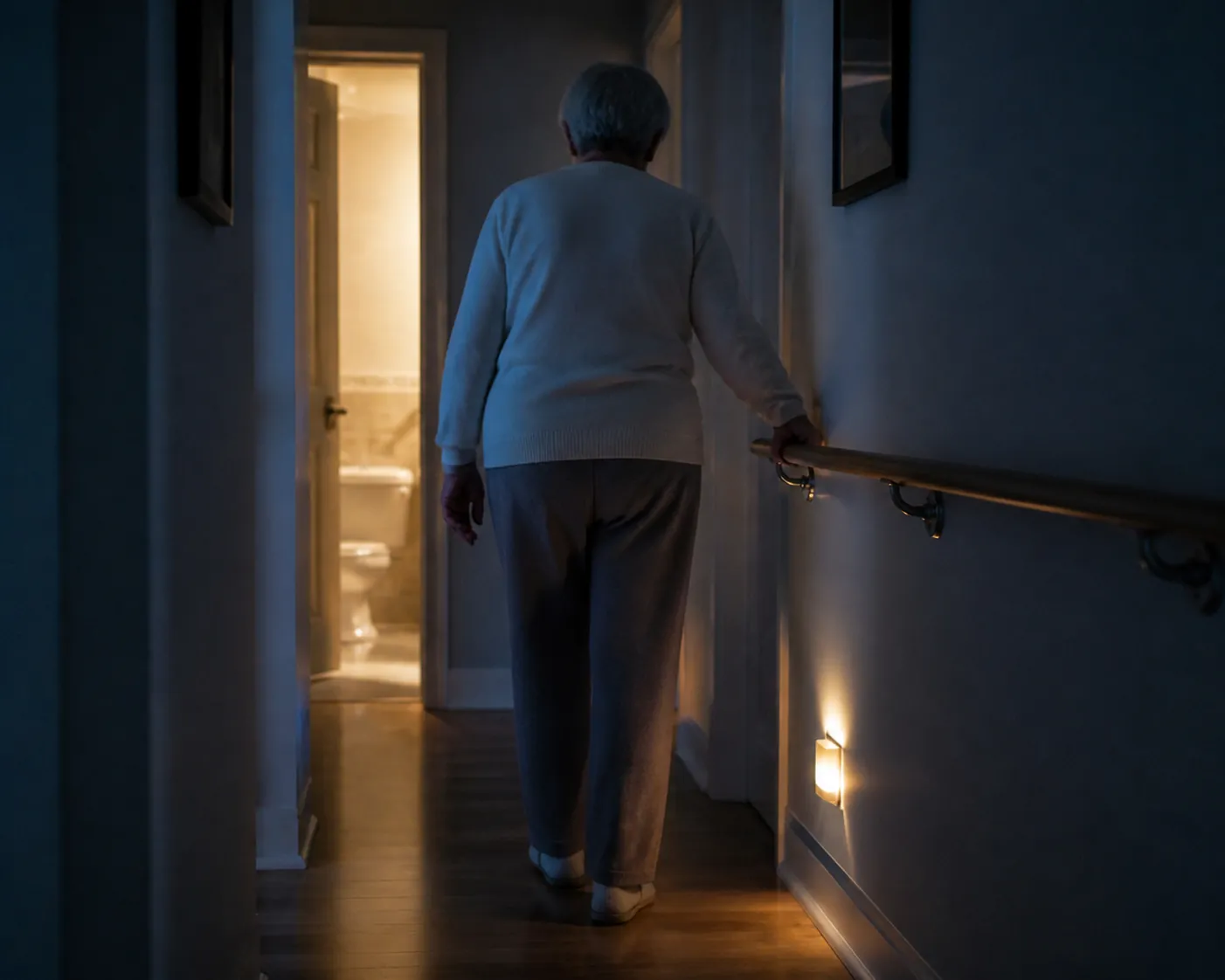
| Nighttime bathroom trip | Rushing, poor lighting, slippers sliding, parent refusing to wake anyone | Clear the bed-to-bathroom path, add night lights, keep the mobility aid at the bedside, and consider a bedside commode if the route is unsafe |
| Toilet transfer | Pulling on the sink, towel bar, doorframe, or caregiver’s hand | Install real grab bars, consider a raised toilet seat or toilet safety frame, and check whether the walker fits the bathroom |
| Shower or tub entry | Stepping over a tub wall, standing with eyes closed, reaching for a towel bar | Use a shower chair or transfer bench, add grab bars, use non-slip surfaces, and avoid unsupported standing showers on weak days |
| Stairs after treatment or surgery | Stopping midway, using both hands on one rail, carrying items while climbing | Limit unnecessary stair trips, keep essentials on one level when possible, and ask PT or OT to assess stair technique |
This is also where caregiver reality needs to be named. NCI’s PDQ summary on informal cancer caregivers reports that 33% of cancer caregivers wanted help keeping their loved one safe at home, and 72% performed medical tasks.[6] If you are counting pills, watching hydration, helping with bathing, and trying to prevent falls, you are not being overprotective. You are doing work that often gets compressed into the phrase “safe at home.”
Before discharge, ask about the house—not just the incision
If your parent is hospitalized for surgery, infection, dehydration, pain control, or treatment complications, discharge planning is the best time to ask for fall-prevention help. Once everyone is home at 9 p.m., the bathroom doorway either fits the walker or it does not. The toilet is either usable or too low. The bed is either reachable or a climbing project.
Ask specific questions while hospital staff can still respond:
- Can my parent get out of bed, walk to the bathroom, turn, sit, stand, and return safely without a staff member lifting them?
- Does the walker, cane, or wheelchair recommended here actually fit through our bathroom doorway and around the toilet?
- Should we have a bedside commode, shower chair, raised toilet seat, toilet safety frame, transfer bench, hospital bed, or temporary first-floor setup before discharge?
- Can occupational therapy or physical therapy evaluate transfers, stairs, bathing, and toileting before we leave?
- Is home health appropriate, and what exactly would the nurse, PT, OT, or aide do in the first week?
- Which symptoms after discharge should lead us to call oncology, primary care, home health, or emergency services?
If discharge has already happened, ask the same questions at the next oncology contact. You do not need to wait for a fall to say, “My parent is now holding the counter every time they stand from the toilet. Can we get OT or PT involved?”
Make the bathroom the first project
The bathroom is where pancreatic-cancer fall risk becomes very practical: urgency from bowel changes, weakness after treatment, dizziness from dehydration or medication, wet flooring, low fixtures, and a parent who wants privacy. It is also the room where family members discover too late that a towel bar is not a grab bar.
Start with toilet transfers. Watch once, respectfully, if your parent will allow it: Where do their hands go? Do they drop onto the seat? Do they need two tries to stand? Are they pulling on the sink, towel bar, doorknob, or your arm? If the answer is yes, the setup is asking a tired body to improvise.
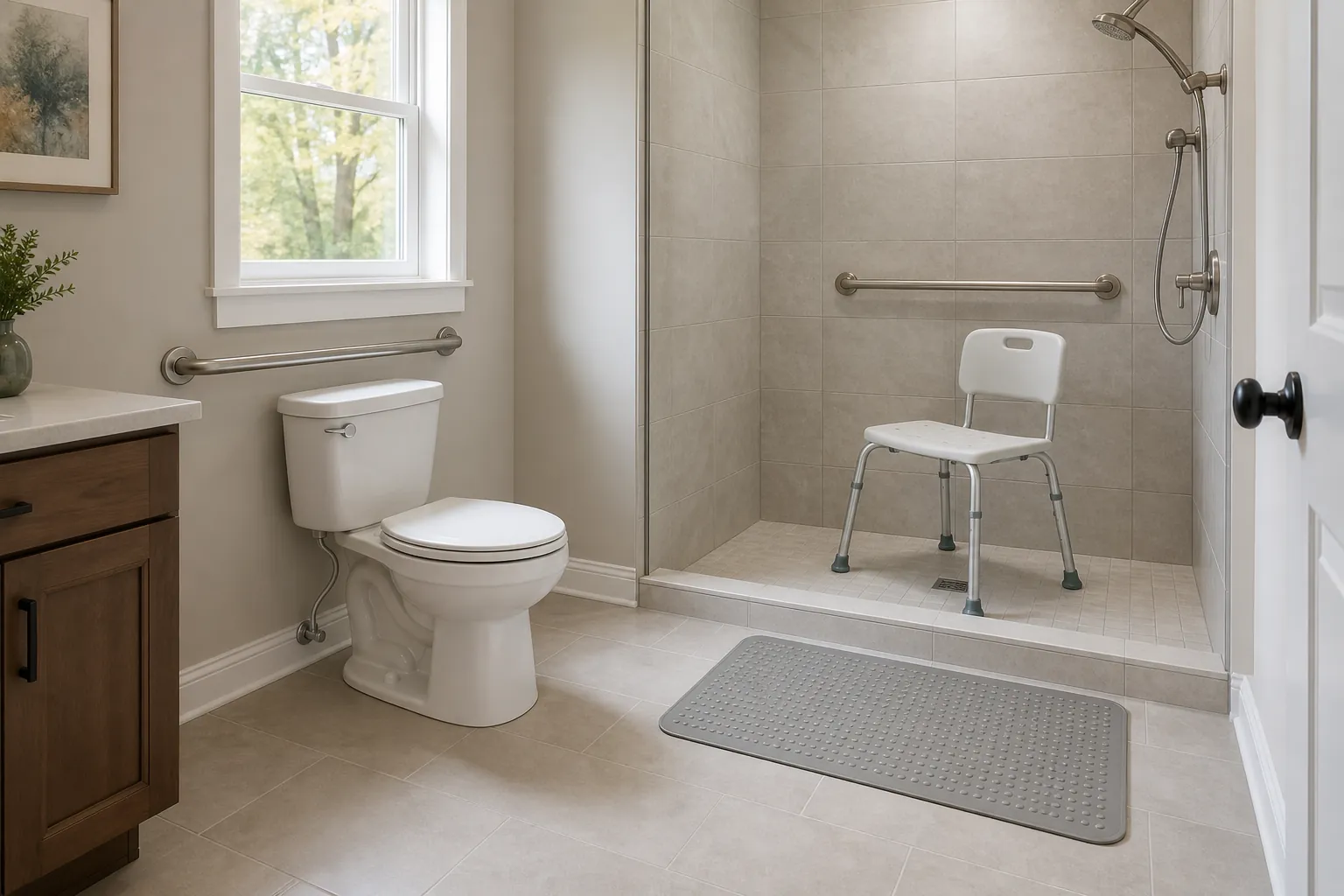
A safer toilet setup may include properly anchored grab bars, a raised toilet seat, or a toilet safety frame. Grab bars should be real grab bars, mounted correctly and able to handle the loads they are designed for; towel bars are not substitutes. For more detail on why this matters, see the site’s guide to towel bars versus grab bars and the warning on using a towel bar as a grab bar.
Then look at bathing. A weak day is not the day to stand in a slippery shower to prove independence. A shower chair, hand-held shower head, non-slip surface, and correctly placed grab bars can turn bathing from a balance test into a seated task. If your parent must step over a tub wall, a transfer bench may be safer than asking them to lift one leg over while tired or numb-footed.
Finally, measure the route. Can the walker enter the bathroom? Can the door close if privacy matters? Is there enough room to turn? If not, the answer may be a different mobility aid, removing the door temporarily, using a nearby commode, or getting OT input. The least safe plan is pretending the bathroom works because everyone is embarrassed to talk about it.
Set up the night route before the first bad night
Nighttime bathroom trips deserve their own plan. Pancreatic cancer care can bring fatigue, medication timing, bowel changes, nausea, poor intake, and dehydration concerns into the same few steps from bed to bathroom. At night, the parent who refuses help may also be the parent most likely to rush because they do not want to wake anyone.
Keep this part simple and non-negotiable:
- Put night lights from bed to bathroom, including the bathroom entrance.
- Remove loose rugs, cords, baskets, scales, shoes, and laundry from the route.
- Keep the walker, cane, glasses, phone, and call bell or monitor within reach of the bed.
- Use footwear that stays on the foot; avoid loose slippers that slide or fold.
- Consider a bedside commode when the bathroom route is long, poorly lit, narrow, or unsafe after treatment.
- If stairs are between the bedroom and bathroom, discuss a temporary first-floor sleeping setup.
The full house still matters. But if your parent is weak, newly medicated, or recovering from surgery, the night route is where “we’ll clean it up later” becomes a fall. For a broader sweep after the urgent fixes, use a room-by-room home-safety assessment rather than trying to remember everything under stress.
Choose mobility supports by the task, not by pride
Many parents resist walkers, shower chairs, commodes, and paid help because those items feel like visible proof that life has changed. That reaction deserves respect. It also does not make the bathroom floor softer.
A useful way to lower the temperature is to match the support to a specific problem instead of announcing a permanent loss of independence. “Use the walker every day forever” is a fight. “Use the walker on chemo days and for nighttime bathroom trips because that is when your legs are least reliable” is a safety plan.
| Support to consider | When it becomes worth discussing | Who can help decide |
|---|---|---|
| Cane | Mild imbalance with enough hand strength and no major turning problem | Physical therapist or clinician familiar with gait |
| Walker | Furniture-walking, fatigue after treatment, unsafe turns, or needing two points of support | Physical therapist; check fit through doorways before relying on it |
| Wheelchair for longer distances | Clinic trips, long hallways, or severe fatigue where walking distance creates fall risk | Oncology team, PT, or durable medical equipment provider |
| Raised toilet seat or toilet safety frame | Pushing hard from the thighs, dropping onto the seat, or pulling on fixtures | OT, home health, or trained installer depending on device |
| Shower chair or transfer bench | Weakness, neuropathy, dizziness, or unsafe tub entry | OT or home health; caregiver should verify bathroom fit |
| Bedside commode | Unsafe nighttime route, urgent toileting, stairs to bathroom, or post-treatment weakness | Oncology nurse, home health, OT, or primary care |
| Temporary hospital bed or first-floor bed | Difficult bed transfers, stairs, pain, drains, or severe weakness after surgery | Discharge planner, home health, OT/PT, or clinician |
If a wheelchair becomes part of the plan, treat it as equipment that needs its own safety habits: brakes before transfers, footrests out of the way, clear turning space, and no pulling up on unstable furniture. The site’s wheelchair safety checklist for seniors covers those basics in more detail.
Build fall review into treatment changes
A pancreatic cancer fall plan should not be a one-time weekend project. Review it whenever the treatment plan or body changes. The most important trigger is not a perfect diagnosis label; it is a visible change in how your parent gets through the house.
- Before hospital discharge: ask for PT/OT input on bed, toilet, shower, stairs, and car transfers.
- After starting or changing chemotherapy: watch for fatigue patterns, neuropathy, dizziness, diarrhea, dehydration, and weaker walking on treatment days.
- After a new medication or dose change: request a medication review focused on dizziness, sedation, blood pressure, bathroom urgency, constipation, and nighttime confusion.
- After weight loss or strength decline: reassess toilet height, shower seating, stairs, chair transfers, and whether the current mobility aid is still enough.
- After dehydration, poor intake, vomiting, diarrhea, or infection concern: assume balance may be worse until the medical issue is addressed.
- After any near-fall: change something immediately. A near-fall is not a funny story if the same route and setup remain in place.
This is where oncology and primary care both belong. Oncology may understand the treatment timing, side effects, and disease course. Primary care may better know the long medication list, blood pressure history, diabetes issues, vision, prior falls, and baseline mobility. The caregiver’s job is often to connect those conversations, because the fall usually happens at home, not in the infusion chair.
Know when family supervision is no longer enough
There is a line between supervising and physically preventing falls. If you are catching your parent, lifting them from the toilet, blocking them from falling in the shower, or sleeping lightly because you expect a dangerous bathroom trip, the plan has already outgrown family-only management.
Escalate to the oncology team or primary-care clinician when you see:
- New or worsening dizziness, fainting, confusion, or sleepiness
- A fall, even if your parent says they are not hurt
- A near-fall that required you to grab, lift, or physically steady them
- New numbness, tingling, foot drop, or balance change during chemotherapy
- Rapid weight or strength decline that changes transfers or walking
- Poor intake, vomiting, diarrhea, fever, or dehydration concerns
- Pain, weakness, or medication side effects that make toileting or bathing unsafe
Ask for the kind of help that matches the problem. OT can work on bathroom setup, transfers, adaptive equipment, and daily tasks. PT can assess gait, stairs, strength, endurance, and the right mobility aid. Home health nursing can monitor symptoms, medications, hydration concerns, wounds, and treatment effects when ordered. A home-care aide may help with bathing, toileting, dressing, meals, and supervision if family cannot cover the unsafe hours.
If cost or coverage is the barrier, ask the discharge planner, oncology social worker, or primary-care office what is available through Medicare, Medicaid, veterans benefits, local aging services, or private-pay agencies. For a starting point on public coverage questions, see the guide to Medicaid long-term care at home.
Treat acute warning signs as medical problems, not household problems
Some fall risks cannot be fixed with a grab bar. If your parent is suddenly confused, too weak to stand, fainting, feverish, severely dehydrated, newly short of breath, unable to keep fluids down, or injured after a fall, that is not a clutter problem. It is a medical situation.
Use the escalation instructions from the oncology team, and do not hesitate to use urgent or emergency care when symptoms are acute. If fever is part of the concern and you are unsure how quickly to act, the site’s guide on when to seek help for fever in an elderly adult can help frame the question, but cancer treatment instructions from the medical team should come first.
The home has to change because your parent’s strength, sensation, hydration, medications, and treatment side effects may be changing. Make the bathroom safer now. Make the night route boring and well lit. Ask for medication and fall-risk review when treatment changes. Bring in OT, PT, home health, or home-care help when you are no longer just supervising. And when the warning signs are medical, treat them that way.
References
- SEER Cancer Stat Facts: Pancreatic Cancer. National Cancer Institute SEER.
- Caregiver Roles and Responsibilities. Pancreatic Cancer Action Network.
- Pancreatic Cancer Nutrition. Johns Hopkins Medicine.
- The Delicate Balance of Treating Older Adults With Metastatic Pancreatic Cancer. ASCO Daily News.
- Management of pancreatic cancer in the elderly. World Journal of Gastroenterology.
- Informal Caregivers in Cancer. National Cancer Institute.
Related reading
Noticed something outdated or inaccurate on this page? Flag a correction. We review every report against CDC, NIA, and AARP HomeFit guidance before updating a page.
Part of the Fall Prevention section.