
STEADI: intervene
Cruise Fall Safety Checklist for Elderly Travelers
Falls on cruise ships aren't random — they cluster in predictable spots like cabins, bathrooms, wet decks, and stairs. This location-by-location checklist shows elderly travelers and their caregivers what to check and book before a voyage to reduce the risk of slips and trips aboard and ashore.
A useful cruise safety checklist for elderly travelers does not begin with a warning to stay home. It begins with the same practical question you would ask in a parent’s house: where will the floor be wet, dark, narrow, crowded, or uneven?
Cruise falls are often discussed as if they are random accidents. The better evidence points to something more useful: injuries cluster in ordinary places. In a 3-year single-ship study, the median age of injured passengers was 72; slips, trips, and falls accounted for 44.8% of onboard injuries and 69.4% of injuries ashore; and the top onboard injury locations were cabins at 20.1% and bathrooms at 13.4%.[1] The CDC Yellow Book 2026 also notes that falls account for 12–18% of cruise ship medical-center visits, making them the second most common diagnosis after respiratory illness.[2]
Those numbers should not be read as a personal fall probability for every older passenger. They do not give a universal fall rate for all cruise travelers over 65. They do tell us where to look first: the cabin, the bathroom, wet public decks, stairs, gangways, tenders, and shore routes. For an older adult who has already fallen once, that matters even more, because CDC fall data show that more than 1 in 4 older adults falls each year and that falling once doubles the chance of falling again.[3]
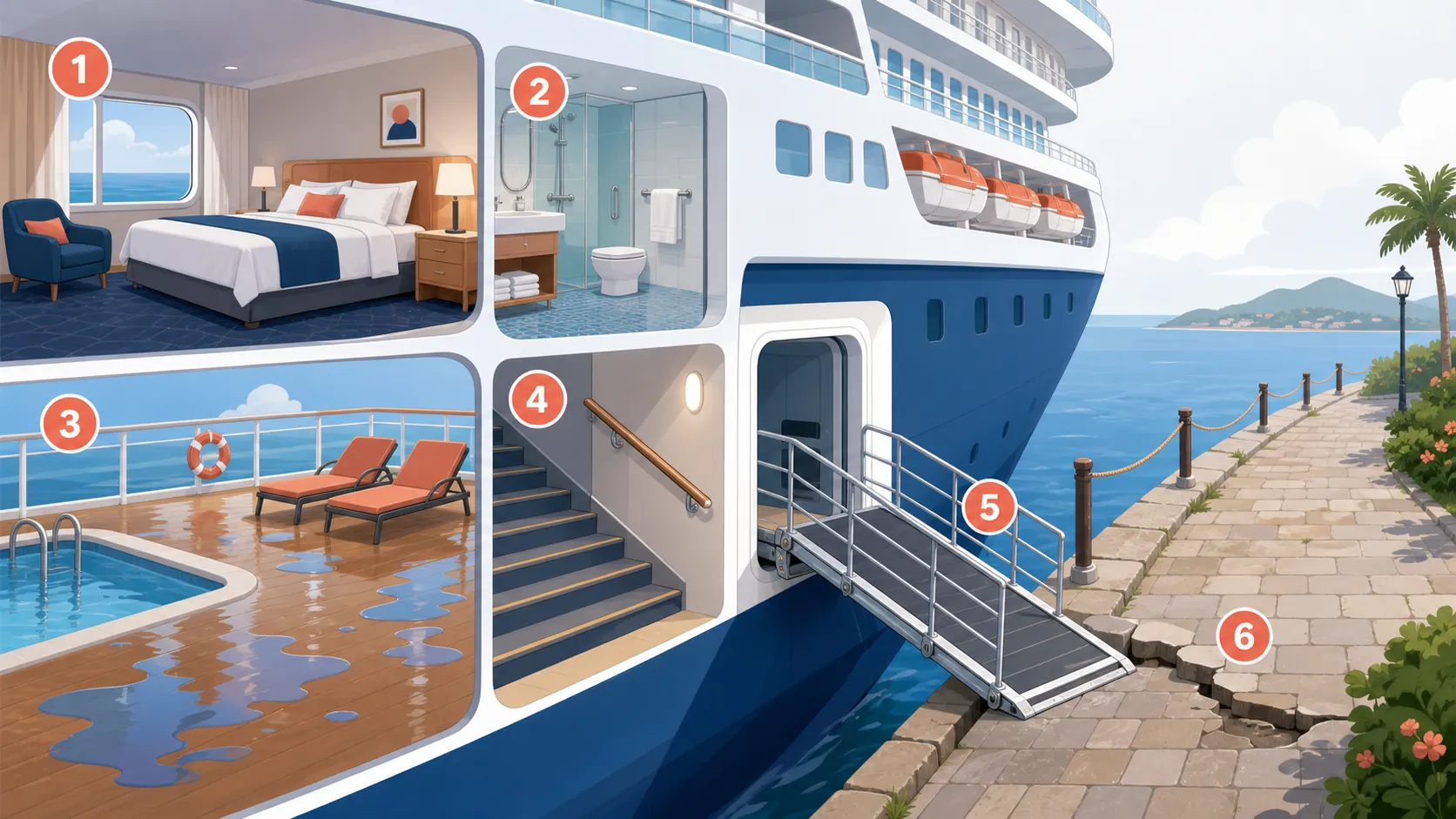
Start with a ship walkthrough, not a packing list
Sunscreen, dinner clothes, and excursions can wait. The first safety decision is whether the ship, cabin, route, and ports fit the traveler’s body on an ordinary tired day. Not the best day. Not the “I’ll manage” day. The day after a long transfer, a poor night’s sleep, or one extra trip to the bathroom in the dark.
This planning guidance is not medical, financial, or legal advice. It is a fall-prevention walkthrough. If a clinician has given specific restrictions after a recent fall, surgery, fainting episode, stroke, medication change, or new mobility problem, those instructions come first. Cabin category and accessibility choices can also affect trip cost, so families should make those decisions with their own budget and booking terms in mind.
| Cruise location | Before booking | First day onboard |
|---|---|---|
| Cabin | Confirm cabin type, doorway width, bed-to-bathroom route, room for cane, walker, scooter, or wheelchair, and distance to elevator. | Walk the route from bed to bathroom with the mobility aid in use; remove loose obstacles and decide where the aid will park overnight. |
| Bathroom | Ask about roll-in shower, shower threshold, grab bars, toilet height, shower bench, and non-slip flooring. | Test the shower entry, toilet transfer, towel reach, and night lighting before the first evening. |
| Public decks | Review pool-deck access, dining distance, elevator access, and whether outdoor routes are required. | Notice wet surfaces, raised thresholds, deck lips, crowd pinch points, and handrail locations. |
| Stairs and elevators | Choose a cabin that reduces unnecessary stair use and long walks. | Identify the nearest elevators and a quiet alternative route for busy times. |
| Gangway or tender | Ask whether the itinerary uses tenders and what rules apply to walkers, scooters, wheelchairs, and manual assistance. | Recheck conditions before each port; weather and gangway angle can change the plan. |
| Shore excursions | Ask about walking distance, terrain, stairs, restrooms, transportation steps, and pace. | Skip or modify any outing that turns into loose gravel, hurried stairs, or a long unsupported walk. |
Cabin and bathroom: book the protection before the suitcase comes out
The cabin is easy to underestimate because it looks private and controlled. On a cruise, it is also where someone wakes up disoriented, steps around luggage, turns toward a compact bathroom, and tries to manage a moving ship before the lights are fully on. The bathroom adds water, thresholds, tight turns, and hurried transfers. That is why the cabin-and-bathroom decision belongs at booking, not at check-in.
Accessible cabins are limited. Cruisebound reports that accessible cabins with features such as grab bars and roll-in showers are roughly 3–5% of cruise ship inventory and can sell out months ahead. It also notes that standard cabin doorways may be about 22–23 inches wide, compared with about 32–36 inches for accessible cabins.[4] Those measurements change the practical answer to a simple question: can the traveler actually use the room with the mobility device they need?
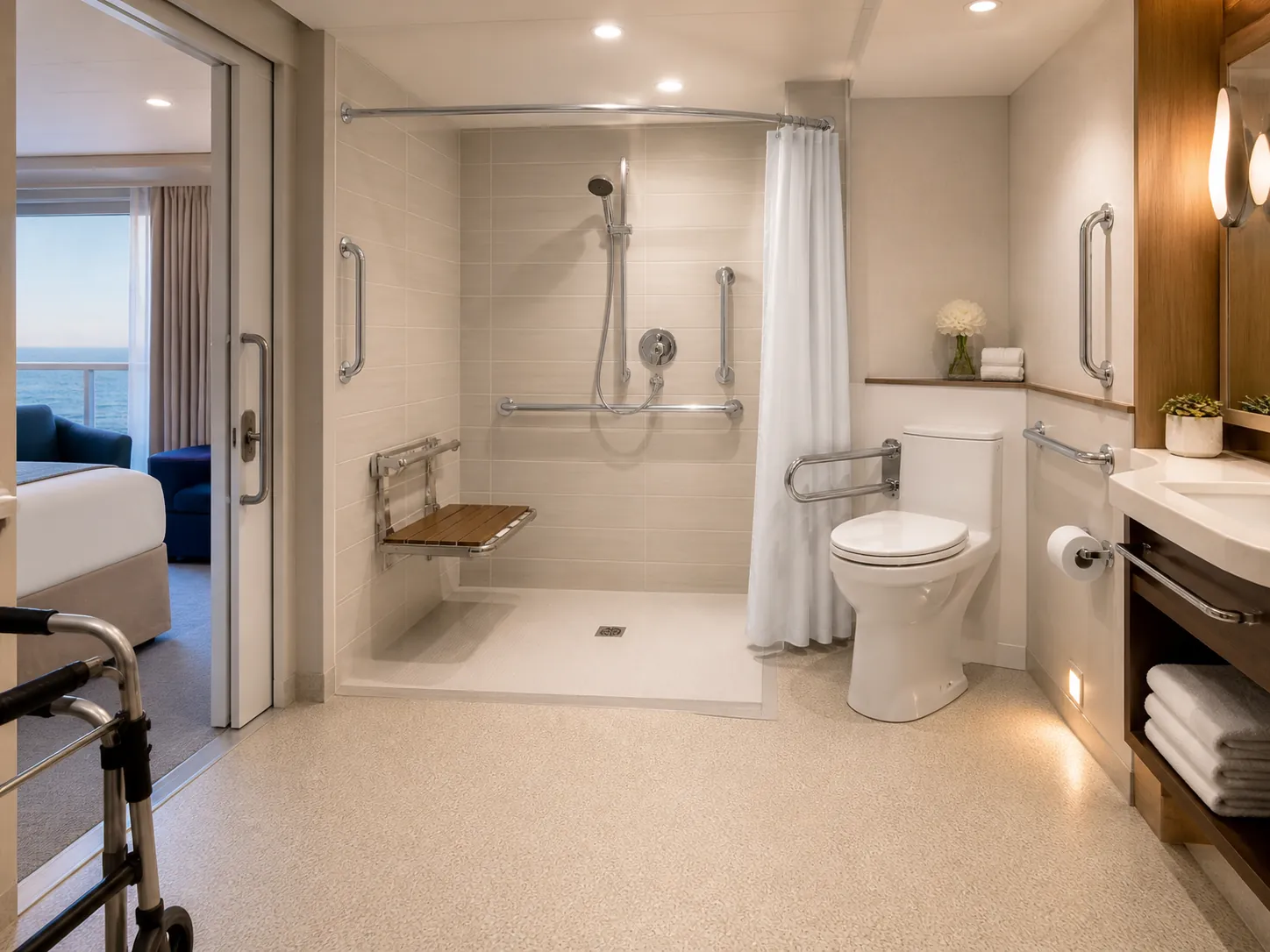
Questions to ask before booking the cabin
The words “accessible” and “mobility friendly” are not enough. Ask for physical details, then save the answer in writing. A phone call is useful; a written confirmation is better when the trip depends on a roll-in shower or a scooter that must fit through the door.
- Is the cabin fully accessible, ambulatory accessible, or standard? Those categories can mean different things.
- What is the cabin doorway width and bathroom doorway width?
- Is the shower roll-in, low-threshold, or a standard step-in shower?
- Are there grab bars at the toilet and in the shower, and where are they placed?
- Is there a built-in shower seat or a portable shower chair available by request?
- Can the traveler’s walker, rollator, scooter, or wheelchair be used inside the cabin, not just stored in it?
- Where can the mobility device be charged or parked without blocking the bed-to-bathroom path?
- How far is the cabin from the nearest elevator, dining room, medical center, and usual meeting point?
- Does the cabin have a connecting door, pull-down bed, coffee table, or furniture arrangement that narrows the walking route?
Cabin location deserves the same attention as cabin features. A beautiful room at the far end of a long corridor may be a poor match for someone who fatigues after dinner. A cabin close to an elevator can reduce walking, but it may also sit near noise and traffic. The best choice is not always the most luxurious one; it is the one that reduces avoidable walking without placing the traveler in a constant crowd.
What to do when you first open the cabin door
Do the first cabin walkthrough before unpacking. Luggage on the floor makes a small room smaller, and the first evening is when people are most tempted to say, “We’ll fix it tomorrow.” Tomorrow is not when the first nighttime bathroom trip happens.
- Walk from the bed to the bathroom with the cane, walker, rollator, or wheelchair the traveler will actually use at night.
- Move suitcases out of the walking path immediately, even if they are not unpacked yet.
- Decide where the mobility aid will sit overnight so it can be reached before the first step, not after.
- Check whether the bathroom door swings into the route or blocks the mobility aid.
- Turn on the lowest useful light and see whether it creates glare, shadows, or a clear path.
- Place shoes or non-slip slippers in the same reachable location every night.
- Put glasses, hearing aids, phone, and any call device where they can be reached from bed.
- Test the shower surface with a dry hand and again when wet; ask for a mat or additional support if the surface feels slick.
- Check towel placement. Reaching across a wet floor after a shower is an unnecessary transfer risk.
Night lighting is not a decoration. It is part of the route. If the traveler has cataracts, macular degeneration, poor contrast sensitivity, or trouble adjusting from dark to light, review vision-related warning signs before the trip and make the cabin path brighter without creating glare. The same logic used in a home bathroom applies here; the difference is that the cruise bathroom is smaller and less forgiving. For a deeper pre-trip check, see 10 Signs of Vision Loss in the Elderly.
Wet decks and public areas: watch the route, not the view
Pool decks, buffet entrances, spa areas, outdoor promenades, and drink stations deserve a different walking pace. Water can travel farther than the obvious puddle. So can sunscreen, spilled drinks, and tracked-in rain. The safest route is often not the prettiest route or the shortest one; it is the route with a handrail, fewer people, better lighting, and less surface change.
Footwear is one of the few fall-prevention tools that has to be on the body to work. Backless sandals, loose slippers, and smooth leather soles are poor matches for wet decks and long corridors. Pack shoes that have a secure heel, a sole with grip, and enough room for feet that swell during travel. If the traveler already uses traction-minded footwear in winter or on wet pavement, the same habit belongs on a ship. The practical footwear logic in How Seniors Living Alone Can Prevent Winter Falls carries over well to rain-slick docks and pool-deck surfaces.
On the first day, find the routes that avoid the worst crowding. That usually means testing a path to the dining room, theater, elevator bank, muster station, and outside deck before the ship is full of people moving in the same direction. A route that works at 3 p.m. may not work when a show lets out, when the buffet opens, or when passengers hurry to a port meeting point.
Stairs and elevators: reduce the moments that make people hurry
Stairs on a ship are not automatically unsafe. The risky combination is a stairway plus motion, crowding, bifocals, a handbag, a plate of food, poor lighting, alcohol, or someone behind the traveler who wants to move faster. If stairs are optional, make them optional before the traveler is tired.
- Use elevators for routine movement if the traveler has balance problems, foot drop, knee instability, dizziness, or low vision.
- Avoid stairways immediately after shows, announcements, port arrivals, and dining-room rushes.
- If stairs must be used, keep one hand free for the rail. Bags, drinks, plates, and phones can wait.
- Do not let a cane or walker become luggage. If the traveler needs it on land, assume they need it in long ship corridors too.
- Build in extra time. Hurrying is a fall-risk multiplier that families can often remove.
Elevators have their own timing problem. On large ships, elevator banks can become crowded, and a traveler with a walker may be nudged into stepping backward or turning sharply. Let the first crowded elevator go. Step in only when there is space to enter forward, turn safely if needed, and exit without being pushed by the next wave of passengers.
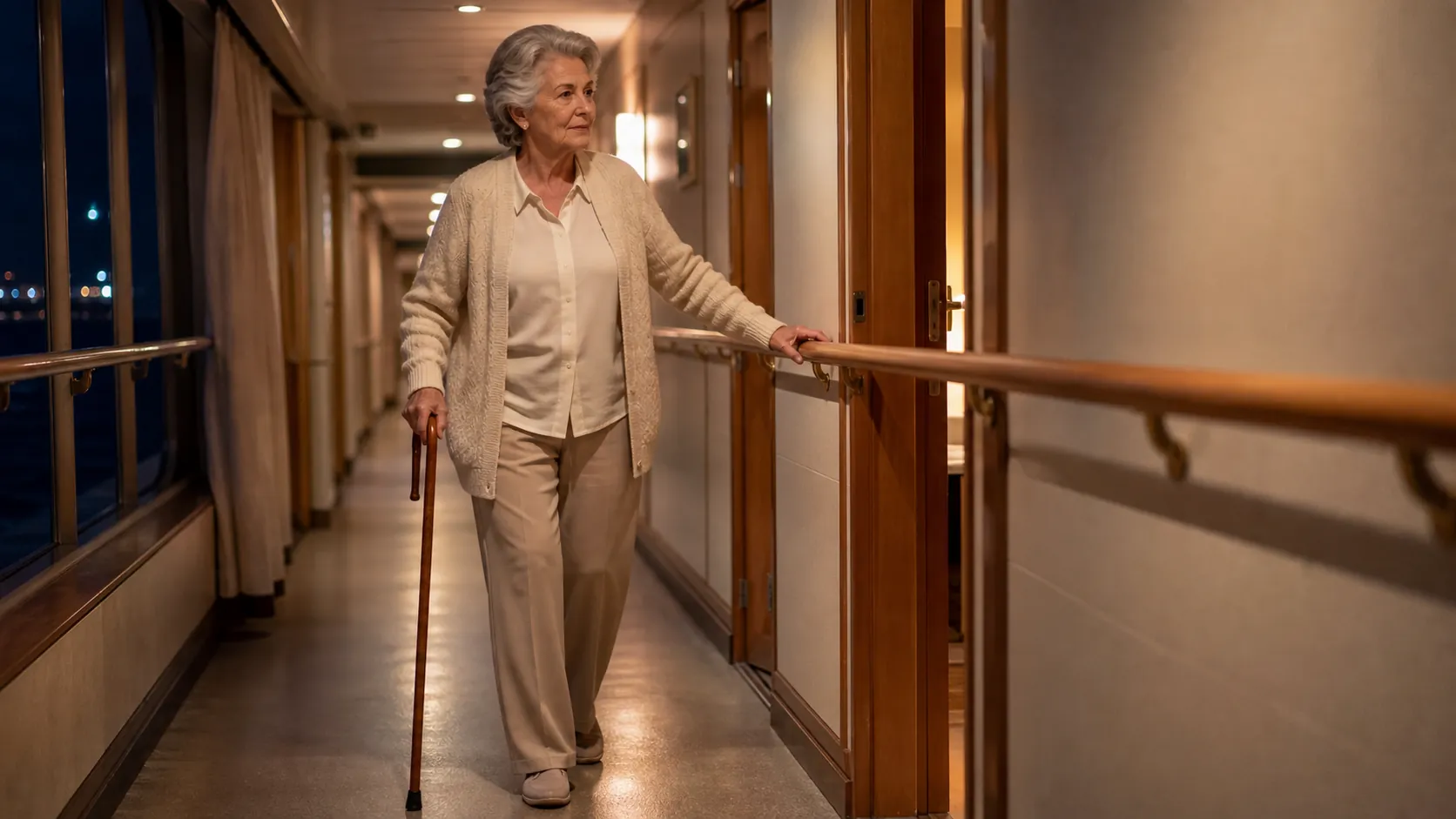
Gangways, tenders, and port days need written answers
The transition from ship to shore is where a good cabin choice can be undone by a bad assumption. Gangways may be steep or wet. Dock surfaces may be uneven. Tenders can add a moving transfer between the ship and a smaller boat. Cruisebound notes that tender access for mobility devices varies by cruise line, which is why this is not a detail to settle at the gangway with a line of passengers behind you.[4]
Before booking, ask whether the itinerary commonly uses tenders and whether each port is expected to dock or tender. Even then, treat the answer as planning information rather than a guarantee, because weather and port conditions can change operations. The important part is to know the cruise line’s rules before the traveler is standing at the edge of a transfer they cannot safely make.
- Will any scheduled port require a tender instead of docking?
- Can the traveler remain seated in a wheelchair or scooter during embarkation, debarkation, or tendering, or must they transfer?
- Are scooters, power chairs, walkers, or rollators allowed on the tender for this ship and sailing?
- What assistance is available at embarkation and debarkation, and must it be requested in advance?
- Where should the traveler meet assistance staff, and how much extra time should be allowed?
- If the traveler cannot safely tender on the day of arrival, what onboard alternatives are available?
Get these answers in writing when mobility access is central to the trip. A cheerful “you should be fine” is not the same as a policy answer for a specific ship, sailing date, mobility device, and port sequence.
Shore excursions: read the ground, pace, and bathroom access
The single-ship study found a higher share of slips, trips, and falls among injuries ashore than onboard.[1] That does not mean every port is dangerous. It means the ship’s controlled environment ends at the gangway. Curbs, cobblestones, gravel, sand, wet pavement, bus steps, low lighting, and rushed group movement all become part of the fall-prevention plan.
Excursion descriptions often use friendly words such as “easy,” “panoramic,” or “short walk.” Translate those words into physical facts before booking. How far is the walk from the meeting point to the bus? Are there steps into the vehicle? Is the path paved? Is seating available during stops? Are restrooms close, accessible, and predictable? A traveler who can walk comfortably for a few minutes on a level ship corridor may not be safe on a hot, uneven path with a group guide moving ahead.
- Choose excursions by terrain first, sightseeing second.
- Ask whether the slowest walker sets the pace or whether the group must keep up.
- Avoid tours that require carrying bags while climbing steps or walking on loose surfaces.
- Plan a seated rest before the return walk, not only after it.
- Keep the mobility aid available during shore stops. Leaving it on the bus because the stop is “quick” is exactly how a short walk becomes a risky one.
There is no shame in treating the ship as the destination for a port day. For some travelers, the safer and happier choice is a quiet breakfast, a short supported walk on deck, and a view from the ship while everyone else rushes down the gangway.
The small health details that change walking safety
General cruise wellness advice only belongs in a fall checklist when it affects balance, alertness, strength, or the ability to respond after a fall. Medication planning does. So do glasses, hearing aids, hydration, footwear, and a carry-on that keeps essential items with the traveler instead of in checked luggage.
The American Geriatrics Society’s Health in Aging tip sheet advises older travelers to keep medications in their original labeled containers, carry them in a carry-on, bring a written medication list, and consider compression stockings for deep vein thrombosis prevention during travel.[5] CDC Travelers’ Health also advises older adults to plan ahead for travel health needs, including medications and destination-specific risks.[6]
- Pack medications, glasses, hearing aids, chargers, mobility-device parts, and a current medication list in the carry-on.
- Ask the prescribing clinician or pharmacist whether any medication changes could increase dizziness, sleepiness, urgency, or nighttime bathroom trips.
- Bring the walking aid the traveler uses at home, even if they hope to need it less on vacation.
- Use compression stockings only as appropriate for the traveler’s health situation and clinician guidance.
- Plan water, meals, and rest so the traveler is not walking long distances while lightheaded, overheated, or weak.
A cruise carry-on for an older traveler should look more like a one-day safety kit than a convenience bag. The same packing discipline used in emergency planning helps here: keep mobility, vision, hearing, medications, and contact information close. For a model of that kind of practical list, see the Hurricane Go-Bag Checklist for an Elderly Parent Living Alone.
If illness or a fall turns the cabin into the whole living space
Ship medical care is not the center of a fall-prevention plan, but families should know when to stop minimizing. Cruise Critic reports that infirmaries operate under American College of Emergency Physicians standards requiring at least one doctor and two nurses on 24-hour call, and it notes that norovirus quarantine typically means cabin confinement until 72 hours symptom-free.[7]
Cabin confinement matters for falls because the room becomes the entire living space. Meals, bathroom trips, fatigue, fever, dehydration, and medication timing all happen in a small area. Keep the walking route clear even when trays, towels, and bags start accumulating. If a fall occurs, or if the traveler has head impact, new confusion, fainting, chest pain, severe dizziness, new weakness, uncontrolled bleeding, or cannot bear weight, contact ship medical promptly rather than waiting to see how the next port goes.
This is also where mobility-aid placement becomes non-negotiable. A walker parked across the bathroom door is a barrier. A cane leaning out of reach is decoration. Keep the route open, keep the aid reachable, and move anything that forces a sideways step in a narrow cabin. The same clear-path principle used during a home water emergency applies on a ship as well; Why a Water Crisis Is a Fall Emergency for Older Adults explains why disrupted routines and blocked routes become fall risks quickly.
The short routine that makes the trip more possible
Before booking, verify the cabin, bathroom, mobility-device fit, elevator distance, tender rules, embarkation help, and shore-excursion terrain. Save the answers. If the answer is vague, ask again in more physical terms: doorway width, shower threshold, transfer requirement, walking distance, surface, stairs, handrails, and where the traveler waits.
On the first day onboard, walk the ship like a temporary home. Start at the bed. Go to the bathroom. Find the light switch. Park the walker. Test the shower. Then walk to the elevator, dining room, medical center, outside deck, and port meeting point at an unhurried pace. Notice wet areas, thresholds, railings, glare, carpet changes, and crowded turns before they become a surprise.
A prior fall or balance concern is not an automatic reason to cancel a cruise. It is a reason to stop relying on “be careful” and start asking better questions while there is still time to choose the cabin, change the excursion, request assistance, or pick the sailing that lets the older traveler participate with less scrambling.
References
- Injuries and illnesses of passengers on a cruise ship, PubMed
- Cruise Ship Travel, CDC Yellow Book 2026 / NCBI Bookshelf
- Facts About Falls, CDC
- Cruising with Mobility Aids, Cruisebound
- Tip Sheet: Safe Travel Tips for Older Adults, Health in Aging
- Senior Citizens and Travel, CDC Travelers’ Health
- Cruise Ship Doctors and Medical Facilities Onboard, Cruise Critic
Related reading
Noticed something outdated or inaccurate on this page? Flag a correction. We review every report against CDC, NIA, and AARP HomeFit guidance before updating a page.
Part of the Fall Prevention section.