
STEADI: intervene
Why a Water Crisis Is a Fall Emergency for Older Adults
A water crisis — whether from flooding, a boil advisory, or a supply outage — quietly multiplies an older adult's fall risk through dehydration, moving floodwater, and slippery post-flood surfaces. This guide maps those three hazards and gives before-during-after countermeasures to keep seniors upright when water access is disrupted.
When the water system fails, the fall-prevention system fails with it. The usual supports that keep an older adult steady — predictable drinking water, dry walking routes, a walker parked in its normal spot, a clear path to the bathroom — can all change in the same hour.
That is why emergency preparedness for seniors during a water crisis has to be more specific than “store water” or “avoid floodwater.” The fall question is simple and practical: can the older adult stay hydrated, avoid unstable water, keep mobility aids usable, and move through the home without slipping?
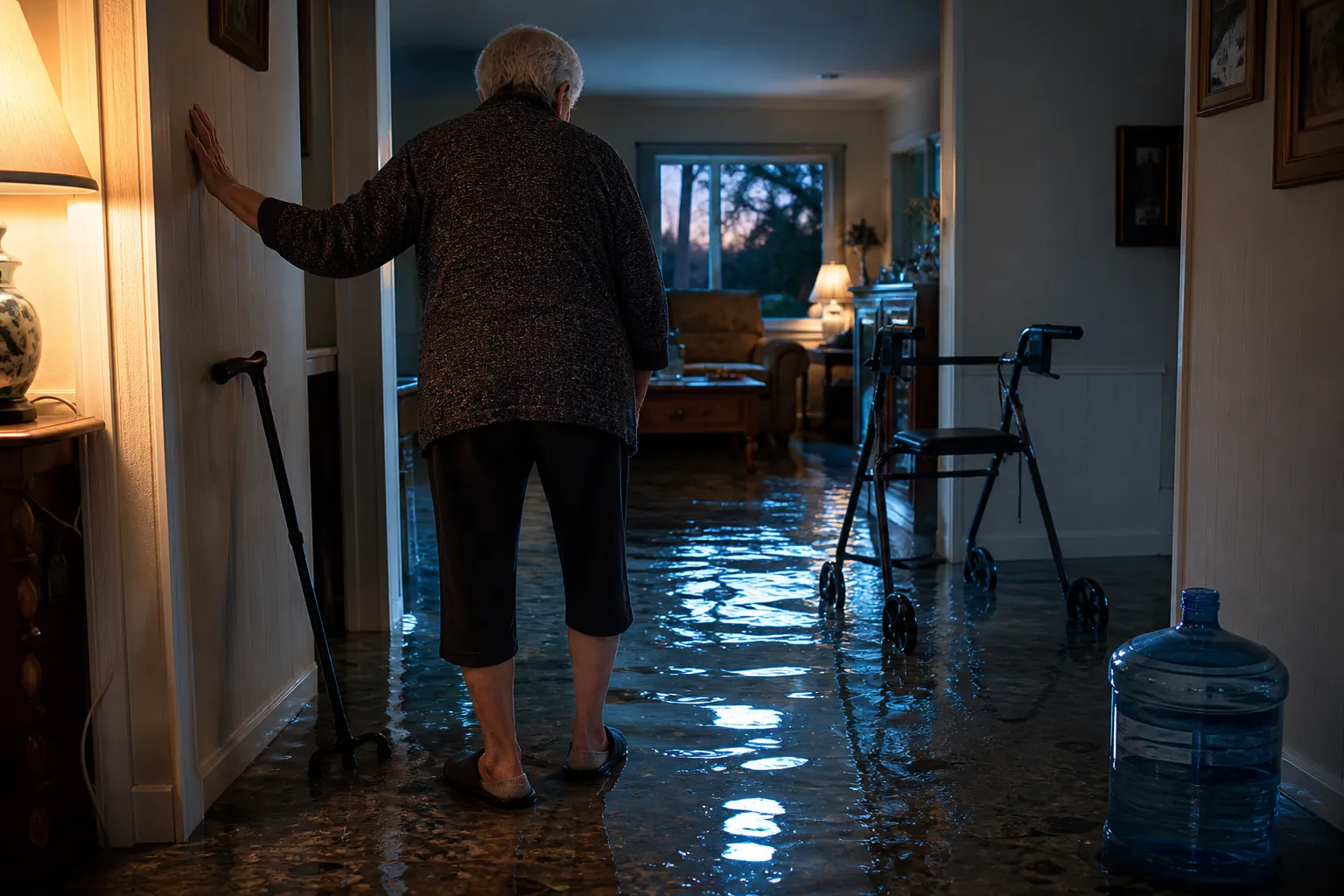
A “water crisis” here means any event that disrupts safe or usable water: flooding, a supply outage, a boil water advisory, a do-not-drink advisory, or a do-not-use advisory. The CDC distinguishes those advisory types because each changes what people can safely do with tap water, but this article is not a full advisory playbook. The focus is narrower: how water disruption changes fall risk for an older adult at home or during evacuation. [1]
Three hazards matter most: dehydration that can worsen balance, moving or standing floodwater that turns walking into a stability problem, and wet post-flood surfaces that make cleanup dangerous after the dramatic part appears to be over.
| Fall hazard | What changes during a water crisis | Fall-prevention question |
|---|---|---|
| Dehydration | Safe drinking water may be unavailable, hard to reach, too heavy to pour, or forgotten during stress. | Can the person drink enough without lifting, bending, rushing, or waiting for someone else? |
| Moving or standing floodwater | Ground depth, current, debris, and surface firmness may be hidden. | Has the no-walking-through-moving-water rule been set before anyone is frightened? |
| Wet post-flood surfaces | Floors, rugs, thresholds, cords, towels, and displaced furniture create new trip and slip points. | Is there a dry, lit, uncluttered route before cleanup starts? |
Last verified: August 2, 2026. This article is for general fall-prevention planning, not medical advice. Fluid needs, fluid restrictions, diuretics, kidney or heart conditions, dizziness, and individualized fall risk should be discussed with the older adult’s clinician.
Hydration is a balance issue, not just a comfort issue
The quietest fall hazard in a water crisis is often the one nobody sees: the older adult drinks less. The tap water may be unsafe. The bottled water may be in the garage. The gallon jug may be on the floor because that is where someone dropped it during storm prep. A caregiver may assume, reasonably but wrongly, that “we have water” means “Mom can drink water safely whenever she needs it.”
The medical link deserves careful wording. In a study of 30,634 adults age 65 and older, 37.9% were dehydrated, and dehydration was positively associated with falls, with an odds ratio of 1.13 and a 95% confidence interval of 1.05 to 1.22. The authors discuss plausible mechanisms including impaired brain perfusion, dizziness, and orthostasis, but the study shows an association, not proof that dehydration directly caused the falls. [2]
That distinction matters because caregivers need useful caution, not a neat slogan. Dehydration is one risk factor among others: medications, strength, vision, blood pressure changes, illness, footwear, and the walking surface all still matter. But during a water crisis, hydration can move from background habit to active fall-prevention task.
Older adults are already more likely to miss early thirst signals. UCLA Health notes that thirst sense weakens with age, that up to 40% of adults 65 and older may be chronically dehydrated, and that diuretics and other common medications can increase fluid loss. NCOA gives similar practical warnings about aging, medications, and hydration. [3][4]
The fall-safe version of stored water asks more questions than a supply checklist usually does:
- Can the older adult reach the water without standing on tiptoe, bending to the floor, or crossing a wet room?
- Can they open it with their grip strength?
- Can they pour it without lifting a full gallon?
- Is there a chair where pouring can happen seated?
- Are cups placed where the person actually sits, takes medications, and eats?
- If thirst cues are unreliable, is there a gentle sip schedule tied to meals, medication times, or phone check-ins?
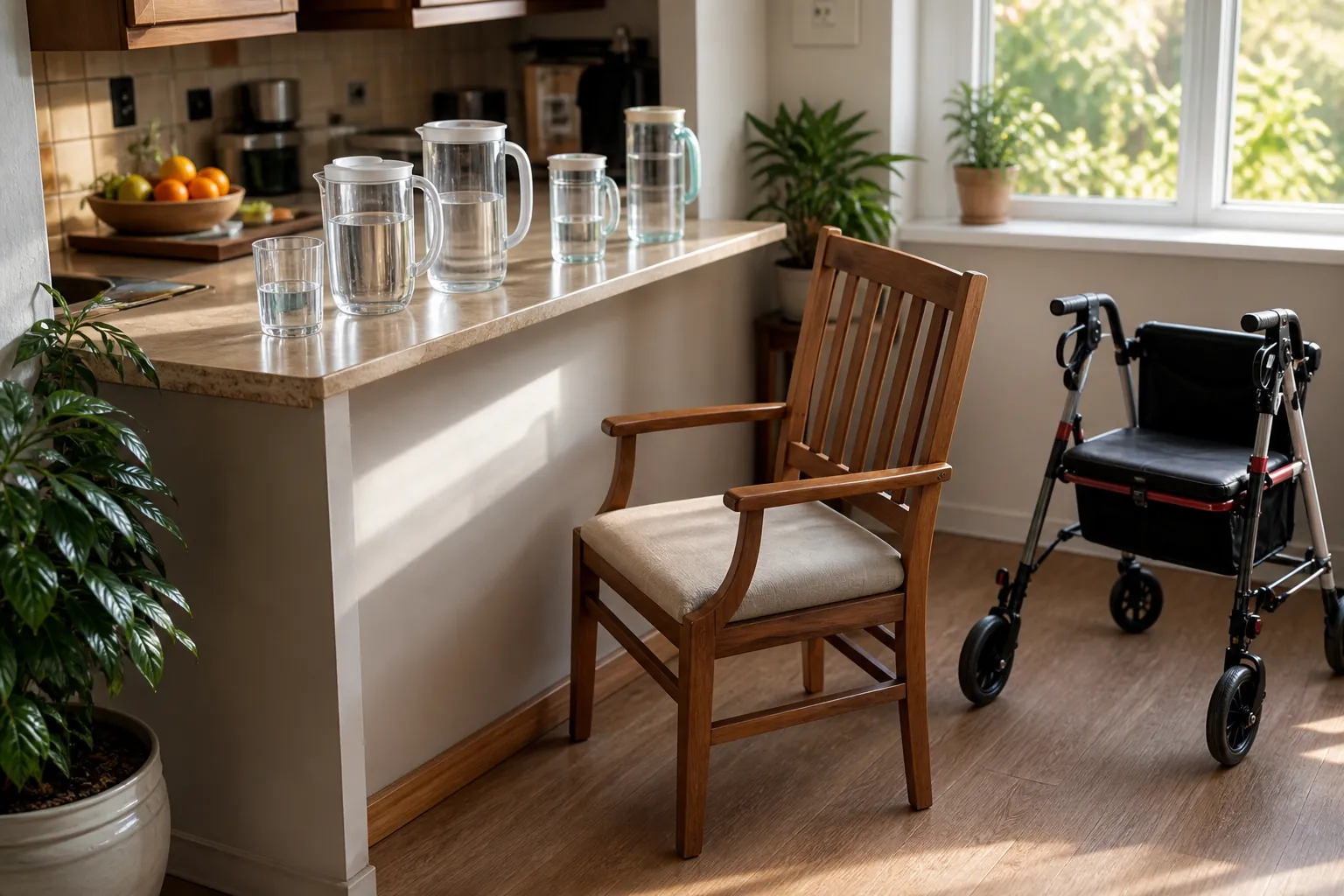
Stored water has to be usable by the person who needs it
CDC emergency water guidance recommends storing at least 1 gallon per person per day, with a 3-day minimum and a 2-week supply preferred when possible. The CDC also advises replacing stored water every 6 months, keeping it at 50°F to 70°F when possible, and storing it away from toxic substances such as gasoline, pesticides, or chemicals. [5]
Ready.gov adds an important condition for older adults in hot weather: water needs can double. That matters for fall prevention because heat, sweating, limited air conditioning, and disrupted routines can make dizziness more likely in the same period when floors and walking routes are less safe. [6]
The adaptation is not complicated. Keep some water in smaller containers instead of relying only on heavy jugs. Put water at waist-to-chest height, not on the floor or a high shelf. Set one container and cup near the usual chair, another near the bed if nighttime drinking is part of the routine, and another near the medication area. If a large container is unavoidable, add a pump, spigot, or caregiver-filled smaller pitcher so the older adult is not trying to deadlift a gallon while standing.
For someone on fluid restriction, dialysis, heart failure management, or diuretics, do not improvise a new intake target during a storm. Ask the clinician ahead of time what the emergency plan should say: how much fluid is allowed, what symptoms should trigger a call, and whether medication instructions change if vomiting, diarrhea, heat exposure, or poor intake occurs.
Moving floodwater is not a walking surface
Floodwater creates a different fall problem than a wet kitchen floor. It hides curbs, holes, soft ground, debris, and current. A rollator, cane, or walker does not fix that; in moving water, it can become one more unstable object.
The Red Cross warning is blunt: just 6 inches of fast-moving water can knock a person off their feet, and 12 inches can carry a vehicle away. [7]
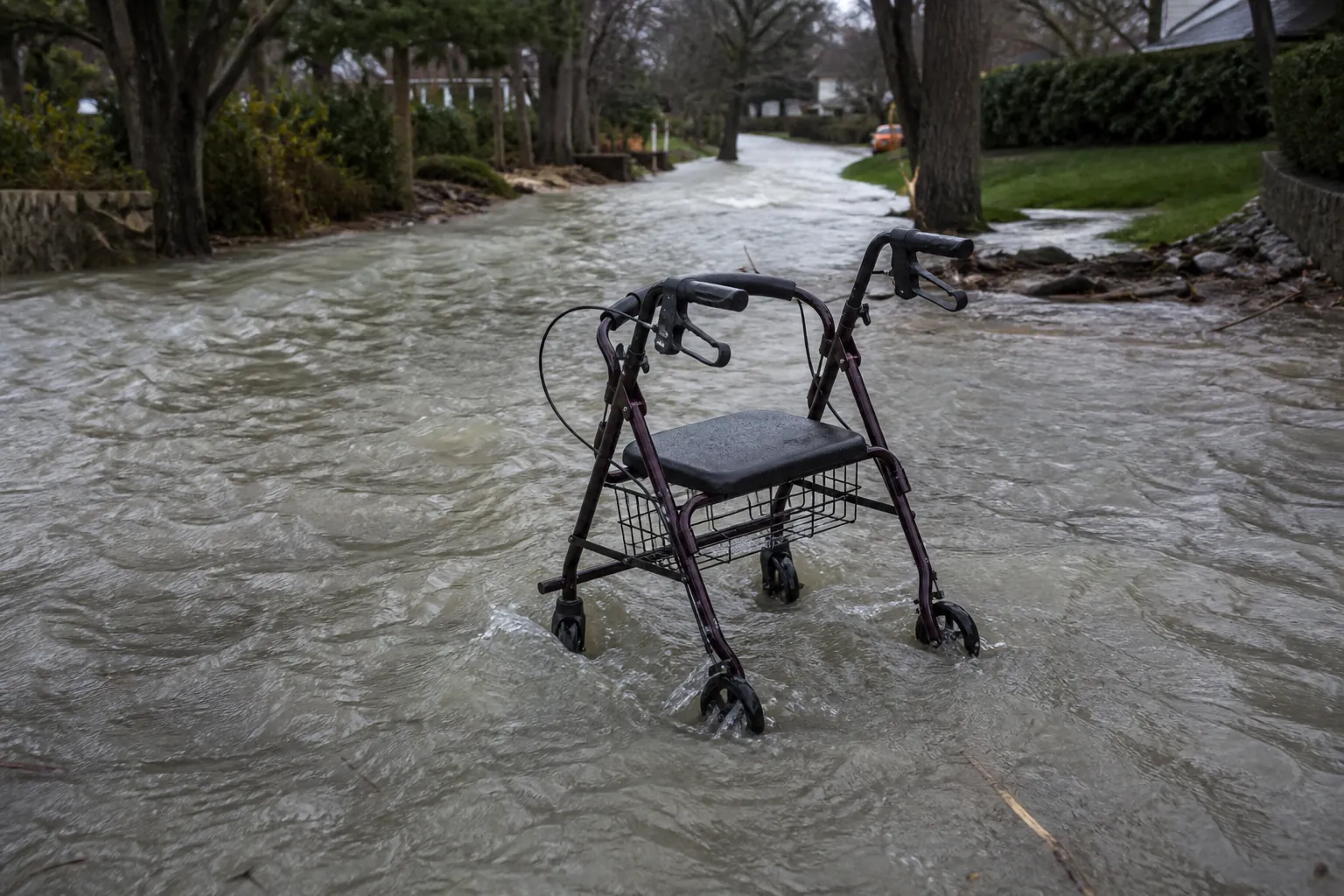
For an older adult, the rule should be decided before the storm, not negotiated at the doorway: do not walk through moving water. That includes “only a little” water across a driveway, sidewalk, apartment walkway, or curb cut. Fear, darkness, sirens, and a ringing phone are poor conditions for deciding whether a current is manageable.
If evacuation may be needed, the safer fall-prevention move is to leave early enough that the person is not being asked to walk through water at all. That is especially true for someone who needs extra time to transfer, uses a mobility aid, has low vision, or becomes unsteady when rushed. A caregiver who waits until the front steps are wet may have fewer choices and a much harder physical task.
There is a narrower situation where walking near floodwater may be unavoidable and water is not moving. California Department of Aging disaster tip sheets advise walking only where water is not moving and using a stick to test ground firmness. That is not permission to test a current; it is a last-resort caution for ground that may look solid and still fail underfoot. [8]
This is also where independence needs protection without pretending risk is equal for everyone. The older adult should know the rule and the reason, not just be told “you can’t.” A plain version works: “If water is moving, we do not walk through it. We call for help or wait for a safer route.”
After the water goes down, the home may still be in its most dangerous condition
The end of visible flooding can feel like permission to start fixing everything. That is when a lot of small fall hazards appear at once: towels on the floor, extension cords, fans, buckets, rolled-up rugs, displaced furniture, wet thresholds, shoes with poor traction, and a walker moved “just for a minute” to make room for cleanup.
The Red Cross notes that many injuries happen during cleanup, and it advises drying a flooded home within 24 to 48 hours or assuming mold is present. The mold timeline is a health concern, but the cleanup rush is also a fall concern: people hurry, carry awkward loads, step backward, and walk on surfaces that are not fully dry. [7]
Before an older adult re-enters or starts moving through a damp home, treat the first clear route like a safety device. It should be dry, lit, and wide enough for the person’s actual mobility aid. The route does not have to cover the whole house at first. It needs to connect the essential places: entrance, bathroom, bed or chair, medication area, and safe water.
- Move wet towels, loose rugs, plastic sheeting, and cords out of the walking path.
- Keep the walker, cane, or rollator in its usual reachable position before the older adult stands.
- Use stable chairs as rest points, especially near places where water is poured, shoes are changed, or cleanup decisions are made.
- Do not ask the older adult to carry water, fans, buckets, boxes, or soaked laundry across a damp floor.
- Change out of wet slippers or socks quickly; soft wet footwear can turn a short walk to the bathroom into a slip.
- If power is out or lighting is poor, delay nonessential movement until a safe light source is in place.
A damp home also confuses memory and habit. If the armchair moved, the walker moved, and the normal route to the bathroom is blocked, an older adult may reach for support that is no longer there. That is not stubbornness. It is the body using yesterday’s map in today’s altered room.
Use the same fall-prevention model, but apply it to emergency conditions
A water crisis does not require a separate playbook from ordinary fall prevention. It requires the same screen–assess–intervene pattern under worse conditions.
Screen: who becomes less steady when the routine breaks?
Before storm season or advisory season, identify the older adult whose fall risk rises when water access changes. Look for recent falls, near-falls, dizziness on standing, low vision, slow transfers, use of a walker or cane, urinary urgency, medications that affect blood pressure or fluid balance, and reluctance to drink because getting to the bathroom is hard.
The bathroom piece is easy to miss. If someone avoids drinking because the bathroom route is long, dark, cluttered, or wet, hydration advice will not work until the route is safer. A room-by-room check before an emergency is more useful than a lecture during one; this home safety assessment checklist is a good place to catch those ordinary hazards before water makes them worse.
Assess: what will fail first if the tap, floor, or power changes?
Walk the home as if the water is already disrupted. Where would safe drinking water sit? Would the person need to cross a slick threshold to reach it? If the hallway flooded, where would the walker be? If furniture moved for cleanup, would the older adult still have a stable handhold? If the power went out, would the person see the edge of a rug, step, or puddle?
For larger changes — grab bars, better lighting, safer thresholds, flooring, bathroom access — use the same priority logic you would use for aging in place generally. The difference is timing. A water crisis exposes the weak points quickly, so the room-by-room home modification priorities that matter most are the ones protecting the routes to water, toilet, bed, exit, and help.
Intervene: make the safer action the easier action
The best water-crisis fall plan reduces the number of risky choices an older adult has to make while stressed. Put smaller water containers where they are used. Pre-place a chair for seated pouring. Keep a flashlight or battery lantern on the route to the bathroom. Mark the no-walking-through-moving-water rule in the family plan. Decide who moves rugs, cords, and wet towels before the older adult comes through the room.
If a fall does happen during a crisis, the next steps are harder because phones, power, roads, and emergency services may also be strained. The crisis-response logic in this post-tornado power outage fall-prevention checklist can help families think through what changes when help is delayed or the home environment is unstable.
Advisories change hydration behavior, even when there is no floodwater
Not every water crisis looks like a flooded hallway. A boil water advisory, do-not-drink advisory, or do-not-use advisory can still raise fall risk because it interrupts habits. Someone who normally fills a cup at the sink may stop drinking while waiting for a caregiver to boil, cool, buy, or deliver safe water. Someone may carry a heavy pot from the stove to the sink. Someone may walk to a basement storage shelf because that is where the bottled water is kept.
Those are fall-prevention failures, not character flaws. The safer setup is to separate the water-safety task from the older adult’s movement task. Let the caregiver handle boiling, cooling, hauling, or advisory interpretation. Let the older adult have clearly labeled, reachable, pourable water that matches the current advisory and any medical fluid plan.
During an advisory, also watch for bathroom-related decisions. Some older adults drink less because they do not want to make extra trips, especially if the bathroom path is dark, damp, or cluttered by supplies. In that situation, the answer is not simply “drink more.” The answer is to make the drinking station and bathroom route safer at the same time.
The larger disaster numbers are a seriousness signal, not the proof of this fall risk
Older adults are overrepresented in some major disaster death tolls, but those figures should not be mashed together into a single claim about falls. Justice in Aging reports that 70% of Hurricane Katrina deaths and half of Hurricane Sandy deaths were older adults. AARP’s disaster-risk tool kit cites older adults’ disproportionate deaths in Katrina and Sandy as part of its case for age-aware disaster planning. [9][10]
Those numbers do not prove that water crises cause falls. They do show why “ordinary” needs — drinking, toileting, walking to the door, using a walker, staying out of floodwater — deserve the same seriousness as sandbags and generators. For many families, the injury risk is not in the televised surge. It is in the hallway afterward.
A practical water-crisis fall plan
Before a water crisis, store enough water, but also divide it into containers the older adult can use. Put water at reachable height. Add a seated pouring spot. Confirm clinician guidance for fluid restrictions, diuretics, kidney disease, heart failure, or other conditions that affect hydration decisions. Walk the home for the routes that matter most: bed to bathroom, chair to water, entrance to safe room, and exit to transportation.
During the crisis, protect the few movements that cannot wait. Keep the mobility aid within reach. Keep drinking water reachable and clearly marked. Do not let the older adult walk through moving water. If evacuation is possible before water reaches walkways, treat that as a fall-prevention decision, not just a transportation decision.
After flooding or cleanup begins, slow the room down before the older adult moves through it. Dry one essential path. Remove towels, cords, rugs, buckets, and clutter from that path. Put the walker back where the person expects it. Keep water, medication, seating, light, and a phone on the safe side of the route.
Caregivers cannot make a water crisis safe. They can make it less likely that dehydration, unstable water, a moved walker, or a damp hallway becomes the reason an older adult falls.
References
- Drinking Water Advisories: An Overview, CDC.
- Association Between Dehydration and Falls, Mayo Clinic Proceedings: Innovations, Quality & Outcomes, 2020.
- Hydration and older adults: Why water matters more as you age, UCLA Health.
- How to Stay Hydrated for Better Health, NCOA.
- How to Create and Store an Emergency Water Supply, CDC.
- Water, Ready.gov.
- Flood Safety, American Red Cross.
- Disaster Tip Sheets, California Department of Aging.
- Unnatural Disaster: Seniors Hit Hardest by Floods, Fires, Justice in Aging.
- Disaster Risks to Older Adults, AARP.
Related reading
Noticed something outdated or inaccurate on this page? Flag a correction. We review every report against CDC, NIA, and AARP HomeFit guidance before updating a page.
Part of the Fall Prevention section.