Curbless Shower vs. Walk-In Tub vs. Tub-to-Shower Conversion: Which Bathroom Upgrade Is Right for Your Aging Parent?
bathroomenvironmentalReviewed: 2026-06-21
Curbless Shower vs. Walk-In Tub vs. Tub-to-Shower Conversion: Which Bathroom Upgrade Is Right for Your Aging Parent?
A head-to-head comparison of the three most common bathroom upgrade options for aging in place, with a decision framework based on mobility level, bathroom size, and budget — plus a clear recommendation for most families.
By Editorial Team
bathroom safety
bathroom remodel
grab bars
curbless shower
walk-in tub
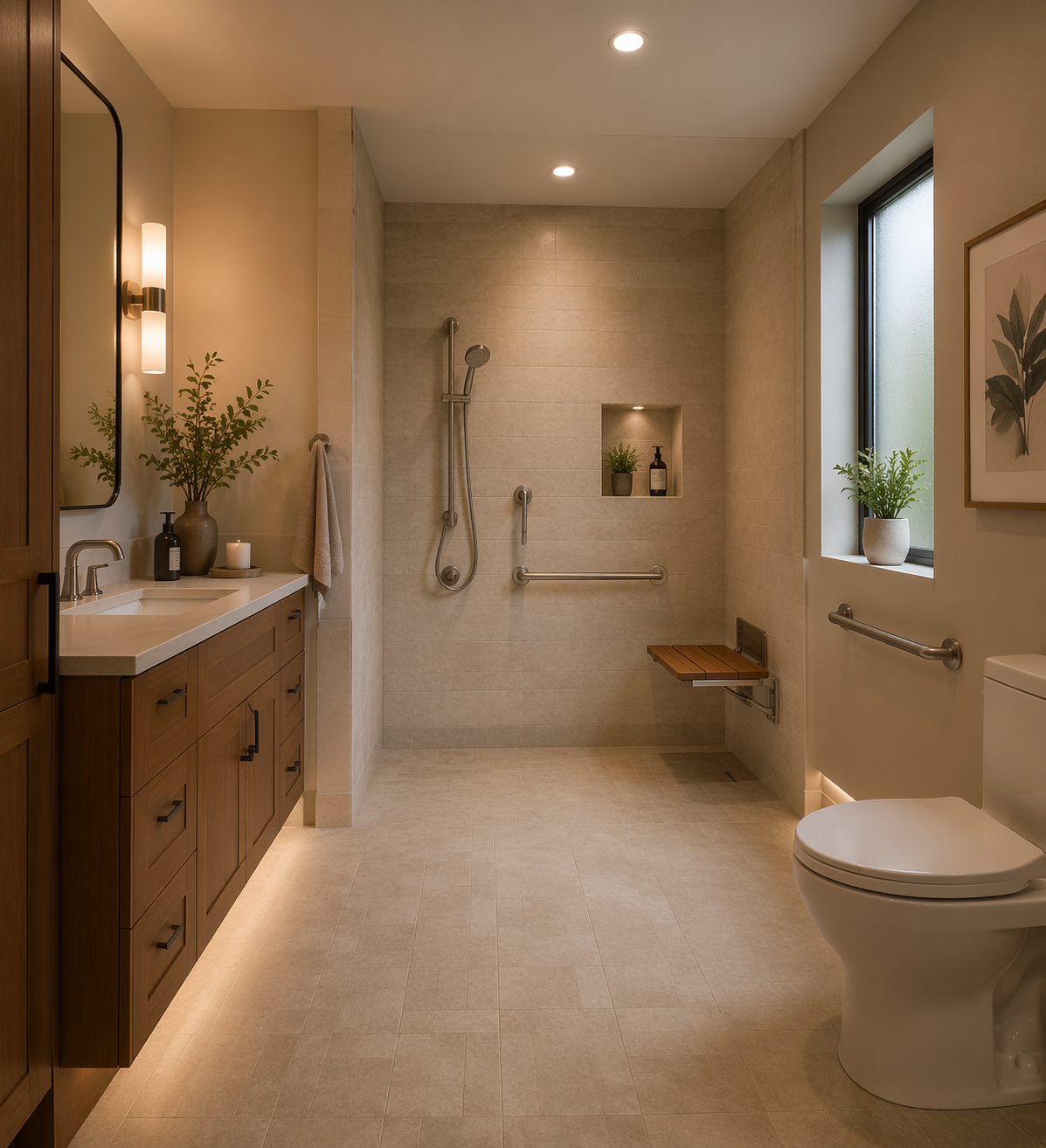
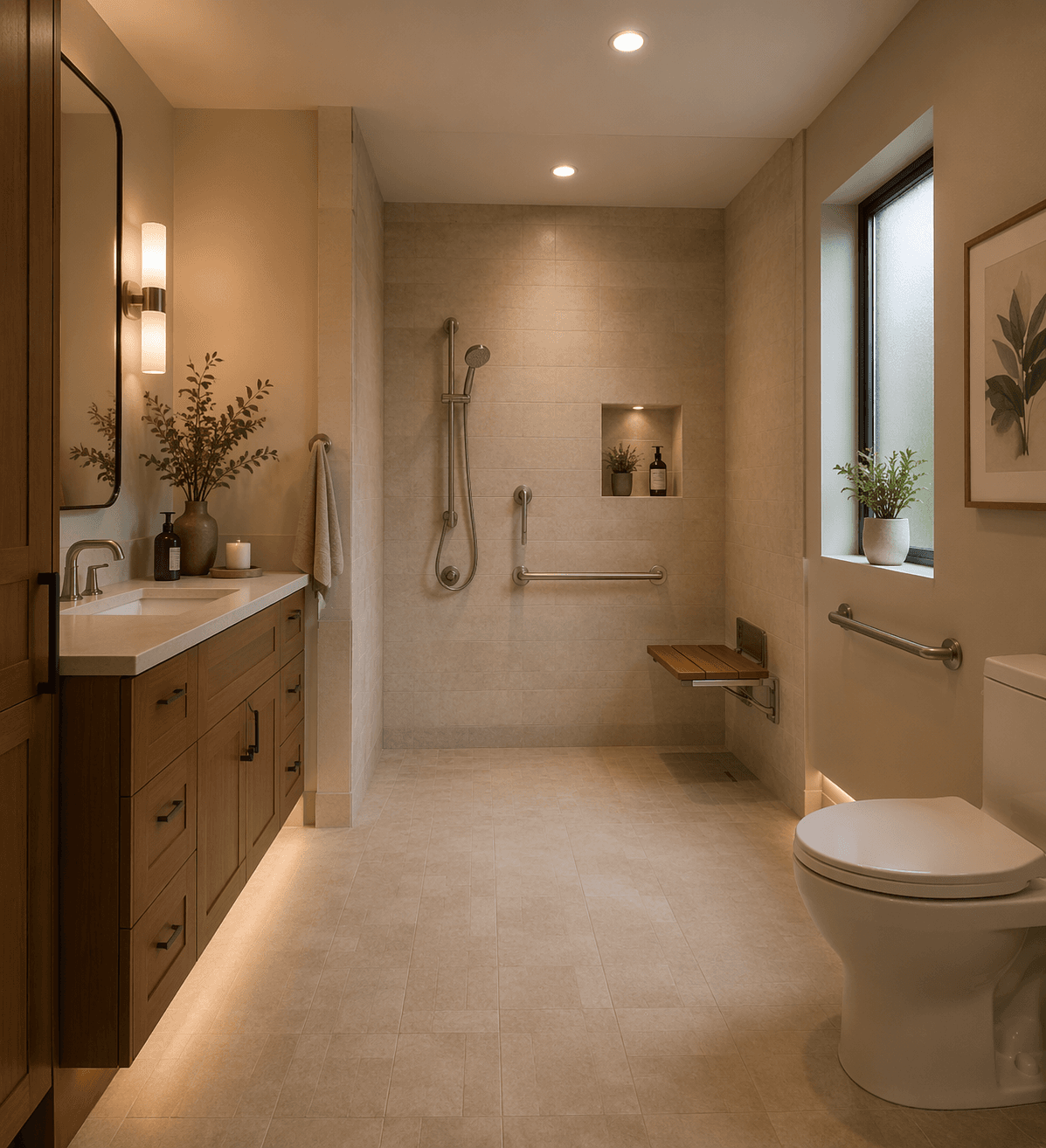
A curbless walk-in shower eliminates the step-over hazard entirely and works for walkers and wheelchairs without modification.
The Three Options at a Glance
When a standard bathtub becomes a barrier rather than a comfort, three primary replacement options emerge. Each solves the same fundamental problem — the 12- to 20-inch step-over into a traditional tub — but they differ sharply in how they handle access, safety, and daily use.
Curbless (Walk-In) Shower
A curbless shower sits flush with the bathroom floor — no step, no threshold, no lip to trip over. Water is managed by sloping the floor toward a linear drain or by using a trench drain at the shower entrance. This is the same design found in many modern hotels and spas, and it is the gold standard for aging-in-place accessibility. A tub-to-shower conversion that removes the existing tub and installs a curbless base typically runs $3,000 to $15,000 depending on layout complexity, tile choice, and whether plumbing needs to be relocated.
Walk-In Tub
A walk-in tub has a watertight door that opens outward, allowing the user to step in without climbing over a high wall. Once inside, the door seals shut, and the tub fills with water for a soak. Prices range from $2,000 for a basic model to more than $20,000 for a luxury unit with jets, heated surfaces, and air therapy systems. These tubs appeal to older adults who value hydrotherapy for arthritis, joint pain, or circulation issues and are unwilling to give up the experience of soaking.
Tub-to-Shower Conversion (Standard Threshold)
This is the middle ground: the existing tub is removed and replaced with a standard shower base that has a 3- to 5-inch threshold or curb. It is less expensive than a full curbless renovation because it does not require re-sloping the entire bathroom floor, but it still leaves a small step to navigate. Many families choose this route when a full curbless installation is structurally difficult — for example, in a second-floor bathroom where the joists cannot accommodate the necessary floor slope.
Head-to-Head Comparison: Curbless Shower vs. Walk-In Tub vs. Tub-to-Shower Conversion
The table below distills the key differences across the dimensions that matter most for aging-in-place decisions. Use it as a quick-reference tool when discussing options with your parent, a contractor, or an occupational therapist.
Comparison of the three primary bathroom upgrade options for aging in place. Cost ranges are national averages from AARP and industry sources and may vary by region and contractor.
Feature
Curbless Shower
Walk-In Tub
Tub-to-Shower Conversion
Entry difficulty
None — step-in at floor level
Low — step over a 3–6" threshold
Moderate — step over a 3–5" curb
Caregiver access
Excellent — can reach in or enter to assist
Poor — must lean over high tub wall
Good — can reach in, limited entry
Emergency exit speed
Immediate — walk straight out
Delayed 60–90 seconds — door must drain fully before opening
Immediate — step over low curb
Wheelchair readiness
Yes — roll-in with no modification
No — cannot roll a wheelchair inside
No — curb blocks wheelchair access
Walker/cane friendly
Yes — level entry
Partial — step-over still required
Partial — low curb, but still a step
Water management
Sloped floor + linear drain
Sealed door + standard drain
Standard shower pan + curtain/door
Cost range (installed)
$3,000 – $15,000
$2,000 – $20,000+
$1,500 – $8,000
Resale value impact
Positive — modern, desirable feature
Negative — perceived as medical equipment
Neutral to slightly positive
Best for
Long-term aging in place, wheelchair users, caregiver-assisted bathing
Hydrotherapy seekers who prioritize soaking over safety speed
Budget-conscious upgrades where full curbless is not feasible
The emergency exit delay is the single most important differentiator between a curbless shower and a walk-in tub. Community reports from older adults and caregivers consistently highlight this concern. As one Reddit user put it:
Those tubs take forever to fill. And if you have an emergency and need to get out, they take forever to drain.
How to Choose: A Decision Matrix Based on Mobility, Space, and Budget
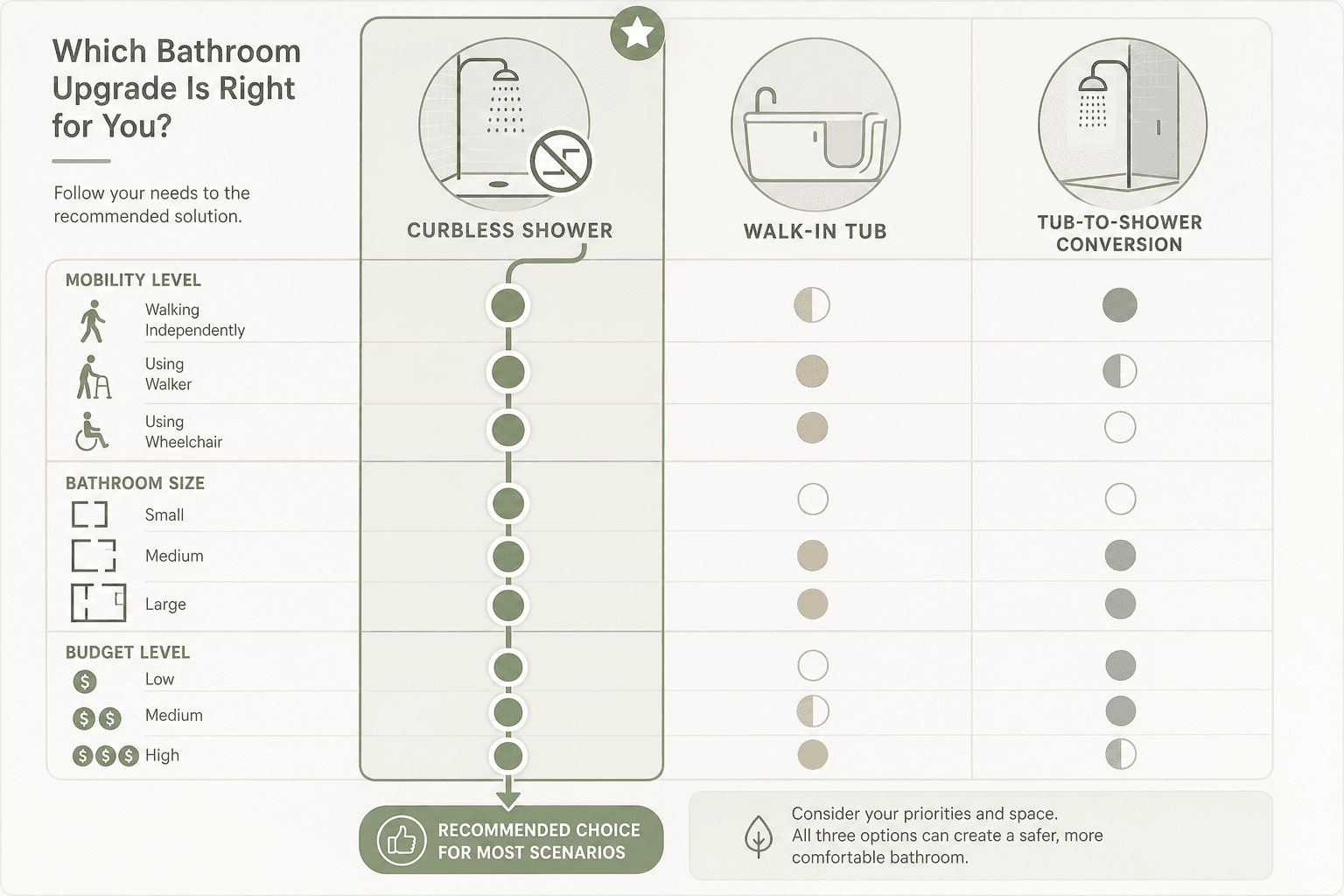
No single option fits every situation. The right choice depends on three factors: the older adult's current and projected mobility level, the physical dimensions of the bathroom, and the available budget. The matrix below walks through the most common scenarios.
Decision matrix for choosing between a curbless shower, walk-in tub, and tub-to-shower conversion based on mobility level, bathroom size, and budget.
Scenario 1: Independent but Unsteady (Uses Cane or No Aid)
For someone who is still walking independently but has begun to feel unsteady on their feet, the primary risk is the step-over into a traditional tub. The bathtub is the single highest fall-risk feature in most bathrooms — climbing over a 12- to 20-inch tub wall while wet and on slippery porcelain is dangerous for anyone with reduced strength or balance.
A curbless shower is the strongest recommendation here. It eliminates the step-over entirely, and if mobility declines further — to a walker or wheelchair — the same shower remains fully usable without modification. If budget is tight, a tub-to-shower conversion with a low threshold (3 inches or less) is an acceptable compromise, but plan to add a shower bench or transfer seat immediately.
Scenario 2: Uses a Walker or Requires Caregiver Assistance
When a walker is part of daily life, or when a caregiver must be physically present during bathing, the curbless shower becomes even more clearly the superior choice. A walk-in tub makes caregiver assistance difficult — the caregiver must lean over a high tub wall to help with washing, and cannot easily enter the tub themselves. A curbless shower, by contrast, allows the caregiver to stand beside the bather or even enter the shower with a second chair if needed.
The minimum recommended shower dimension for this scenario is 36 inches by 60 inches, which provides enough room for a fold-down or transfer bench and space for a caregiver to assist. If the bathroom is smaller than 40 square feet, a curbless shower may still be possible, but the layout will need careful planning with a CAPS-certified contractor.
Scenario 3: Uses a Wheelchair or Will Likely Need One
For wheelchair users, the choice is straightforward: a curbless shower is the only viable option among the three. A walk-in tub cannot accommodate a wheelchair, and a standard tub-to-shower conversion still has a curb that blocks roll-in access. The shower must be at least 60 inches by 60 inches to allow a wheelchair to turn inside, and the floor must be sloped to a linear drain so that water flows away without a step.
This is also the most expensive scenario because it often requires widening the bathroom doorway to at least 32 inches (ADA minimum) and reconfiguring the entire floor plan. However, the alternative — transferring from a wheelchair to a shower chair and then into a tub — introduces multiple fall risks at each transfer point.
When a Walk-In Tub Actually Makes Sense
There is one scenario where a walk-in tub is the better choice: when the older adult has a strong emotional attachment to soaking and hydrotherapy provides measurable relief for arthritis, chronic pain, or circulation issues, and when they are still steady enough to stand for the 60- to 90-second drain period. In this case, the walk-in tub preserves a bathing experience that a shower cannot replicate.
The 'Block Now, Bars Later' Strategy: Future-Proofing Without Full Renovation
Whether you choose a curbless shower, a walk-in tub, or a tub-to-shower conversion, there is one low-cost step you should take during any bathroom renovation: install wall blocking for grab bars — even if you do not plan to install the bars right away.
Wall blocking involves adding horizontal 2x6 or 2x8 lumber between the wall studs at the height where grab bars will eventually be mounted. This creates a solid anchor that can support the required 250 to 300 pounds specified by the National Association of Home Builders (NAHB) for grab bar installations. Without blocking, grab bars must be anchored into studs or use heavy-duty toggle bolts — and the studs are rarely at the exact position where the bar is most useful.
Install blocking in three locations: beside the toilet (24 to 30 inches from the floor), inside the shower or tub area (34 to 38 inches from the floor), and at the shower entrance (for a vertical grab bar to assist with balance during entry). Even if your parent does not need grab bars today, the blocking ensures that when they do — often sooner than expected — the installation is simple, secure, and does not require tearing out finished work.
Common Mistakes to Avoid When Choosing a Bathroom Upgrade
Even with the right shower or tub choice, a few design missteps can undermine the safety of the entire bathroom. These are the most frequent errors we see in aging-in-place renovations.
Choosing glossy tile for the shower floor. Glossy porcelain or ceramic tiles become dangerously slippery when wet. The AARP recommends slip-resistant floor tiles with a coefficient of friction (COF) rating of at least 0.42 for bathrooms. Matte, textured, or pebble-finish tiles are far safer.
Using towel bars as grab bars. A standard towel bar is designed to hold a few pounds of wet fabric — not 250 pounds of human weight during a fall. Only bars explicitly rated for grab-bar use and anchored into wall blocking or studs should be used for weight-bearing support.
Installing soft bath rugs or mats. Bath rugs with non-slip backing can still shift, bunch, or curl at the edges. The safest option is a textured, slip-resistant floor surface throughout the bathroom — no rugs at all.
Keeping round doorknobs. Round knobs are difficult to grip for someone with arthritis, reduced hand strength, or neuropathy. Replace them with lever-style handles that can be operated with a closed fist or an elbow.
Forgetting about lighting. A bathroom that is dimly lit — especially during nighttime trips — is a fall waiting to happen. Add a night light or motion-activated light strip along the baseboard, and ensure the main light switch is accessible from the doorway.
Recommended Shower Specs for Aging in Place
If you decide to move forward with a curbless shower — which, as we have argued, is the best choice for most families — here are the minimum dimensional and installation standards to discuss with your contractor. These specifications come from the NAHB's CAPS program and are widely accepted as the baseline for aging-in-place bathroom design.
Shower width: Minimum 36 inches for a seated shower. For a walk-in shower with a bench, aim for 36 inches by 60 inches. For full wheelchair access, the shower must be at least 60 inches by 60 inches.
Grab bar weight capacity: Bars must support between 250 and 300 pounds, anchored into wall blocking or directly into studs. Do not rely on adhesive-mounted or suction-cup bars as primary safety devices.
Shower seat: A fold-down or fixed bench rated for at least 250 pounds. The seat should be 17 to 19 inches high — the same height as a comfort-height toilet — to make transfers easier.
Handheld showerhead: Installed on a sliding bar so it can be adjusted for seated or standing use. This allows the bather to direct water where needed without twisting or reaching.
Floor slope: The shower floor should slope at least 1/4 inch per foot toward a linear drain. A linear drain at the shower entrance (rather than a center drain) allows the floor to be truly flat at the entry point.
Doorway width: If the bathroom door is narrower than 32 inches, plan to widen it. This is essential for wheelchair access and also makes it easier for a caregiver to enter with a walker or transfer chair.

Comments
Join the discussion with an anonymous comment.