
STEADI: intervene
A Dust Storm Is Here — What an Older Adult Should Do Now
Older adults caught in a dust storm need exact, in-the-moment steps — at home, in the car, or outside — as well as clear thresholds for when symptoms mean 911 versus urgent care. Respiratory red flags deserve monitoring for about a week afterward, since dust-driven emergency visits keep rising days after the storm, and post-storm darkness, debris, and downed lines add their own fall hazards.
Do this now
Most dust storm safety tips for seniors can wait. If the dust is already at the window, around the car, or blowing across the sidewalk, do these first:
- Get inside if you can. If you are already inside, stay there.
- Close doors and windows. Switch the air conditioning or ventilation to recirculation if that setting is available. [1]
- Sit down somewhere stable, away from a drafty door or window.
- Keep your rescue inhaler, emergency medications, glasses, water, and a charged phone within arm’s reach.
- Do not go outside to move a trash bin, check the mailbox, look at the sky, or sweep dust. Avoid exertion while the dust is in the air. [1]
- If breathing is suddenly severe, chest pain starts, you faint, or you feel confused, call 911 now.
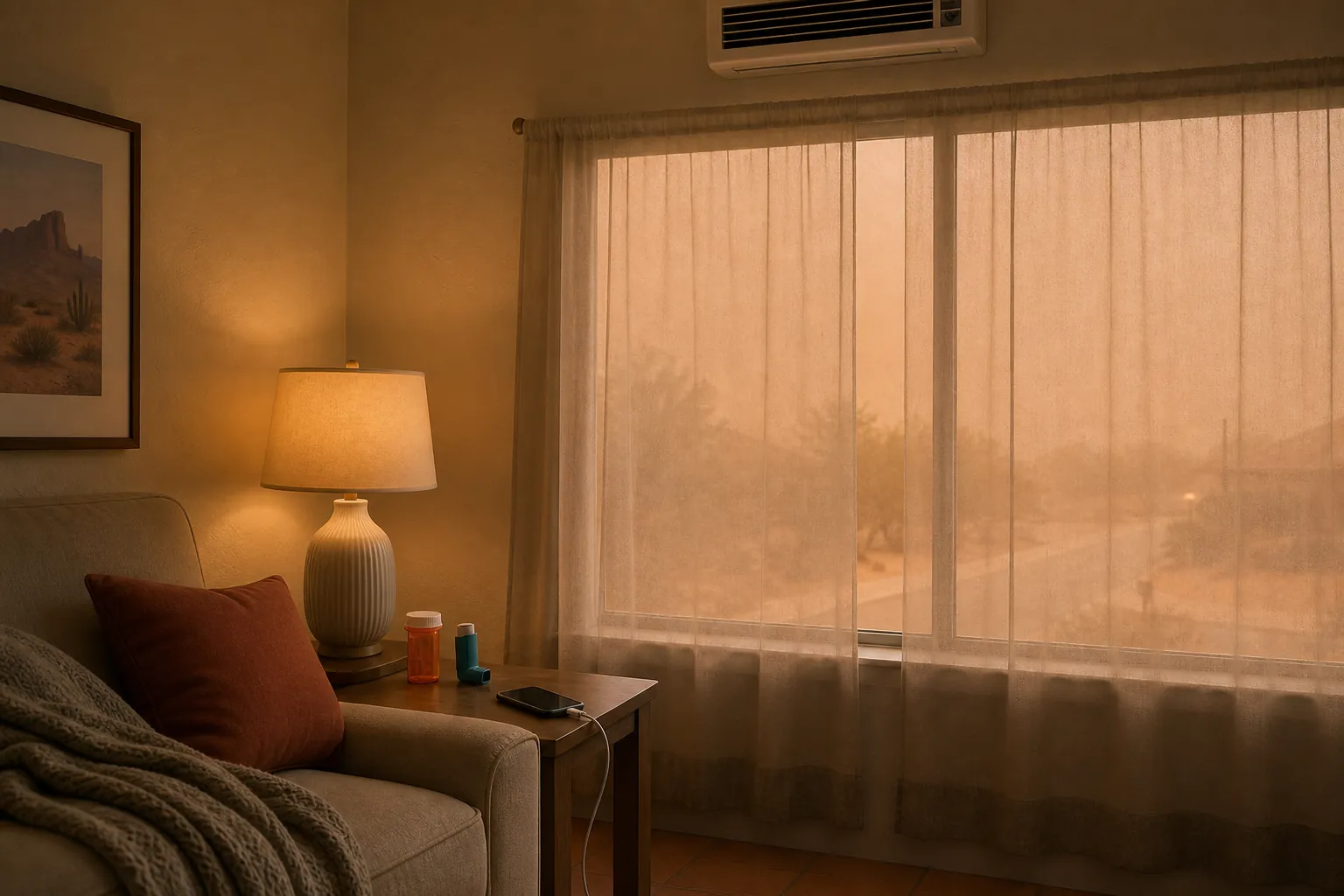
If you are at home
The safest room is usually the one that lets you stop moving. Close the nearest exterior door or window, then sit. If closing another window means crossing the house, climbing a step stool, or walking through a dark hallway, leave it and call someone else to handle it later.
Put the phone on the charger before the battery becomes a second emergency. If you use oxygen, a nebulizer, CPAP, powered mobility equipment, or another medical device, keep the device instructions and backup-power plan close enough that you do not have to search for them in a dim room.
If an adult child, neighbor, or caregiver may worry, send one plain message: “I’m inside, windows closed, phone charging, staying seated.” That tells them what matters and saves you from repeating the story while you are short of breath.
If you are in the car
In the car, exact wording matters. In a dust storm, the National Weather Service says to pull off the pavement as far as possible, stop, turn off all lights, set the emergency brake, take your foot off the brake so the tail lights are not illuminated, stay belted until the storm passes, and never stop in a travel lane. [2]
- Look for a safe place to leave the roadway. Do not make a sudden stop in the lane where other drivers are still moving.
- Pull off the pavement as far as possible.
- Stop the vehicle.
- Turn off all lights. That includes the lights another driver might try to follow.
- Set the emergency brake.
- Take your foot off the brake so the brake lights are not glowing.
- Stay buckled until visibility returns.
The lights-and-brake part feels wrong to many drivers. It is there because a driver behind you may steer toward visible tail lights and hit a stopped car. Once you are safely off the pavement, your job is not to be more visible in the lane. Your job is to be out of the lane.
If you are coaching an older parent by phone, do not ask them to describe the storm. Ask only: “Are you off the pavement?” “Are the lights off?” “Is the emergency brake on?” “Is your foot off the brake?” “Are you buckled?” Then stop talking unless they need help calling 911.
If you are outside
Cover your nose and mouth and seek shelter immediately. The American Lung Association gives that instruction plainly, and it is the right one. [1]
Choose the nearest real shelter, not the cleanest one. A store entrance, lobby, parked car, neighbor’s porch, or garage is better than trying to make it all the way home through blowing dust. If you use a cane, walker, or rollator, slow down rather than rushing; a fall in traffic or on a curb is a second emergency.
If you cannot get indoors quickly, turn your back to the blowing dust, cover your nose and mouth with cloth, and get away from moving traffic. Call someone once you are sheltered, not while you are still trying to cross a street or parking lot.
After the first blast, decide what kind of help is needed
The thresholds below are general safety guidance, not a diagnosis and not a substitute for medical care. A checklist cannot tell whether symptoms are asthma, heart failure, pneumonia, valley fever, anxiety, or something else. Use your clinician’s personal plan if you have one; when in doubt, call a clinician, nurse triage line, urgent care, or 911 based on how serious the symptoms are.
Call 911 now
- Severe or rapidly worsening trouble breathing
- Chest pain, chest pressure, or pain spreading to the arm, jaw, back, or shoulder
- Blue, gray, or very pale lips or face
- Confusion, fainting, new inability to stay awake, or sudden severe weakness
- Signs of stroke, such as face drooping, arm weakness, or speech trouble
- A crash, fall, head hit, or possible fracture during the storm
- A rescue medication or oxygen plan is not working the way the clinician said it should
Seek urgent care or same-day medical advice
- Wheezing, coughing, or shortness of breath is worse than usual but not at a 911 level
- You need your rescue inhaler more often than your personal care plan allows
- A cough becomes deeper, wetter, or is paired with fever, chills, or unusual fatigue
- Leg swelling, sudden weight change, or breathlessness while lying down appears in someone with heart disease or heart failure history
- A caregiver notices the older adult is not acting like themselves, even if the person says they are “fine”
Contact the primary care clinician
- Mild throat irritation, mild cough, or watery eyes are improving after getting indoors
- You want to confirm whether to adjust an asthma, COPD, allergy, or heart-failure action plan after a dust exposure
- You had symptoms during the storm that settled, but you live alone and need a monitoring plan for the next several days
- You are not sure whether a medication, inhaler, filter, mask, or device needs replacing after heavy dust
Keep watching symptoms after the sky clears
Clearer air outside the window does not mean the exposure is over. The American Lung Association says dust particles can linger from a few hours up to 10 days, and it names older adults among groups at higher risk for lung irritation. [1]
That is why the symptom watch should continue for about a week, especially for people with asthma, COPD, heart disease, heart failure history, or a recent respiratory infection. A 2025 Southwest emergency-department study looked at more than 33,500 emergency visits in Arizona, California, and Utah from 2005 through 2018. It found dust storms were associated with a 6% increase in asthma emergency visits within two days, a 6% increase in culture-negative pneumonia and congestive heart failure emergency visits within the following week, and a 13% increase in motor-vehicle-accident emergency visits on the storm day. [3][4]
Those numbers do not prove that every visit was caused by dust. They do say the danger is not limited to the hour when visibility is worst. For an older adult living alone, that changes the plan: someone should check in later the same day, again the next day, and for several days after if breathing, energy, walking steadiness, or heart symptoms are not back to usual.
| Time after the storm | What to watch | What to do |
|---|---|---|
| Same day | Breathing trouble, chest symptoms, crash or fall injuries, confusion, power loss affecting medical devices | Use the 911 or urgent-care thresholds above; do not drive in poor visibility |
| Next 48 hours | Wheezing, rescue-inhaler use, worsening cough, unusual fatigue | Call the clinician or urgent care if symptoms are worse than the person’s usual pattern |
| Following week | Cough with fever or chills, breathlessness when lying down, swelling, reduced walking tolerance, poor appetite or weakness | Seek same-day medical advice for concerning changes, especially with lung or heart history |
| Up to 10 days | Dust irritation that returns when cleaning, opening windows, or going outside | Limit exertion, keep windows closed when dust is still present, and ask for help with dusty cleanup |
Alerts that are actually worth setting
A Dust Storm Warning is not just a weather headline. The National Weather Service issues one when visibility is one-quarter mile or less because of blowing dust. [2]
For older adults who live alone, alerts should reach more than one device and more than one person. Ready.gov includes NOAA Weather Radio and the FEMA app in its older-adult emergency guidance. [5] The American Red Cross also recommends a support network, at least 30 days of medications, and backup-power planning for medical devices. [6]
The simple version: turn on Wireless Emergency Alerts on the cell phone, keep a NOAA Weather Radio where it can be heard, install the FEMA app if the older adult or caregiver will use it, and choose the person who will call when a warning comes through. An alert that no one hears is decoration.
When the air clears, do not rush the first walk
After a dust storm, the house and yard may not be arranged the way your body remembers them. Dust can hide a step edge. A mat can curl. A branch can land on the walkway. Power may be out, and the first trip to the bathroom or porch may happen in poor light.
- Turn on a light or use a flashlight before standing.
- Put on shoes with backs and traction before walking outside or into the garage.
- Use the cane, walker, grab bar, or railing even if the trip is short.
- Do not step over downed wires, branches, blown furniture, or loose roofing material.
- Ask someone steadier to check the porch, walkway, driveway, and gate before you go out.
- Leave dusty sweeping, filter changes, and outdoor cleanup for someone who can do it without breathing strain or fall risk.
If the storm turns into a longer indoor-air problem, the same clean-room thinking used during wildfire smoke can help; see Wildfire Safety for Older Adults During a Heat Dome. If utilities are interrupted, Why a Water Crisis Is a Fall Emergency for Older Adults and the Post-Tornado Power Outage Fall Prevention Checklist for Seniors cover the same problem from another angle: when the environment changes, the fall risk changes with it.
References
- Dust Storms, American Lung Association, July 25, 2025
- Dust Storms and Haboobs, National Weather Service
- New Study Links Dust Storms to Increased Emergency Department Visits in US Southwest, National Jewish Health, February 18, 2025
- Dust Storms and Emergency Department Visits in the Southwestern United States, PubMed, 2025
- Older Adults, Ready.gov
- Older Adults, American Red Cross
Related reading
Noticed something outdated or inaccurate on this page? Flag a correction. We review every report against CDC, NIA, and AARP HomeFit guidance before updating a page.
Part of the Fall Prevention section.