
STEADI: Intervene
What Seniors Should Do When an Evacuation Order Is Given
An evacuation order is a leave-now instruction, not a signal to keep packing. This guide gives older adults — and the caregivers coaching them by phone — the exact grab, dress, move, and tell sequence to follow in the first minutes, with branches for slow mobility, assistive devices, and no ride.
If an evacuation order was just given, treat it as a leave-now instruction. An evacuation warning is the stage when people who need extra time should leave early; an evacuation order means there is an immediate threat to life and people are lawfully directed to leave the area now. Cal OES and Cal Alerts use that distinction plainly, and it matters most for older adults because slow movement, a walker, oxygen equipment, a wheelchair, or a delayed ride can turn “a few more minutes” into being stuck. [1][2]
- Grab the pre-packed go-bag, phone, charger, keys, wallet, and the mobility device you use.
- Dress for movement: sturdy shoes first, then protective clothing you can put on quickly.
- Move on the safest cleared path to the car, ride, neighbor, lobby, pickup point, or public evacuation route.
- Tell one person where you are going, then follow official routes and do not take shortcuts.
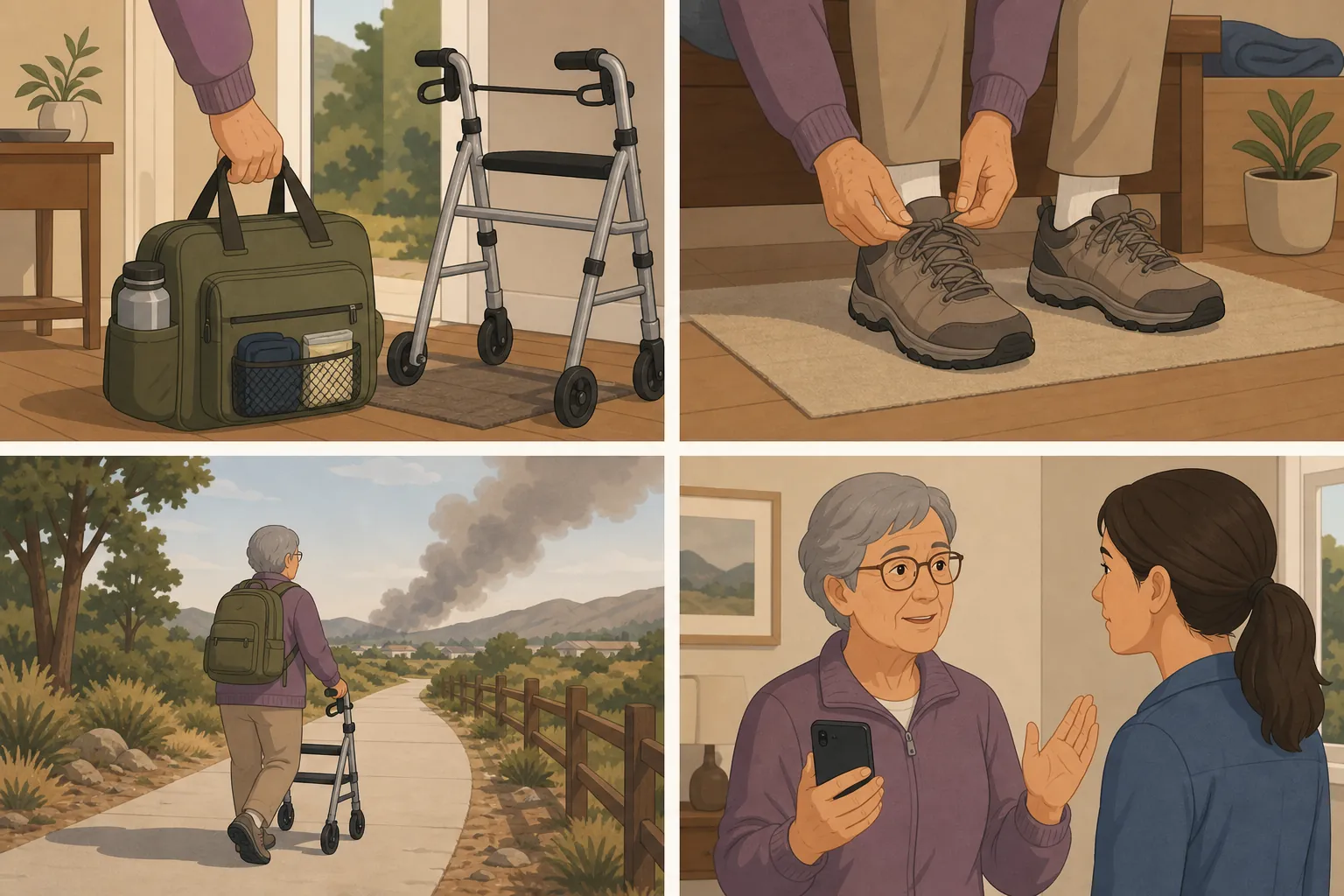
That grab → dress → move → tell sequence is not a named government formula. It is a shortened crisis version of official evacuation guidance: Ready.gov says to take the emergency supply kit, wear sturdy shoes and protective clothing, call the out-of-state contact, and follow official evacuation routes without shortcuts. [3] For older adults, the sequence also has to account for assistive devices, insurance information, medications, and helpers who may need clear instructions. [4][5]
If the bag is packed and the ride is ready
Do not reopen the plan. Pick up the bag, put on shoes, take the assistive device, and leave. The car can be loaded imperfectly. The house can be locked imperfectly. The next task is to get the older adult’s body across the threshold without a fall.
If you are coaching by phone, start with the command, not a question: “The order means leave now. Put on your shoes. Pick up your walker. Pick up the bag. I’m staying on the phone while you go to the door.” Questions like “What else do you need?” can send someone back into bedrooms, drawers, pill boxes, and file folders. At this point, the useful question is narrower: “Are your shoes on?”
Keep the phone hands-free if possible: speakerphone in a pocket, lanyard, waist pack, or bag pocket is safer than walking with one hand occupied. AARP’s go-bag guidance favors a wheeled duffel and carrying supplies in a way that keeps both hands free, which is especially important when stairs, curbs, smoke, rain, or uneven pavement are involved. [6]
If there is no packed bag
Take what is already within reach and leave. Do not build a new evacuation kit while an order is active.
- Phone and charger
- Keys
- Wallet, ID, Medicare, Medicaid, or insurance cards if they are in the normal wallet or folder
- Medications only if they are in one known, reachable place
- Glasses, cane, walker, wheelchair, or other device already being used for safe movement
The full kit belongs in the before-the-order stage. FEMA’s evacuation list includes supplies such as water, a radio, flashlight, first aid kit, whistle, cell phone, and chargers, and Red Cross guidance for older adults includes maintaining a 30-day medication supply where possible. [5][7] If you are preparing before a hazard reaches your area, use the full senior evacuation kit checklist. If the order has already arrived, do not search the house to make the kit complete.
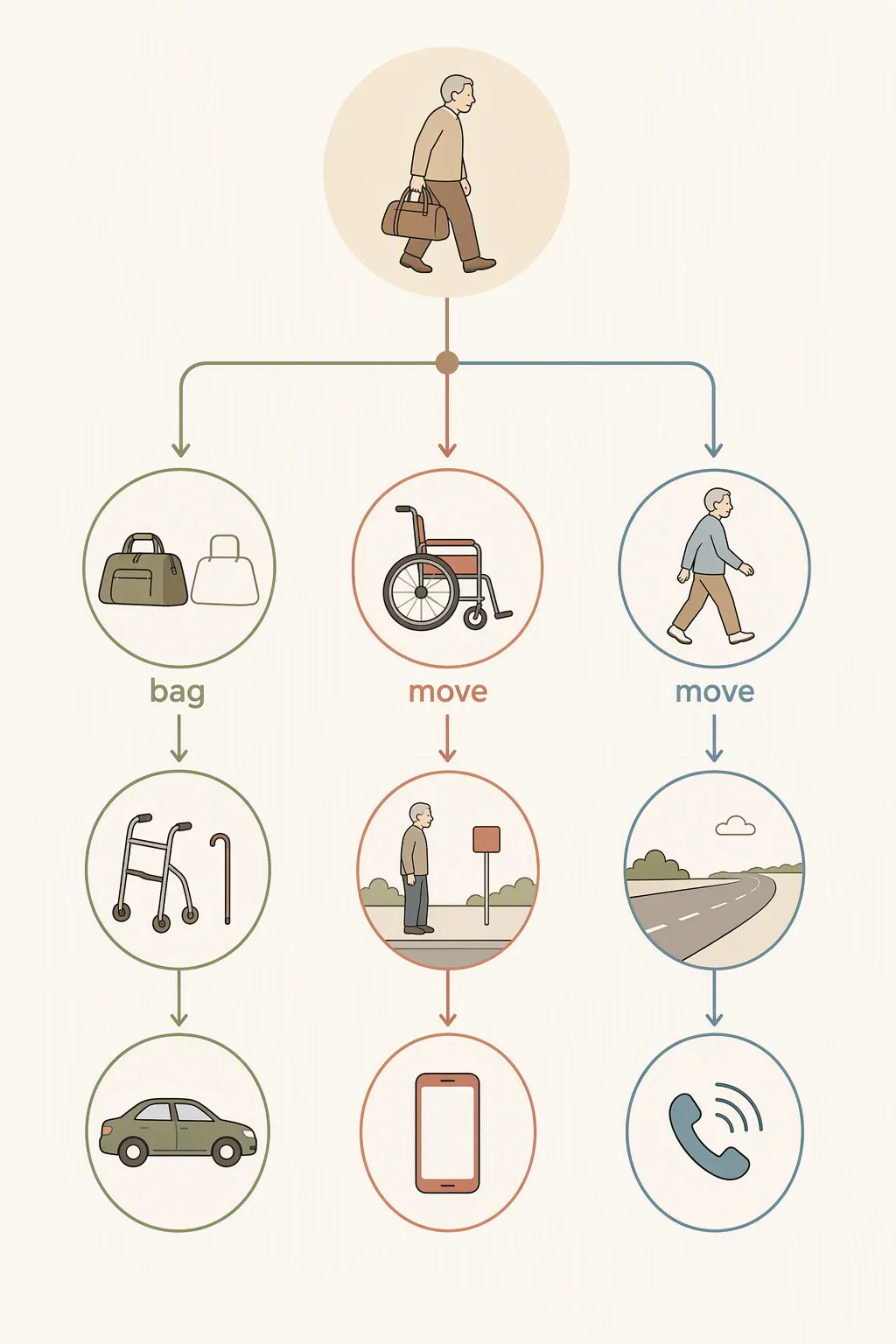
The decision tree for the first minutes
| What changed | Do this now | Stop doing this |
|---|---|---|
| Bag is packed; ride is ready | Grab bag, phone, charger, keys, wallet, shoes, mobility device; leave by the safest cleared path. | Do not add extra clothing, documents, keepsakes, or household tasks. |
| No bag is packed | Take phone, charger, keys, wallet, reachable medications, and the device needed to move safely. | Do not search multiple rooms or sort pill bottles. |
| Uses a cane or walker | Put shoes on before standing for the final move; keep the cane or walker within reach; use the widest, clearest exit. | Do not carry a heavy shoulder bag that throws balance off. |
| Uses a wheelchair | Take the chair, cushion if already in place, charger if needed and reachable, and use the exit with the least threshold or slope problem. | Do not switch to walking just to save time if walking is unsafe. |
| Ride is late | Call once, give the exact pickup point, and set a short decision point; if they cannot arrive now, shift to another helper or emergency assistance. | Do not wait silently inside because a ride was promised. |
| No ride | Call a neighbor, building manager, local emergency line, paratransit contact, or 911 if immediate evacuation help is needed; state the mobility need clearly. | Do not keep packing while hoping transportation appears. |
| Cannot move fast or cannot get out | Call 911 or the local emergency number now; say the address, room, mobility device, and what help is needed. | Do not spend those minutes trying unsafe stairs, cluttered paths, or unsupported transfers. |
If the older adult uses a cane, walker, or wheelchair
The assistive device leaves with the person. Do not park the walker by the couch “just for a second” while carrying boxes to the car. Do not ask someone who normally uses a wheelchair to walk to make loading faster. The fastest evacuation is the one that does not create a fall, collapse, or stuck transfer in the doorway.
USFA advises older adults who use walkers or wheelchairs to make sure they can get through doorways and to discuss escape plans with family, neighbors, or the fire department if extra help is needed. [8] During the order itself, that planning advice becomes a simple test: choose the exit the device can actually pass through, even if it is not the exit someone else would prefer.
For a walker or cane user, the fall-prevention order is: shoes, device, bag, door. Shoes come before the threshold because socks, slippers, wet pavement, gravel, and hurried steps are a bad mix. If the bag is heavy, put it on wheels, across the body, or in a backpack-style carry if that has already been set up. If carrying it changes posture or blocks the device, leave the extra weight and keep the device.
For a wheelchair user, the exit route matters more than the shortest route. Avoid a threshold, ramp, curb, or garage slope that the person cannot manage safely under stress. If help is needed for a transfer, say that plainly to the helper or dispatcher: “Wheelchair user. Cannot transfer alone. Needs evacuation assistance from the living room.” Red Cross guidance for older adults emphasizes telling helpers exactly what is needed rather than making a general request for help. [5]
If the ride is delayed
A delayed ride is not a reason to keep gathering things. It is a transportation problem, so solve only that problem.
- Call the arranged driver once.
- Say the pickup location, the mobility device, and whether the person can wait outside, at the curb, in the lobby, or must be helped from inside.
- If the driver cannot come now, call the next helper: neighbor, family member, building manager, community contact, local emergency number, or 911 if the threat is immediate.
- Tell one outside contact what is happening: “Evacuation order. Waiting at the front lobby with walker. Trying neighbor now.”
Ready.gov includes checking on neighbors who may need a ride as part of evacuation action, but for the person who needs the ride, the instruction is just as direct: ask now, and ask specifically. [3] “Can someone pick me up?” is weaker than “Can you pick me up at the east lobby in ten minutes? I have a walker and one bag.”
If there is no ride
Do not wait for a perfect ride to appear. Call for evacuation help and state the barrier in the first sentence.
- “I am under an evacuation order and I do not have transportation.”
- “I am 82 and use a walker.”
- “I am in apartment 2B, near the front door.”
- “I can walk to the lobby with help,” or “I cannot get down the stairs.”
Local evacuation assistance programs and registries vary by city, county, and state, and registration does not guarantee that someone will arrive during a specific emergency. That is why the order-stage action is not “look up the program.” It is “call the emergency or local assistance number you already have, and if the threat is immediate, call 911.”
If the person cannot move fast enough to leave safely
Shift from evacuation-by-yourself to rescue information. That is not failure. It is the moment to stop spending strength on unsafe movement and start giving responders exact information.
Ready for Wildfire’s evacuation guide tells people who are trapped or unable to evacuate to call 911. [9] Keep the same principle for any urgent evacuation hazard: call the local emergency number, stay on the line if told to, and give the location in a way someone can act on.
- Address and apartment, unit, room, or side entrance
- Whether the person can stand, transfer, or walk with assistance
- Walker, cane, wheelchair, oxygen equipment, or other mobility barrier
- Whether a caregiver is on the phone but not physically present
- The safest entry point if known
For an adult child coaching by phone, this is the handoff sentence: “I’m calling 911 now. Stay near the door if you can do that safely. Do not try the stairs alone. Keep your phone with you.” The goal is to reduce the number of risky transfers, not to talk someone into a movement their body cannot do.
What to say while coaching someone by phone
A calm voice helps, but the words need to be mechanical. The person on the other end may be frightened, embarrassed, angry about leaving, worried about pets, or trying to protect documents. Do not argue with every concern. Convert the call back into the next physical action.
| If they say | Say this |
|---|---|
| “I just need a few more things.” | “The order means leave now. If it is not already in your hand or bag, leave it. Shoes next.” |
| “I can’t find my papers.” | “Take your wallet if it is there. Do not search. Go to the door with your walker.” |
| “My ride isn’t here.” | “Stand or sit by the safest pickup point. I’m calling the backup now. Keep your phone on.” |
| “I don’t want to leave.” | “I know. Right now we are only doing the next safe step: shoes, bag, door.” |
| “I can’t get down the stairs.” | “Do not try the stairs alone. I’m calling for evacuation help and telling them exactly where you are.” |
If the person becomes focused on one missing item, do not keep negotiating. Repeat the smallest safe instruction and remove choices: “Put on the shoes by the door.” “Pick up the cane.” “Open the front door.” “Go to Mrs. Lee’s apartment.” This is not the time for a full preparedness conversation. The full preparedness work belongs earlier, alongside plans for smoke, flood, shelter routes, and mobility aids in resources such as wildfire smoke evacuation preparation, a fall-proof shelter route, and a flash flood fall-prevention checklist.
Tell one person where you are going
Before the phone battery drops, before the car starts moving, or as soon as the person is safely with the driver, tell one contact the destination and route if known. Ready.gov specifically includes calling the out-of-state contact during evacuation guidance. [3]
- “Leaving now with Denise.”
- “Going to the county shelter at the high school.”
- “Taking the official route on Highway 12.”
- “Walker and blue go-bag are with me.”
One clear message prevents a second emergency: family calling different shelters, a caregiver driving toward a home that is already empty, or responders being told someone may still be inside when they have already left.
Follow official routes, then stay out until officials say it is safe
Use the route officials give, even if a familiar shortcut looks faster. Ready.gov warns evacuees to follow recommended evacuation routes and not take shortcuts because roads may be blocked. [3] For an older adult, a blocked road is not just a traffic problem. It can mean sitting too long without medication access, a restroom, oxygen support, mobility help, or a safe place to transfer.
Do not return home until officials say it is safe. Return trips after storms, fires, floods, or other disasters bring their own fall hazards: debris, wet flooring, unstable steps, damaged railings, poor lighting, and power outages. That aftermath belongs to a different checklist, such as storm-damage safety for seniors, but the order-stage rule is simple: leave first, return only after clearance.
Medical and safety note
This guide is general emergency-safety information, not medical advice. If an older adult depends on oxygen, dialysis, refrigerated medication, powered medical equipment, or hands-on transfer help, follow the person’s clinician-approved emergency instructions when they are available. During an active evacuation order, if leaving safely is not possible, call 911 or the local emergency number and state the exact mobility or medical support needed.
An evacuation order is not the moment to become more prepared. Extra preparation can become the danger. The safest sequence is the smallest one that gets the older adult out without creating a fall, a missed ride, or a lost contact: grab, dress, move, tell.
References
- Know the Difference: What Evacuation Warnings and Orders Mean, Cal OES.
- Evacuations, Cal Alerts.
- Evacuation, Ready.gov.
- Older Adults, Ready.gov.
- Older Adults Emergency Preparedness, American Red Cross.
- Emergency Go Bag, AARP.
- What should I bring with me when I evacuate my home or during a disaster?, FEMA.
- Fire Safety for Older Adults, U.S. Fire Administration.
- Go! Evacuation Guide, Ready for Wildfire.
Related reading
Noticed something outdated or inaccurate on this page? Flag a correction. We review every report against CDC, NIA, and AARP HomeFit guidance before updating a page.
Part of the Fall Prevention section.