
STEADI: Intervene
Earthquake Safety for Elderly Parents Who Can't Get Down
What should an elderly parent do when the shaking starts if they can't safely drop to the floor? Learn the adapted Drop, Cover, and Hold On actions for cane, walker, and wheelchair users and for people who stay in bed, and how to practice them in about a minute.
When the floor starts moving, the usual earthquake instruction — Drop, Cover, and Hold On — can become a problem for an older parent who cannot safely get to the floor or get back up from it. The safer version is still built around the same goals: avoid being thrown down, protect the head and neck, and stay put until the shaking stops. The action changes by body position and mobility aid.
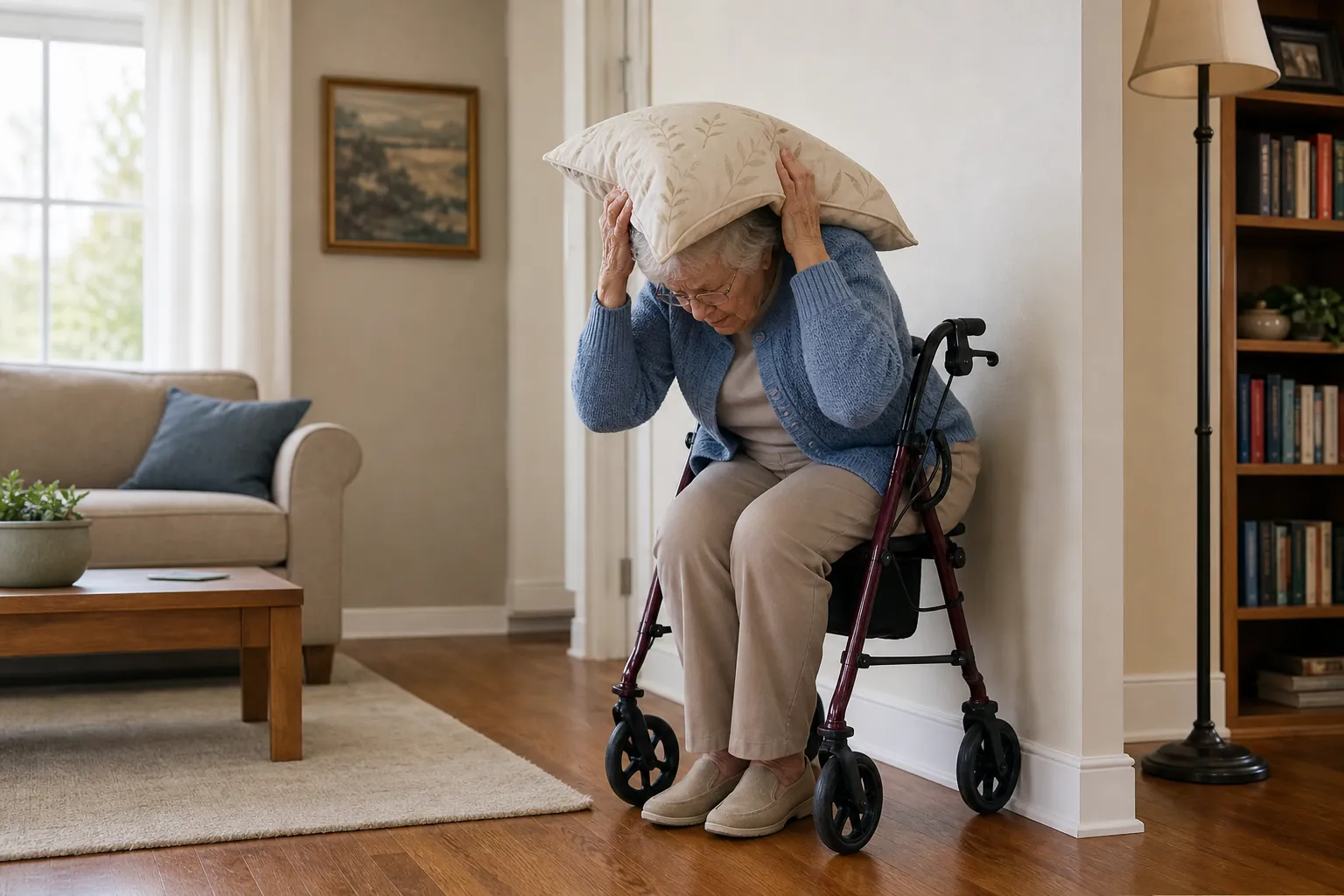
For an earthquake preparedness checklist for elderly parents, this is the line that needs to be rehearsed before the emergency kit: if getting down is unsafe, stay where you are, lock wheels if there are wheels, get as low and stable as possible, cover the head and neck with your arms or whatever is within reach, and hold that position until the shaking stops. Great ShakeOut guidance gives adapted actions for people using canes, walkers, and wheelchairs, including sitting on a chair or bed when needed, locking wheels, keeping the cane nearby, and using a book or pillow to protect the head and neck.[1] The American Red Cross gives the same practical direction for people who cannot drop: brace, protect the head and neck with arms, a pillow, a book, or whatever is available, and remain seated if using a wheelchair or walker.[2]
This is educational safety information, not medical advice, building-safety advice, or a substitute for emergency instructions from local authorities. If your parent has major balance limits, recent fractures, dizziness, cognitive impairment, or a complex mobility setup, review the plan with a licensed occupational therapist, geriatric nurse, physical therapist, certified aging-in-place specialist, or local emergency-management professional before you rely on it.
The during-shaking rule: protect the head without creating a fall
A strong instruction has to fit the parent’s actual room and body. A parent standing at the kitchen sink with a cane needs a different sentence than a parent already in bed. A wheelchair user needs brakes locked before anything else. A walker user should not be told to transfer to a chair while the room is moving.
The California Department of Aging puts the instinct problem plainly: if a person is in bed or sitting down, do not get up, because a standing person can be thrown to the floor.[3] That matters for older adults because falls are already common outside earthquakes: CDC data say more than 1 in 4 older adults falls each year, and falling once doubles the chance of falling again.[4] Those are general fall statistics, not earthquake injury statistics, but they explain why “just drop to the floor” is not harmless advice for a frail parent.
| If shaking starts and your parent is… | First action | Head and neck protection | What to say in practice |
|---|---|---|---|
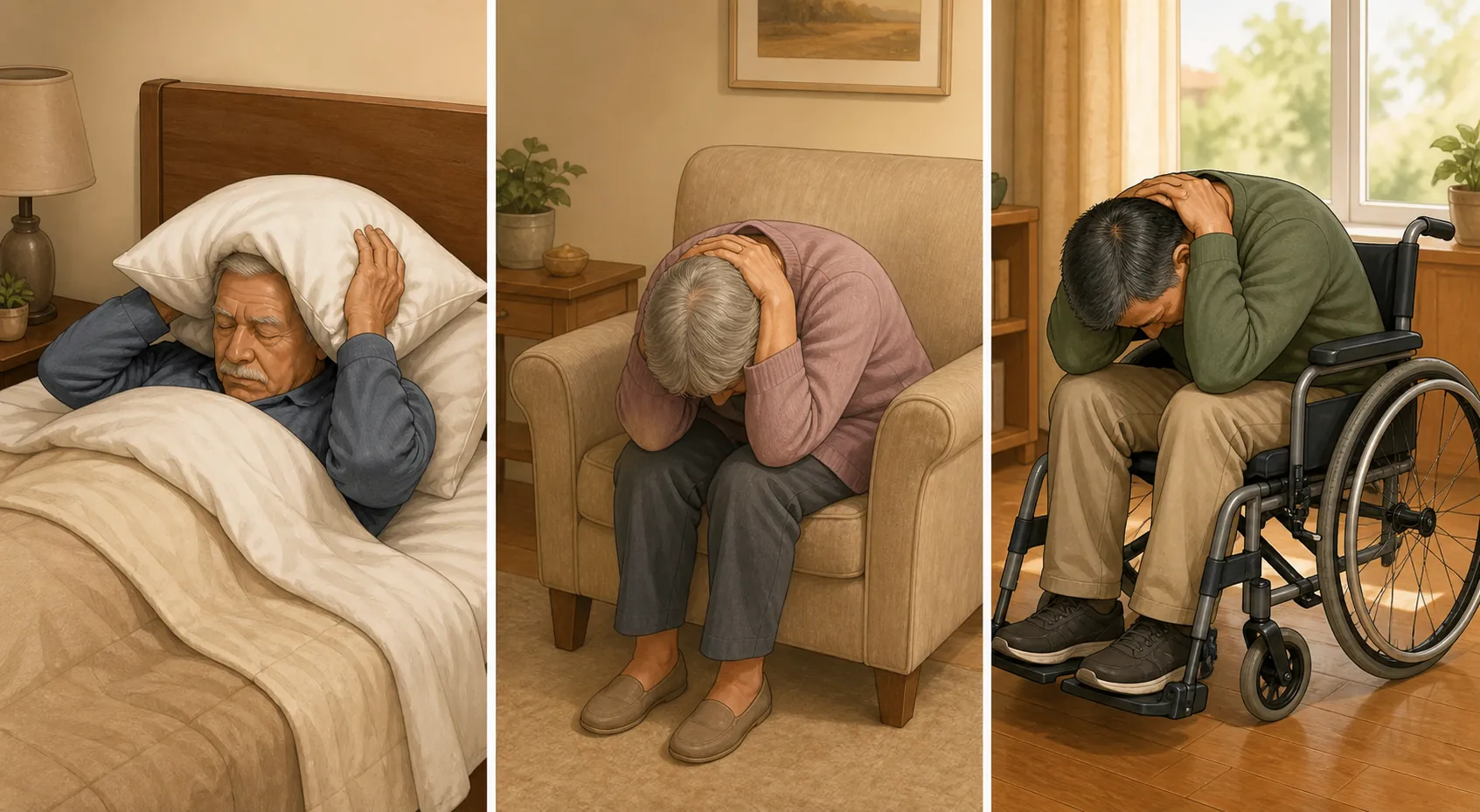
| Using a cane | Sit on a nearby chair or bed if one is within easy reach; otherwise get as low and stable as safely possible | Cover with both hands and arms; keep the cane within reach for after the shaking | Sit if you can. Cover your head. Keep your cane near. |
| Using a walker | Lock the walker brakes if present; do not try to transfer during shaking | Lower forward as safely as possible and cover with arms, a pillow, book, purse, coat, or cushion | Brakes. Stay with the walker. Cover your head. |
| Using a wheelchair | Lock both wheels; stay seated | Bend forward if able and cover with arms or a nearby object | Lock both brakes. Stay seated. Cover your head. |
| Seated and unable to get down | Stay seated; brace feet if possible | Lean forward if safe and cover with arms, pillow, book, coat, or cushion | Stay in the chair. Cover your head and neck. |
| In bed | Stay in bed; do not stand up during shaking | Pull a pillow or blanket over the head and neck | Stay in bed. Pillow over your head. |
If your parent uses a cane
A cane user’s plan is short because the main danger is overcomplicating it. If a sturdy chair, bed, or couch is one or two safe steps away, the parent sits. Then they cover the head and neck with both hands and arms and keep the cane close enough to reach after the shaking stops. Great ShakeOut’s adapted cane-user guidance includes sitting on a chair or bed when needed, covering the head and neck with both hands, and keeping the cane nearby.[1]
Do not build the drill around a long walk to the “best” spot in the home. During shaking, the nearest stable place usually matters more than the perfect place across the room. If the parent normally parks the cane against a wall, under a table, or by the bed, practice placing it where it will not slide away and will not block their feet.
A simple cane-user command is: “Sit. Cover your head. Keep your cane.” That is enough to practice. After the shaking stops, the cane is part of the recovery plan, not something the parent should have to search for on the floor.
If your parent uses a walker
A walker plan needs more care because a walker can either stabilize the parent or become one more moving object. The first instruction is brakes, if the walker has them. King County Aging & Disability Services tells people using wheelchairs or walkers to lock both brakes on both sides as tightly as possible.[5] Great ShakeOut and Red Cross guidance also tell walker and wheelchair users to lock wheels and stay in place during shaking.[1][2]
The second instruction is not to transfer. Do not tell a parent to move from walker to recliner, walker to toilet, or walker to bed while the floor is moving. Transfers are balance tasks even on a quiet day. During shaking, the walker-user version is: lock, lower, cover, hold.
- Lock the brakes on both sides, if the walker has brakes.
- Stay with the walker rather than trying to walk across the room.
- Get as low as safely possible. For some parents, that means bending forward while seated on the walker seat. For others, it means widening the stance and lowering the head and shoulders without losing balance.
- Cover the head and neck with arms, or with a pillow, book, purse, coat, lap blanket, or seat cushion if one is within reach.
- Hold that position until the shaking stops.
If the walker has a seat, practice whether the parent should sit on it during shaking. Some parents already use the seat safely; others are safer staying standing with both hands on the frame. That is a body-specific decision, and it should be settled before an earthquake, not negotiated while lamps are moving.
Keep the protective object boring and reachable. A couch pillow on the walker seat, a folded coat over the walker basket, or a firm cushion on a nearby chair is more useful than a helmet stored in a closet. The Red Cross specifically allows practical protection such as a pillow, book, or whatever is available when a person cannot drop.[2]
If your parent uses a wheelchair
For a wheelchair user, the first useful word is “lock.” Lock both wheels. Stay seated. Do not transfer to the bed, toilet, sofa, or floor during shaking. Red Cross guidance says wheelchair and walker users should lock wheels and remain seated until the shaking stops.[2] King County’s adapted guidance adds the detail caregivers should practice out loud: lock both brakes on both sides as tightly as possible.[5]
After the brakes are locked, the parent gets as low as their body and chair allow. That may mean leaning forward with the head tucked, if that position is safe for breathing, circulation, and balance. It may mean staying upright but bringing the arms over the head and neck. It may mean pulling a coat, cushion, purse, book, or lap blanket over the head. Great ShakeOut and King County both include using available objects, such as a book, pillow, cushion, purse, or coat, to protect the head and neck when standard cover is not reachable.[1][5]
Practice the brake motion until it is automatic. If your parent has limited hand strength, vision loss, arthritis, or tremor, check whether they can actually reach and engage both locks quickly. If they cannot, ask a wheelchair professional, occupational therapist, or durable medical equipment provider whether the brake setup needs adjustment. A drill that depends on a brake the parent cannot operate is not a drill; it is a wish.
The caregiver phrase can be: “Lock both brakes. Stay seated. Cover your head.” Say it the same way each time. The parent should not have to decide whether the doorway, hallway, or kitchen table is better while the chair is moving.
If your parent is already sitting and cannot get down
A parent in a recliner, dining chair, armchair, shower chair, or toilet chair should not be told to stand up during shaking. California’s older-adult disaster guidance is direct: if a person is sitting down, do not get up.[3]
The seated plan is to stay seated, brace if possible, and cover the head and neck. If the chair has arms, the parent may grip the arms while lowering the head. If there is a pillow, book, folded jacket, towel, or cushion within reach, it goes over the head and neck. If nothing is nearby, both hands and arms are still useful cover.
This is where room setup pays off. A favorite chair should not sit beside a tall bookcase, under heavy framed art, or next to a glass display cabinet if there is a safer place to put it. If the parent spends hours in one chair, that chair is not just furniture; it is one of the main earthquake positions.
If your parent is in bed
The bed instruction often feels wrong to families because the instinct is to get up and “do something.” During shaking, the safer action is usually to stay in bed and cover the head and neck with a pillow. Great ShakeOut, the Red Cross, and the California Department of Aging all give this direction for people in bed: stay there, do not get up, and cover the head and neck.[1][2][3]
Practice the exact motion from the parent’s normal sleeping position. If glasses, a phone, medications, water, or a CPAP hose are on the nightstand, do not turn the drill into a reach-and-grab routine. The during-shaking action is pillow over head and neck, hold still, wait. Bedside shoes, flashlights, glasses placement, and post-shaking movement belong in the broader plan, not in the first seconds of shaking.
For that broader setup, use the existing power-outage and bedside safety checklist after you have decided what the parent does during the shaking.
Choose the parent’s safe spots after you know the movement they can make
Safe-spot planning should start where the parent actually spends time: bed, recliner, bathroom, kitchen chair, desk, wheelchair charging spot, favorite end of the sofa. Then look up, beside, and behind. Earthquake Country Alliance warns that people are more likely to be injured by falling or flying objects — including televisions, lamps, glass, and bookcases — than by a building collapse in many U.S. earthquake situations.[6] Illinois emergency-management guidance for seniors also names falling objects as one of the greatest hazards and tells older adults to keep walking aids nearby.[7]

A safer spot is not automatically a new spot. Sometimes the best work is moving the lamp, anchoring the bookcase, shifting the chair away from a window, or clearing the walker path around the bed. If an interior wall is available and there is nothing heavy hanging above it, it can be a good place to position a favorite chair or wheelchair resting spot. King County’s guidance specifically recommends taking cover next to an interior wall with nothing hanging overhead and away from shelving and glass.[5]
- Move regular seating away from large windows and glass doors when possible.
- Do not place a favorite chair under heavy art, mirrors, hanging plants, or shelves.
- Keep tall bookcases, cabinets, televisions, and floor lamps from looming over the parent’s usual seat.
- Keep the cane, walker, wheelchair, call device, and protective pillow or cushion where the parent can reach them without standing.
- Check bathroom and bedside positions separately; those are common places where older adults are already seated, standing, or half-awake.
If you want the full household work — fastening furniture, supplies, documents, communications, and home walk-throughs — keep that in the broader earthquake preparedness checklist for seniors. Keep the focus here on the narrower question: what your parent does while the shaking is happening.
What not to tell a frail parent to do
Bad earthquake advice often sounds decisive. That is part of the danger. It gives the caregiver a clean command and gives the parent a risky task.
- Do not tell a parent to run outside during shaking. Moving through a room, doorway, porch, stair, or sidewalk while objects are falling can add risk.
- Do not send them to a doorway as a special safety strategy. Modern guidance treats doorway advice as outdated for most homes.
- Do not use “triangle of life” advice. Earthquake Country Alliance and Great ShakeOut materials reject it as dangerous and inconsistent with recommended protective actions.[1][6]
- Do not insist that a frail parent drop to the floor if they cannot safely get down and recover from that position.
- Do not turn the first seconds into a scavenger hunt for keys, shoes, medications, pets, or a go-bag.
Emergency kits, evacuation maps, and bedside supplies still matter. They just come after the parent has survived the shaking without being knocked down. For evacuation routes and family communication, use a separate emergency evacuation plan for elderly parents. For a practical weekend version of supplies and drills, use the one-weekend earthquake safety checklist.
Turn the plan into a one-minute drill
A drill does not need to be dramatic. In fact, it should not be. Great ShakeOut encourages people to practice Drop, Cover, and Hold On at least once a year, and ShakeOut drills are commonly built around a one-minute practice window.[1] For an older parent, that minute is enough to test whether the command is physically possible.
- Pick two or three likely locations: bed, recliner, kitchen table, bathroom, wheelchair charging spot, or wherever your parent spends real time.
- Choose the adapted action for each location: cane, walker, wheelchair, seated, or bed.
- Say the command out loud in the same words each time: “Lock both brakes. Stay seated. Cover your head.” Or: “Stay in bed. Pillow over your head.”
- Have the parent hold the position for about one minute if that is safe and tolerable.
- After the minute, check what failed: brakes hard to reach, pillow too far away, cane sliding, chair too close to glass, lamp beside the walker, phone blocking the nightstand.
- Change the room, not the parent’s body. Move the object, change the chair position, put a cushion within reach, or simplify the command.
Repeat the drill at least once a year. The Great ShakeOut on the third Thursday of October can be a useful reminder if that timing fits your household.[1] If your parent’s mobility changes — a new walker, a hospital stay, a fall, a new wheelchair, dizziness, vision changes, or a move to another bedroom — practice again sooner.
If your parent has fallen recently or seems less steady after an illness or hospitalization, treat the earthquake plan as part of fall prevention. The next steps may include a fall-response plan, medication review, home-health conversation, or mobility-aid adjustment. These resources can help with that side of the work: what to do after a senior fall and post-hospital fall-prevention strategies.
The safest earthquake instruction is the one your parent can actually perform while frightened: stay where they are if getting down would be unsafe, lock wheels if present, get low and stable, cover the head and neck, and wait until the shaking stops.
References
- Drop, Cover, and Hold On — Great ShakeOut
- Earthquake Safety — American Red Cross
- Disaster Preparedness Tip Sheets — California Department of Aging
- Facts About Falls — Centers for Disease Control and Prevention
- How to Drop, Cover, and Hold—Even When You Can't — King County Aging & Disability Services, October 14, 2020
- Step 5: Drop, Cover, and Hold On — Earthquake Country Alliance
- Planning Guide for Seniors — Illinois Emergency Management Agency and Office of Homeland Security
Related reading
Noticed something outdated or inaccurate on this page? Flag a correction. We review every report against CDC, NIA, and AARP HomeFit guidance before updating a page.
Part of the Fall Prevention section.