
STEADI: intervene
Helping Elderly Earthquake Survivors With Disabilities Regain Mobility
After an earthquake, many older adults with disabilities develop an intense fear of movement that can lead to falls and loss of independence. This guide explains how to recognize kinesiophobia and use graded exposure and trauma-informed strategies to help your loved one regain mobility safely.
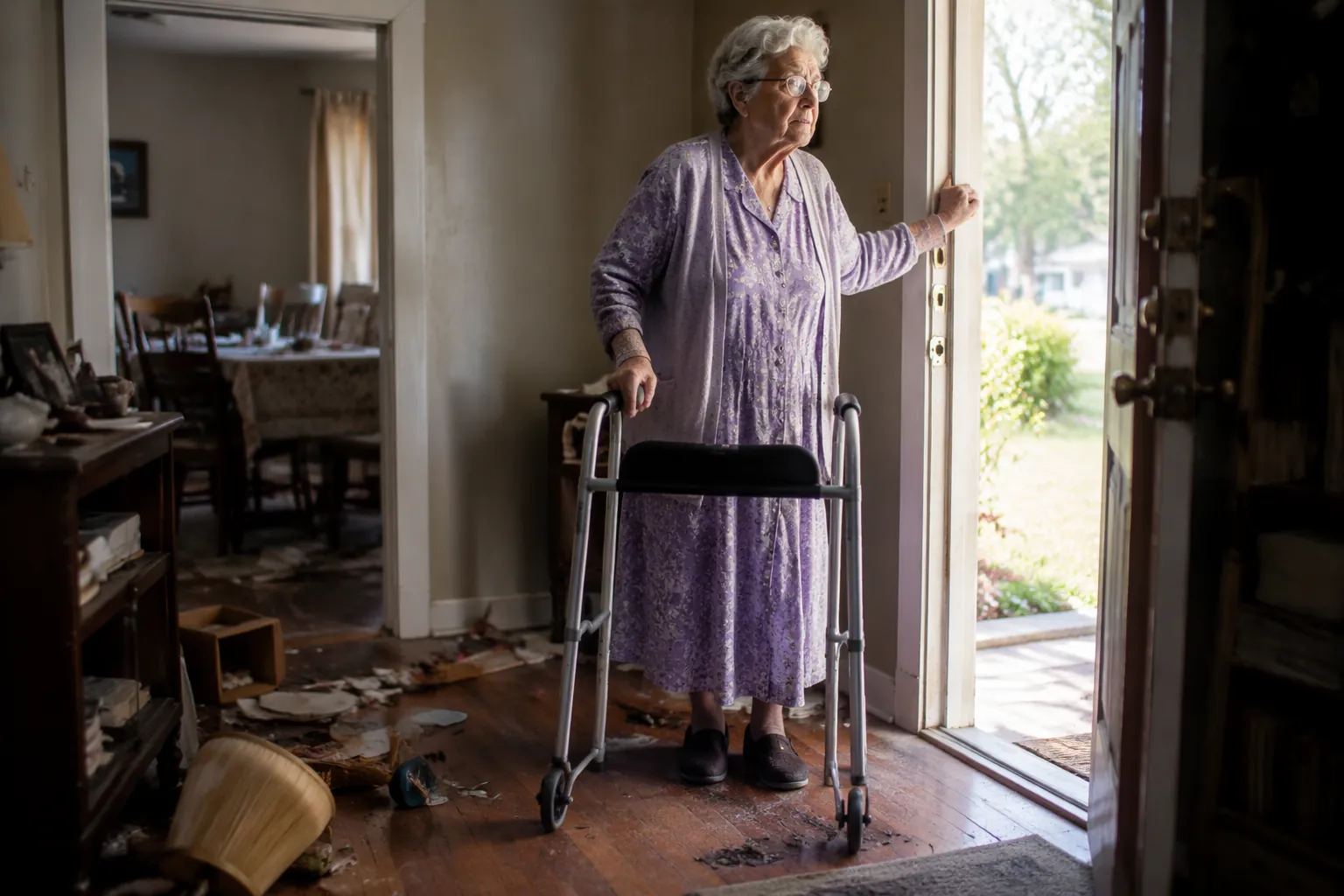
They survived the earthquake. Now they will not walk to the bathroom without pleading, will not transfer from the chair unless someone stands inches away, or will not leave the house because the sidewalk, porch, or hallway no longer feels trustworthy. For families caring for elderly earthquake survivors with disabilities, that refusal can look like stubbornness from the outside. Up close, it is usually more complicated: the person is trying to prevent another injury by avoiding movement, and the avoidance can quietly create the weakness, imbalance, and fall risk everyone is afraid of.
Before a mobility plan begins, immediate earthquake safety still comes first. If the shaking has just happened, aftershocks are likely, utilities may be damaged, and the home may not be safe to move through. Families who are still in that first response window may need an immediate safety protocol such as earthquake safety tips for seniors living alone before asking an older adult to practice walking. Once urgent danger has passed, though, a new problem often appears: the house may be standing, but the person no longer believes their body can safely move through it.
When fear of movement becomes the injury after the injury
Kinesiophobia means an excessive fear of movement because movement is expected to cause pain, injury, or another dangerous event. After an earthquake, that fear has a very reasonable starting point. The floor did move. Furniture did shift. A walker may have rolled, a cane may have been out of reach, glass may have fallen, and the route to the bathroom may have become a real hazard.
The problem is what happens next. If an older adult with arthritis, neuropathy, low vision, hearing loss, Parkinsonian symptoms, stroke history, dementia, or prior falls stops moving because the ground might shake again, the body starts adapting to immobility. Transfers get harder. Standing tolerance shrinks. Steps become shorter and more guarded. The caregiver, trying to be kind, may begin doing more lifting, more fetching, and more arguing, while the older adult becomes more certain that movement is unsafe.
This is not simply “nerves.” In a 2024 cross-sectional study of 260 survivors of the February 2023 Kahramanmaraş earthquakes in Türkiye, older survivors had a mean Tampa Scale for Kinesiophobia score of 45.9, compared with 39.6 among younger adults; the study notes that scores above 37 indicate a high level of kinesiophobia. Older adults also had higher fear of falling, with a Falls Efficacy Scale median of 30 versus 12, and worse balance, with a Berg Balance Scale median of 46.5 versus 56.[1]
The fall difference was not subtle. In that same study, 19.6% of older earthquake survivors had already fallen after the earthquake, compared with 3.9% of younger adults, roughly a five-fold difference.[1] That does not prove that every post-earthquake fall is caused by kinesiophobia, and the study was conducted in Türkiye, not in a U.S. home care system. But it does show that the pattern caregivers describe at home can be measured: fear of movement, fear of falling, poorer balance, and actual falls can travel together after a quake.
The same study also found kinesiophobia correlated with pain severity, anxiety, and PTSD symptoms.[1] That matters because the caregiver cannot safely split the problem into “physical” on one side and “emotional” on the other. A person who says, “If I stand up, I’ll fall,” may be speaking from knee pain, from the memory of the room shaking, from dizziness, from a prior fall, from aftershock fear, or from all of those at once.
Older adults are also more vulnerable to disaster-related trauma symptoms. A meta-analysis cited by the VA National Center for PTSD found older adults were 2.11 times more likely to experience PTSD symptoms after natural disasters.[2] That finding should not be used to label every frightened older survivor with PTSD. It should make families slower to dismiss repeated refusal as laziness, attention-seeking, or “just getting old.”
The fear-avoidance loop families can accidentally feed
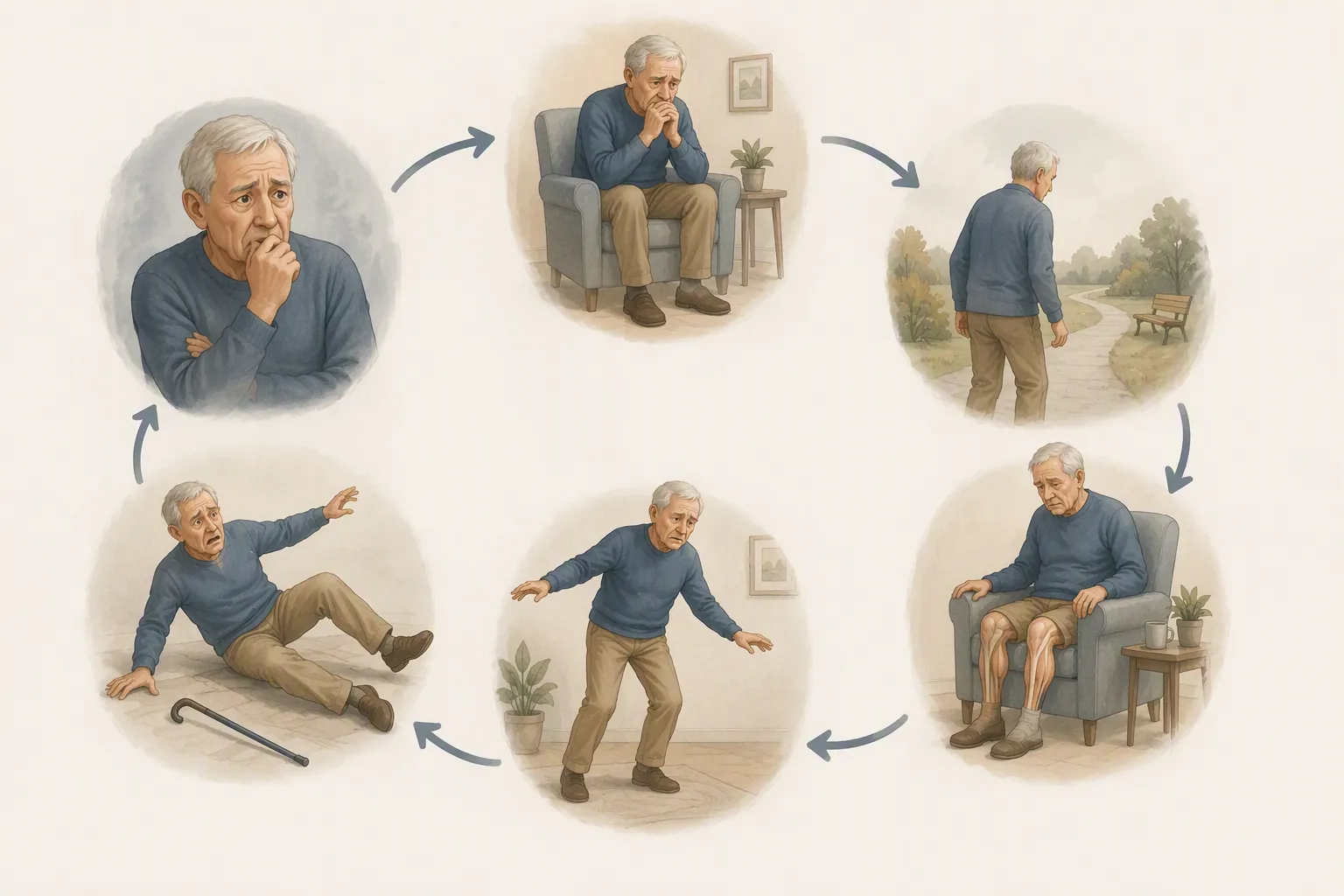
A common loop starts with a protective thought: “If I do not walk, I cannot fall.” For a day or two after a disaster, resting may be appropriate, especially if injuries have not been checked. But when the avoidance continues, the body pays for it. Less walking means less leg strength, less ankle strategy, less practice shifting weight, less confidence turning, and less tolerance for standing long enough to wash hands, pull up clothing, or wait for a door to open.
The caregiver can become trapped in the same loop from the other side. If every transfer turns into panic, the caregiver may rush, pull harder, or take over. If the older adult refuses, the caregiver may bring the meal, the commode, the medications, and the laundry to the chair because it is faster and kinder in the moment. Sometimes that is necessary. Over time, it can teach the nervous system that standing is no longer part of ordinary life.
Standard fall-prevention advice still has a place, but it cannot carry the whole recovery. Balance and functional training reduce fall risk, according to a Cochrane review, but the review did not identify a program designed specifically for post-earthquake kinesiophobia.[3] In other words, exercise matters, but a generic handout that says “practice balance daily” may miss the reason the person will not stand up in the first place.
The same is true for equipment. A properly fitted walker, cane, grab bar, night light, repaired eyeglasses, charged hearing aids, and a clear path to the bathroom can reduce danger. California’s Department of Aging recommends keeping walking aids near at all times, storing extra walking aids in different rooms, and including an extra pair of eyeglasses and hearing aid batteries with emergency supplies.[4] Those steps are practical after any disaster. They become more effective when they are paired with a plan that helps the older adult practice safe movement without feeling pushed into danger.
For a related disaster recovery comparison, families may find it useful to review post-hurricane fall prevention. The home hazards are different, but the caregiving tension is familiar: restore safe movement without pretending the danger was imaginary.
Start with the problems that should not be coached through
The first step is not encouragement. It is screening. Do not start standing drills, stair practice, or walking laps with an older adult who has new or worsening pain, suspected fracture, head injury, new weakness, severe shortness of breath, fainting, chest pain, sudden confusion, or an injury that has not been medically evaluated. If there was a fall during or after the earthquake, treat the refusal to move as possible information, not as a behavior problem.
Dizziness deserves special caution. After earthquakes, some people report that the ground still feels like it is moving, or they become dizzy when rolling in bed, looking up, bending, or turning their head. That can be trauma-related, but it can also be vestibular. In one post-earthquake patient series, 47 of 60 patients had benign paroxysmal positional vertigo, or BPPV.[5] BPPV is often treatable, but it needs the right evaluation; trying to “walk it off” can make a frightened person more frightened and less safe.
A physical therapist, occupational therapist, physician, vestibular therapist, or other qualified clinician should be involved when the older adult has an untreated injury, severe dizziness, repeated falls, major mobility loss, or a disability that changes the risk calculation. That is especially important when cognitive impairment affects judgment, when low vision makes debris hard to detect, when hearing loss interferes with instructions, or when an existing movement disorder complicates balance. If Parkinson’s disease is part of the picture, use guidance specific to preventing falls in a parent with Parkinson’s rather than assuming the earthquake fear is the only problem.
A graded-exposure route for the first safe movements
Graded exposure means the person practices a feared movement in a controlled, repeatable way that is challenging enough to build confidence but not so intense that the body learns, again, that movement equals panic. For a caregiver, this is less like cheerleading and more like setting the room, timing, equipment, and expectations so success is possible.
| Caregiver action | What it is meant to protect |
|---|---|
| Name the fear without debating it | Dignity and trust |
| Choose one small movement | Predictability and safety |
| Keep practice below panic intensity | The nervous system’s ability to relearn |
| Repeat before adding difficulty | Strength, balance, and confidence |
| Pair movement with an aftershock plan | The person’s sense that mobility does not mean abandoning safety |
Name the fear without arguing with it
The sentence “There is nothing to be afraid of” usually fails because there was something to be afraid of. A steadier opening is more concrete: “Your body is expecting the floor to move again. We are going to practice only from the chair to the walker, with the brakes checked, and then sit back down.” This keeps the fear in the room without giving it command of the whole day.
For someone with memory loss, long explanations may not help. Use the same short cue each time, in the same place, with the same setup. For someone with hearing loss, face them before giving directions and make sure hearing aids are working. For someone with low vision, describe changes in the room before asking them to move. The movement plan should fit the disability, not require the person to perform as if the disability disappeared after the earthquake.
Choose one safe movement, not a whole independence campaign
Pick the movement that matters most and can be made reasonably safe. That might be standing from the recliner with a walker in front, transferring from bed to a bedside commode, walking five steps to the bathroom doorway, or stepping onto the porch with a hand on the rail. The movement should be specific enough that both people know when it starts and when it ends.
Avoid turning the first practice into a test of character. “Let’s walk all the way down the hall” may sound modest to the caregiver and impossible to the survivor. A better starting point may be standing for ten comfortable breaths, shifting weight once, or walking only to a taped marker on the floor. If the older adult has not been cleared for weight-bearing, this is where the plan stops until a clinician gives safer options.

Practice below panic intensity
A little fear during practice is expected. Panic is different. If the person is gripping the walker until their hands hurt, holding their breath, crying, shaking, becoming dizzy, or begging to stop, the step is too large for that session. The caregiver’s job is not to prove that the person can survive distress. It is to find the edge where the person can move, recover, and be willing to try again.
One useful rule is to stop while the practice is still organized. Sit down before exhaustion turns into a collapse. End before frustration turns into a fight. Let the person’s last memory of the attempt be, “I stood and sat safely,” not, “They made me keep going until I failed.” That memory is part of the next session’s equipment.
Repeat, then add one variable
Do not add distance, speed, turns, conversation, obstacles, and outdoor surfaces all at once. Repeat the same movement until it becomes less alarming, then change one feature. Stand from the chair, then stand and take two steps, then walk to the bathroom door, then enter the bathroom, then practice the turn, then practice when the hallway light is lower. Each added variable should have a reason tied to daily life.
The caregiver can track confidence in ordinary language: “Was that easier, harder, or the same as yesterday?” A formal Tampa Scale score belongs in clinical hands, not on the kitchen table as a self-diagnosis project. What the family needs at home is a practical signal that the movement is becoming more tolerable and more reliable.
Build the aftershock plan into mobility
Some survivors refuse to leave the chair because the chair has become their safety plan. If they stand, they feel exposed. If they walk to the bathroom, they worry an aftershock will catch them halfway. A mobility plan that ignores that fear asks the person to choose between walking and safety. A better plan shows how the two fit together.
- Identify safe stopping points along the route, such as a sturdy chair, interior wall, or clear space away from glass.
- Keep the walker, cane, wheelchair, or transfer device within reach before practice starts.
- Place shoes, glasses, hearing aids, phone, flashlight, and medications where they can be reached without rushing.
- Agree on the words the caregiver will use if shaking starts, so instructions do not become shouted improvisation.
- Practice one route at a calm time instead of waiting for the first urgent bathroom trip.
Preparedness is not a reward after the person becomes brave. It is one of the conditions that makes practice possible.
How caregivers can help without turning every hallway into a negotiation
Caregivers often get blamed from both directions. If they push, they are told they are insensitive. If they help too much, they are told they are enabling dependence. The better standard is more concrete: create the smallest safe opportunity for the older adult to do a piece of the movement themselves.
That might mean placing the walker correctly but letting the person push up from the chair. It might mean guarding at the side instead of pulling from the front. It might mean carrying the laundry but asking the person to walk to the table for lunch. It might mean using a wheelchair for a long clinic visit while still practicing two standing transfers at home. Disability support and mobility recovery are not opposites; the art is knowing which support preserves capacity and which support quietly replaces it.
Pain should be taken seriously, not used as a reason to abandon all movement without review. Because kinesiophobia after the Turkish earthquakes correlated with pain severity, pain may be part of the fear signal.[1] Ask where it hurts, when it started, what makes it worse, and whether it is new since the quake or fall. New pain needs evaluation. Chronic pain may need a modified route, better timing around medication, different footwear, a different assistive device, or therapist-guided strengthening.
Anxiety and trauma symptoms also need room in the plan. Some families find that the older adult moves better when the news is off, the practice time is predictable, the route is quiet, and the caregiver does not narrate every possible danger. Others need professional mental health support alongside PT or OT, especially if nightmares, intrusive memories, constant scanning for aftershocks, or refusal to enter certain rooms persists.
Once the first graded-exposure work is underway, broader recovery planning can help families coordinate appointments, home routines, and emotional support. A guide to supporting a parent during rehab and recovery can be useful at that stage, when the question shifts from “How do we get through this transfer?” to “How do we rebuild the week?”
A realistic standard for progress
The goal is not to make an older earthquake survivor fearless. Fear may remain appropriate when aftershocks are possible, repairs are unfinished, or the body is still recovering. The goal is to restore enough safe movement that fear no longer governs every transfer, step, and room change.
Good progress may look small: standing with less gripping, walking to the bathroom before urgency becomes panic, accepting the walker without shame, turning safely instead of freezing, stepping outside with a plan for what to do if shaking starts. Those gains matter because they interrupt the loop. The person is not being forced to deny what happened. They are relearning that the body can move again inside a safety plan that respects what happened.
Post-earthquake kinesiophobia is treatable, but it asks families to respect both halves of the problem: the trauma memory that makes movement feel dangerous, and the physical deconditioning that can make that danger more real with each inactive day.
References
- Evaluation of fear of falling, balance, and kinesiophobia in earthquake survivors. PMC. 2024. https://pmc.ncbi.nlm.nih.gov/articles/PMC12012920/
- The Impact of Disaster Events on Older Adults. VA National Center for PTSD. https://www.ptsd.va.gov/
- Exercise for preventing falls in older people living in the community. Cochrane. 2019. https://www.cochrane.org/
- Disaster Tip Sheets. California Department of Aging. https://aging.ca.gov/
- Post-earthquake dizziness: a report of benign paroxysmal positional vertigo. Tevzadze & Shakarishvili. 2007.
Related reading
Noticed something outdated or inaccurate on this page? Flag a correction. We review every report against CDC, NIA, and AARP HomeFit guidance before updating a page.
Part of the Fall Prevention section.