
STEADI: Intervene
How to Take Elderly Parents to a Concert Safely
Taking an elderly parent to a concert safely starts with decisions you make before buying tickets. This step-by-step guide covers ADA accessible-seating rules, venue research, and a day-of checklist for mobility, crowds, heat, and hearing — including when to skip the show.
Reviewed by Elena Ramirez, PT, DPT. This guide is plan-ahead fall-prevention and accessibility information for caregivers; it is not medical advice, legal advice, or emergency guidance.
A concert outing with an elderly parent is mostly decided before the tickets are bought. If you cannot verify accessible seating, the entrance route, parking or drop-off, restroom access, weather exposure, crowd flow, and a workable exit plan before purchase, the safer choice may be a different performance, a different venue, a livestream, or no show.
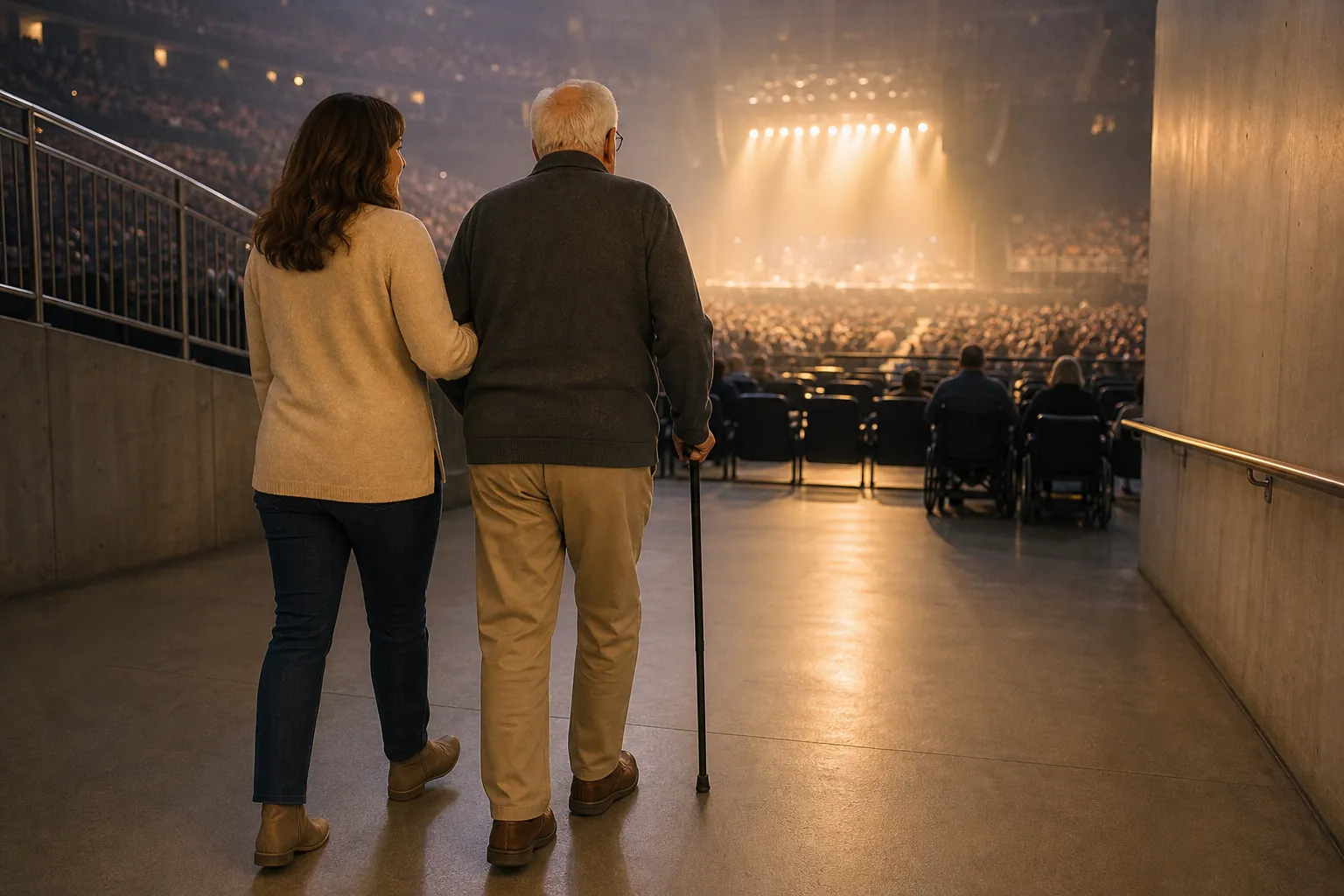
Before you buy: treat the ticket map like safety equipment
The first decision is not whether your parent is “old enough” or “disabled enough” for accessible seating. ADA guidance says people with mobility disabilities include people who cannot climb steps or walk long distances because of conditions such as arthritis, cardiac conditions, or respiratory conditions, not only people who use wheelchairs full-time.[1] A parent who walks around the house without trouble may still need an accessible seat in a dark, crowded, large venue with stairs, sloped aisles, long concourses, and slow exits.
That matters because falls are common enough that “we’ll figure it out when we get there” is a weak plan. CDC data say more than one in four older adults falls each year; falling once doubles the chance of falling again, and falls lead to about 3 million emergency department visits and about 1 million hospitalizations annually.[2] Those numbers do not mean every concert is dangerous. They mean the aisle, the restroom route, the standing time, and the exit line are part of the safety plan.
Federal ADA ticket-sales guidance gives caregivers several concrete protections to use before purchase. Venues that sell tickets for accessible seats must sell them in the same manner, during the same hours, through the same stages of sales, and through the same channels as non-accessible seats, including online when online sales are used. They also must offer accessible seats at the same prices as comparable non-accessible seats.[1]
The venue also may not require proof of disability, such as a doctor’s note. It may ask the buyer to attest that the accessible seat is for a person with a mobility disability or another disability that requires the accessible seating feature.[1] That distinction is important when a parent is embarrassed, uncertain, or says, “I’m not in a wheelchair.” The question is not whether they use a wheelchair every day. The question is whether the regular seating path creates a real barrier.
- Can your parent reach the seat without stairs, or with only stairs they can safely manage?
- Is there an accessible seat or transfer-friendly seat available in the section you can afford?
- Can at least one companion sit directly next to your parent, not several rows away?
- Is the seat close enough to an accessible restroom to avoid a long mid-show walk?
- Is the entrance step-free from parking, rideshare, shuttle, or drop-off?
- If the venue is outdoors, is there shade, cooling access, or a clear weather-cancellation threshold?
- Can you leave before the main crowd without crossing a dense standing area?
- If the box office cannot answer these questions, can you choose a different date, section, venue, or format?
Accessible inventory is real, but it is limited
Buying early is not just about better sightlines. Under the 2010 ADA Standards, a single wheelchair space must be at least 36 inches wide, and the number of required wheelchair spaces is based on venue capacity. For example, a venue with 1,000 seats must provide 10 wheelchair spaces.[3] That is enough to create access, but it is not an endless supply. For popular shows, accessible inventory can disappear quickly.
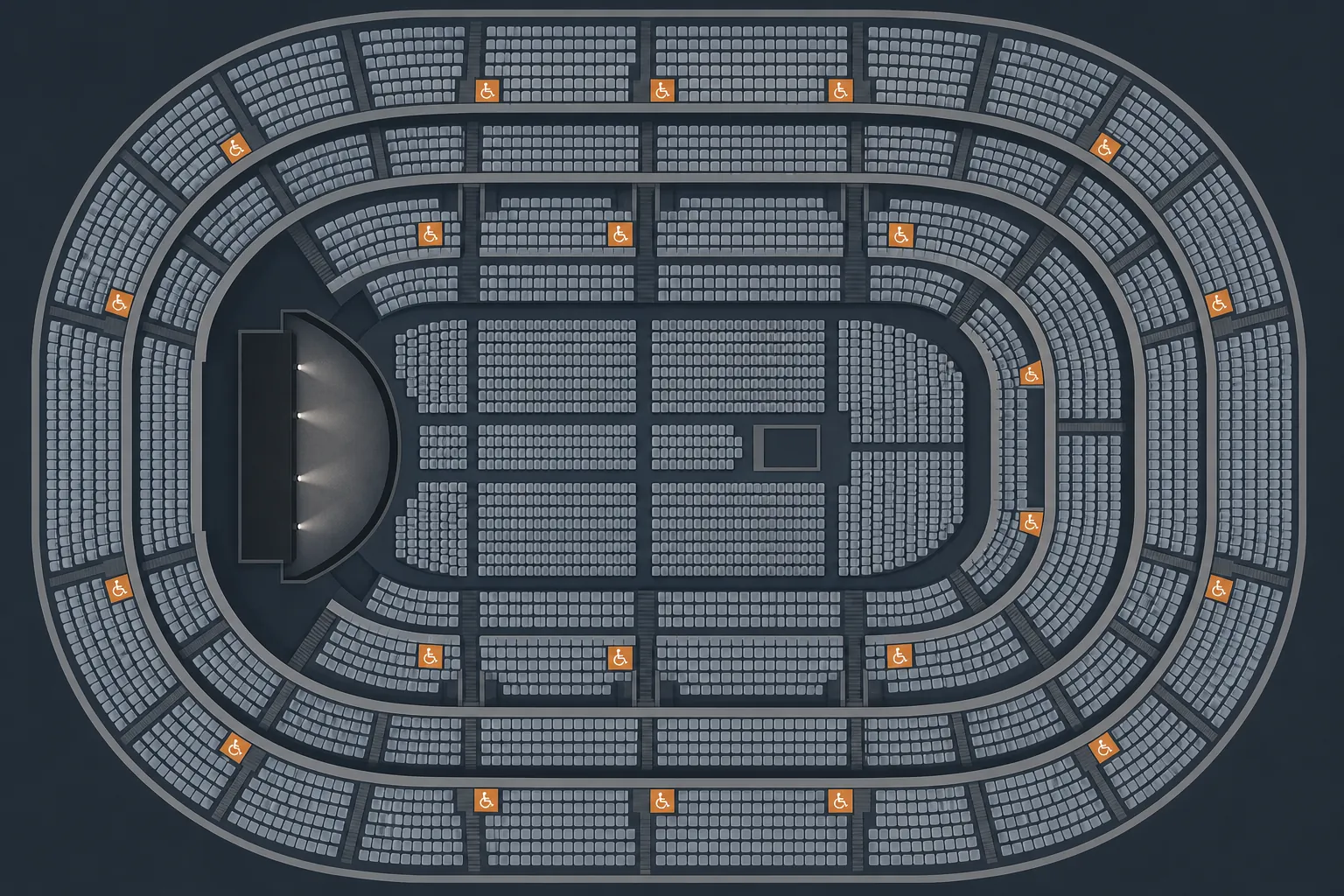
Accessible seats also are not supposed to be isolated in one undesirable corner. ADA standards require wheelchair spaces to be dispersed horizontally and vertically in assembly areas, with some exceptions depending on the venue layout.[3] In practice, that means the accessible seats may appear across several sections on the map, and each location can create a different night: closer restroom, longer elevator ride, better view, worse weather exposure, easier exit, harder concession route.
Companion seating should be checked before payment, not after. ADA guidance says a person purchasing a wheelchair space may buy up to three companion seats in the same row and contiguous with the wheelchair space when those seats are available.[1] The Access Board standards also require companion seats to provide equivalent size, quality, and amenities compared with adjacent seating.[3] If a platform offers one accessible space but no adjacent companion seat, call the box office before assuming the venue can fix it at the door.
Call the venue with questions a seating chart cannot answer
A seating chart can show a wheelchair symbol. It usually cannot tell you whether the closest elevator is out of service, whether the accessible restroom is on the same level, whether the drop-off curb is blocked by tour buses, or whether an outdoor lawn seat means a long uneven walk. Event-accessibility planning guidance emphasizes that accessible routes, parking, restrooms, seating, signage, and staff communication all need to be planned as part of the event, not treated as separate favors.[4]
The box office or guest services desk is the right place to be specific. Do not ask only, “Are you accessible?” Ask what will happen from curb to seat to restroom to exit. If the first person gives a vague answer, ask for accessibility services, guest experience, or the venue’s ADA coordinator if one is available.
| What to verify | What to ask |
|---|---|
| Entrance route | Which entrance is step-free from accessible parking, rideshare, shuttle, or drop-off, and how far is it from the curb? |
| Elevators and ramps | Is the seat level reachable without stairs, and are elevators available to the public before and after the show? |
| Restrooms | Is there an accessible restroom on the same level as the seats, and is it open during the full event? |
| Seating details | Is this a wheelchair space, companion seat, transfer seat, aisle seat, or limited-mobility seat, and what exactly does that mean at this venue? |
| Parking and drop-off | Where should the driver enter, wait, or return, and is the route different after the show? |
| Mobility aids | Can your parent bring a cane, walker, rollator, transport chair, or wheelchair, and where can it be kept safely during the performance? |
| Bag rules | Are medications, water, hearing protection, and mobility-aid accessories allowed under the bag policy? |
| Staff help | Can staff escort a guest to an elevator, accessible seating area, or medical/guest services area if needed? |
| Outdoor exposure | Which accessible seats are shaded or covered, and what happens for extreme heat, storms, smoke, or poor air conditions? |
| Exit plan | Can you leave early through the same accessible route, and will elevators or gates remain available before the encore ends? |
Write down the answers. If you have to call again, you want to be able to say, “Guest services told me Section 112 uses the north elevator and the accessible restroom is behind Portal C.” That is much easier than trying to reconstruct a phone call while your parent is standing in a crowd.
Choose seats for the weakest part of the outing, not the best view
The right seat is the one that reduces the most likely failure point. For one parent, that may be stairs. For another, it may be standing in line, walking from the parking lot, heat, needing the restroom quickly, or becoming disoriented after dark. A perfect view that requires a hard exit is not a perfect seat.
When buying online, look for the venue or ticket platform’s accessible seating filter, wheelchair icon, or accessibility request path. Practical ticketing guides from marketplaces such as SeatGeek describe accessible-ticket purchase flows, but the controlling baseline remains the ADA rule: accessible seats should be available through the same sales channels as comparable non-accessible seats when tickets are sold through those channels.[1][5]
- Prefer an aisle only if the aisle does not expose your parent to repeated jostling, spilled drinks, or people stepping over them.
- Prefer a lower level only if it is actually easier to reach; some upper accessible platforms have a simpler elevator route than lower bowl seats with steps.
- Prefer proximity to a restroom when your parent uses diuretics, has urgency, tires easily, or becomes anxious when routes are unclear.
- Prefer a companion seat directly beside your parent when they need help standing, hearing instructions, navigating crowds, or deciding when to leave.
- Avoid general-admission floors unless you have confirmed accessible viewing, seating, restroom access, and a way to avoid dense standing crowds.
If your parent refuses the word “accessible,” use the practical language: fewer steps, shorter walks, a place to sit, a nearby bathroom, an easier way out. The ticket category is not a verdict on their independence. It is how the venue makes the evening possible.
Plan transportation as part of fall prevention
The parking lot is where many “simple” outings become hard. A parent may do well inside the arena and still struggle with a gravel overflow lot, a dark curb cut, a shuttle step, or a half-mile walk that nobody mentioned. Decide the transportation plan only after you know the accessible entrance.
- If driving, reserve accessible parking when the venue offers it, and confirm whether the placard holder must be present.
- If using rideshare, confirm the exact drop-off point before the show and the pickup point after the show; they are often different.
- If another family member is dropping you off, choose a waiting location away from moving traffic and post-show crowds.
- If taking public transit, check the station elevator status and the distance from station to venue.
- If using a venue shuttle, ask whether it is step-free or lift-equipped and how long guests may wait after the show.
Build in a seated pause between travel and entry when possible. That may mean arriving early enough to sit near the entrance, not arriving early just to stand in a longer line. “Early” is useful only when you know where your parent can wait safely.
Use a mobility aid for the venue your parent is entering, not the house they left
A cane, walker, rollator, transport chair, or rented wheelchair can be reasonable for a concert even if your parent does not use one at home. Home is familiar, measured, and usually quiet. A venue is larger, darker, louder, and full of people who change direction without warning.
Choose the least cumbersome aid that solves the real problem. A cane may help with balance but not fatigue. A rollator may provide a seat but may be difficult in tight rows. A transport chair may preserve stamina through parking and entry but requires a companion who can push safely. A full wheelchair space should be purchased if your parent will remain in a wheelchair during the show; do not assume a standard row can store a chair without blocking egress.
Test the aid before the concert. Adjust height, check brakes, practice folding it, and make sure your parent can rise from it safely. If the device is new, do not let the concert be the first long outing.
The day-of checklist
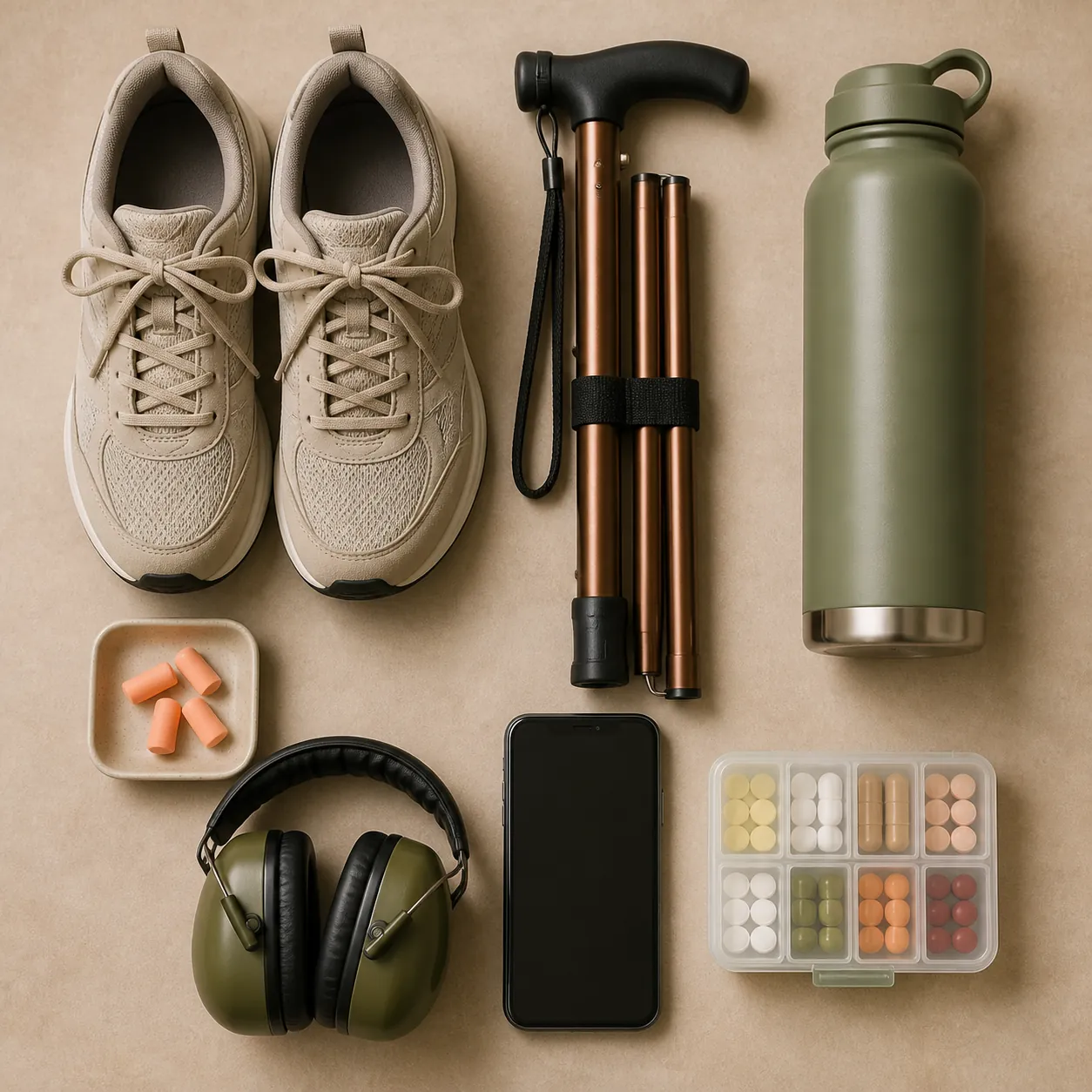
The day-of list should be short enough to use while people are still excited. Pack for walking, waiting, noise, weather, medication timing, and the possibility that you will leave earlier than planned.
- Comfortable, closed-back shoes with traction; avoid new shoes, slick soles, and loose sandals.
- The mobility aid you planned, plus any needed tips, brakes, charger, cushion, or storage tag.
- Medications and essentials in a bag that complies with the venue’s policy; keep critical medication with the caregiver or parent, not in a car.
- Water if allowed, or a plan for where to buy it without crossing the busiest concourse.
- Foam earplugs or over-ear hearing protection, even if your parent says they are “fine with noise.”
- A fully charged phone, portable battery, written seat location, and emergency contact card.
- A meeting point outside the main flow in case companions separate.
- A restroom plan: go before taking seats, and again before the encore if urgency or crowding is likely.
- A crowd plan: wait out the rush, leave before the encore, or use the accessible exit route you verified.
Hearing protection belongs on the same list as shoes and medications. A 2023 CDC MMWR report noted that about one in four U.S. adults ages 20 to 69 had evidence suggestive of noise-induced hearing loss, and it cited a World Health Organization standard recommending a maximum average sound level of 100 dB(A) over 15 minutes for amplified venues and events.[6] Cleveland Clinic similarly notes that rock concerts can exceed 100 dB and that the safe exposure time at that level is about 15 minutes; it also describes concert earplugs with noise reduction ratings in the 15 to 30 range.[7] The practical move is simple: bring the ear protection before anyone needs it.
At the venue: slow down the transitions
Most of the hard moments happen during transitions: curb to entrance, security to seat, seat to restroom, seat to exit, exit to car. Once the music starts, your parent may be perfectly happy. The work is keeping each transition from becoming a rushed negotiation.
- Use the entrance you verified, even if another gate looks shorter. Shorter is not better if it adds stairs, uneven pavement, or a crowded bottleneck.
- Ask staff early. It is easier for an usher to direct you to the correct elevator before the concourse fills.
- Pause after security. Let your parent regain balance, adjust hearing protection, and orient to the lights and sound before walking farther.
- Do the restroom trip before the opener or early in the show if waiting until intermission would mean long lines.
- Keep the exit path clear. Do not park a walker, cane, bag, or transport chair where someone can trip or where staff may need the aisle.
- Watch for fatigue before your parent admits it. Slower steps, gripping rails, irritability, confusion, or refusing to drink may be the real signal.
If something goes wrong, shift from “saving the evening” to reducing harm. Ask venue staff for guest services or medical support, move away from crowd pressure if possible, and do not hesitate to leave. For caregivers who want a separate emergency-oriented template, the site’s hospital emergency safety checklist for elderly patients is a better fit than trying to turn a concert plan into crisis triage.
Heat, weather, and outdoor shows
Outdoor concerts add a separate safety decision. CDC heat guidance identifies adults age 65 and older as being at higher risk during heat because of factors such as chronic medical conditions, medications, and reduced ability to adjust to temperature changes.[8] A shaded accessible seat, a cooling area, and a short walking route may make the difference between a workable show and one that should be skipped.
- Check the forecast for the full time window: arrival, waiting, show, and exit.
- Ask whether accessible seating is shaded, covered, or exposed.
- Confirm whether sealed water, refillable bottles, cooling towels, or medical exceptions are allowed.
- Know where the air-conditioned or shaded rest area is before your parent needs it.
- Set a weather threshold in advance: heat, storms, poor air, or long exposed lines may be enough reason not to go.
If heat is already a concern at home, treat the concert as an extension of the same planning problem. The site’s room-by-room heat wave safety plan for older adults can help you think through hydration, cooling, and medication-related questions before adding a crowded outdoor venue.
If your parent has dementia or cognitive changes
Live music can still be meaningful for people with cognitive changes, but a standard commercial concert is not the same as a curated dementia-friendly program. Northwestern reported in July 2026 on a structured live music series designed for dementia patients that offered emotional, social, and intellectual benefits.[9] That kind of setting is built differently from a loud arena with dark concourses, dense exits, alcohol sales, and changing sensory input.
For a parent with dementia, look first for relaxed performances, sensory-friendly shows, smaller seated venues, daytime concerts, familiar music, and flexible exits. Use dementia-specific safety planning for transportation, identification, separation risk, toileting, noise, and overstimulation; the site’s earthquake preparedness tips for dementia caregivers are for a different hazard, but the caregiver logic is similar: plan for confusion before the environment becomes stressful.
Leaving safely is part of the ticket plan
The encore is optional. The exit is not. If your parent is tired, the restroom line is growing, the elevator queue is forming, or the rideshare area will be chaotic, leaving before the final song can be the best safety decision of the night.
Before the show starts, tell your parent and companions what the leaving plan is. For example: “If Dad looks tired, we leave before the encore and meet the car at the north entrance.” This avoids turning the decision into a debate in the aisle while thousands of people are standing up.
- Use the same accessible route you entered unless staff directs you to a safer alternative.
- Let the densest crowd move ahead if your parent is steady, seated, and not in distress.
- Keep one companion responsible for the parent and another, if available, responsible for the car, rideshare, or navigation.
- Do not rush across traffic lanes, parking lots, or ride-share queues because a driver is waiting.
- Once home, note what worked and what failed before planning the next outing.
When skipping is the safe outcome
A concert is supposed to give your parent pleasure, not prove that the family can overpower a bad setup. Skip, exchange, resell, or choose another format when the workable pieces are not there.
- No accessible or limited-mobility seat is available for the route your parent can actually manage.
- The venue cannot explain the step-free entrance, elevator route, restroom access, or exit plan.
- The only available seats require stairs, long standing, or a general-admission crowd your parent cannot safely navigate.
- Outdoor heat, storms, smoke, poor air, or cold would make waiting and exiting unsafe.
- Your parent is newly ill, newly dizzy, unusually weak, more confused than usual, or recovering from a recent fall.
- The transportation plan depends on luck: an unknown curb, an unverified shuttle, a long dark walk, or a driver who cannot wait.
The point of planning is not to make every concert possible. It is to find out, early enough to choose well, whether this concert can be made safe enough for this parent, in this venue, on this day. If the accessible route, seating, weather, stamina, crowd, or cognitive-safety conditions cannot be made workable, choosing another performance is not a failure of caregiving. It is the safety decision the planning process was meant to reveal.
References
- ADA Requirements: Ticket Sales — ADA.gov
- Facts About Falls — CDC
- Chapter 8: Special Rooms, Spaces, and Elements, 2010 ADA Standards — U.S. Access Board
- A Planning Guide for Making Temporary Events Accessible — ADA National Network
- Accessible seating guide: How to buy accessible tickets online — SeatGeek
- Safe Listening at Venues and Events with Amplified Music — CDC MMWR, 2023
- Ears Ringing After a Loud Concert? — Cleveland Clinic
- Heat and Older Adults (Aged 65+) — CDC Heat Health
- Live music series offers boost to dementia patients — Northwestern Now, July 2026
Related reading
Noticed something outdated or inaccurate on this page? Flag a correction. We review every report against CDC, NIA, and AARP HomeFit guidance before updating a page.
Part of the Fall Prevention section.