
Evidence-Based Home Modifications That Actually Prevent Falls: What the Research Says
Not all home modifications are equally effective. This article reviews the latest systematic reviews and RCTs to show that secure rails (grab bars and handrails) are the single most evidence-supported intervention for preventing falls at home, and explains why some modifications work better than others.
The Problem with Kitchen-Sink Advice on Home Modifications
If you have searched for "home modifications to prevent falls," you have likely encountered lists that treat a $25 grab bar as equivalent to a $12,000 walk-in shower. These kitchen-sink guides — "install grab bars, add lighting, remove rugs, buy a shower chair, widen doorways" — present every option as equally important. They do not tell you which intervention carries the strongest evidence, which one a 2026 systematic review of nine randomized controlled trials actually endorses, or why some well-intentioned modification programs fail to reduce falls at all.
This matters because the stakes are high. According to the CDC, 14 million older adults — one in four Americans aged 65 and older — fall each year. Falls are the leading cause of fatal and non-fatal injuries among older adults, and over half of all falls occur at home. The total healthcare cost of non-fatal older adult falls reached $80 billion in 2020, up from $50 billion in 2015. When a caregiver invests time, money, and emotional energy into modifying a parent's home, that investment should go toward changes that the best available research actually supports.
This article does not offer another list. It examines the evidence hierarchy — from systematic reviews and randomized controlled trials to population-level studies — to answer a specific question: which home modifications actually prevent falls, and why?
What the Evidence Hierarchy Shows: Secure Rails Lead the Way
The strongest evidence in the home-modification literature points to a single category of intervention: secure rails, which include grab bars in bathrooms and handrails on stairs. A 2026 systematic review published in the journal Assistive Technology examined nine randomized controlled trials and concluded that secure rails reduce both the number of people who fall and the overall rate of falls among community-dwelling older adults.
The review highlights two landmark trials with specific, measurable effects:
- Cumming et al. (1999) reported a 19% reduction in the number of fallers (p=0.050) after installing secure rails.
- Clemson et al. (2023) found a 26% reduction in the overall fall rate among participants who received rail installations.
These effect sizes are not trivial. A 19% reduction in fallers means that for every five homes where rails are installed, roughly one fall that would have occurred is prevented. A 26% reduction in fall rate compounds over time: a person who would have fallen four times over two years instead falls three times. For an older adult with osteoporosis or on blood thinners, each prevented fall can mean the difference between remaining at home and a hospitalization that leads to nursing home placement.
Why do secure rails work better than other modifications? The mechanism is straightforward: falls often happen during weight shifts — stepping into a shower, rising from a toilet, navigating a step — when the body needs a stable point to transfer weight. A properly installed grab bar or handrail provides that stable point. Unlike non-slip mats or improved lighting, which reduce the probability of a slip or misstep, rails actively compensate when a slip or misstep occurs.

The WashU HARP Trial: A 38% Reduction in Falls with Targeted Modifications
The most compelling single trial in the home-modification literature is the Home Hazard Removal Program (HARP) from Washington University School of Medicine, published in JAMA Network Open in 2023. This randomized controlled trial enrolled 310 participants with an average age of 75 (50% African American, 75% women) and followed them over two years. The intervention group received an occupational therapy assessment followed by targeted home modifications, while the control group received usual care.
The results were striking:
| Outcome | Intervention Group | Control Group | Difference |
|---|---|---|---|
| Fall rate (falls/person/year) | 1.5 | 2.3 | 38% reduction (p=0.03) |
| Average intervention cost | $765 | — | — |
| Estimated healthcare savings per person | $1,613 | — | ~2:1 ROI |
The 38% reduction in fall rate is the largest effect size reported in any home-modification RCT to date. Importantly, the average per-person cost of the intervention was $765 — well within reach of many families, especially when compared to the $18,658 average cost of a single inpatient visit for a fall injury. The estimated $1,613 per-person reduction in healthcare utilization means the program effectively paid for itself within the study period.
Broader Population Evidence: The Health and Retirement Study
Randomized controlled trials like HARP provide the strongest causal evidence, but they are expensive and difficult to run at scale. Population-level studies offer a complementary view: do home modifications reduce falls when implemented in real-world conditions, without the controlled environment of a trial?
A Duke University analysis of the Health and Retirement Study — a nationally representative longitudinal survey of older Americans — found that participants who received home modifications had 17% lower odds of experiencing a fall and 22% lower odds of sustaining a fall-related injury compared to those who did not. These effects are smaller than the HARP trial's 38% reduction, which is expected: population-level studies include a wider range of modification quality, adherence levels, and participant characteristics. But the direction is consistent, and the injury reduction finding is particularly important. Even when a fall occurs, a well-modified home may reduce the severity of the outcome — a softer landing surface, a grab bar that breaks the fall, or a clear pathway that prevents a secondary impact.
Taken together, the RCT evidence and the population-level evidence tell the same story: home modifications reduce falls, and the effect is meaningful. The question is not whether modifications work, but which ones work best and under what conditions.
Why Some Studies Show Mixed Results: Adherence, Installation, and Quality
Not every study on home modifications has produced positive results. Some trials have found no significant reduction in falls, and a few have even suggested that certain modifications — like removing throw rugs — might increase fall risk if the removal creates a new hazard (such as a bare floor that becomes slippery). Understanding why some studies fail is as important as understanding why others succeed.
The 2026 systematic review identifies three primary reasons for mixed or null results:
- Low adherence rates. In the Cockayne et al. (2021) trial — one of the largest, with 1,331 participants — only 32 bath safety bars and 4 raised toilet seats were actually implemented across the entire intervention group. When modifications are not installed, the study cannot measure their effect. This is not a failure of the intervention; it is a failure of implementation.
- Poor installation quality. A grab bar that is not anchored into a stud or blocking will pull out of the wall under load. A handrail that is mounted at the wrong height may actually increase fall risk by forcing an awkward reach. The review notes that studies did not consistently address design features like installation height or orientation of grab bars, making it difficult to compare results across trials.
- Co-intervention confounding. Many modification programs bundle multiple changes — rails, lighting, flooring, education, exercise — making it impossible to isolate which component drove the effect. This is why the evidence for secure rails is particularly valuable: several trials examined rails in isolation or as the primary intervention, allowing a cleaner causal inference.
Practical Implications for Caregivers: What to Prioritize and How to Proceed
The research points to a clear decision framework for families planning home modifications. Here is how to translate the evidence into action:
- Start with a professional assessment. The HARP trial's success was built on occupational therapy assessment before any modification was installed. An OT can identify the specific transfer points where your parent is at highest risk — the step into the shower, the transition from bed to standing, the stair landing without a handrail — and recommend the right type and placement of rails. See our Occupational Therapist's Guide to Aging-in-Place Home Modifications for a room-by-room framework.
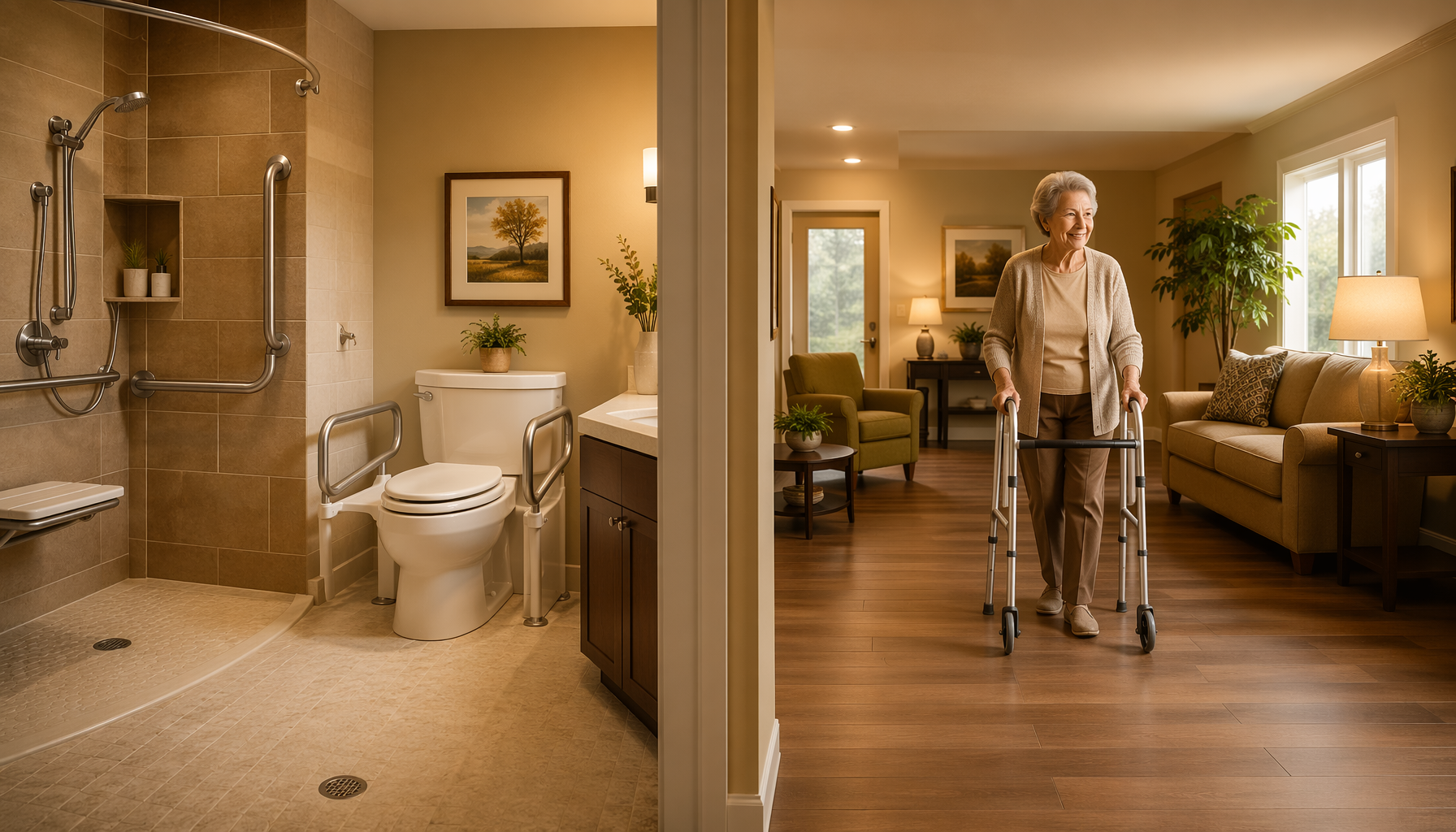
- Prioritize secure rails in bathrooms and on stairs. The evidence is strongest for these locations. In the bathroom, install grab bars at the toilet (for sit-to-stand transfers) and in the shower or tub (for stepping in and out). On stairs, ensure handrails are present on both sides and are mounted at a height that allows a natural grip (typically 34 to 38 inches). For a deeper dive on bathroom modifications, see Bathroom Remodel for Elderly Safety.
- Ensure proper installation. A grab bar must be anchored into a stud or use heavy-duty toggle bolts rated for at least 250 pounds. Do not rely on suction-cup grab bars as primary safety devices — they can fail without warning. Hire a qualified contractor or work with an OT who can recommend installation standards.
- Do not stop at rails. While rails have the strongest evidence, other modifications — improved lighting, non-slip flooring, clear pathways — contribute to a safer environment. The HARP trial used a combination of modifications tailored to each participant's home. The key is to use the evidence hierarchy to decide which modifications to prioritize when budget is limited.
- Plan for adherence. The Cockayne trial showed that even when modifications are prescribed, they are not always installed. Make a plan with your parent or the contractor to ensure the work is completed. Follow up after installation to confirm that the modifications are being used — a grab bar that is never gripped is no better than no grab bar at all.
The Bottom Line: Evidence Supports Action, But Not All Action Is Equal
The research is clear: home modifications reduce falls. A 2026 systematic review of nine RCTs, a landmark trial showing a 38% reduction in fall rate, and a national population study all point in the same direction. But the evidence is also specific: secure rails — grab bars and handrails — carry the strongest support, with effect sizes of 19% to 26% in well-conducted trials. Other modifications matter, but they matter less, and their effectiveness depends heavily on proper installation and consistent use.
For caregivers facing the overwhelming task of making a home safe, the message is both reassuring and actionable: you do not need to do everything at once. Start with the intervention that the best available evidence endorses. Install secure rails where your parent needs them most. Have a professional assess the home. Ensure the work is done correctly. Then build from there.
The alternative — doing nothing — carries a known cost. Fourteen million older adults fall each year. Over half of those falls happen at home. The evidence says we can change that. The question is whether we will act on what the evidence tells us.
Related reading
Noticed something outdated or inaccurate on this page? Flag a correction. We review every report against CDC, NIA, and AARP HomeFit guidance before updating a page.
Part of the Fall Prevention section.