
STEADI: Intervene
Power Outage Fall Risks Every Senior Caregiver Should Know
Power outages trigger a cascade of fall hazards for seniors with medical devices—sudden darkness, generator cords across walkways, lost mobility device charging, and temperature disorientation. This guide explains those hidden risks and the low-cost steps you can take now to prevent a fall before the next blackout.
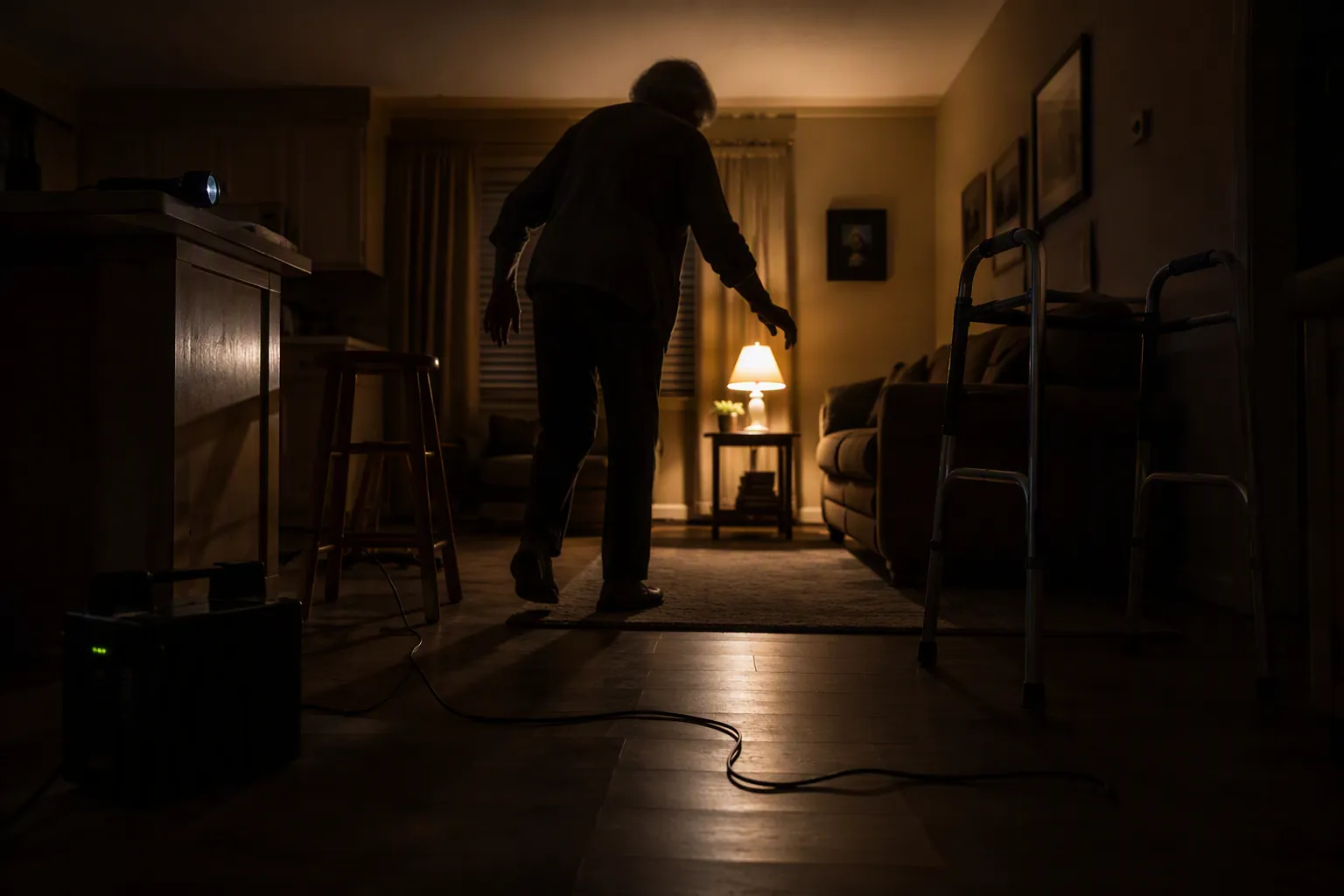
The power goes out at 1:17 a.m. The house does not become dramatic. It becomes unfamiliar.
The older adult who knows every step from the bed to the bathroom now stands up into a room with no edges. The walker is where it always is, except the charger cord for the portable oxygen concentrator was moved earlier in the evening. A backup battery is humming beside the recliner, with its cord crossing the shortest route to the hallway. The flashlight is in the kitchen drawer, exactly where it belongs during the day and exactly where it cannot help during the first minute in the dark.
That is the part of power outage safety for older adults with medical devices that ordinary preparedness advice often misses. The first danger is not only that a device may stop working. It is that the home’s walking map changes at the same time the person’s balance, vision, judgment, and options get worse.
Preparedness gaps show up in the details. A 2026 study of 222 Iowan adults ages 45–80 from the COPDGene cohort found that 58% had no medical care plan for power outages, 20% had a pre-prepared emergency kit, and 8% had discussed medication contingency with a provider. The sample is regional and limited, so it should not be treated as a national measurement. Still, the pattern is hard to ignore: many people with health risks had not planned the parts of an outage that require decisions before the lights fail. [1]
Duration matters, too. NPR reported in July 2024 on the medical relevance of outages lasting 8 hours or more, and cited Climate Central data showing that most major U.S. outages from 2000 to 2023 were weather-related, with extended 8-hour-plus outages occurring in the majority of events. That does not mean every blackout becomes a medical emergency. It means a plan that only covers the first flashlight grab may be too short for a person who depends on electricity to breathe comfortably, charge mobility equipment, refrigerate medicine, or keep the home within a safe temperature range. [2]
The blackout cascade starts at floor level
A power outage is usually discussed as a supply problem: batteries, water, food, radio, phone charger. Those matter. But for an older adult with a cane, walker, rollator, wheelchair, lift chair, oxygen equipment, CPAP, powered recliner, hospital bed, or medication that needs temperature control, the outage also becomes a movement problem.
| What changes during the outage | Why it becomes a fall risk |
|---|---|
| The room goes dark suddenly | Edges, depth, thresholds, rugs, furniture legs, and pets become harder to locate before the first step. |
| Backup batteries, generators, and chargers are moved into use | Cords often take the shortest electrical route, not the safest walking route. |
| Powered devices lose charging or stop adjusting | A person may be left without the usual assist for standing, transferring, turning, or reaching the bathroom. |
| The home becomes too hot or too cold | People rush, improvise, use unsafe heating choices, or become less steady while trying to solve the temperature problem. |
The dangerous part is the overlap. A person is not simply walking in the dark. They may be walking in the dark while pulling an oxygen tube around a new battery location, while the lift chair no longer raises to its usual height, while the hallway is warmer than usual, while a caregiver is still trying to find the right cord.
Darkness removes the cues older adults use to stay upright
A familiar room can be safe partly because it is predictable. The nightstand is here, the doorway is there, the bathroom threshold feels different underfoot, the walker fits between the bed and dresser if it is angled just right. In a blackout, the person has to rebuild that map without the visual cues that make small corrections possible.
This is why “keep flashlights nearby” is too vague. Nearby to whom? Nearby while lying in bed, sitting in a recliner, using the toilet, or standing at the kitchen sink? A light in a drawer may be organized, but it is not reachable if the first task is crossing the room without seeing the floor.
The placement test is simple: the older adult should be able to turn on a light before standing or before taking the first step from each usual resting place. That means beside the bed, beside the favorite chair, in the bathroom, and along the route to any medical device, charger, or exit that might be needed during the outage.
Hearing loss can make the first minutes more confusing. A senior-focused power outage guide cites National Institutes of Health estimates that disabling hearing loss affects 22% of adults ages 65–74 and 55% of those ages 75 and older. If a person cannot clearly hear a caregiver calling from another room, a smoke or carbon monoxide alarm, or instructions about where cords have been placed, the safest plan is not a shouted plan. It is a visible, practiced setup. [4]
Good outage lighting is not bright in theory. It is reachable in the exact places where the person wakes up, transfers, turns, and walks. Low-glare battery lamps, plug-in lights with battery backup, headlamps, and motion lights can all help, but only if they are charged, tested, and placed where the older adult can operate them without bending, searching, or crossing the room first.
A quick room test for lighting
- Start from the bed, recliner, toilet, and kitchen chair the person actually uses.
- Ask whether a light can be turned on before standing.
- Check whether the light shows the floor, not only the wall or ceiling.
- Make sure the person can identify the walker, cane, oxygen tubing, slippers, threshold, and nearest stable handhold.
- Repeat the test after furniture, chargers, or medical equipment are moved.
Backup power can create the next obstacle
Backup power is often bought with the right intention and placed with the wrong geometry. The outlet is on one side of the room. The device is on the other. The shortest route is across the walking path. Suddenly the solution has become a cord at ankle height.
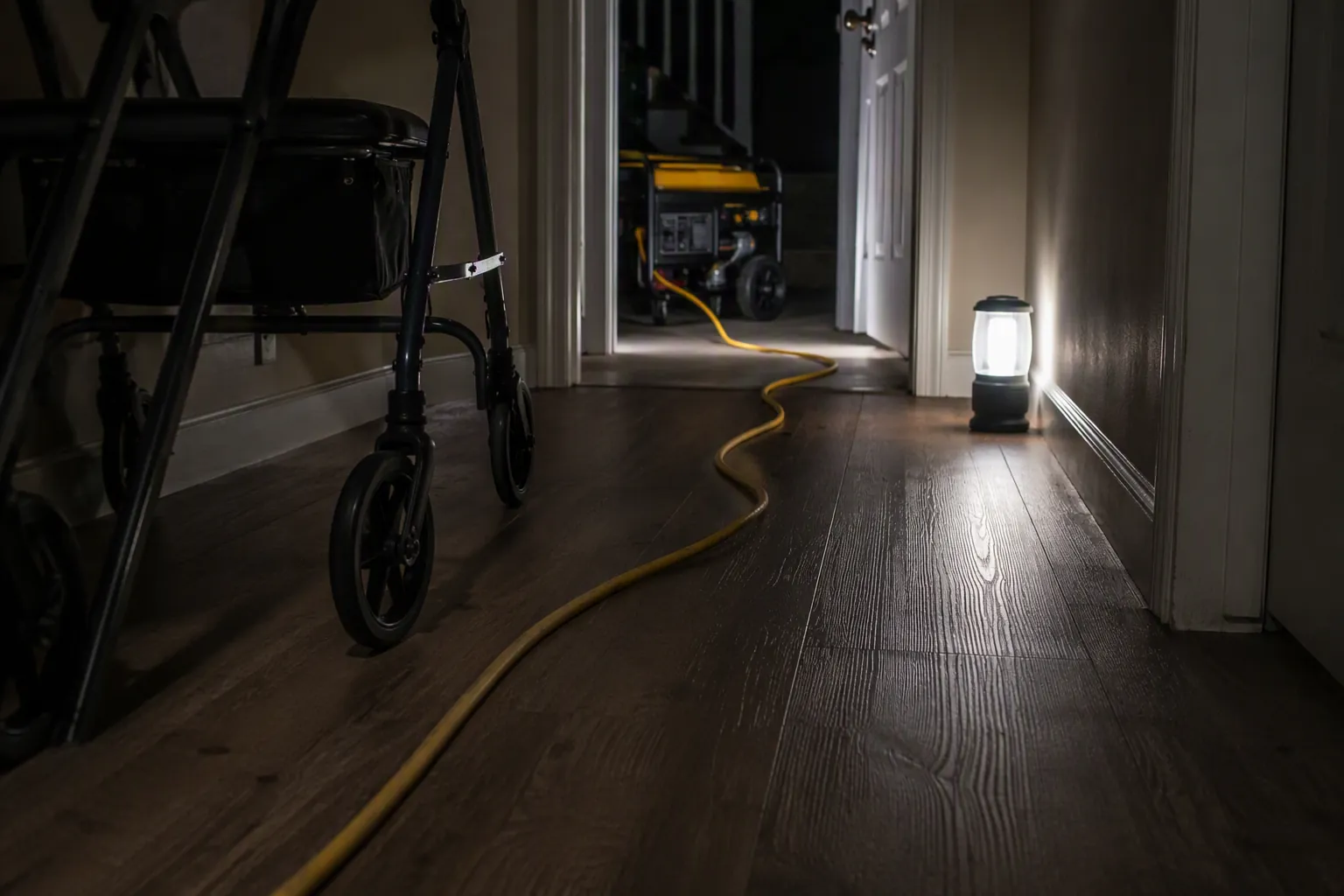
This is especially easy to miss with portable batteries and generators because the first question is usually, “Will it power the device?” The second question has to be, “Where will the cord run while someone is half-awake and walking to the bathroom?”
Generator safety has its own non-negotiables. CDC guidance says generators should be kept at least 20 feet from the home, away from doors, windows, and vents, and homes should have carbon monoxide detectors; it also warns never to use a gas oven or gas range to heat the home. Those rules are not fall-prevention extras. If a caregiver has to open doors, reroute cords, move equipment, or improvise heat during an outage, the walking environment changes again. [3]
The safest cord is the one that never crosses a walking path. If a cord must be used, it should be routed along walls, behind furniture that will not be moved, or through a space the older adult does not need to cross. Tape may reduce movement, but it does not make a cord disappear. A taped cord across a hallway is still a raised line on the floor where a cane tip, slipper, walker wheel, or oxygen tube can catch.
Do the cord walk before the outage. Plug in the backup battery or simulated setup. Place the oxygen concentrator, CPAP, charger, lamp, phone, and mobility equipment where they would actually be used. Then walk the nighttime route from bed to bathroom, chair to kitchen, chair to bedroom, and device to exit. If the caregiver has to say, “Just step over this,” the setup is not ready.
What to tape near the backup power station
- Which device gets plugged in first.
- Which outlet, battery, or generator connection is used.
- Where the cord must run so it does not cross the walking route.
- Which devices should not be connected at the same time.
- Who to call if the device cannot be powered safely.
This written note does not need to be elegant. It needs to be visible to the person who will be tired, worried, and holding a flashlight.
Powered mobility and medical devices need a movement plan, not just a battery
A power outage can take away more than lights. It can change how a person stands up, gets out of bed, transfers to a toilet, reclines safely, rolls to the kitchen, or keeps oxygen equipment positioned. For someone who depends on powered mobility or powered medical equipment, the outage plan has to include the physical action that equipment normally makes possible.
The ADATA Emergency Power Planning fact sheet distinguishes among backup options such as deep-cycle batteries, warns against casually substituting vehicle batteries, and urges planning around the actual power needs of the equipment. It also points caregivers toward charging strategies and generator sizing rather than assuming one battery works for every device. [5]
That distinction matters because device runtime is not a universal number. A battery that lasts through one person’s CPAP settings may not last through another’s. A portable oxygen concentrator, power wheelchair, scooter, hospital bed, lift chair, suction machine, or nebulizer may have different power draws, charging requirements, alarms, and backup options. The only safe number is the number confirmed for the exact make, model, settings, battery age, and use pattern.
A medical-device outage checklist from PowerOutage.us advises device-specific backup planning, including identifying which devices are essential, documenting power requirements, and keeping manufacturer and utility contact information available. That kind of list is useful because it prevents a common caregiver mistake: planning for the device name instead of the device behavior. [6]
For fall prevention, the key question is physical: what happens if this device loses power while the person is using it?
- If a lift chair stops low, can the person stand without pulling on a walker that may roll?
- If a hospital bed cannot raise, can the person sit up and transfer safely?
- If a power wheelchair or scooter cannot charge, is there a safe manual alternative and someone who can assist without injury?
- If oxygen equipment is moved closer to backup power, does the tubing still avoid the walker path?
- If a CPAP or other nighttime device stops, will the person get up suddenly in the dark while sleepy or short of breath?
Utility medical baseline or medical needs programs may help some households, but they vary by utility and location. NPR reported that PG&E’s Disability Disaster Access program provided free battery banks for eligible medical device users, but that example should not be read as a national guarantee or a promise of priority restoration. Each household still has to contact its own utility and confirm what is available, what documentation is required, and what the program does not cover. [2]
For readers looking into utility support, our overview of energy assistance programs for seniors is a side path worth checking. It should sit beside the home walkthrough, not replace it.
Temperature problems make people improvise
Heat and cold become fall risks because they change behavior. People leave the room where the walker is set up. They open doors and windows that alter lighting and floor surfaces. They carry fans, blankets, ice, space heaters, or extension cords. They rush. They try a room they do not usually use because it feels cooler or warmer. A home that was arranged around safe transfers can become a set of temporary workarounds.
Unsafe heating choices also enter the picture when the outage lasts. CDC guidance warns against using a gas oven or gas range to heat the home, and its generator guidance is meant to prevent carbon monoxide exposure when people try to keep power running during an outage. A heating workaround that makes the air dangerous or forces cords through the living area has not solved the safety problem. [3]
Medication storage can add pressure. CDC emergency guidance for insulin says it can generally be kept at room temperature between 59°F and 86°F, but people should follow product instructions and emergency guidance for their own medication. For a caregiver, the practical fall-prevention point is to know the plan before someone is searching a dark refrigerator, carrying a cooler, or rushing to move supplies after the house has already become uncomfortable. [7]
Temperature is also where “shelter in place” needs a real stopping point. If the home can no longer stay within a safe range for the person, if medical equipment cannot be powered without unsafe cords or generator placement, or if the older adult becomes confused, weak, dizzy, or unable to transfer safely, the plan should already say who is called and where the person can go.
Walk the home as it will be used during an outage
The useful preparation happens before the storm alert, not while the caregiver is standing in the hallway with a battery pack and a roll of tape. Pick an ordinary evening and set up the home as if the power had failed. Do not tidy first. Use the walker, oxygen tubing, slippers, throw rugs, pets, laundry baskets, and device chargers as they actually exist.
Then walk the routes that matter:
- Bed to bathroom.
- Recliner to bathroom.
- Bedroom to kitchen.
- Chair to medical device or charger.
- Main sitting area to exit.
- Any route a caregiver must take while carrying equipment.
Look for what changes when the lights are gone. Is the walker parked farther away because the charger needs that outlet? Does the oxygen tube now cross the bathroom doorway? Does the battery lamp create glare instead of showing the floor? Does the power strip sit where the person turns? Can the older adult reach the phone without standing? Can a caregiver assist without stepping backward over a cord?
If you want the action version of this walkthrough, use our Senior Fall Prevention Checklist for Power Outages as the before/during/after companion. This article is the slower pass through why those small tasks matter.
The fixes that usually cost less than the equipment
- Put a charged light within reach of every place the older adult sleeps or rests.
- Label the backup power setup with the device priority and cord route.
- Move charging stations so cords stay against walls instead of across walking paths.
- Keep the walker, cane, wheelchair, or rollator in the same reachable position during normal nights and outage setups.
- Test whether the older adult can turn on lighting before standing.
- Confirm device backup requirements with the manufacturer, supplier, clinician, and utility instead of relying on generic runtime estimates.
- Write down when the plan changes from staying home to calling for help or relocating.
Storm-specific planning still matters. Severe thunderstorms, hurricanes, and tornado warnings can each create different timing problems, especially when hearing loss or evacuation decisions are involved. For those side paths, see our guides to severe thunderstorm safety for elderly parents, hurricane warning fall prevention for seniors, hurricane stay-or-go decisions for Texas seniors, and tornado preparedness for seniors with hearing loss.
The fall-prevention work is quieter than buying a generator. Map the walking routes. Put light where the person can reach it before standing. Keep cords out of paths. Verify device power needs with the people who made, prescribed, supplied, or service the equipment. Decide before the outage when the home is no longer safe enough to stay in.
A blackout is not one hazard. It is a chain of small changes that can make an older adult less steady, less oriented, and more likely to meet an obstacle at the worst possible moment.
References
- PMC 2026 study by Comellas et al., PubMed Central, 2026.
- Power outage safety: How people who use medical devices can prepare, NPR, July 2024.
- What to Do to Protect Yourself During a Power Outage, Centers for Disease Control and Prevention.
- Power Outage Preparedness for Seniors & Elderly, PowerOutage.us.
- Emergency Power Planning for People Who Use Electricity and Battery Dependent Assistive Technology and Medical Devices, ADA National Network.
- Medical Device Power Outage Checklist, PowerOutage.us.
- Managing Insulin in an Emergency, Centers for Disease Control and Prevention.
Related reading
Noticed something outdated or inaccurate on this page? Flag a correction. We review every report against CDC, NIA, and AARP HomeFit guidance before updating a page.
Part of the Fall Prevention section.