
STEADI: Assess
Heat Exhaustion or Heat Stroke in Older Adults?
Recognize heat exhaustion and heat stroke in older adults even when the signs look different — reduced thirst, little or no sweating, confusion mistaken for dementia — and know exactly when cooling at home must become a 911 call.
If an older adult is overheated and confused right now, treat the confusion as a danger sign, not as a normal heat-wave reaction. Heatstroke can involve a body temperature of 104°F or higher and mental-status changes such as confusion, agitation, slurred speech, delirium, seizures, or coma; emergency guidance says to call 911 for suspected heatstroke, begin cooling the person, and avoid giving fluids while waiting for help. [1][2]
Cooling at home belongs in a narrower lane: symptoms are mild, the person is alert enough to cooperate, and they are clearly improving. UC Davis Health describes heat-exhaustion symptoms as typically improving after about 30 minutes of cooling; the Red Cross advises getting medical help if heat-exhaustion symptoms worsen, last longer than an hour, vomiting occurs, or confusion develops. [2][3]
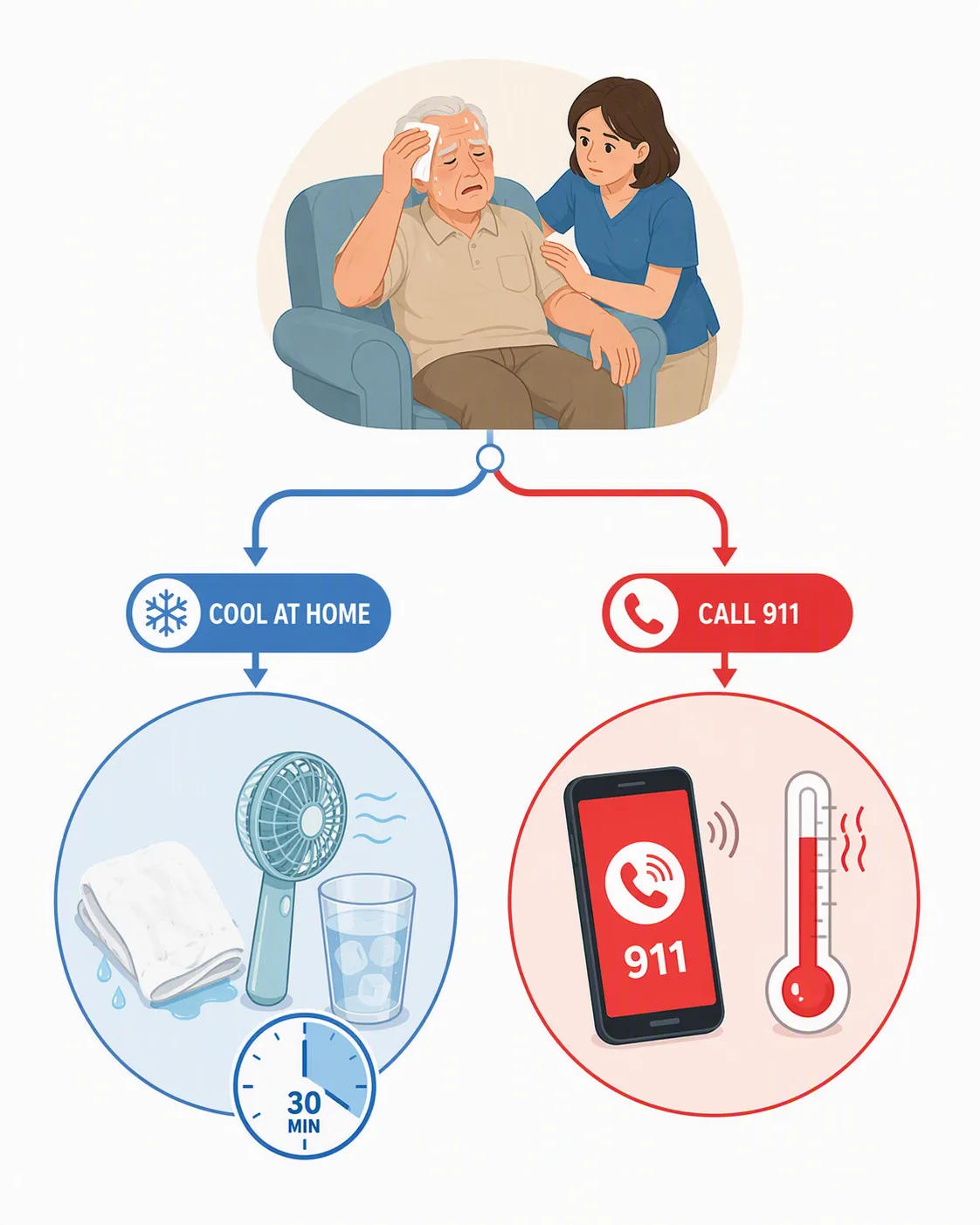
The fast split: cool at home or call 911
Do this triage before trying to decide whether the label is “heat exhaustion” or “heat stroke.” The label matters less than the direction the person is moving.
| What you see | What it means for action |
|---|---|
| Confusion, slurred speech, seizure, loss of consciousness, or behavior that is suddenly very unlike the person | Call 911. Start cooling while waiting. Do not try to make the person drink if heatstroke is suspected. |
| Temperature at or above 104°F, especially with mental-status changes | Call 911. Mayo Clinic and Red Cross both use 104°F or higher in heatstroke guidance. |
| Hot skin, rapid pulse, fainting, or symptoms that are getting worse | Move toward emergency care rather than watching longer. |
| Heavy sweating, weakness, dizziness, headache, nausea, or cramps, but the person is awake, coherent, and able to follow directions | Move to a cooler place, loosen clothing, use cool cloths or a cool bath, and offer sips of water if they are fully alert and not vomiting. |
| Mild symptoms that clearly improve during active cooling | Continue close monitoring. UC Davis gives roughly 30 minutes as a practical improvement benchmark for heat exhaustion. |
| Vomiting, confusion developing, symptoms worsening, or symptoms lasting longer than an hour | Get medical help. Red Cross lists these as escalation points for heat exhaustion. |
The safest first move is usually physical cooling: get the person out of heat, remove extra clothing, apply cool wet cloths or mist with water, and use air movement if available. If the person is awake, not confused, and not vomiting, small sips of water may be reasonable for heat exhaustion. Once heatstroke is suspected, the Red Cross instruction changes: call 911, cool the person rapidly, and do not give fluids. [2]
Why older adults may not look “hot enough” to be in trouble
Older adults can be harder to read during heat illness because the signals caregivers often wait for may be weak or absent. Jefferson Health specifically lists delayed or reduced thirst, lack of perspiration, behavior change, and inability to concentrate as warning signs in older adults. [4]
That means “she says she isn’t thirsty” does not settle the question. Neither does dry skin. A person who is sitting in a hot room, not drinking, not sweating, and acting vague or unusually irritable may be showing the very pattern that makes older-adult heat illness easy to miss.
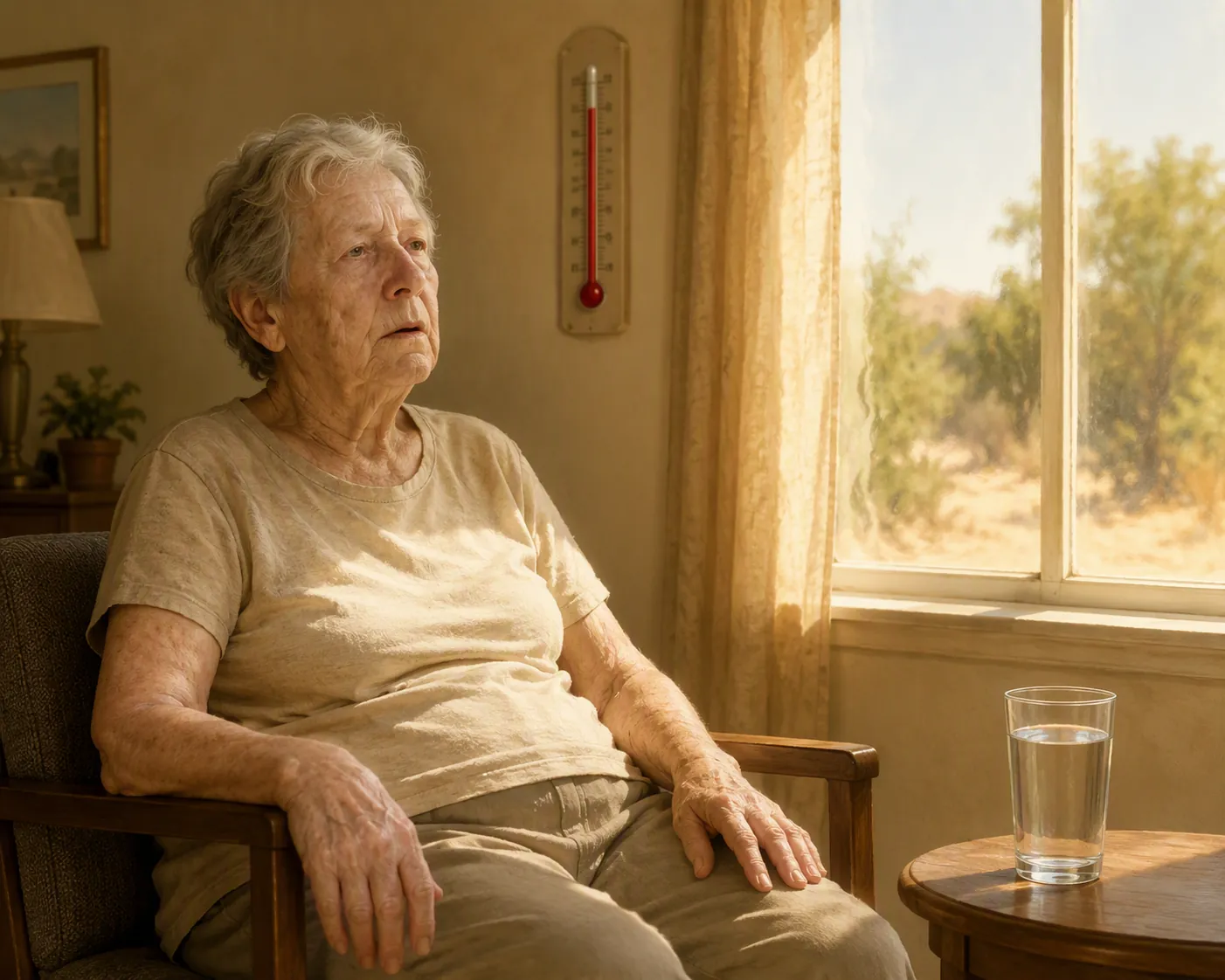
Dementia and chronic illness make this harder. Atrium Health Wake Forest Baptist quotes emergency medicine physician Dr. William L. “Terry” Gordon explaining that people with dementia or chronic medical problems may not feel thirsty or may not recognize that they are overheating, so caregivers need to check on them frequently during extreme heat. [5]
The practical consequence is simple: do not wait for a perfect symptom cluster. In an older adult, “acting strange” during a heat wave deserves the same attention as dizziness or collapse, especially if the room is hot, the person has had little fluid, or they cannot clearly explain how they feel.
Heat exhaustion and heat stroke, without the false comfort
Heat exhaustion is the warning zone: the body is struggling, but the person may still be awake, responsive, and able to cool down with help. UC Davis Health lists symptoms such as dizziness, weakness, heavy sweating, headache, nausea, and cramps, and says symptoms should improve with cooling in about 30 minutes. [3]
Heatstroke is the emergency zone. Mayo Clinic describes it as the most serious form of heat injury and says it requires emergency treatment; signs can include a core body temperature of 104°F or higher, altered mental state or behavior, altered sweating, nausea and vomiting, flushed skin, rapid breathing, racing heart rate, and headache. [1]
The danger for families is assuming heat illness must climb neatly from cramps to exhaustion to stroke. Mayo Clinic notes that classic, nonexertional heatstroke most often affects older adults and people with chronic illness, the very group in whom symptoms may be harder to interpret. [1]
How to use the 30-minute cooling window
If the person is alert, not confused, not vomiting, and does not have a very high temperature, active cooling can begin immediately. Move them into air conditioning or shade, loosen tight clothing, put cool wet cloths on the skin, and encourage small sips of water if they can swallow safely.
Then watch for actual improvement, not just stillness. Are they more oriented? Is dizziness easing? Are they steadier sitting up? Is nausea settling? UC Davis Health’s roughly 30-minute benchmark is useful because it gives a caregiver a point at which waiting becomes a decision, not a drift. [3]
A person can look quieter because they are recovering, or because they are getting weaker. If they are harder to wake, less coherent, newly combative, unable to sit safely, or speaking unclearly, stop treating the situation as ordinary heat exhaustion.
During that cooling window, check these things
- Orientation: Can they say where they are, who is with them, and what is happening?
- Speech: Is it clear, or newly slurred, rambling, or hard to follow?
- Skin and sweating: Are they hot, flushed, unusually dry, or no longer sweating despite heat?
- Stomach symptoms: Are they vomiting or too nauseated to drink?
- Movement safety: Can they sit and stand without nearly falling?
- Temperature if available: Is the reading near 104°F or higher?
Weakness, dizziness, dehydration, and confusion also make heat illness a fall-risk problem. If the person insists on walking to the bathroom, going outside, or “checking something” while overheated, someone should stay close and reduce movement until the situation is clearly improving.
When home care ends
Call 911 now if any of these are present:
- Confusion, delirium, agitation, seizure, fainting, loss of consciousness, or slurred speech.
- A temperature of 104°F or higher, especially with any mental-status change.
- Symptoms that worsen during cooling instead of improving.
- Vomiting or inability to safely drink.
- Heat-exhaustion symptoms that last longer than an hour.
- A caregiver’s concern that the person cannot accurately report thirst, overheating, or how sick they feel.
Those points come from slightly different sources, and they should not be blended into one tidy rule. Mayo Clinic and Red Cross both use 104°F or higher in heatstroke guidance; UC Davis Health gives the roughly 30-minute improvement benchmark for heat exhaustion; Red Cross uses worsening symptoms, vomiting, confusion, and symptoms lasting longer than an hour as reasons to seek medical care. [1][2][3]
If you do call 911, begin cooling while waiting: move the person out of heat, remove extra clothing, and use cool cloths, misting, fanning, or other rapid cooling steps available to you. If heatstroke is suspected, do not give fluids while waiting for emergency responders. [2]
For the ordered response steps after recognition, use what to do for seniors on a red alert heat day. For the plan-ahead side of this problem, see how to prevent heatstroke and falls in seniors during a heatwave, and if medications may be affecting heat tolerance, review heat-sensitive medications for older adults.
But in the active moment, the decision is narrower. If mental-status changes appear with a dangerously high temperature, or symptoms worsen instead of improving during cooling, call 911 and keep cooling the person while help is on the way.
References
- Heatstroke – Symptoms and causes, Mayo Clinic.
- Extreme Heat Safety, American Red Cross.
- Is it heat exhaustion or heat stroke?, UC Davis Health, 2024/07.
- How to Recognize the Signs of Heatstroke in Older Adults, Jefferson Health.
- Tips to Keep the Elderly Safe in Extreme Heat, Atrium Health Wake Forest Baptist.
Related reading
Noticed something outdated or inaccurate on this page? Flag a correction. We review every report against CDC, NIA, and AARP HomeFit guidance before updating a page.
Part of the Fall Prevention section.