
STEADI: intervene
How to Help an Elderly Parent Through a Flight Delay
A first-hour response plan for caregivers whose elderly parent's flight has just been delayed — ordered steps to protect medication timing, mobility assistance, and food and water access, plus the rebooking and refund rights to enforce without waiting on the airline.
The announcement has just changed to delayed, or your parent has texted from the gate and sounds calm in that way older parents often do when they are trying not to worry anyone. This is the hour to get practical. How to help elderly parents during flight delays is not mainly about finding the nicest airport lounge or waiting for the airline app to sort itself out. It is about keeping the medication schedule visible, keeping water and a restroom within reach, making sure wheelchair assistance has not silently dropped out of the system, and deciding early whether the safer plan is to wait, rebook, or stop for the night.
Do not spend the first half hour refreshing the departure board while your parent gets colder, thirstier, or more tired. Start a clock-based checklist.
The first-hour checklist
| When | What to do | What to say or check |
|---|---|---|
| Minutes 0–10 | Confirm the real delay and set a 30-minute status rhythm. | Ask the gate agent what changed, whether the aircraft or gate may change, and when the next update will be posted. |
| Minutes 10–20 | Protect the medication schedule. | Confirm where the medication bag is, what dose time is coming next, and whether your parent needs food or water with it. |
| Minutes 15–30 | Handle water, food, and restroom access. | Put water within reach, identify the nearest accessible restroom, and decide whether your parent can safely go there without losing the gate update. |
| Minutes 20–40 | Re-confirm wheelchair, guided assistance, and pre-boarding. | Ask the agent to verify the assistance request on the booking and to note any gate or aircraft change. |
| Minutes 30–50 | Decide whether waiting is still the safest plan. | Compare the delay length with fatigue, medication timing, mobility limits, and the risk of a late-night arrival. |
| Minutes 45–60 | Escalate if basic needs or disability assistance are not being met. | Start with the gate agent, then ask for the Complaints Resolution Official if an accessibility right is being ignored. |
Airlines are required to notify passengers of a status change within 30 minutes after the airline becomes aware of it for flights departing within seven days, so a 30-minute check rhythm is not nagging; it matches the obligation you can reasonably point to at the counter. Ask, write down the answer, and set the next check time instead of waiting for someone to wander over with better news. [1]

Make the delay visible, not vague
The first useful question is not “How long will this take?” because the first answer is often an estimate. Ask for the pieces that affect your parent’s body and movement: Is the gate changing? Is the aircraft changing? Is boarding still expected here? Is there any chance the flight moves earlier again? If you are coordinating by phone, ask your parent to take a photo of the gate screen and boarding pass, then keep the phone call short enough that they are not standing in the aisle trying to manage a bag, a cane, and a conversation.
Write the time of the delay announcement in a note on your phone. Add the next posted update time. If you speak with an agent, add the agent’s name if it is offered, the gate number, and the exact instruction given. This is not for building a legal file in the moment. It is so you do not have to reconstruct decisions later while your parent is tired and the gate has changed twice.
If your parent is alone, give one instruction at a time: “Stay seated at Gate B12. Put your water and medications where you can reach them. I’m going to call the airline now.” A stranded older traveler does not need six competing tasks while the board is changing overhead.
Protect the medication clock before chasing vouchers
A delay can turn messy very quietly around medication. The bag with the pill organizer is under the seat, or worse, in a checked suitcase. The parent does not want to discuss prescriptions at a crowded gate. A dose that was supposed to happen after landing is now due before boarding. Nobody is trying to be careless; the schedule just moved and the body did not.

Start with location. Ask, “Are your medications in your carry-on where you can reach them right now?” If the answer is no because the bag was checked, move that problem to the gate agent immediately. Do not wait until the scheduled dose time has already passed. The agent may not be able to produce a checked bag quickly, but the earlier you ask, the more options there may be before rebooking or cancellation complicates the luggage path.
Then separate timing from guessing. Have your parent look at the label, the pill organizer, or their written schedule. If a dose is due during the delay, help them take it as normally as possible, with water and any required food, unless their own clinician has instructed otherwise. If a dose has been missed, do not tell them to double up unless their prescribing clinician or pharmacist has specifically said that is the correct response for that medicine. This article is not medical advice; individual medications have individual rules, and the safe call is to contact the prescribing clinician, pharmacist, or after-hours nurse line when timing becomes uncertain.
The practical medication check is short:
- Medication bag is in the carry-on, not checked luggage.
- Next dose time is written down in the caregiver’s phone.
- Water is within reach before the dose is due.
- Food is available if the medicine is normally taken with food.
- No missed dose is doubled without medication-specific professional guidance.
- If rebooking changes the arrival time, the next dose time is checked again.
This is the same kind of out-of-home safety interruption that shows up in other crisis plans, whether the problem is an airport delay or an evacuation route. The useful habit is to protect the body first, then solve transportation. If you want a broader version of that sequence, the site’s evacuation fall-prevention checklist follows the same logic: medication, mobility aid, route, and rest before paperwork.
Water, food, and the restroom are not comfort extras
A healthy adult may treat a two-hour delay as an annoyance and a bad sandwich. For an older parent, the same two hours can mean a long walk to the restroom, skipped water to avoid that walk, dizziness after standing, or taking medication on an empty stomach because nobody wanted to lose their place near the gate.
Put water where your parent can reach it without bending down or asking again. If you are with them, buy it or fill a bottle before the gate crowd gets restless. If you are remote, ask them to identify the closest shop or water station, then decide whether they can safely get there alone. If they use a cane, walker, or wheelchair, do not assume “nearby” means reachable. Nearby may still mean a crowded crossing, a slick floor, a heavy restroom door, or a boarding announcement they cannot hear from the concession line.
Food belongs in the same check as medication. If a meal voucher eventually appears, fine; use it. Do not let the possibility of a voucher delay a small purchase if your parent needs food now to take medication safely or avoid shakiness. Keep receipts if the delay later becomes a customer-service or reimbursement issue, but do not make an older traveler physically wait for a formal entitlement before eating.
Restroom access needs an actual plan. Ask where the nearest accessible restroom is, whether your parent can get there without losing wheelchair assistance, and who will stay with the bags. If the flight is delayed but could begin boarding soon, tell the gate agent before leaving the gate area: “My mother uses wheelchair assistance and needs the restroom. Please do not mark her as absent from pre-boarding; we are going to that restroom and coming back.”
Keep wheelchair and guided assistance active after the delay
Wheelchair service can fail in the gap between the original plan and the delayed plan. The original attendant helped your parent to the gate and left. The aircraft changes. The gate changes. Boarding pauses, then restarts. Everyone at the counter may assume the assistance request is still visible somewhere in the system, while the person who cannot independently cover a long terminal distance is the one left waiting.
The rule gives you firmer language than “Can someone help when you get a chance?” Airlines must promptly provide requested wheelchair or guided assistance, and they must not leave a passenger who is not independently mobile unattended for more than 30 minutes. Passengers who self-identify as needing extra time or assistance must also be allowed to pre-board. [2]
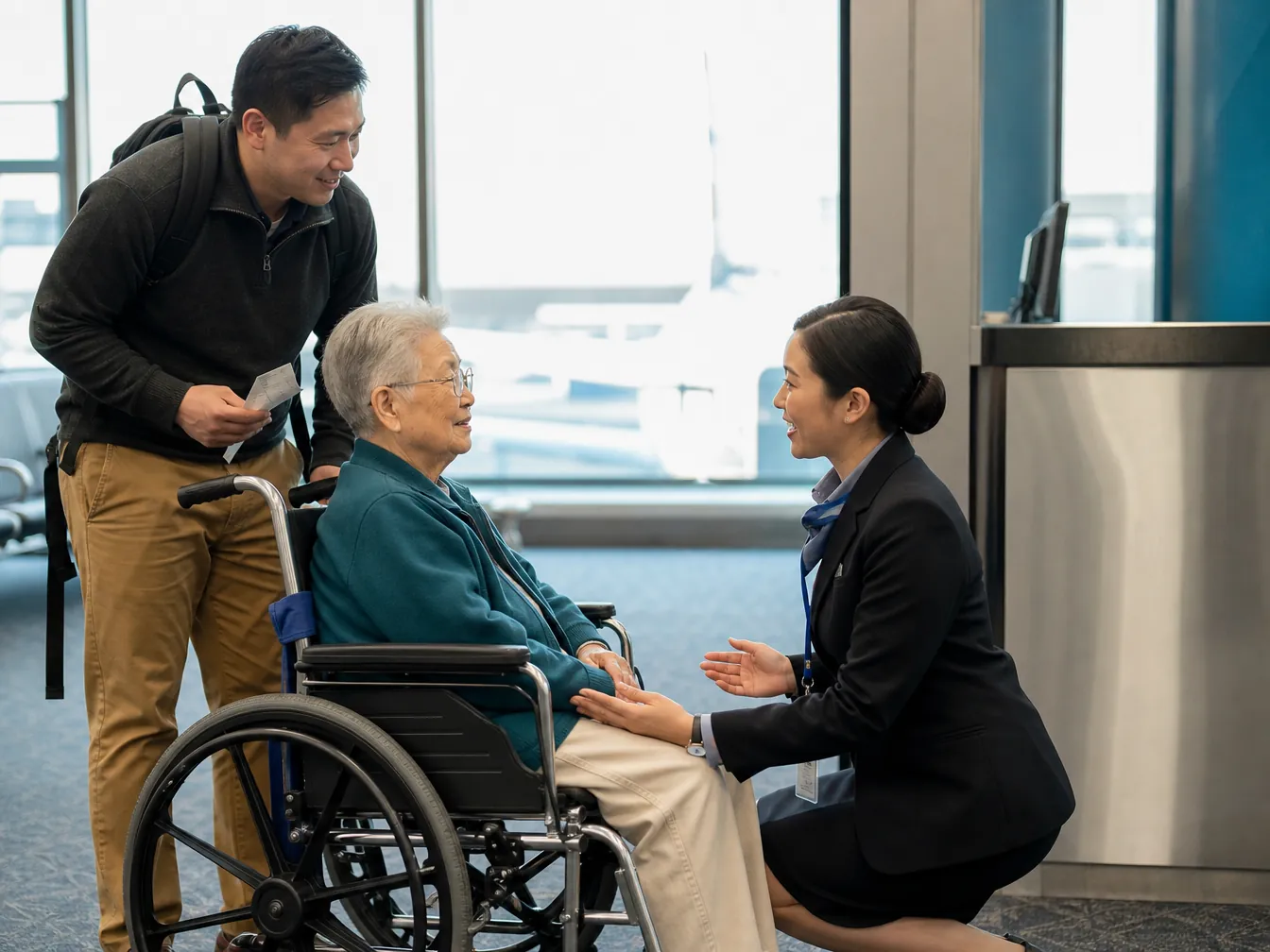
After any delay announcement, re-confirm the assistance request out loud with the gate agent. Do it even if the wheelchair was arranged weeks ago. The useful sentence is plain: “My father has wheelchair assistance on this reservation and is not independently mobile for a gate change. Please confirm the request is active for this delayed flight and tell me who will assist if the gate or aircraft changes.”
If your parent is remote, ask them to go to the counter only if they can do so safely. Otherwise, call the airline and the airport assistance number if available, while your parent stays seated near the gate. Have the reservation code, flight number, gate, and a description ready: “Elderly passenger seated at Gate C18, wheelchair assistance requested, cannot walk to a new gate without assistance.” Specific location helps more than a general complaint.
During a gate change, do not let the agent wave vaguely down the concourse and call that assistance. Ask who is transporting your parent and whether the new gate has been told to expect a wheelchair passenger. If there is a restroom stop, ask whether the attendant can wait or return at a named time. If boarding is restarted, ask the new gate agent to preserve pre-boarding: “She needs extra time and assistance to board, and she self-identifies as needing pre-boarding.”
Stop waiting politely when the delay creates a second risk: your parent has been left alone without reachable help, the gate has changed without an attendant, boarding is starting without pre-boarding, or a restroom need is being ignored because no one wants to move the chair. At that point, you are not asking for courtesy. You are asking the airline to meet an assistance obligation.
Decide whether waiting is still the safer plan
The airline may be focused on getting the aircraft out. Your decision is narrower: can your parent safely continue this trip on the new timeline? A delay that is tolerable at 11 a.m. may become unsafe at 9 p.m. if arrival now means a long walk through an unfamiliar airport, a missed medication routine, closed food options, or a tired transfer into a car.
Use these questions before you accept the first rebooking option:
- Will the new departure or arrival time collide with a medication dose, meal need, or usual bedtime in a way that needs clinician or pharmacist guidance?
- Will wheelchair or guided assistance be available at the connecting and arrival airports at the new time?
- Does the new route add a tight connection, aircraft change, bus gate, or long terminal transfer?
- If the flight arrives late at night, who will meet your parent, and where exactly?
- Would a hotel near the airport be safer than pushing through fatigue?
For controllable delays of three hours or more and controllable overnight cancellations, major U.S. airlines have publicly listed commitments such as meal vouchers and complimentary hotel accommodations on the DOT dashboard. Those commitments depend on the airline and the circumstances, so use the dashboard language carefully: “Is this delay considered controllable, and what meal or hotel commitment applies to this itinerary?” [1]
Refund rights sit beside that decision, not ahead of safety. The DOT dashboard also addresses prompt refunds for canceled or significantly changed flights, regardless of cause. If the proposed replacement trip is physically unreasonable for your parent, ask the agent to explain refund and rebooking choices before accepting a route that creates a new mobility problem. [1]
If you often travel with an older parent, the same fatigue math appears before other crowded trips too. The site’s state fair safety guide for seniors is not about airports, but it is useful on the same point: distance, heat, standing time, and separation plans matter more as the day gets longer.
If the delay happens on the aircraft
A gate delay and a tarmac delay are different. At the gate, you can often still reach food, water, restrooms, medication, and agents. On the aircraft, movement and access shrink. If your parent is already seated on the plane, ask them to use the call button early for water, restroom access, and any urgent medication-related need. Waiting until everyone is tense makes it harder for the crew to help.
For covered carriers at U.S. airports on aircraft with 30 or more seats, the tarmac-delay rule requires the airline to begin moving the aircraft to a place where passengers can deplane before three hours for domestic flights or four hours for international flights, with limited exceptions. Food and water must be provided no later than two hours after the tarmac delay begins. [3]
Those limits are not a reason to wait two hours before asking for water for an older parent. They are the outside guardrails. If your parent needs water for medication, is lightheaded, or needs restroom help, the correct time to ask is now.
Escalate without skipping the safety work
Escalation works best when it is specific. “My mother is elderly and this is unacceptable” may be true, but it gives the agent too much room to apologize and move on. Name the unmet need: wheelchair assistance, guided assistance, pre-boarding, water for medication, restroom access, rebooking that preserves assistance, meal voucher, hotel, or refund option.
Start at the gate because that is where the immediate fix usually lives. If disability assistance is the problem and the first agent cannot or will not address it, ask for the Complaints Resolution Official by name: “I need to speak with the CRO about wheelchair assistance for a passenger who is not independently mobile.” Airlines must make a Complaints Resolution Official available at no cost when an Air Carrier Access Act issue appears to be involved. [2]
Use this ladder:
- Gate agent: Ask for the immediate operational fix — water, restroom access, wheelchair re-confirmation, pre-boarding note, rebooking, voucher, or hotel instruction.
- Supervisor or service desk: Use this when the gate is overwhelmed, the answer changes, or rebooking creates a new access problem.
- Complaints Resolution Official: Use this when disability assistance, wheelchair handling, guided assistance, or pre-boarding is being denied, delayed, or ignored.
- DOT complaint: Use this after the urgent situation is stabilized or if the airline fails to respond appropriately to an accessibility or consumer-rights issue.
Keep the tone boring and documented. Time, flight number, gate, parent’s location, requested assistance, what was promised, what did not happen. Anger may be justified, but a clean timeline is more useful when you need a chair, a room, a refund, or a complaint record.
If you are helping by phone
Remote caregiving during a delay is awkward because you can see the risk but not the room. Do not make your parent become the dispatcher if they are already managing mobility limits. Put them in the simplest possible position: seated, hydrated, medication visible, boarding pass accessible, phone charged, and waiting for one clear next instruction.
Ask for three photos if they can take them safely: the boarding pass, the gate screen, and their current seated location or nearby gate sign. Then you make the calls. Call the airline, use the app or website, and if needed call the airport information line to ask how wheelchair assistance is dispatched in that terminal. If another relative or friend can reach the airport faster than you can solve the problem remotely, send them a concise handoff: flight number, gate, parent’s mobility need, medication timing issue if relevant, and what the airline has already said.
If your parent tends to underreport discomfort, ask concrete yes-or-no questions: “Is your water in your hand?” “Can you see the gate counter from your seat?” “Do you need the restroom in the next 15 minutes?” “Is the wheelchair still with you, or did the attendant leave?” “What time is the next medication?” These are easier to answer than “Are you okay?” and less likely to produce the automatic “I’m fine.”
Travel disruptions are easier when the plan was built before the trip, of course. The site’s cruise safety checklist for older adults and hurricane safety checklist for senior cruise travelers are better for that planning stage. During an airport delay, though, the job is narrower: stabilize the hour you are already in.
The line to use at the counter
When the situation starts to sprawl, use one sentence that puts the airline’s next task in plain view:
“My parent is an elderly passenger with wheelchair assistance and medication timing needs; please confirm the next flight status update, keep wheelchair assistance active through any gate change and pre-boarding, and tell me whether this delay qualifies for meal, hotel, rebooking, or refund options.”
That sentence will not make a delayed aircraft appear. It does something more immediate: it stops the first hour from dissolving into assumptions. Someone checks the chair. Someone checks the next update. Someone names the food, hotel, rebooking, or refund path. Your parent gets water before the formal voucher conversation, and the medication clock does not disappear under the airline’s clock.
References
- Airline Cancellation and Delay Dashboard — U.S. Department of Transportation
- Wheelchair and Guided Assistance — U.S. Department of Transportation
- Tarmac Delays — U.S. Department of Transportation
Related reading
Noticed something outdated or inaccurate on this page? Flag a correction. We review every report against CDC, NIA, and AARP HomeFit guidance before updating a page.
Part of the Fall Prevention section.