
STEADI: intervene
Hurricane Safety Checklist for Senior Cruise Travelers
A time-staged hurricane-season cruise checklist for older travelers and their caregivers — what to do before booking, right after booking, and in the weeks before embarkation so medications, mobility aids, documents, and travel buffers are ready when a storm reroutes the ship. Explains why cruises are rarely canceled for hurricanes, when travel insurance must be purchased to cover a named storm, and how to verify the details with your cruise line.
A hurricane-season cruise is not automatically a bad idea for an older traveler. The ship is not meant to challenge the storm; it is meant to avoid it. Royal Caribbean describes avoiding operation near tropical systems as its weather-alert operating policy, and cruise lines commonly adjust routes rather than sail into dangerous weather [1][2]. Cruise Critic likewise treats full hurricane-related cancellations as uncommon compared with itinerary changes and rerouting [3].
That is the reassuring half. The half that matters for a senior cruise traveler is less cheerful: a reroute can skip a port, a delayed return can collide with a prescription refill or specialist appointment, and the person at home may be trying to follow updates through a cruise-line app, ship announcements, in-cabin TV messages, or other onboard channels they cannot see directly [4]. This hurricane safety checklist for senior cruise travelers is built around those small failures, because those are the ones families can actually prevent.

The timing matters more than the weather map
Once a storm has a name, several useful choices may already be gone. Once checked luggage is handed over, the blood pressure pills inside it are no longer available. Once a same-day return flight is booked after disembarkation, a late ship has very little room to be merely inconvenient.
Use the timeline below as the working plan. The later sections explain the parts worth slowing down for.
| When | What to do | Why it matters for an older traveler |
|---|---|---|
| Before booking | Choose buffer days, avoid tight return commitments, and understand insurance timing before paying the deposit. | This is where the hard-to-reverse decisions happen. |
| Right after booking | Verify cruise-line accessibility, medical, device, and weather-update procedures in writing or saved screenshots. | The family needs line-specific rules, not assumptions from a previous sailing. |
| Two weeks out | Build the medication, document, device-power, and mobility-aid backup plan. | A rerouted or delayed cruise is mainly a continuity problem. |
| One week out | Confirm transportation, caregiver communication, refill status, appointments, and what happens if the ship returns late. | This prevents the scramble at home. |
| Embarkation day | Keep medications, prescriptions, essential documents, device supplies, chargers, and one change of clothes in the carry-on. | The carry-on is the safety margin until the cabin and luggage are available. |
Before booking: protect the calendar first
The highest-value hurricane-season cruise decision is usually not the cabin category. It is the calendar around the cruise.
Plan to arrive in the embarkation city at least one day early, and two if the older traveler has limited stamina, a long flight, a mobility device, or a medication schedule that does not tolerate chaos. NerdWallet recommends arriving before embarkation rather than flying in the same day; its Hurricane Milton account also describes a single cruise that returned one day late, which is useful as an illustration of why buffers matter, not as proof that one-day delays are typical [5].
Do the same on the return side. A same-day flight after disembarkation may look efficient on a calm-weather itinerary. During hurricane season, it makes the family dependent on the ship returning on schedule, clearing the port smoothly, luggage appearing quickly, the older adult moving through the terminal without delay, and ground transportation behaving. That is too many pieces for one morning.
- Avoid scheduling a must-attend medical appointment, infusion, procedure, or caregiver handoff the day after the cruise.
- If the older traveler lives alone, arrange a backup person who can check the home, receive deliveries, or meet transportation if the return changes.
- If flights are involved, price the safer itinerary before treating the cheaper same-day option as a bargain.
- If the traveler uses a rollator, wheelchair, oxygen-related equipment, or a CPAP, leave extra time for airport and port handling.
Buy travel insurance while the storm is still theoretical
Do not wait until the forecast looks interesting. Celebrity Cruises notes that travel insurance coverage for a named storm generally must be purchased before the storm is named, and some policies require purchase within roughly 14 to 21 days of the initial trip deposit [2]. The exact window is policy-specific, so the practical rule is simple: compare coverage before booking, and buy the chosen policy immediately after the deposit if it is the right fit.
Read the policy for the actual problem you are trying to solve. For an older traveler, that may be trip interruption, missed connection, medical coverage away from home, prescription replacement, mobility-device damage, or lodging and transportation if the return shifts. “Hurricane coverage” is not a single universal benefit. The named-storm rule, covered reasons, exclusions, pre-existing-condition waiver rules, and purchase deadlines can all vary.
If a family member is making the arrangements, save the policy number, assistance phone number, and claim instructions somewhere the traveler and caregiver can both reach without logging into one person’s email.
Do not let missed-port refunds distract you
It is fair to ask what happens if the ship skips a port. It is just not the most important safety question.
Under many cruise contracts, lines do not owe compensation for itinerary changes. Reports from The Points Guy and Cruise Critic describe missed-port compensation as often limited to destination port fees, commonly around $10 to $20 as onboard credit, with refunds for excursions booked through the cruise line; full cancellations are treated differently and may bring full-fare refunds and sometimes future cruise credit [6][3]. Terms vary by cruise line, sailing, port, excursion type, and contract language, so verify your line’s current policy before treating any amount as guaranteed.
The family argument worth having before booking is not whether a missed beach day is disappointing. It is whether everyone understands that the itinerary is flexible while the traveler’s medical needs are not.
Right after booking: get line-specific answers in writing
A hurricane-season cruise is not the time to rely on “we’ve cruised before.” Cruise lines, ships, ports, cabin layouts, app procedures, medical-center policies, and accessibility rules differ. As soon as the booking is made, collect the answers that would be hard to chase during a storm week.
- Ask how the line communicates weather-related itinerary changes before and during sailing: app alerts, email, texts, in-cabin TV, public announcements, guest services, or a combination.
- Confirm whether a caregiver at home can receive or view updates, or whether the traveler must relay them.
- Verify accessible cabin features, shower configuration, thresholds, bed height, scooter or rollator storage, and whether mobility devices can be used safely in corridors and dining areas.
- Ask about the medical center’s hours, how after-hours care is requested, and how prescription or device problems are handled onboard.
- Confirm rules for CPAP machines, batteries, extension cords, distilled water requests, oxygen-related equipment, and mobility-device batteries.
- Save confirmations as screenshots or PDFs, not just as links inside an app.
This is the same plain planning logic that applies to other senior outings: book the accessibility pieces before the day gets crowded and the choices get narrower. CareWise’s state fair safety planning guide uses that approach for a day trip; a cruise simply raises the stakes because the traveler is sleeping, eating, medicating, and moving inside the plan for several days.
If an older traveler is proud of handling their own travel, do not turn this into an interrogation. Sit together for fifteen minutes and make a shared note titled “If the ship changes plans.” The note should say where updates appear, who at home gets called, what insurance number to use, and what cannot be packed in checked luggage.
Two weeks out: build the medication and device buffer

Two weeks out is when the cruise stops being an itinerary and becomes a continuity plan. The question is not only “What do we pack?” It is “What keeps this person stable if the ship skips a port, returns late, or luggage is unavailable for several hours?”
The CDC advises travelers to pack medications in a carry-on, preferably in original bottles, and to bring copies of prescriptions; Cruise Critic’s medical-kit guidance also recommends written prescriptions and a doctor’s note for controlled substances [7][8]. For a senior cruise traveler, that advice should be treated as nonnegotiable. Checked luggage is for clothing. The carry-on is for anything that would create a medical or functional problem if it disappeared.
- Prescription medications in original labeled containers when possible.
- A current medication list with dose, schedule, prescribing clinician, pharmacy, and reason for use if the traveler is comfortable including it.
- Written prescriptions or refill documentation for essential medications.
- A doctor’s note for controlled substances or injectable medications, if relevant.
- Glasses, hearing-aid batteries or charger, dentures or dental supplies, glucose-monitoring supplies, and any daily assistive item.
- CPAP mask, hose, power cord, adapter, and any line-approved battery or backup arrangement.
- One full change of clothing, basic toiletries, and incontinence supplies if used.
The American Red Cross advises older adults preparing for emergencies to consider at least 30 days of medications, extra assistive items such as canes and eyeglasses, and backup power planning for medical devices [9]. That is at-home disaster guidance, not a cruise packing rule. Still, it points to the right cruise question: how many extra days of medication and supplies would protect this traveler if the return is delayed and refilling is awkward?
For many families, the answer is not literally 30 days in a carry-on. It may be a practical surplus approved by the prescriber and pharmacy, plus written documentation and a reachable caregiver. If the medication is tightly controlled, refrigerated, injectable, expensive, or difficult to replace, start earlier than two weeks. Pharmacy rules, insurance refill limits, and prescriber availability can turn a simple request into a week of phone calls.
Power-dependent equipment deserves the same treatment. COAST Seniors and Ready.gov both emphasize backup planning for older adults who depend on medical devices or electricity during emergencies [10][11]. On a cruise, that means confirming the ship’s rules before packing batteries, extension cords, power strips, oxygen-related equipment, or charging accessories. Do not assume that an item allowed at home or in a hotel is allowed onboard.
If the cruise is part of a broader storm season plan for an aging parent, use the same medication-continuity thinking at home. CareWise’s storm preparedness checklist for aging parents goes deeper on caregiver coordination, while the 72-hour senior typhoon safety checklist is useful for comparing at-home storm supplies with cruise disruption supplies. They are not the same checklist; at home you stock the house, while on a cruise you protect what must stay with the traveler.
One week out: make the delay plan boring
One week before sailing, the goal is to remove suspense. Everyone should know what happens if the itinerary changes, who gets called, and which tasks are already handled.
- Refills: Confirm that essential prescriptions are filled, packed, and not sitting in a pharmacy queue.
- Appointments: Move any non-urgent appointment that would be hard to attend if the ship returns late.
- Transportation: Reconfirm flights, hotel, accessible transfer, wheelchair assistance, and pickup plans.
- Home support: Tell the pet sitter, home aide, neighbor, or family backup what to do if the return date changes.
- Documents: Print or save offline the passport or ID details, cruise documents, insurance policy, medication list, emergency contacts, and cruise-line accessibility confirmations.
- Communication: Decide how often the traveler will check in and what message means “plans changed, but I am safe.”
- Money access: Make sure the traveler has a working credit card, a small amount of cash, and knows which card was used for the booking and insurance.
This is also the week to discuss disappointment. If the cruise misses a port, the older traveler may not care about the port fees but may care deeply about the one excursion they had been picturing for months. Explain before boarding that the captain and line may substitute sea days, switch ports, reverse the route, or change arrival times. A calm conversation now prevents the caregiver from having to sound dismissive later.
For mobility, walk through the whole travel day on paper. From the front door to the car, from the airport curb to the gate, from the port terminal to the gangway, and from the gangway to the cabin, identify where the traveler will stand, sit, wait, roll, or need help. Hurricane-season disruption often means longer lines and changed timing. A rollator is helpful only if it is where the traveler needs it and allowed where they plan to use it.
Embarkation day: the carry-on is the safety plan
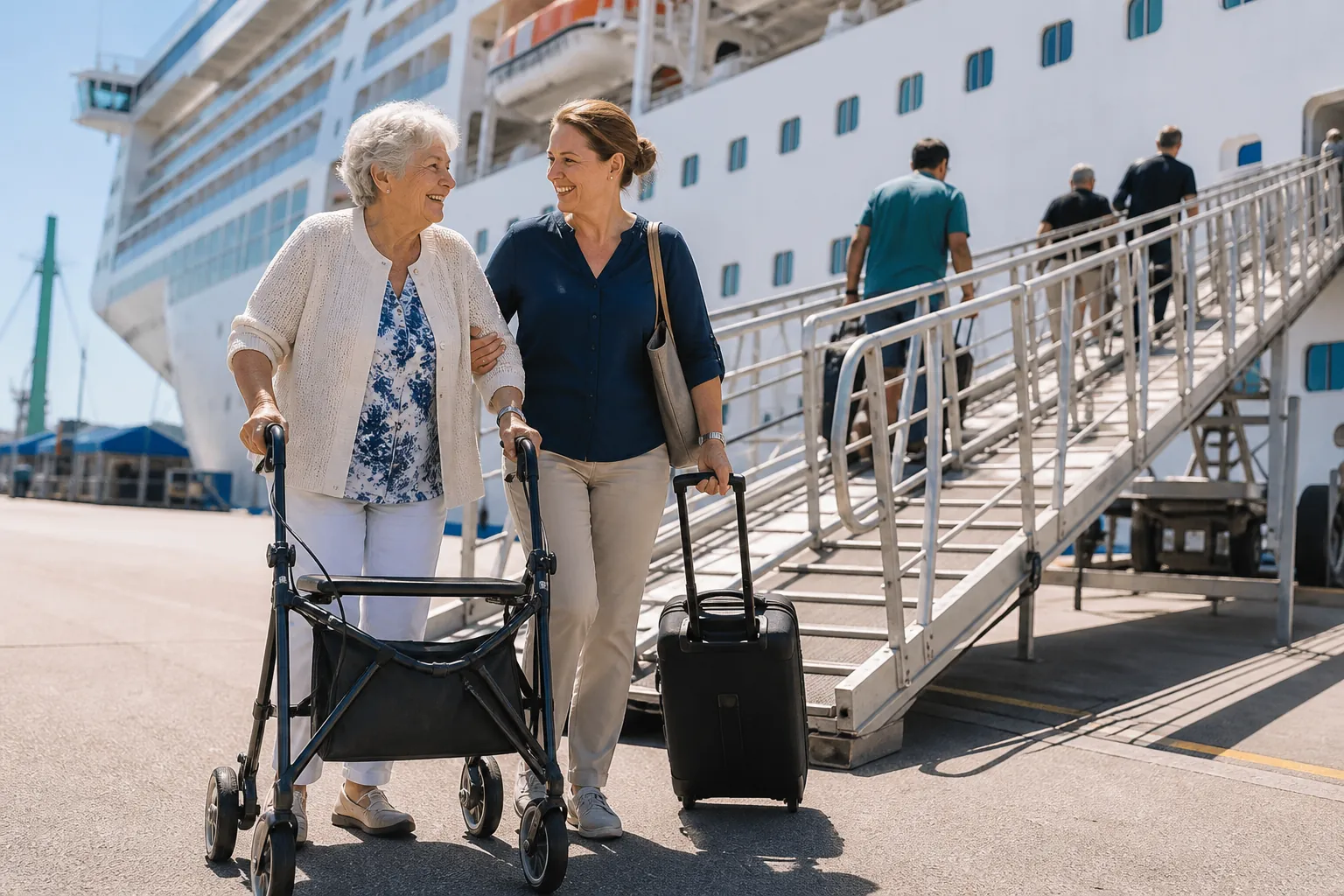
On embarkation day, assume checked luggage will be unavailable until later. That is normal enough even without weather. The older traveler should be able to get through the day, the evening, and the next morning with what is in hand.
- Medications, including the next 24 to 48 hours of scheduled doses plus the agreed extra supply.
- Original prescription bottles or labeled packaging whenever practical.
- Medication list, prescriptions, doctor’s notes, allergy list, and emergency contacts.
- Passport or required ID, cruise documents, insurance details, and copies saved offline.
- Phone, charger, portable battery, hearing-aid supplies, glasses, and device charging cords.
- CPAP or other essential device parts that cannot be replaced onboard.
- Mobility-aid accessories, such as cane tips, rollator bag, seat cushion, or charger if the device uses one.
- A light layer, one change of clothes, basic toiletries, and any continence or skin-care supplies needed before luggage arrives.
Before handing over larger bags, ask one last dull question: “If we do not see this suitcase until bedtime, is anything important inside?” If the answer is yes, move it.
If the storm changes the cruise while you are onboard
Once onboard, the family’s job is not to outguess the captain from a weather app. It is to keep the older traveler informed, medicated, rested, and connected. Cruise lines may communicate weather and itinerary updates through onboard announcements, in-cabin TV, apps, guest-services notices, or direct messages, and travelers should check the line’s chosen channels instead of relying on rumor in the buffet line [4].
If a port is skipped, visit guest services only for facts that affect action: revised schedule, excursion refund process, mobility assistance for the new plan, dining or medical-center changes, and whether the return time has changed. The refund question can wait behind medications, transportation, and caregiver communication.
If the return date or time changes, notify the person at home early. Do not wait until the last sea day if a pharmacy pickup, home aide, pet care, airport ride, or medical appointment is affected. A two-sentence message is enough: “The ship changed plans because of weather. I am safe. New expected arrival is __; please move/check __.”
The sensible answer is flexibility around fixed needs
For many older adults, the right answer is not to avoid hurricane-season cruises. It is to stop treating the itinerary and return date as fixed. The medical needs are fixed. The medication schedule is fixed. The CPAP parts, mobility support, documents, and caregiver communication plan are fixed. The port order is not.
Buy the coverage before a storm exists. Verify the cruise line’s current rules instead of relying on memory. Build travel buffers on both ends. Keep medications and essential documents with the traveler. Prepare for mobility and power-device interruptions. Make sure the older adult and the caregiver both know where updates will appear.
Last verified: August 25, 2026. This article is educational and is not medical, legal, financial, insurance, or travel-contract advice. Cruise-line policies, insurance purchase windows, refund terms, port-fee amounts, medical-device rules, and documentation requirements can change; verify directly with the cruise line, insurer, clinician, pharmacist, airline, and port-transfer provider before travel.
Clinical review: Pending named review by a credentialed clinical or senior-safety reviewer. No anonymous or unverified medical review is implied.
References
- Weather Alert Ship Operating Policy, Royal Caribbean.
- Cruising During Hurricane Season, Celebrity Cruises.
- What Happens to Your Cruise When Natural Disasters Strike, Cruise Critic.
- Hurricane During a Cruise, Travel with Brigitte.
- Tips for Cruising During Hurricane Season, NerdWallet.
- Cruise Ship Itinerary Changes, The Points Guy.
- Pack Smart, Centers for Disease Control and Prevention.
- A Cruiser’s Medical Kit: Packing Prescription Drugs, OTC Medications and What to Leave at Home, Cruise Critic.
- Older Adults, American Red Cross.
- Before the Next Storm: A Hurricane Preparedness Checklist for Older Adults and Caregivers, COAST Seniors.
- Older Adults, Ready.gov.
Related reading
Noticed something outdated or inaccurate on this page? Flag a correction. We review every report against CDC, NIA, and AARP HomeFit guidance before updating a page.
Part of the Fall Prevention section.