
STEADI: Intervene
Senior Travel Safety Checklist for Labor Day Weekend
A phase-based senior travel safety checklist for Labor Day 2026, timed to the September 3–7 window and built around the four risks that send older travelers to the ER: falls in unfamiliar places, medication lapses, blood clots from long sitting, and heat and dehydration. It covers what to check two weeks out, the day before, en route, at the destination, and after returning home.
Labor Day weekend 2026 runs from Thursday, September 3, through Monday, September 7. AAA’s 2026 holiday travel data points to Friday, September 4, as the busiest rental-car pickup day, with INRIX projecting the worst road congestion on Friday from 12 p.m. to 8 p.m. and Monday from 2 p.m. to 5 p.m. [1]
That timing matters, but a senior travel safety checklist for Labor Day weekend cannot stop at “leave early” and “pack snacks.” For an older traveler, the emergency-room risks are more specific: a fall in an unfamiliar bathroom, a missed blood thinner or diabetes dose, four-plus hours of sitting without movement, and heat or dehydration because everyone was focused on beating traffic.

The urgency is real without making the trip sound like a bad idea. The CDC reports that more than 1 in 4 older adults falls each year, fewer than half tell their doctor, and falls lead to about 3 million emergency department visits and 1 million hospitalizations annually. [2] Nearly 9 in 10 older adults take at least one medication, so medication planning is not a side errand. [3] CDC travel guidance says anyone traveling more than 4 hours by air, car, bus, or train can be at risk for blood clots, with risk increasing after age 40. [4][5] Adults 65 and older are also more prone to heat-related illness and adjust less well to sudden temperature changes. [6]
This article is for planning and fall-prevention education, not a substitute for medical advice. If your parent has heart failure, kidney disease, diabetes, anticoagulant use, recent surgery, dementia, a recent fall, or a fluid restriction, use this checklist as a starting point for the clinician who already knows the chart.
The four risks to plan around before the holiday rush
| Risk cluster | What usually goes wrong | The practical prevention move |
|---|---|---|
| Falls in unfamiliar places | A hotel bathroom, dark hallway, low toilet, loose rug, curb, or rushed rest stop changes the walking environment. | Do a room and bathroom scan before bedtime, keep shoes on for walking, add light, and clear the path. |
| Medication disruption | Pills are packed in checked luggage, left in the car, taken at the wrong time, or separated from the dose list. | Keep medications in the carry-on or personal bag, with a written list and extra doses. |
| Long sitting and blood-clot risk | The traveler sits through a traffic delay, flight, bus ride, or train trip without moving for more than 4 hours. | Plan movement every 1 to 2 hours when possible; use calf exercises when standing is not possible. [4] |
| Heat and dehydration | Older adults may not feel thirsty early, and some medications or medical conditions complicate fluid intake. | Drink before thirst unless on a fluid limit; ask the doctor how to handle heat, water pills, or restricted fluids. [6] |
Traffic still belongs in the plan because tired drivers, long sitting, and rushed rest stops all feed into those four clusters. The National Safety Council’s holiday analysis found that Labor Day 2023 had the highest average traffic deaths per day of any holiday, and its six-year Labor Day average was about 476 deaths compared with 432 on comparable non-holiday weekends. [7] That is a reason to build a calmer schedule, not a reason to cancel a visit.
Use the 2026 trip calendar, not a vague packing list
A checklist only helps if it appears while someone can still act. “Remember Mom’s medications” is not useful when the suitcase is already checked. “Check the hotel bathroom” is not useful after everyone is half-asleep. For Labor Day 2026, use the trip calendar this way.
| When | Main job | Do not leave this until later |
|---|---|---|
| Two weeks out | Confirm medical, medication, coverage, mobility, heat, and long-sitting plans. | Provider questions, refills, dose list, mobility equipment, hotel accessibility, driver decision. |
| Day before departure | Put the safety plan into bags, phones, and the car. | Carry-on medications, water plan, shoes, documents, emergency contacts, room-request confirmation. |
| En route | Prevent the predictable travel problems while everyone is distracted. | Medication timing, movement breaks, calf exercises, hydration, rest stops, safe driving handoffs. |
| At the destination | Make the unfamiliar room behave more like home. | Bathroom lighting, floor hazards, footwear, medication storage, heat plan, fall-response plan. |
| After returning home | Watch for delayed problems. | Fall symptoms, missed-medication effects, heat illness, and possible clot symptoms after prolonged immobility. |
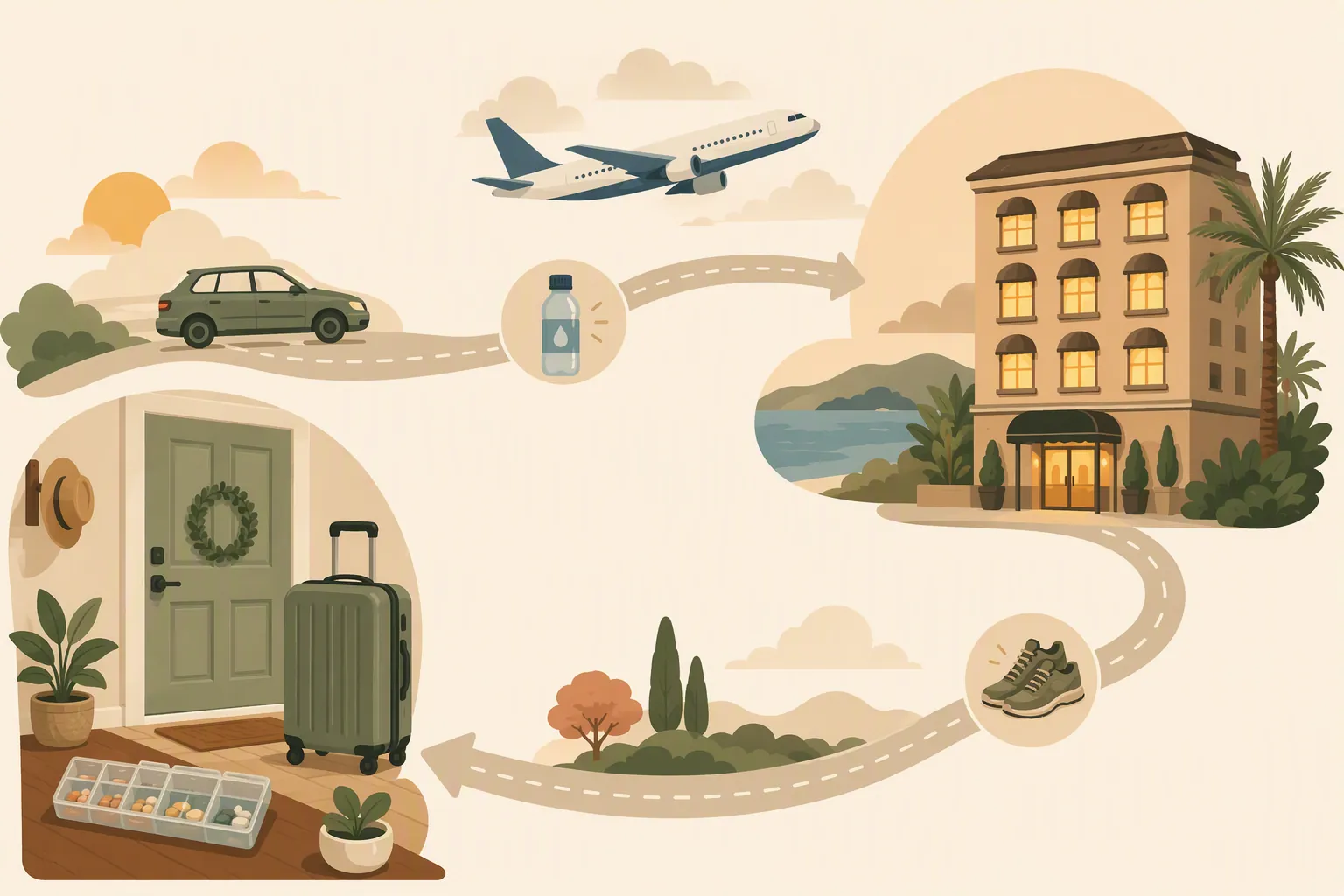
Two weeks out: make the decisions that cannot be fixed at the gate
CDC travel guidance for older adults recommends a pre-trip medical visit 4 to 6 weeks before travel when possible, especially for international trips or travelers with ongoing health conditions. [8] If Labor Day is already closer than that, do not abandon the task. Use the time left to ask targeted questions.
- Ask whether the trip changes any medication timing, especially for blood thinners, insulin, diuretics, sedatives, pain medications, or medications taken with food.
- Ask how to handle time-zone changes if the trip crosses time zones. Do not improvise a new schedule for high-risk medications on the travel day.
- Ask whether compression stockings are appropriate. They are not a universal purchase; they should fit correctly and make sense for the traveler’s circulation and medical history.
- Ask what “drink more water” should mean if the older adult is on a fluid restriction, has heart failure or kidney disease, or takes water pills. CDC heat guidance specifically notes that older adults on fluid limits or water pills should get clinician guidance about fluids in hot weather. [6]
- Ask whether a recent fall, dizziness, new confusion, low blood pressure, or worsening balance should change the lodging choice, travel mode, or activity plan.
This is also the point to build the medication packet. The AGS Health in Aging Foundation advises older travelers to carry a medication list with brand and generic names, doses, and the prescribing doctor’s contact information. [9] CDC’s Pack Smart guidance also supports packing medicines in original, labeled containers and bringing more than enough for the trip. [10]
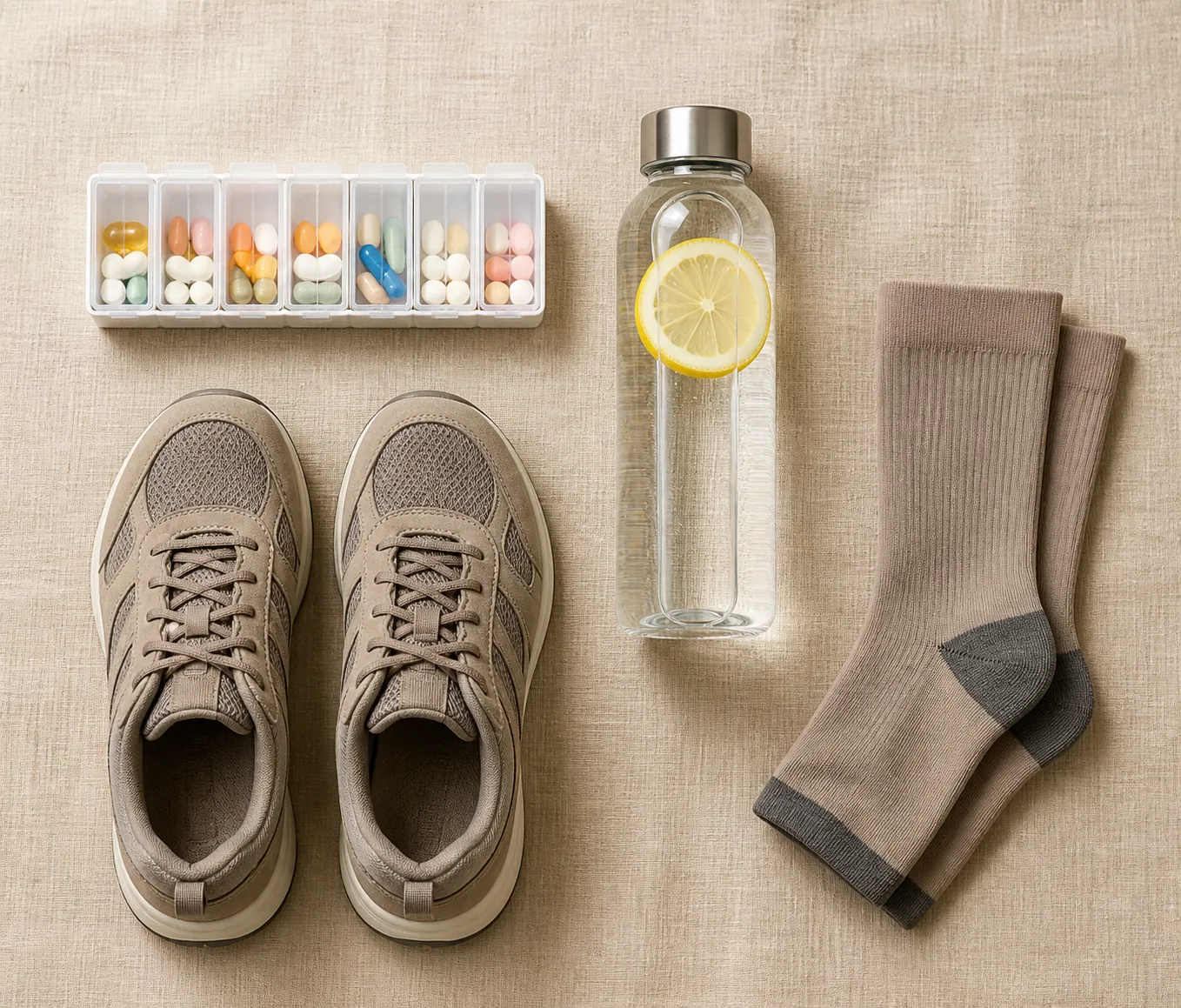
Medication setup
- Refill prescriptions early enough that the pharmacy has time to resolve stock or insurance problems.
- Pack medications in the personal item or carry-on, not checked luggage. NCOA travel guidance specifically warns older adults to keep medications with them rather than in checked bags. [3]
- Keep original labeled containers for travel, especially for flights, controlled medications, and border crossings. Use a pill organizer only if it will not separate the traveler from the label information they may need.
- Print one medication list for the traveler and one for the adult child or companion. Include medication name, dose, time taken, reason for use if known, prescriber, pharmacy, allergies, and emergency contacts.
- Set phone alarms for travel-day doses before departure day. A quiet alarm labeled “Eliquis 8 p.m.” or “metformin with dinner” is more useful than a general reminder after the group is already in a restaurant.
Coverage and insurance check, if the trip crosses a border
Do not turn this into a three-hour insurance project unless the destination requires it. For a domestic weekend trip, the useful question is usually whether the plan has in-network care near the destination and how urgent care works. For international travel, the stakes change. CDC notes that medical evacuation can cost more than $100,000 and that some travel insurance policies exclude preexisting conditions. [11]
Coverage note, last verified August 25, 2026: Medicare.gov says Original Medicare generally does not cover health care outside the United States, with limited exceptions; some Medigap policies may offer foreign travel emergency coverage. [12] State rules, Medicare Advantage networks, Medicaid, and retiree plans can differ, so verify the traveler’s actual plan before departure. For a deeper coverage worksheet, use a Medicare benefits checklist rather than guessing at the hotel desk.
Mobility, lodging, and driving decisions
Two weeks out is when you can still change a room, request a shower chair, choose a ground-floor unit, reserve wheelchair assistance, or decide that one person should not be the holiday driver. A single study of high-risk community-dwelling older adults, the SAFE study, found that bathroom falls were more than twice as likely to injure as falls in other areas, and that 10.4% of public-building falls occurred in hotels or motels. [13] That study does not prove every hotel bathroom is dangerous. It does make the bathroom check worth doing on purpose.
- Ask the hotel whether the room has a walk-in shower or tub, grab bars, elevator access, good lighting, and a non-slip bath surface.
- Pack the cane, walker, hearing aids, glasses, and charging cords as safety equipment, not as optional comforts.
- Decide who carries bags. An older adult may be perfectly able to travel and still not be the right person to manage a rolling suitcase over a curb in a crowded drop-off lane.
- If driving is questionable, settle it before the morning of the trip. NHTSA encourages older drivers and families to assess vision, cognition, physical changes, medications, and comfort with driving situations as part of safe driving decisions. [14]
If the trip includes a long drive, use a car breakdown checklist for older drivers for roadside supplies. NHTSA’s summer driving guidance also emphasizes basic vehicle checks such as tires, fluids, batteries, belts, hoses, lights, and air conditioning before summer travel. [15]
The day before: put the plan where hands can reach it
The day before is not for redesigning the trip. It is for making sure the good plan is physically attached to the person who needs it.
- Put all medications, the medication list, glasses, hearing aids, mobility devices, insurance cards, ID, and emergency contacts in the personal bag or carry-on.
- Pack one extra day of essential medication if possible, more for trips where weather or flight delays could strand the traveler.
- Lay out supportive, closed-back walking shoes for the travel day. Do not let “easy airport shoes” become loose slippers.
- Freeze or chill water bottles if appropriate for the travel mode, and pack snacks that match the traveler’s diabetes, swallowing, dental, or sodium needs.
- Confirm hotel room requests, arrival time, parking distance, elevator status, and whether a shower chair or accessible room was actually reserved.
- Charge phones, medical-alert devices, hearing aids, power banks, and mobility scooter batteries.
- Put a small flashlight or plug-in night light in the bag. Hotel bathrooms are not designed around your parent’s midnight route.
For caregivers who already keep a go-bag, this overlaps with a senior emergency kit checklist. The Labor Day version is smaller and more personal: medications, movement, hydration, footwear, light, and a way to call for help.
En route: the safety work happens while everyone is distracted
Friday, September 4, from noon to 8 p.m. is the 2026 congestion window to avoid if you can; Monday, September 7, from 2 p.m. to 5 p.m. is the return window to treat with the same caution. [1] If avoiding those windows is impossible, build the older traveler’s needs into the schedule instead of pretending the drive, flight, bus, or train ride will run smoothly.
Medication during the trip
- Keep the medication bag under the seat or at the traveler’s feet, not in the trunk, overhead bin if it may be hard to reach, or another person’s suitcase.
- Use the medication list when giving or reminding about doses. Holiday meals, time zones, and traffic delays make memory less reliable.
- If a dose is missed, do not double up unless the prescriber has already given that instruction. Call the pharmacist, clinician, or nurse line.
Movement during long sitting
CDC guidance says movement every 1 to 2 hours and calf exercises can help reduce blood-clot risk during travel. [4] This applies to air, car, bus, and train trips over 4 hours; it is not just an airplane issue.
- For car travel, schedule rest stops before the traveler is stiff or urgent. A safe stop every 1 to 2 hours is better than a rushed stop after four hours of “almost there.”
- For flights, buses, and trains, choose an aisle seat when possible if the traveler can safely stand and walk.
- When standing is not possible, use seated calf exercises: raise heels, raise toes, and tighten and release calf muscles.
- Do not skip mobility aids at rest stops or airports because the distance “looks short.” Crowds and fatigue change the calculation.
Heat, hydration, and bathroom timing
CDC heat guidance tells older adults to drink before feeling thirsty, while also noting that people on fluid limits or water pills should follow clinician guidance. [6] That caveat matters. For one parent, the mistake is not drinking enough. For another, the mistake is pushing fluids without regard to heart, kidney, or medication instructions.
- Offer fluids at planned intervals rather than waiting for thirst.
- Pair hydration with planned bathroom stops so the older traveler does not rush across a crowded rest area.
- Keep the car cool before the older adult gets in, and do not leave medications or mobility equipment in a hot vehicle.
- If the traveler has a fluid limit, use the clinician’s plan. For more help with that conflict, see heat safety for seniors with fluid limits.
Airport screening and assistance
For air travel, request wheelchair or mobility assistance early if the airport distance is likely to be too much. TSA says passengers 75 and older may receive modified screening procedures, such as being able to leave on shoes and a light jacket during screening unless additional screening is needed. [16] That does not remove the need to allow time, keep medications accessible, and avoid a last-minute sprint to the gate.
At the destination: do the fall scan before bedtime

The most useful hotel-room safety check happens before luggage spreads across the floor and before anyone is tired. One person should enter the room with the older traveler’s route in mind: bed to bathroom, bed to door, chair to suitcase, shower to towel.
The five-minute room scan
- Turn on every light and identify the switch the traveler will use at night.
- Clear the floor path from bed to bathroom. Move luggage, cords, shoes, ottomans, and decorative rugs.
- Check the bathroom floor, tub, and shower for slick surfaces. Use the bath mat only if it lies flat and does not slide.
- Place toiletries, glasses, hearing aids, water, phone, and medications where the traveler can reach them without bending or crossing the room in the dark.
- Set up the cane, walker, or rollator on the side of the bed the traveler will actually use.
- Put supportive shoes or non-slip footwear next to the bed. Bare feet and hotel carpet are not a fall-prevention plan.
- Plug in the night light or leave the bathroom light cracked if it will not disturb sleep.
Bathroom caution deserves the extra minute. The SAFE study’s bathroom-fall injury finding came from one specific study population, but it matches the practical problem families see in hotels: unfamiliar tub height, different lighting, no grab bar where the person expects one, and wet surfaces. [13]
Medication and heat at the destination
- Move medications from the travel bag to one stable, visible location away from heat and direct sunlight.
- Keep the dose list with the medications, not buried in an email someone may not be able to find quickly.
- Check whether the room refrigerator is needed for any medication, and verify that it is actually cold before relying on it.
- Plan outdoor activities for cooler parts of the day when possible, and give the older adult a real option to rest indoors without treating it as spoiling the trip.
- Watch alcohol in the evening. It can complicate balance, hydration, sleep, and medication routines.
If a fall happens away from home
Do not rush the person up just to reduce embarrassment. Check whether they hit their head, lost consciousness, have new pain, cannot bear weight, seem confused, or take a blood thinner. When any of those are present, seek medical help rather than waiting until the drive home. Falls are common, underreported, and a major source of emergency care for older adults. [2]
For a more detailed watch list after any fall, use senior health warning signs after a fall. The important Labor Day point is simpler: do not let the holiday schedule talk everyone out of evaluating a fall that would have worried you at home.
After returning home: watch the problems that show up late
The trip is not over medically the minute the bags land in the hallway. The return day can hide fatigue, dehydration, missed doses, muscle stiffness, and injuries the older adult minimized to keep the weekend pleasant.
- After a fall: watch for new or worsening pain, trouble walking, head impact concerns, confusion, dizziness, unusual sleepiness, bruising that expands, or any decline from the person’s usual function. Seek medical care promptly for head impact, loss of consciousness, blood-thinner use, inability to bear weight, or new confusion.
- After heat exposure: check whether the person is recovering with cooling, rest, and the fluid plan their clinician allows. If symptoms are severe, worsening, or not improving, get medical help. CDC identifies adults 65 and older as more vulnerable to heat illness. [6]
- After medication disruption: compare the pill organizer, bottle count, and written schedule. If doses were missed or doubled, call the pharmacist or prescriber for instructions rather than guessing.
- After prolonged sitting: take new leg symptoms, chest symptoms, or breathing concerns seriously, especially after travel over 4 hours. CDC travel guidance treats long-distance travel by air, car, bus, or train as a clot-risk situation for some travelers. [4][5]
- After a hard travel day: leave one recovery window before appointments, errands, or another long outing. Fatigue is when the loose bathmat, dark hallway, and skipped cane become important again.
A Labor Day trip with an older parent can still be a good trip. It just needs the safety work assigned to real moments: two weeks out, the day before, on the way, before bedtime in the hotel, and after everyone gets home.
References
- Labor Day Travel Trends — AAA Newsroom, August 24, 2026.
- Facts About Falls — CDC.
- How to Travel Safely as an Older Adult — National Council on Aging.
- Blood Clots During Travel — CDC Travelers’ Health.
- Understanding Your Risk for Blood Clots with Travel — CDC.
- Heat and Older Adults — CDC.
- Labor Day — National Safety Council Injury Facts.
- Older Adults and Healthy Travel — CDC Travelers’ Health.
- Tip Sheet: Safe Travel Tips for Older Adults — Health in Aging Foundation.
- Pack Smart — CDC Travelers’ Health.
- Travel Insurance — CDC Travelers’ Health.
- Travel outside the U.S. — Medicare.gov.
- Circumstances and outcomes of falls among high risk community-dwelling older adults — Stevens et al., 2014.
- Driving Safely While Aging Gracefully — NHTSA.
- Summer Driving Tips — NHTSA.
- Screening Passengers 75 and Older — TSA.
Related reading
Noticed something outdated or inaccurate on this page? Flag a correction. We review every report against CDC, NIA, and AARP HomeFit guidance before updating a page.
Part of the Fall Prevention section.