
STEADI: intervene
Severe Storm Checklist for Seniors That Puts Falls First
Standard storm checklists miss the hazard most likely to send an older adult to the ER during severe weather: falls. This guide pairs the essential 72-hour senior kit with pre-, during-, and post-storm fall-hazard controls, giving caregivers one layered document for preparing a parent's home.
A useful emergency preparedness checklist for seniors during severe storms has to do more than stock water and batteries. For an older adult, the storm often turns ordinary movement into the emergency: the hallway goes dark, the front step gets slick, the walker is across the room, the phone is dead, and the one rug everyone meant to remove is still curled at the edge.
Supplies matter. But if the checklist stops at supplies, it misses the part a caregiver usually has to clean up afterward. Falls are already common among older adults: CDC data says more than 1 in 4 older adults falls each year, with about 3 million fall-related emergency department visits and about 1 million fall-related hospitalizations annually in the United States.[1] Severe weather adds darkness, wet surfaces, debris, rushed decisions, and interrupted routines to that baseline risk.
AHRQ’s hurricane analysis is not a “falls caused all injuries” finding, and it should not be treated that way. It does show the bigger pattern caregivers worry about: among adults 65 and older in a hurricane’s direct path, injury-related emergency department visits resulting in admission rose 53.2% during the storm week, while treat-and-release injury visits rose 48.2%.[2] That is enough reason to build a senior storm plan around movement safety, not just around being stranded.
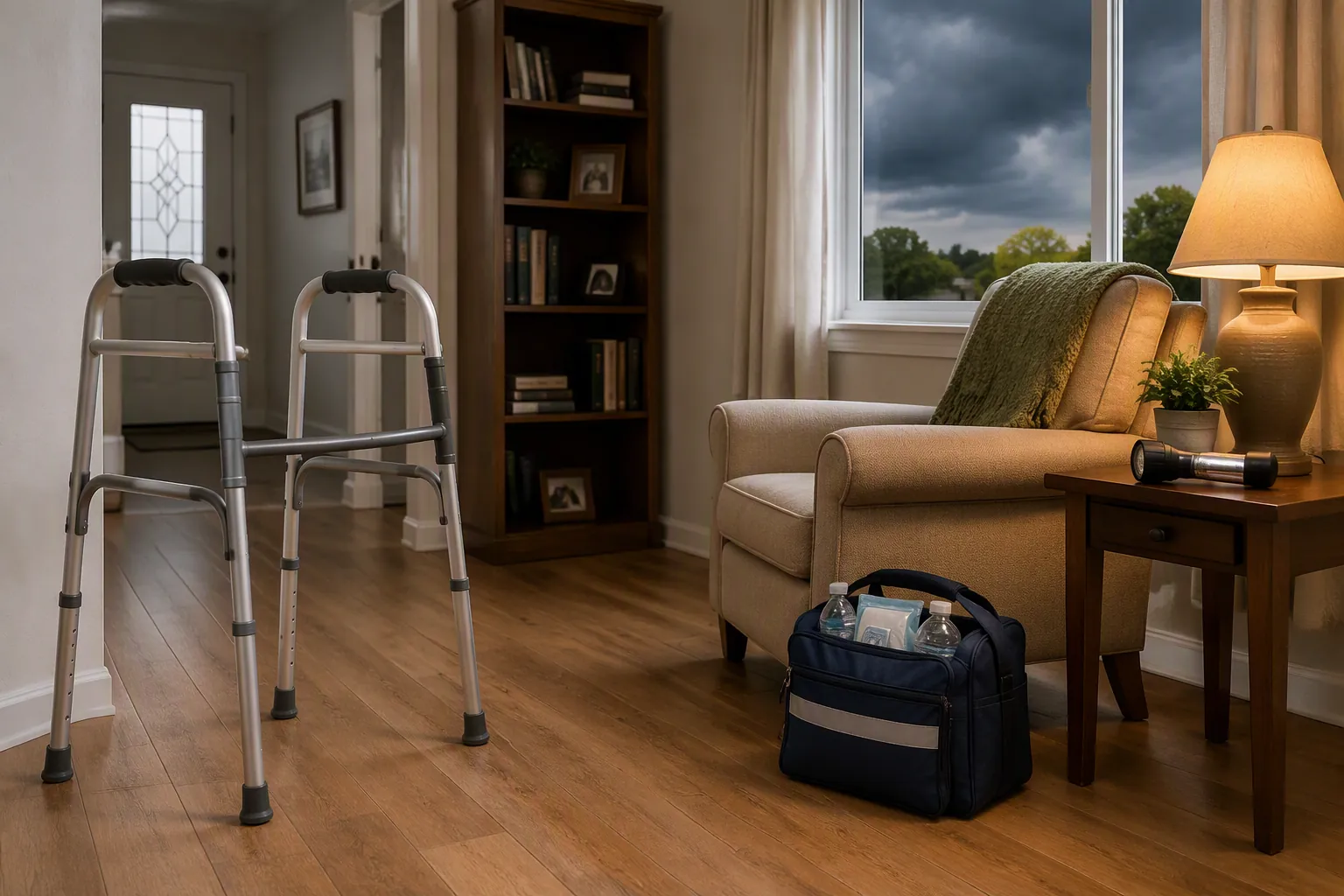
Use one checklist with two jobs
A good version does both. It keeps an older adult supplied if help, power, stores, or transportation are delayed. It also keeps that person from having to improvise in the dark, in wet shoes, or over debris.
| Layer | What it prevents | What to set up before the storm |
|---|---|---|
| Supply kit | Running out of water, food, medication, batteries, chargers, or communication tools | Water, food, radio, lights, batteries, chargers, medication plan, assistive-device backups, glasses, hearing-aid supplies |
| Home walkthrough | Trips in the dark, slips on rugs, reaching for distant canes or walkers, blocked exits | Clear paths, remove or tape rugs, secure cords, stage lights, place mobility aids, check cane tips, set glasses and hearing supplies within reach |
| During-storm rules | Unnecessary walking, candle burns, outdoor falls, confusion about power status | Use one safe room, battery lighting, radio updates, no outdoor trips, one plugged-in lamp |
| Post-storm sweep | Falls after the danger seems over | Check wet floors, branches, leaves, ice, downed lines, uneven outdoor paths, and cleanup tasks before normal routines resume |
Do this as a walkthrough, not as a shopping trip. Start at the bed, walk the route to the bathroom, then the kitchen, then the safest interior room, then the main exit. If your parent uses a walker, cane, wheelchair, oxygen tubing, hearing aids, or a medical alert device, walk the route with those items in mind. The problem is rarely one dramatic hazard. It is usually three small ones in a row.
Build the 72-hour-plus senior storm kit
Ready.gov’s basic kit guidance starts with essentials such as 1 gallon of water per person per day, several days of nonperishable food, a NOAA Weather Radio with tone alert, flashlights, extra batteries, a manual can opener, and backup phone chargers.[3] Those items belong in every senior storm kit. The senior version needs a few additions because a missed battery or missing pair of glasses can become a mobility problem.
- Water: store at least 1 gallon per person per day, then add more if heat, medical needs, pets, or local emergency guidance call for it.[3]
- Food: choose nonperishable foods that do not require standing at the stove, heavy lifting, or complicated can-opening.
- Lighting: pack flashlights and batteries, then stage extra lights in the rooms where walking actually happens.[3]
- Communication: include backup phone chargers and a NOAA Weather Radio so weather alerts do not depend only on a charged phone or internet service.[3]
- Medications and medical information: keep current medication lists, pharmacy information, physician contacts, and a plan for refills if transportation is interrupted. The Red Cross recommends keeping about 30 days of medications when possible.[5]
- Assistive-device backups: include spare cane tips if available, hearing-aid batteries, eyeglasses, and backup items for devices your parent depends on. Ready.gov specifically tells older adults to plan for assistive devices and medical alert systems.[4]
- Documents and contacts: keep emergency contacts, insurance information, identification copies, and support-network numbers in a waterproof pouch.
- A wheeled grab-and-go container: use a rolling bin, small suitcase, or wheeled bag if your parent may need to leave. A heavy duffel is not a senior-friendly emergency kit if it has to be carried across a wet driveway.
If your parent lives alone, separate the “stay home” kit from the “leave now” kit. Red Cross guidance distinguishes a Go-Kit of about 3 days from a Stay-at-Home Kit of about 2 weeks, and recommends reviewing the plan every 6 months.[5] That review should include checking expiration dates, replacing batteries, testing lights, confirming contacts, and asking the blunt question: could this be used by your parent without you standing there?
For hurricane isolation planning, use a more specific living-alone walkthrough alongside this checklist: room-by-room hurricane safety for seniors living alone. For flash-flood risk, do not let the kit conversation delay the leave-or-stay decision; use a flood-specific plan such as flash-flood safety for older adults.
Do the pre-storm fall walkthrough before anyone is rushed
This is the part most generic storm lists skip. A box of supplies in the closet does not help if your parent falls on the way to it. Before the storm, walk the house the way your parent will use it when the lights are out: from bed to bathroom, bed to safe room, chair to kitchen, kitchen to phone, chair to exit.
Clear the walking routes, not just the obvious clutter
Clear enough space for the mobility aid your parent actually uses. A path that works for a steady adult carrying groceries may not work for a walker, rollator, cane, or shuffling gait. Remove laundry baskets, decorative stands, shoe piles, plant pots, magazine stacks, pet bowls, and extension cords from the main routes.
- Remove throw rugs from storm walking paths. If a rug truly has to stay, tape the edges flat with appropriate rug tape before the storm.
- Secure cords against walls so they cannot cross the path to a bathroom, bedroom, safe room, kitchen, or exit.
- Move low furniture that is easy to forget in the dark, especially footstools, small tables, baskets, and ottomans.
- Check the entryway. Wet shoes, umbrellas, loose mats, and tracked-in leaves can turn the first few steps inside the door into the slickest spot in the house.
If you only have time for one home modification before the storm, choose the path from bed to bathroom. That is the route most likely to be used half-awake, in low light, and without waiting for help.
Stage light where the hand reaches first
Put one working flashlight in each room your parent may enter during the storm. Do not leave them all in the kitchen drawer. A flashlight still in the package is not a storm plan; it is a future frustration.
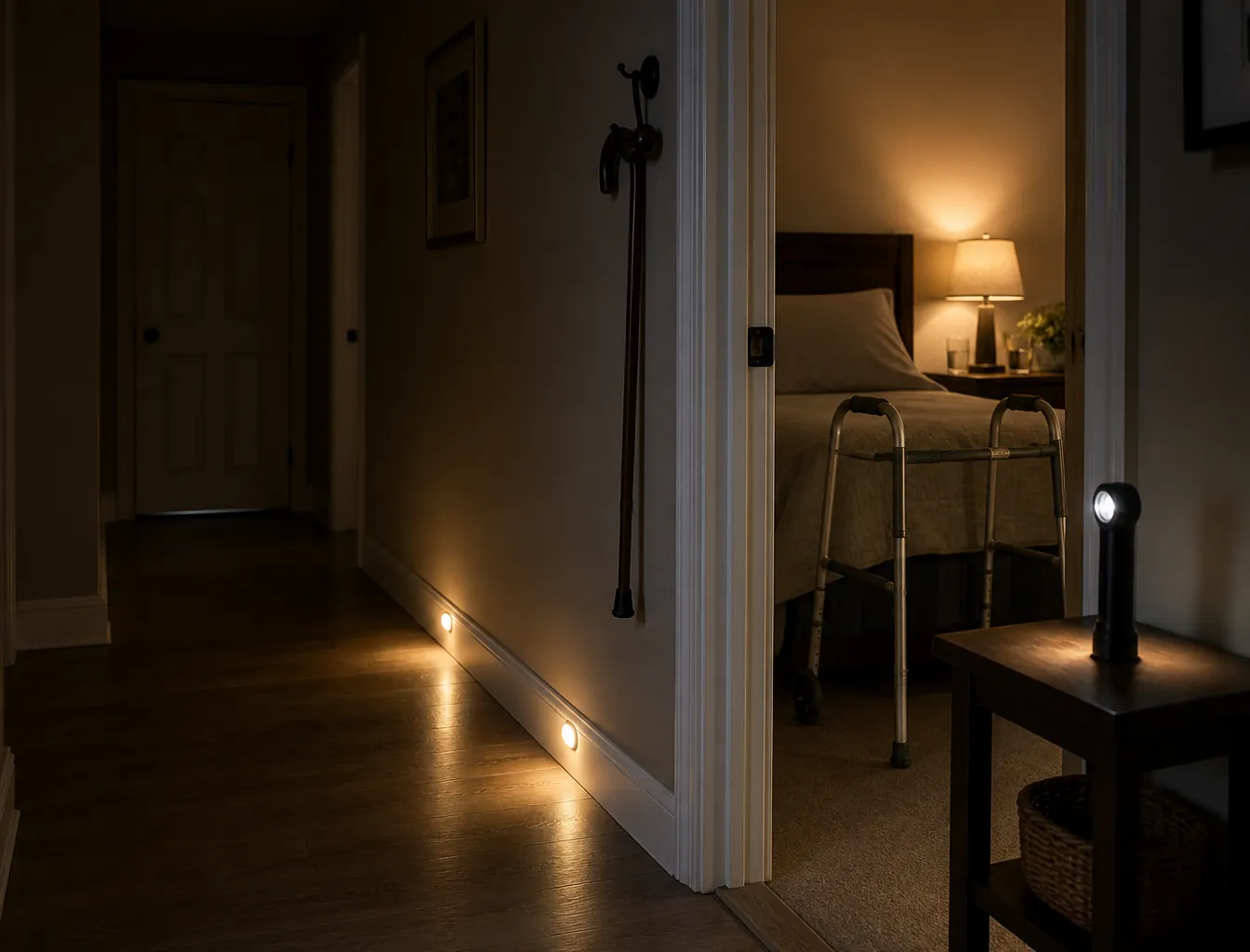
- Place a flashlight on the bedside table, not across the room.
- Place another near the bathroom doorway.
- Put one at the safe-room location.
- Keep one near the main exit for post-storm inspection, but do not make your parent go outside alone to use it.
- Use battery-powered lights instead of candles, especially if balance, vision, memory, oxygen use, pets, or loose clothing are concerns.
Charge phones, medical alert devices, hearing-aid charging cases, power banks, and rechargeable lanterns before the warning period gets busy. If power outages are common where your parent lives, pair this checklist with a dedicated power-outage fall-proofing walkthrough or a broader power-outage safety checklist for seniors.
Put mobility aids where they will be needed, not where they look tidy
The cane leaning by the front door does not help if your parent gets up at 2 a.m. The walker parked in the hallway does not help if furniture blocks the first three steps from bed. Before the storm, place mobility aids at the points where movement starts.
- Walker or rollator: park it beside the bed within arm’s reach, with wheels locked if appropriate.
- Cane: place it on the side your parent uses to stand, and check that the rubber tip is not worn smooth.
- Wheelchair: keep the transfer path clear, brakes working, and footrests out of the walking path when not in use.
- Bedside commode, if used: make sure the path is clear, the seat is stable, and supplies are reachable without twisting.
- Oxygen tubing or charging cords: route them along walls or behind furniture so they do not cross the path.
Set glasses, hearing aids, hearing-aid batteries, dentures, shoes, and a phone in the same reachable zone. In a storm, “I’ll just walk across the room to get them” is exactly the sentence the checklist is meant to prevent.
Make the safe room livable enough to reduce wandering
Choose the safest interior room recommended for the storm type and local guidance, then make it easier to stay there. Put a chair with arms in the room if your parent needs help standing. Add water, snacks, medication needed during the warning period, a flashlight, radio, phone charger, blanket, glasses, hearing supplies, and the mobility aid your parent needs to leave the room safely.
If evacuation is possible, keep the wheeled grab-and-go container near the exit before conditions deteriorate. Do not place it in the walking path. A packed bag that becomes an obstacle has failed one of its jobs.
During the storm, shrink the house
Once the storm is active, the safest plan is usually less movement. The goal is not to keep normal routines going. It is to reduce the number of trips across dark or changing surfaces.
- Stay in the chosen interior safe area when local guidance calls for sheltering.
- Use battery-powered lighting instead of candles.
- Keep the weather radio on or nearby so alerts do not depend only on a phone.
- Do not go outside to check damage while wind, floodwater, lightning, ice, or debris hazards may still be present.
- Keep one lamp switched on and plugged in so it turns on when power returns. That gives a simple signal without requiring your parent to walk room to room testing switches.
- Keep shoes or non-slip footwear at the bedside or safe-room chair. Bare feet and socks are a poor match for wet floors, broken glass, or scattered debris.
If your parent calls and wants to “just check the porch,” “just move the trash bin,” or “just see if the branch hit the car,” treat that as a fall-prevention problem, not stubbornness. Give the next safe action: stay seated, keep the radio on, wait for the check-in call, and let someone else inspect outside when conditions are safe.
After the storm, inspect before normal routines restart
The storm being “over” does not mean the home is ready for an older adult’s usual routine. The first bathroom trip, first porch step, first walk to the mailbox, and first attempt to sweep branches can carry more fall risk than the hours spent sitting safely inside.
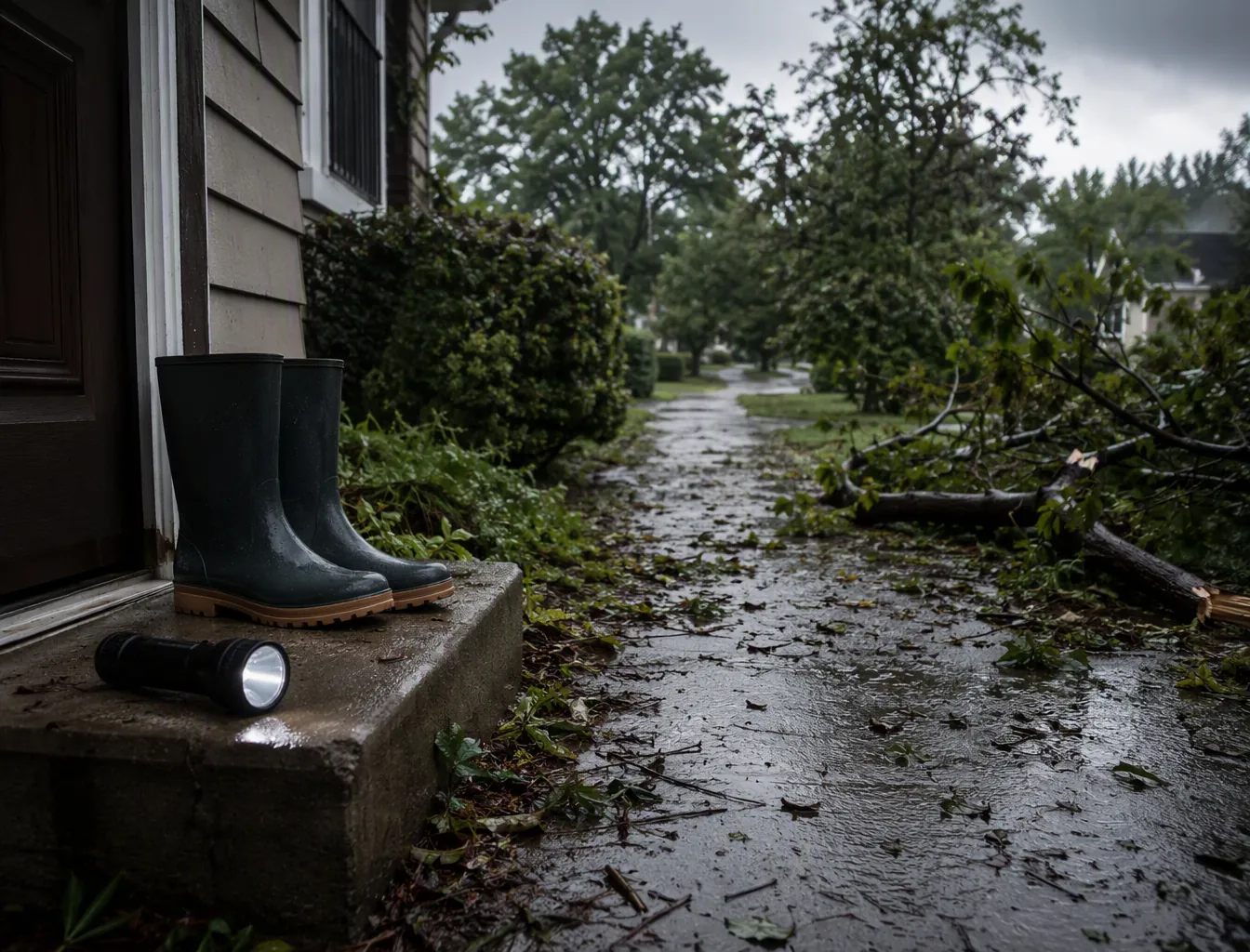
Do the indoor sweep first
- Check floors near doors and windows for water.
- Dry entryways before your parent walks through them.
- Move towels, buckets, extension cords, fans, and cleanup supplies out of walking paths.
- Look for shifted rugs, especially at bathroom, kitchen, and entry thresholds.
- Check that nightlights, lamps, and flashlights are still where your parent expects them.
- Confirm the bathroom route is clear before bedtime, not after your parent is already tired.
Then check the outdoor route your parent is most likely to use
Do not start with the whole yard. Start with the actual route: door, threshold, porch, steps, railings, walkway, driveway, mailbox, trash area, and car. Look for wet leaves, branches, mud, loose gravel, shifted mats, standing water, broken pavement, and anything hanging into the walking path.
- Keep your parent away from downed power lines and from any branch, fence, vehicle, or water that may be touching them.
- Do not ask your parent to drag branches, shovel, salt, sweep heavy wet leaves, or carry storm debris if balance, strength, heart or lung symptoms, dizziness, or fatigue are concerns.
- Use daylight when possible for the first outdoor inspection.
- If the route is wet from heavy rain, use a rain-specific hazard check such as how to prevent falls in heavy rain.
- If snow or ice is involved, use a winter-room and entryway plan such as winter-proofing a parent’s home room by room.
This is where a check-in protocol helps. Before your parent walks outside, they call or answer a call. The question is not just “Are you okay?” Ask whether the power is on, whether any floor is wet, whether they can reach the bathroom safely, whether they have shoes on, whether branches or ice are on the path, and whether they have already tried to clean anything up.
If a fall happens, switch out of checklist mode
This page is for planning ahead. If your parent falls during or after a storm, the job changes from prevention to triage. Do not use a preparedness checklist to decide whether injuries, head impact, new confusion, severe pain, weakness, or inability to get up can wait. Use the site’s post-fall triage guidance or call emergency services when urgent symptoms or unsafe conditions are present.
For planning, keep the layered checklist in one place: kit, walking paths, lighting, mobility aids, during-storm rules, and post-storm inspection. That is the document a caregiver can actually use before the weather turns, and the one an older adult can live with when staying independent still matters.
References
- Older Adult Fall Prevention — CDC, January 2026.
- Emergency Department Visits for Injuries in Older Adults During the Week of a Hurricane — AHRQ HCUP Statistical Brief #267.
- Build A Kit — Ready.gov, July 2026.
- Older Adults — Ready.gov, March 2026.
- Older Adults Emergency Preparedness — American Red Cross.
Related reading
Noticed something outdated or inaccurate on this page? Flag a correction. We review every report against CDC, NIA, and AARP HomeFit guidance before updating a page.
Part of the Fall Prevention section.