
How leukemia prognosis changes fall prevention for older adults
A leukemia diagnosis in an older adult increases fall risk through disease-related weakness, chemotherapy side effects, and symptom medications. This guide explains the specific risks and provides practical steps for caregivers to prevent falls during treatment.
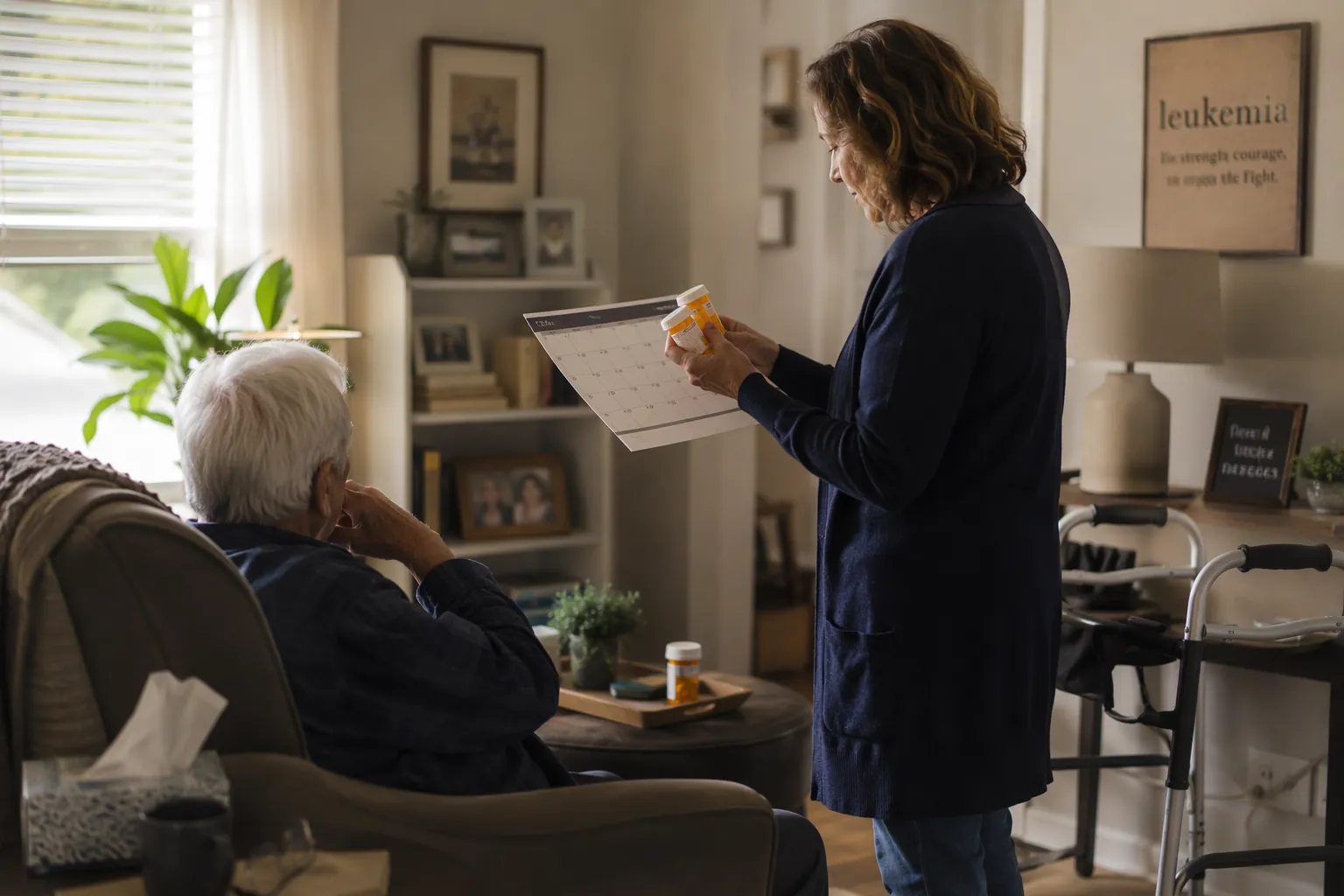
The week an older adult is diagnosed with leukemia, fall prevention has to move from “we should probably make the house safer” to part of the treatment plan. The person coming home from clinic may be newly weak from anemia, sleeping poorly, trying to understand a medication schedule, and walking to the bathroom at night after a day that has already used up most of their strength. That is not ordinary aging with a few loose rugs added.
This does not mean leukemia treatment is the problem to avoid. For many older adults with acute myeloid leukemia, treatment is the reason there is meaningful time to protect. In the VIALE-A trial, azacitidine plus venetoclax improved median overall survival to 14.7 months, compared with 9.6 months for azacitidine alone, in previously untreated patients who were ineligible for intensive chemotherapy; the regimen became central for patients age 75 or older, or those unfit for intensive chemotherapy, and it is typically given in repeated monthly cycles until progression or unacceptable toxicity.[1] Cleveland Clinic’s Mikkael Sekeres, MD, has also noted that for patients in their 70s who decline treatment, life expectancy may be only 3 to 4 months.[2]
That prognosis backdrop changes the household job. If treatment may continue month after month, the fall plan cannot wait until the first frightening stumble. It belongs beside the pill box, the clinic calendar, the blood count checks, and the call list for the oncology team.
Why leukemia changes the usual fall-prevention conversation
Older adults with cancer already have a higher fall burden than their peers without cancer. One oncology review reported a 15% to 20% greater fall risk in older adults with cancer than in age-matched adults without cancer, and a 2026 systematic review found that 18% to 79% of older adults experienced falls after starting cancer treatment.[3][4] Those numbers are useful as a warning light, not as a prediction for any one household.
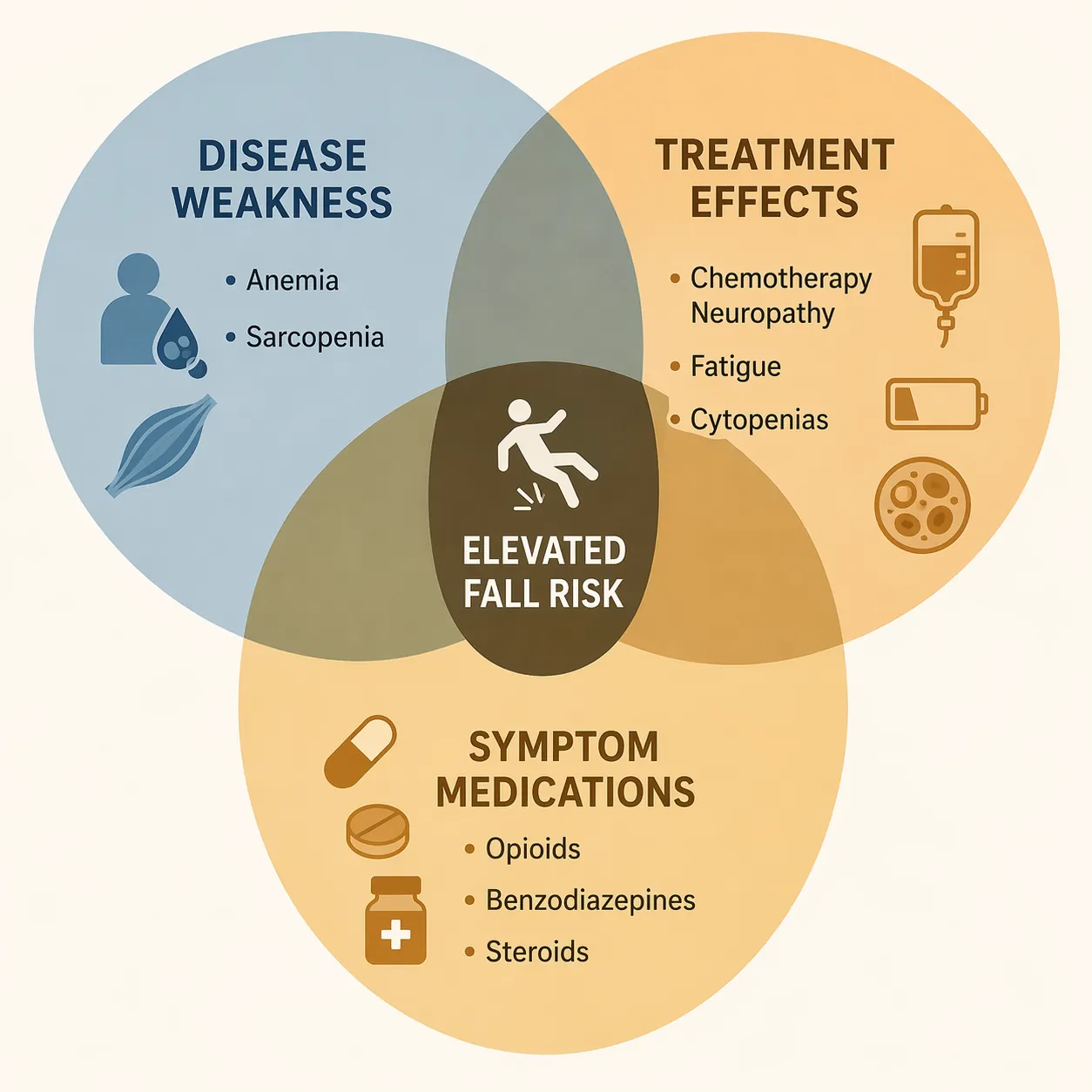
Leukemia adds its own pressure to that warning light. Blood cancers can leave a person weak before treatment begins. AML treatment can bring fatigue, cytopenias, long clinic days, infection precautions, and medication changes. CLL may follow a different course, sometimes more slowly, but older adults with CLL can still face treatment-related fatigue, dizziness, neuropathy, or medication interactions. The fall plan has to follow the actual disease, treatment regimen, blood counts, and home situation, not the diagnosis label alone.
There is another reason to be precise: much of the strongest fall-risk evidence in cancer comes from hospitalized patients. A hospital bed, IV pole, call bell, night checks, and inpatient medication pattern are not the same as a dim hallway at home. The evidence still gives caregivers a useful checklist, but it should be translated with the oncology team rather than copied mechanically.
The checklist that turns worry into things to review
A 2022 systematic review and meta-analysis of hospitalized cancer patients identified several fall risk factors that are especially practical for families to bring into clinic conversations: age, prior falls, opioid use, benzodiazepine use, steroid use, antipsychotic use, sedative use, radiation therapy, chemotherapy, assistive-device use, and longer hospitalization. The same analysis reported increased odds of falls with opiates, benzodiazepines, steroids, and chemotherapy, with odds ratios of 1.72, 2.17, 2.89, and 1.71 respectively.[5]
| Risk factor to ask about | What the caregiver can do with it |
|---|---|
| History of falls or near-falls | Report even “caught myself” events, because they may show weakness before an injury happens. |
| Chemotherapy or treatment cycle changes | Ask when fatigue, low counts, dizziness, or neuropathy are most likely during the cycle. |
| Opioids, benzodiazepines, sedatives, antipsychotics, or steroids | Request a medication review focused on balance, alertness, blood pressure, and nighttime bathroom trips. |
| Assistive-device use | Have the walker, cane, or rollator reassessed if the patient is too weak, rushed, or confused to use it safely. |
| Hospitalization or recent discharge | Treat the first days home as a high-risk transition, not as a return to baseline. |
That assistive-device line matters more than it first appears. A walker can prevent a fall when it is fitted well and used consistently. It can become part of the fall when the person is too fatigued to lift or steer it, abandons it at the bathroom doorway, or tries to manage it while carrying tissues, a water bottle, or discharge papers. The device is not the safety plan by itself.
What to watch as treatment begins
The first pattern to watch is weakness that changes ordinary distances. A person who could walk from the bedroom to the kitchen last month may now need to sit halfway there. Anemia, poor sleep, appetite loss, infection, dehydration, and long appointment days can all show up as slower transfers, shuffling, furniture-walking, or sudden “I just need to lie down” exhaustion. The American Cancer Society lists weakness, balance problems, dizziness, pain, numbness, and some medicines among factors that can contribute to falls in people with cancer.[6]
The second pattern is treatment fatigue that arrives on a schedule the family may not yet recognize. With monthly AML regimens such as venetoclax plus a hypomethylating agent, there may not be a clean “after chemo is over” date. There are clinic visits, labs, dose holds or adjustments, infection checks, transfusions for some patients, and a new monthly rhythm. A safer home plan has to survive that rhythm.
The third pattern is neuropathy or altered sensation. Not every leukemia treatment causes the same nerve effects, and neuropathy risk depends on the drugs used, prior conditions, and cumulative exposure. For a caregiver, the practical signs are simpler: feet that feel numb or burning, trouble judging where the floor is, new unsteadiness when turning, or needing to look down constantly while walking. Those changes should be reported, not treated as clumsiness.
The fourth pattern is bleeding or infection risk layered onto the fall itself. A fall is never ideal, but for a leukemia patient with low platelets, low white blood cells, fever, head impact, or new confusion, the threshold for calling the oncology team or emergency services is lower. Families should not wait until they are standing over someone on the floor to decide whom to call.
Medication review is fall prevention, not paperwork
The medicine list often becomes the place where leukemia care and fall risk meet. Pain medication may help a patient move, but opioids can also increase sedation or dizziness. A benzodiazepine may be prescribed for severe anxiety or sleep, but it can make a nighttime bathroom trip more dangerous. Steroids may be necessary in some regimens or supportive-care plans, while also affecting sleep, muscle strength, mood, and alertness. The point is not to stop medications on your own. The point is to make balance and falls part of the medication conversation.
- Bring every prescription, over-the-counter medicine, sleep aid, anti-nausea drug, pain medicine, supplement, and “as needed” medication to the oncology medication review.
- Ask which medicines are most likely to cause dizziness, sedation, low blood pressure, confusion, urgent urination, or nighttime waking.
- Ask what time of day each medicine is safest to take, especially if the patient already gets up at night.
- Report falls, near-falls, new sleepiness, new confusion, or a sudden change in walking before the next scheduled visit if the change is significant.
A written medication schedule should be usable by the tired person giving the care. If a spouse is setting alarms overnight, tracking anti-nausea pills, and watching for fever, a beautiful chart with too many tiny boxes may fail. The safer version is the one the actual caregiver can follow at 2 a.m.
Make the bathroom and night route the first home project
Room-by-room fall proofing is useful, but leukemia care pushes the bathroom and nighttime route to the front of the line. Fatigue, urgent toileting, sleep disruption, pain medication, dizziness, and anemia all tend to gather there. If you only have energy for one home change this week, make the bed-to-bathroom path safer.
- Clear the exact route the patient uses, not the route the family wishes they used.
- Add low-glare night lighting from bed to toilet, including the bathroom threshold.
- Place stable seating where the patient actually becomes tired, such as near the bathroom or dressing area.
- Use grab bars and non-slip surfaces rather than relying on towel bars, sink edges, or a caregiver’s arm.
- Keep masks, tissues, water, thermometer, phone, and call bell within reach so the patient is not walking while carrying too much.
For a broader room-by-room approach, use a general cancer home-safety guide such as How to Fall-Proof Your Home After Stage 4 Cancer. For bathroom-specific changes, an evidence-based bathroom modification guide can help families decide what should be temporary, what should be installed properly, and what should not be improvised.
One caution: infection precautions can complicate the usual fall-prevention advice. If the oncology team has given neutropenic precautions or cleaning instructions, home changes should respect those instructions. A clutter-free bathroom is safer; a shared, hard-to-clean workaround may not be.
Reassess mobility after every major treatment change
The first walker, cane, shower chair, or bedside commode may not remain the right tool. Leukemia care changes quickly: a hospitalization, transfusion need, infection, new medication, low counts, dose change, or worsening fatigue can turn yesterday’s safe routine into today’s near-fall. Reassessment is not a sign that the family failed. It is how the plan stays honest.
Ask the oncology team when physical therapy or occupational therapy should be involved. An OT can look at transfers, bathroom setup, energy conservation, and equipment fit; a PT can assess gait, strength, endurance, and device use. If the home needs more than small adjustments, an OT or CAPS home-modification sequence can keep the family from spending money on changes that do not match the patient’s real movement pattern.
Watch transfers closely. Many falls happen when someone is almost seated, almost standing, or almost back in bed. If the caregiver is pulling under the patient’s arms, twisting their own back, or bracing a weak adult by instinct, both people are at risk. The safer answer may be a transfer technique, a different chair height, a gait belt taught by a professional, a bedside commode, or more hands-on help.
Protect the caregiver from an impossible plan
A fall-prevention plan that depends on one exhausted spouse hearing every footstep is not a plan; it is a slow emergency. In a qualitative study of 14 caregivers of older adults with AML receiving hypomethylating agents and venetoclax, 71% of caregivers were spouses, 93% were female, and the median caregiver age was 65. The study described caregivers absorbing both physical-protection and emotional-support roles while dealing with shock after diagnosis, observed physical and cognitive changes, long clinic waits, competing responsibilities, and the uncertainty of indefinite treatment.[7]
That study was small, mostly white, and drawn from one Southeastern U.S. center, so it should not be treated as a universal caregiver portrait. Still, it captures a pattern many families recognize: the person preventing falls is often older, frightened, sleep-deprived, and trying not to show it.
- Choose safety changes that reduce monitoring, such as lighting, reachable supplies, bathroom equipment, and a clear call system.
- Write down who covers clinic days, nights after treatment, and the first days after discharge.
- Set a rule for when the caregiver does not attempt a lift alone.
- Ask early about home health, therapy referrals, transportation help, respite, or additional supervision if falls or near-falls begin.
If falls recur or the caregiver cannot sleep because they are listening for movement all night, the question may no longer be “What grab bar should we buy?” It may be whether the person now needs scheduled overnight help or a different level of supervision. A 24/7 home-care decision framework can help families discuss that change before a crisis forces it.
Decide the call thresholds before a fall happens
A leukemia patient’s fall plan should include a written “what now” page. Put it where the caregiver will actually see it: on the refrigerator, inside the medication binder, or saved as a phone note. The oncology team should help tailor it to the patient’s platelet count, infection risk, anticoagulant use, cognition, and treatment phase.
- Call 911 for head injury with loss of consciousness, new confusion, severe pain, suspected fracture, trouble breathing, uncontrolled bleeding, or inability to get up safely.
- Call the oncology team urgently after any fall if the patient has low platelets, fever, new weakness, new dizziness, head impact, is taking blood thinners, or seems different from baseline.
- Do not lift the patient from the floor alone if they may be injured or if the caregiver cannot do it without straining.
- Record what happened: time, location, symptoms before the fall, medications taken, whether the patient hit their head, and what changed afterward.
For a fuller triage sequence, keep a post-fall guide such as Your Parent Just Fell: A Caregiver's Guide to the First 72 Hours with the care papers. The leukemia-specific addition is to ask the oncology team how blood counts, fever, bleeding risk, and current medications change the usual advice.
What to ask at the next oncology visit
The most useful questions are not abstract. They connect treatment timing to the hallway, bathroom, bed, and caregiver’s back.
- “When in this cycle is weakness, dizziness, low counts, or infection risk most likely?”
- “Which of these medicines could increase falls, especially at night?”
- “Should PT or OT assess walking, transfers, bathroom safety, or the walker before the next cycle?”
- “After what kind of fall should we call oncology first, and when should we call 911?”
- “Do the latest blood counts change what we should do after a bump, bruise, head hit, or fever?”
This article is for caregiver education and is not medical advice. AML and CLL differ, treatment regimens differ, guidelines change, and the oncology team should make individualized decisions with the patient and family.
The practical instruction is simple enough to act on: ask the oncology team to make fall risk part of the leukemia treatment plan now; review medications and mobility at each cycle, hospitalization, discharge, or major symptom change; and adapt the home in ways that protect the patient without turning the caregiver into the only piece of safety equipment.
References
- Azacitidine and Venetoclax in Previously Untreated Acute Myeloid Leukemia. NEJM. 2020.
- The Truth About Leukemia in Older Adults: It's Still Treatable. Cleveland Clinic.
- Falls in Older Patients With Cancer: Recognizing and Reducing the Risk. The ASCO Post. January 25, 2017.
- Fall prevention in older patients with cancer: A call for action. Journal of Geriatric Oncology. 2026.
- Risk factors for falls in hospitalized patients with cancer: A systematic review and meta-analysis. Asia-Pacific Journal of Oncology Nursing. 2022.
- Balance Problems, Weakness, and Falls. American Cancer Society.
- Perspectives of caregivers of older adults with acute myeloid leukemia during initial hypomethylating agents and venetoclax chemotherapy. Supportive Care in Cancer. 2023.
Related reading
Noticed something outdated or inaccurate on this page? Flag a correction. We review every report against CDC, NIA, and AARP HomeFit guidance before updating a page.
Part of the Fall Prevention section.