
Room checklist
Bathroom Remodel for Elderly: Evidence-Based Features That Reduce Fall Risk
Discover the five bathroom modifications with the strongest research support for preventing falls—from grab bars and curbless showers to non-slip flooring and layered lighting—backed by CDC data, peer-reviewed studies, and ADA standards. This article is for caregivers and older adults seeking authoritative, evidence-based guidance for an aging-in-place bathroom remodel.
You have probably read that 80% of falls happen in the bathroom. I have seen that number in multiple articles. But the CDC does not publish that figure. What the CDC actually reports is that roughly 235,000 older adults go to emergency rooms each year for bathroom-related falls. That is a concrete number from a specific source, and it is the one I will use. The 80% claim may have originated from a misinterpretation, but it cannot be verified, and repeating it only undermines the credibility of everything that follows.
The bathroom is not 80% of the problem. It is a serious, measurable part of it. And the evidence for what works to reduce those falls is stronger than many people realize. The problem is that the evidence is not reaching everyone equally.
The Data Landscape: 1 in 4, 235,000, $80 Billion
Start with the basics. The CDC reports that 1 in 4 older adults—over 14 million people—falls each year. In 2024, the age-adjusted fall death rate reached 78.4 per 100,000, a 21% increase from 2018. The non-fatal falls alone cost the healthcare system $80 billion annually. And the bathroom accounts for roughly 235,000 ER visits per year. Those are the numbers that set the stage, and they come directly from the CDC and NCOA, not from an industry blog.
Now look at the gap. The HHS Office of the Assistant Secretary for Planning and Evaluation (ASPE) found that 1 in 4 older adults has a mobility limitation combined with an unmodified bathroom barrier. That is a population-level intervention opportunity: millions of people who need a modification and do not have one. And yet, only 68.7% of those over 52 had any assistive home feature in 2006—the most recent national survey on this question, now nearly twenty years old. I include that figure with a warning: government data collection on home modifications has not kept pace with the need.
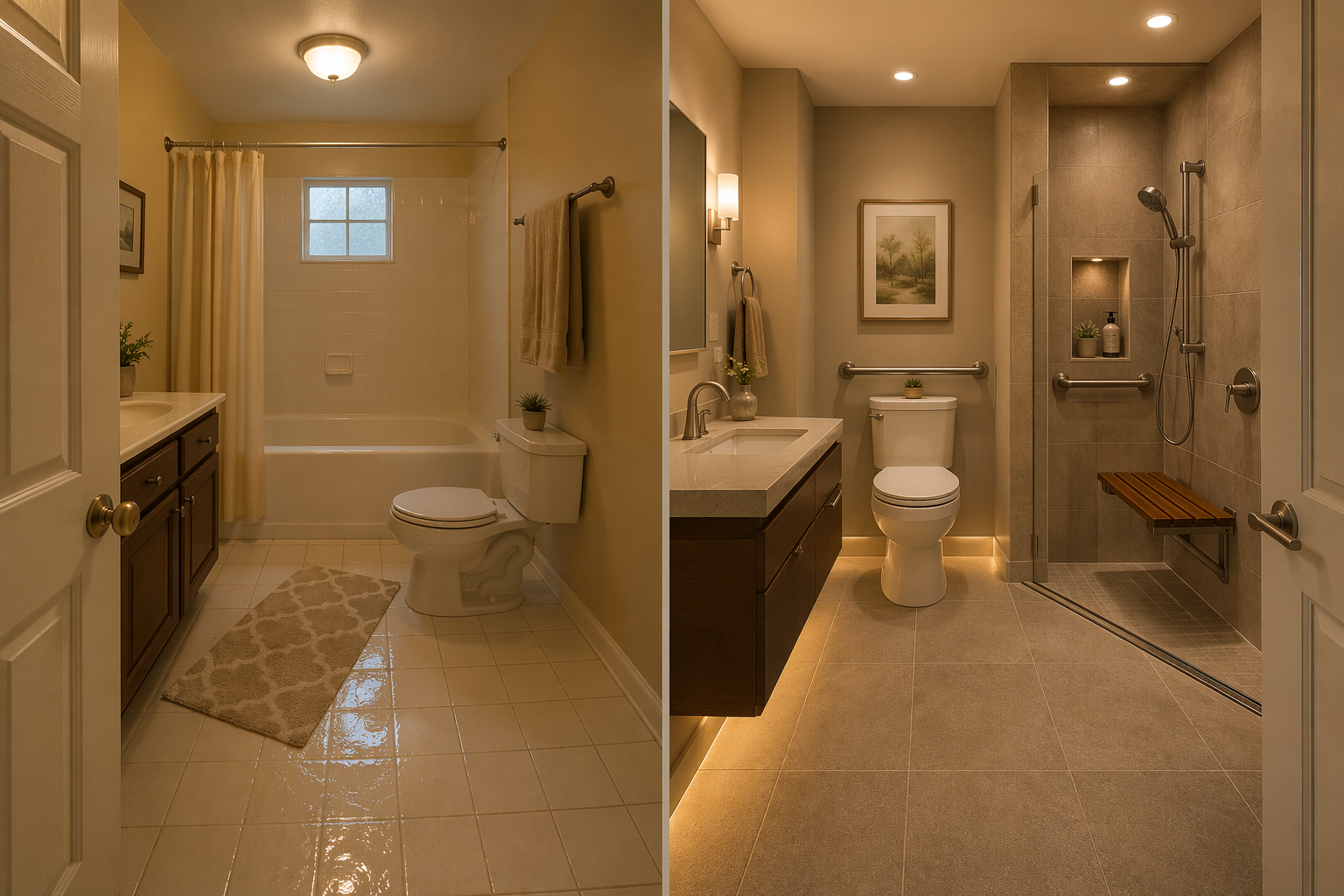
Five Modifications With Precision Specs
The strongest research consistently supports five specific bathroom features. I will present each as an evidence brief, including the technical specifications that matter and the limitations of the underlying studies.
1. Grab Bars: Anchored to Structure, Not Surface
One source reports that grab bars, properly installed into wall studs with a load capacity of 250 pounds or more, can reduce fall risk by up to 50%. I use careful language here because the original study is not linked in the source that cites it. The claim comes from an industry website (allseniors.org) and should be cross-referenced against a peer-reviewed meta-analysis before treating it as established fact. The practical spec, however, is well-supported by building codes: the ADA recommends a height of 33 to 36 inches from the floor, a diameter of 1.25 to 1.5 inches, and anchoring into blocking or studs. Those dimensions are not controversial. What is less often discussed is that many existing bathrooms have towel bars anchored only to drywall, which will not hold a person's weight.
2. Curbless (Zero-Threshold) Shower Entry
A curbless shower eliminates the step-over height that causes many bathroom falls. One frequently cited study, published in the Journal of the American Geriatrics Society, found that comprehensive home modifications—including bathroom changes like curbless showers—reduced fall rates by 26% and fall-related injuries by 33%. I include this with a reservation: the source (porchlightathome.com) did not provide the full citation. I would not present this as a bulletproof finding without verifying the original study. But the direction aligns with other research on environmental risk reduction. A curbless shower typically costs $6,000 to $10,000, according to AARP, and requires planning for proper drainage and waterproofing.
3. Non-Slip Flooring With Clear DCOF Thresholds
The tile industry uses a standard called Dynamic Coefficient of Friction (DCOF). The minimum recommended value for wet bathroom floors is 0.42. Many contractor sources recommend 0.60 or higher for wet areas—a significantly more conservative threshold. The difference matters: a tile with DCOF 0.40 will be noticeably more slippery when wet than one with 0.60. Neither number is a guarantee, but the higher threshold offers a wider margin of safety. When selecting flooring, ask the supplier for the DCOF test result and look for the value in the spec sheet—not all tiles are tested for wet slip resistance.
4. Comfort-Height Toilet (17–19 Inches)
A standard toilet seat sits about 14 to 15 inches from the floor. A comfort-height toilet measures 17 to 19 inches. The biomechanical argument is straightforward: each inch of seat height reduces the knee and hip torque required to sit and stand by roughly 15%. For someone with arthritis or reduced leg strength, those inches translate to less wobble and lower fall risk. This modification is also one of the least expensive—a comfort-height toilet costs typically $200 to $600, and if you are already remodeling, the additional cost over a standard model is marginal.
5. Layered Lighting With Motion Activation
About half of bathroom falls occur during nighttime trips when lighting is either absent or too bright after darkness adaptation. The AARP recommends layered lighting: overhead fixtures for general illumination, a lighted mirror for task lighting, and dimmers to adjust brightness. I would add motion-activated night lights along the path from bed to bathroom—preferably warm-colored LEDs that do not disrupt sleep. The key is to eliminate complete darkness on the route. For a dedicated article on the bed-to-bathroom path, see our nighttime fall prevention guide.
The Adoption Gap: 40% of Repeat Fallers Have Nothing
A 2021 study published in the peer-reviewed journal Preventive Medicine Reports (Ng et al.) analyzed data from 2,404 Medicare beneficiaries aged 65 and older who had experienced at least one fall. The findings are sobering: only 55.5% of those who fell had any bathroom modifications at all. Among those who had fallen two or more times—the group at highest risk—40.2% had zero modifications. The study controlled for age, sex, income, health status, and functional limitations. This is not a cost or awareness problem alone; something deeper is preventing people from getting the features that could reduce their fall risk.
Racial Disparities: The Data Most Bathroom Guides Ignore
The Ng et al. study also examined racial and ethnic differences. The numbers are striking, and they are not something you will find in most bathroom remodel articles.
| Group | Adjusted Odds Ratio | 95% CI | p-value | What it means |
|---|---|---|---|---|
| Non-Hispanic Black | 0.38 | Not reported | <0.001 | 62% lower odds of having modifications |
| Hispanic | 0.64 | Not reported | 0.039 | 36% lower odds of having modifications |
| Non-Hispanic White | 1.00 (reference) | — | — | Comparator group |
Non-Hispanic Black older adults are 62% less likely to have bathroom modifications compared to non-Hispanic Whites, even after adjusting for income, health status, and functional limitations. Hispanics are 36% less likely. The p-values confirm that these are not random fluctuations. This is the most important finding in the article, and it is the one that existing bathroom remodel guides routinely omit.
Why does this gap exist? The data offers some clues. The HHS ASPE report notes that only 6% of respondents who added home modifications had insurance or government programs pay any of the cost. Homeowners are nearly five times more likely to add assistive features than renters (adjusted OR = 4.74). Lower homeownership rates among Black and Hispanic older adults, differential access to capital, and systemic gaps in healthcare referral to occupational therapy all likely contribute. But the study does not pin down causation. What it does show is that an evidence-based recommendation that ignores these structural barriers is incomplete.
What Drives the Gap? Structural Barriers Beyond Awareness
The HHS ASPE data, though nearly twenty years old, remains the most recent national survey on this topic. It shows that among the population 52 and older, 68.7% had at least one assistive home feature in 2006. That means one in three were missing even basic safety elements like a grab bar or a raised toilet. The same report found that renters are dramatically less likely to have modifications—a pattern that likely intersects with racial disparities given lower rates of homeownership among Black and Hispanic households.
There are targeted funding sources: the VA Specially Adapted Housing grant provides up to $126,526 for eligible veterans (FY 2026), and the Special Home Adaptation grant provides up to $25,350. But those programs are limited to veterans with service-connected disabilities, not the general population. For most older adults, paying for a bathroom remodel means out‑of‑pocket cash or a home equity loan. If you need help navigating payment options, see our complete guide to grants and loans for home modifications.
Any Evidence-Based Bathroom Guide That Ignores Equity Is Incomplete
This article exists because most bathroom remodel guides for older adults take one of two approaches: a phased checklist ("start under $500, then mid‑range, then full renovation") or a general evidence summary that covers all rooms at once. We already publish both types on this site—for a broader overview, see our evidence behind aging-in-place home modifications article. What none of those guides do is drill into five specific bathroom features with precise technical specs and, more importantly, expose the racial and ethnic disparities in who actually gets them.
The evidence for grab bars, curbless showers, non‑slip flooring with DCOF ≥0.42 (preferably ≥0.60), comfort‑height toilets, and layered lighting is solid. But the data shows that nearly 40% of people who have already fallen multiple times still do not have a single modification, and Black and Hispanic older adults are far less likely to have them even after accounting for income and health. That is not a failure of evidence. It is a failure of implementation.
If you are a clinician, a CAPS‑certified contractor, or a family caregiver making decisions for yourself or a parent, the technical specs matter. But the real question is: who is being left out, and what are we going to do about it? That is the judgment I hope this article leaves you with.
Related reading
Need a professional assessment?
Find a CAPS-credentialed professional or local aging services through our outbound resource list — we never name or rank individual contractors.
Find Local HelpNoticed something outdated or inaccurate on this page? Flag a correction. We review every report against CDC, NIA, and AARP HomeFit guidance before updating a page.