
Fall Prevention for Seniors with Meniere's Disease Vertigo
Falls from Meniere's disease stem from two separate threats: sudden drop attacks during vertigo and ongoing balance problems between episodes. This guide provides a crisis-response protocol for vertigo attacks and a prevention plan for between-attack management.
When the room starts spinning, fall prevention for seniors with Meniere's disease vertigo begins with one distinction that matters more than any checklist: some attacks give you a few seconds to protect yourself, and some do not.
During a vertigo attack, a person may feel the spin building, reach for the wall, and have enough time to sit or lie down. During a true drop attack, sometimes called a Tumarkin otolithic crisis, the person may suddenly fall without warning. The first situation calls for a practiced response. The second calls for injury reduction, because the usual advice to "sit down when you feel dizzy" arrives too late.
What to Do When Vertigo Starts
The crisis plan should be simple enough to remember when the body is already frightened. If vertigo starts, sit or lie down immediately on a stable surface. Support the head. Stay still. Avoid bright light, quick head turns, and trying to "walk it off." Keep prescribed emergency medication where it can be reached without crossing the room. After the spinning settles, wait at least 20 minutes before trying to rise, then come up slowly and with support nearby.[1][2][3]
- Get low quickly: sit on a chair, bed, toilet seat with support, or the floor if that is the safest option.
- Support the head: rest it against a pillow, headboard, wall, or folded towel.
- Reduce stimulation: dim lights, stop reading or scrolling, and avoid sudden head movement.
- Use only medication already prescribed for attacks, such as meclizine or diazepam, and keep it reachable.
- Do not rush the first stand: pause after symptoms settle, sit at the edge of the bed or chair, then stand with a handhold.
That plan belongs on the refrigerator, inside a nightstand drawer, and in the phone of anyone who helps. It is not elegant, but it is useful. The person having the attack should not have to explain the plan while nauseated, sweating, and trying not to fall.
The Part This Protocol Cannot Fix
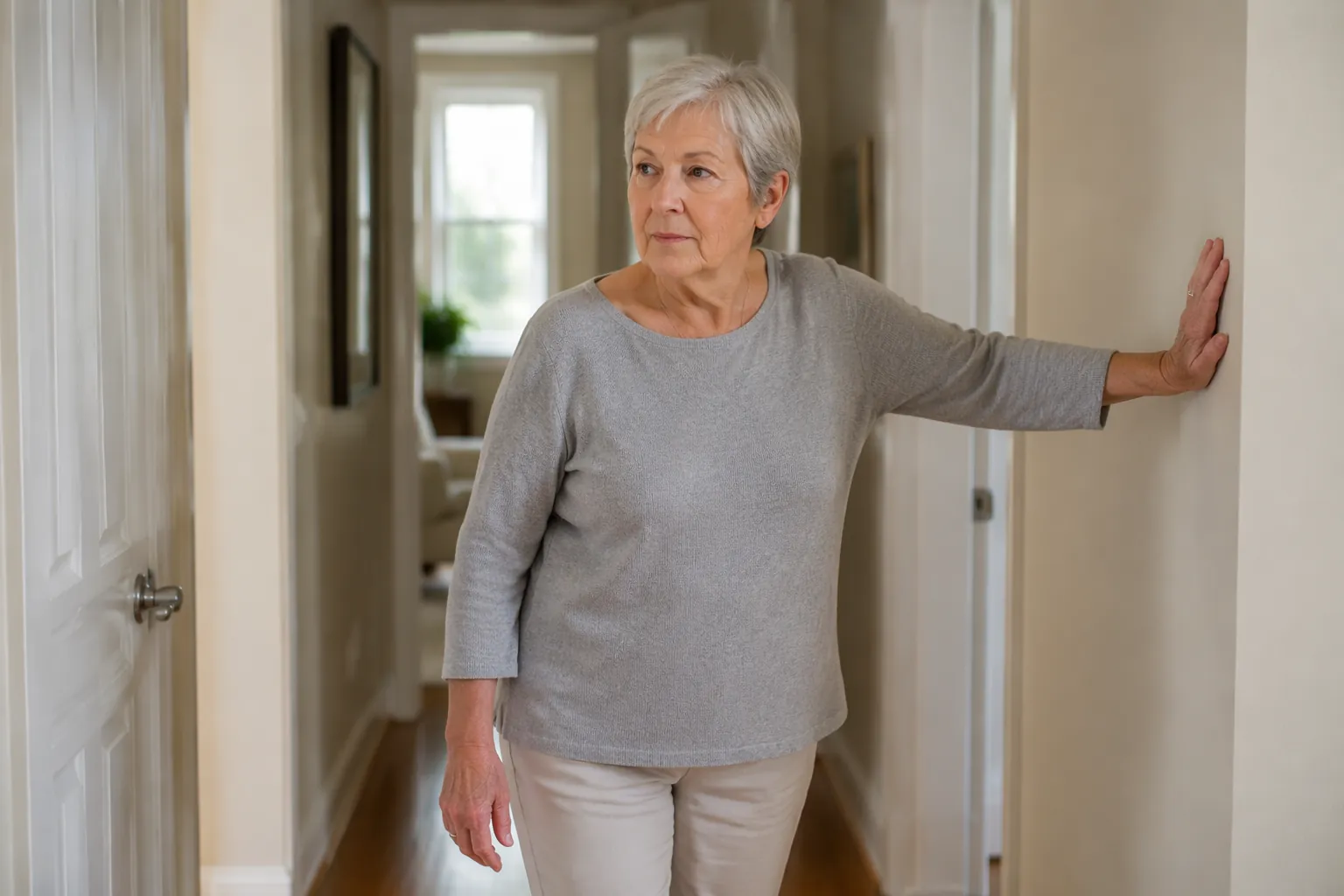
A no-warning drop attack is different. People may describe being thrown to the ground, collapsing suddenly, or landing before they understand what happened. For that kind of event, the problem is not poor reaction time. There may be no usable warning.
That is why Meniere's fall planning needs two tracks. A meta-analysis reported a pooled frequency of vestibular drop attacks leading to a fall to the ground of 8%, with a 95% confidence interval of 4% to 12%.[4] A separate 2024 report described drop attacks across a wider range, and one survey of 602 people with Meniere's disease found that 49% reported experiencing them.[5] Those numbers are not interchangeable: definitions vary, and not every reported drop attack means the same severity. The narrower number is more useful when talking specifically about falls to the ground.
For someone with suspected drop attacks, the goal shifts. You still keep the vertigo protocol, because many attacks do give warning. But you also plan as if a fall might happen before the person can reach for anything.
- Place stable seating at key waiting points: beside the bed, near the bathroom, in the kitchen, and near the entry.
- Clear the likely fall zones: hallway corners, the bed-to-bathroom route, and tight spaces near furniture.
- Discuss hip protectors if falls are sudden, hard, or recurrent.
- Consider softer landing surfaces where practical, while avoiding thick rugs that create trip edges.
- Use a medical alert device with fall detection if the person lives alone or is alone for long stretches.
This is not giving up on prevention. It is admitting that not every Meniere's event gives the nervous system enough time to compensate. The home has to help on the days the body cannot.
Between Attacks, the Risk Does Not Disappear
Many families make the mistake of treating Meniere's fall risk as only an attack problem. The severe episode gets everyone's attention, but the quieter risk is the person who is never quite steady between attacks: walking with a wider base, turning too quickly in the kitchen, needing the wall during a hallway trip at night.
That quieter risk is common enough to plan for. In a 2024 report, 65.5% of people with Meniere's disease reported balance problems even outside acute vertigo episodes.[5] That does not prove every person with Meniere's has the same impairment, but it does mean prevention cannot stop at "sit down when dizzy."
The between-attack plan has three household jobs: reduce attack frequency when possible, improve balance capacity when appropriate, and make the home less punishing when balance fails.
Ask About Vestibular Physical Therapy Early
A large claims-based cohort study in JAMA Otolaryngology-Head & Neck Surgery included 805,454 adults with dizziness. Receipt of physical therapy within 3 months of the dizziness diagnosis was associated with an 86% reduction in the odds of falling by 12 months.[6] That is the kind of finding worth bringing to a clinician, not because it proves physical therapy alone prevents every fall, but because it points to a missed practical step.
The same study found that only 6% of patients received physical therapy within 3 months of diagnosis.[6] That gap is familiar in the worst way: dizziness is discussed, medication is adjusted, imaging or specialist visits may happen, and the person still goes home to the same hallway, the same bathtub edge, and the same untrained balance system.
Vestibular rehabilitation is not the same thing as taking medication during an acute attack. A vestibular-trained physical therapist may use gaze stabilization, habituation exercises, balance training, gait work, and careful progression of head and body movement. The pacing matters. Exercises that are too aggressive can provoke symptoms, and Meniere's disease can fluctuate. The point is not to bully the inner ear into behaving. The point is to teach the eyes, body, and remaining balance systems to work together as safely as possible between episodes.
A useful appointment question is plain: "Given my Meniere's symptoms and falls or near-falls, should I be referred to a vestibular physical therapist?" If there have been sudden collapses, say that directly. If the problem is mainly unsteadiness between attacks, say that too. A therapist plans differently for no-warning falls than for slow, cautious walking.
Use Diet and Trigger Management for Attack Control, Not as a Fall-Proofing Promise
Diet changes belong in the plan, but they should carry the right job description. Low-sodium eating is commonly recommended for Meniere's disease, with sources such as Mayo Clinic describing a limit of 1,500 mg of sodium per day as a way to reduce fluid retention and help manage symptoms.[7] Cleveland Clinic and the National Institute on Deafness and Other Communication Disorders also describe diet changes and trigger management as part of Meniere's care.[8][9]
For fall prevention, that means diet may help by reducing the frequency or severity of attacks for some people. It does not remove the need for a bathroom grab bar, a vestibular therapy referral, or a plan for sudden events. The practical review is usually sodium first, then alcohol, caffeine, MSG, hydration patterns, and stress triggers with the treating clinician. Food logs can help when memory becomes unreliable after a bad week of symptoms.
Make the Home Match Meniere's Patterns
Generic fall-prevention advice often lists every possible home change until no one knows where to start. With Meniere's disease, start where vertigo, rushing, darkness, and head movement meet.
| Area | Why It Matters | Practical Change |
|---|---|---|
| Bedroom-to-bathroom path | Night trips combine darkness, urgency, and quick turns. | Use nightlights, clear the route, remove loose rugs, and keep a stable handhold available. |
| Bathroom | Wet surfaces and head movement during bathing increase fall consequences. | Install grab bars, use non-slip surfaces, and keep towels and toiletries within easy reach. |
| Hallways | A vertigo spell or imbalance episode may happen away from furniture. | Keep walkways wide, well lit, and free of cords, baskets, and low tables. |
| Kitchen | Standing, reaching, turning, and carrying items happen together. | Create a seated prep option and keep common items between shoulder and knee height. |
| Entry | Shoes, thresholds, pets, packages, and poor lighting cluster at the door. | Add lighting, a chair or bench, and a place to set items down before moving. |
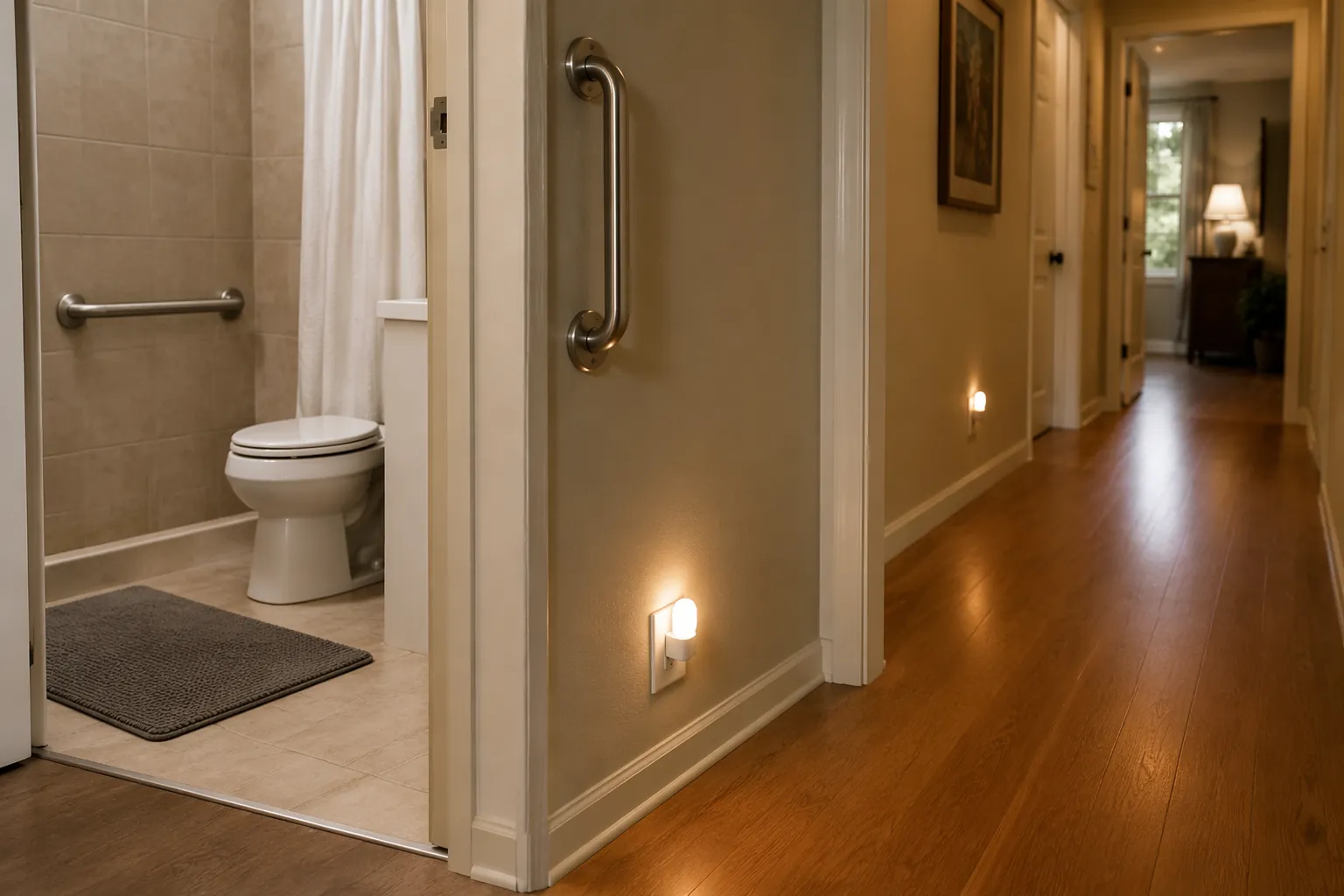
The bathroom deserves early attention. A grab bar near the toilet and in the bathing area is not a decoration; it is a planned handhold for the moment when the head turns and the floor moves. Non-slip mats need to lie flat, without curled edges. Nightlights should illuminate the route, not glare into the eyes.
Footwear also belongs in the conversation. A firm, thin-soled shoe often gives the feet better information than a thick, soft slipper. The best shoe is the one the person will actually wear during the risky parts of the day, including the early walk to the bathroom.
If the whole house needs a pass, use a room-by-room process rather than arguing over one rug at a time. CareWise Guide's home modification priority guide and guide to prioritizing aging-in-place modifications can help families separate urgent safety changes from projects that can wait.
Review Medications for the Hallway Test
Medication review should not be a vague instruction to "ask your doctor." Bring the actual bottles, including sleep aids, anxiety medications, blood pressure medicines, pain medicines, antihistamines, and any vestibular suppressant used during attacks. The safety question is specific: "Could any of these make me less steady, slower to react, or more likely to fall, especially at night?"
Vestibular suppressants can be useful during acute vertigo when prescribed, but long-term or poorly timed use may interfere with alertness or balance compensation for some patients. The answer is not to stop prescribed medication on your own. The answer is to have the ENT, primary care clinician, pharmacist, or vestibular specialist look at the full list with falls in mind.
Exercise Helps, but Borrowed Evidence Should Be Labeled
Tai Chi and structured programs such as Otago often appear in fall-prevention advice for older adults. They may be useful for strength, stepping control, confidence, and balance practice. The caution is that much of that evidence comes from general senior fall-prevention research, not trials designed specifically for older adults with Meniere's disease.
That does not make the exercises useless. It means they should be chosen around the person's actual symptom pattern. A senior who is unsteady between attacks may benefit from supervised balance and strength work. A person with unpredictable drop attacks needs injury-reduction planning alongside exercise. A person whose symptoms flare with repeated head turns needs a vestibular-trained clinician to set the pace.
Do Not Let Fear Become the Only Strategy
After a frightening fall, caution is sensible. Permanent retreat is not. Many older adults start by avoiding the shower alone, then the stairs, then the mailbox, then the family visit. Muscles weaken, walking gets less practiced, and the next trip across the room becomes harder.
That cycle is not a character flaw; it is a predictable response to a body that has become unreliable. CareWise Guide's article on how fear of falling creates a dangerous cycle is worth reading if the home has become safer but the person is still shrinking their day.
The goal is not bravery. It is graded confidence: a clear route to the bathroom, a practiced attack response, the right clinician involved, and movement that is challenging enough to preserve function without pretending the diagnosis is irrelevant.
A Two-System Plan Families Can Actually Use
For a senior with Meniere's disease, one fall-prevention list is too blunt. The plan needs two systems living side by side.
- During a vertigo attack: get low, support the head, reduce stimulation, use prescribed emergency medication as directed, wait before rising, and stand slowly with support.
- For possible drop attacks: assume there may be no warning, then reduce injury with safer landing zones, reachable seating, hip protection when appropriate, and fall detection if needed.
- Between attacks: ask about vestibular physical therapy, review medications, manage sodium and triggers, strengthen safe movement, and modify the home around the riskiest routes.
If the family is stuck deciding who should assess the house, an occupational therapist, a vestibular physical therapist, and a Certified Aging-in-Place Specialist do different jobs. CareWise Guide's comparison of OT vs. CAPS for home modifications can help sort the sequence. The broader home safety gap is often not that families do not care; it is that they do not know which change matters first.
Bring the written plan to the ENT, primary care clinician, or vestibular-trained physical therapist. Ask them to mark what fits the diagnosis, what needs changing, and what should be rehearsed at home before the next bad night.
References
- Fall Prevention, Vestibular Disorders Association.
- Vertigo - self-care, MedlinePlus.
- I Have Meniere's Disease. How Can I Prevent Another Attack?, Brain & Life.
- Vestibular drop attacks in Meniere's disease: a systematic review and meta-analysis, Journal of Vestibular Research.
- Meniere's disease and vestibular drop attacks: an international survey, Frontiers in Neurology, 2024.
- Use of Physical Therapy and Subsequent Falls Among Patients With Dizziness in the US, JAMA Otolaryngology-Head & Neck Surgery, 2023.
- Meniere's disease - Diagnosis and treatment, Mayo Clinic.
- Meniere's Disease, Cleveland Clinic.
- Meniere's Disease, National Institute on Deafness and Other Communication Disorders.
Related reading
Noticed something outdated or inaccurate on this page? Flag a correction. We review every report against CDC, NIA, and AARP HomeFit guidance before updating a page.
Part of the Fall Prevention section.