
The Home Safety Gap: Why Families Delay Action and How to Start
Most older adults want to age at home, yet only about 10% of U.S. homes have basic safety features. This article explains why families struggle to move from worry to action and offers a tiered, start-anywhere framework to close the gap.
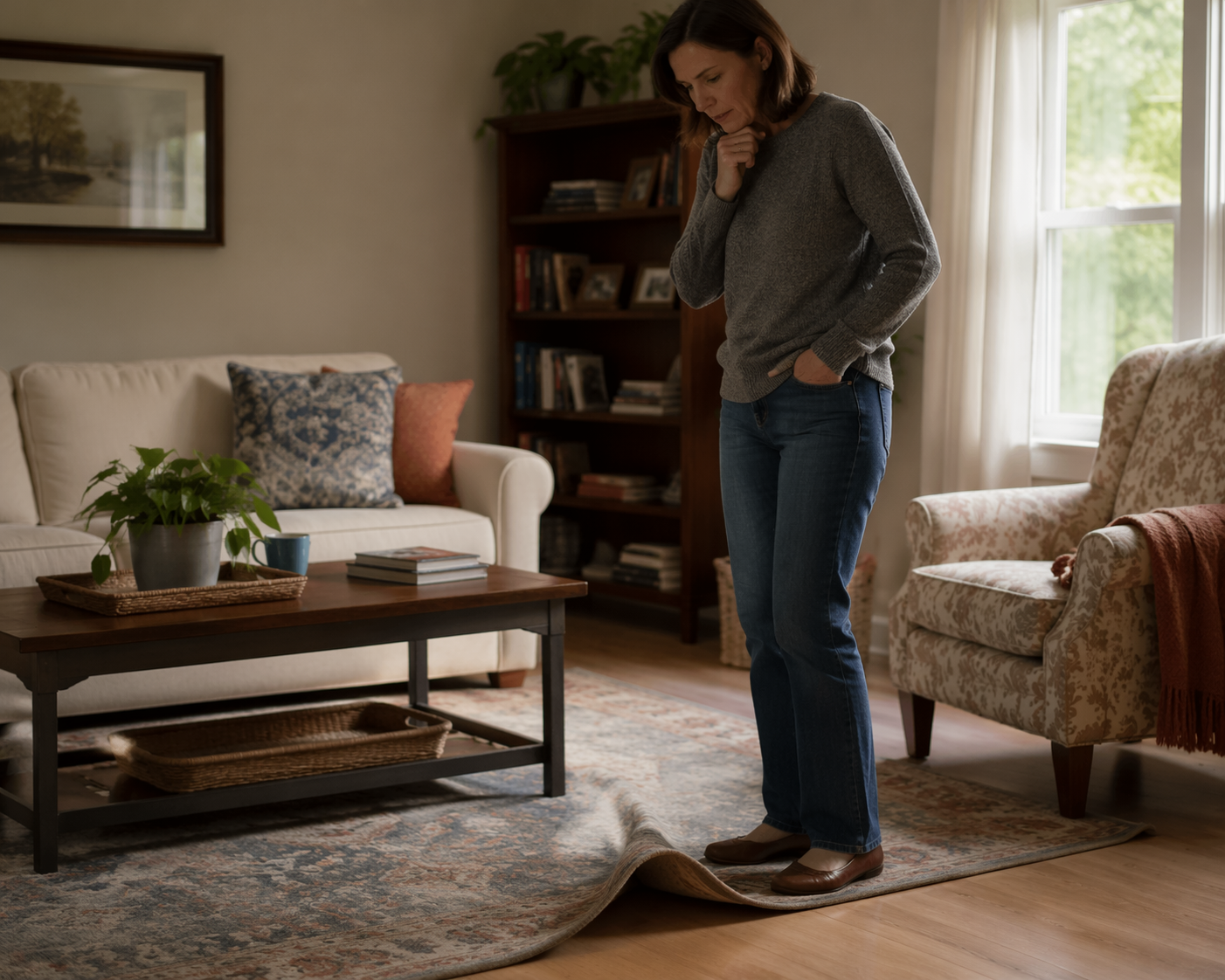
The rug has been curling at the corner for months. Everybody sees it. The daughter notices it when she carries groceries in. The grandson steps over it without thinking. The older parent says it has always been there, which is true, and also exactly the problem. Many families begin home safety for older adults in this uncomfortable middle place: the danger is visible, the conversation is awkward, and nobody wants a loose rug to become the event that forces action.
The national numbers make that private hesitation look less like one family’s stubbornness and more like a pattern. More than 90% of older adults want to age in place, yet about 10% of U.S. homes have basic aging-ready features such as a step-free entry, first-floor bedroom and full bath, and at least one accessibility feature, according to a Census Bureau American Housing Survey synthesis by Choice Mutual.[1] A University of Michigan National Poll on Healthy Aging found that 85% of older adults planning to stay in their current homes did not think they would need significant modifications, while only 18% of adults 50 and older had already made any home modifications.[2]
That is the home safety gap: not a lack of products, not a lack of checklists, and not always a lack of love. It is the distance between noticing and doing. Families know the hallway is dark. They know the shower wall has no grab bar. They know the stairs are harder in winter when joints are stiff and shoes are wet. Then the weeks keep moving.
Why families wait after they already know
A parent’s refusal often gets described too simply. “She won’t listen.” “He’s being difficult.” Sometimes that is how it feels from the adult child’s side, especially when the same person who refuses a grab bar also expects a ride to every appointment. But home changes can sound like a verdict. A daughter says “safety,” and a mother hears “decline.” A son says “walk-in shower,” and a father hears “I can’t be trusted in my own bathroom.”
The older adult may not feel old enough for the change. That matters because many safety fixes are marketed as if the person has already accepted a new identity: patient, fall risk, dependent, frail. A raised toilet seat with arms may be sensible, but it is still sitting there in the bathroom announcing something nobody has agreed to say out loud.
Adult children delay for a different reason. They often know too much and too little at the same time. They can name six problems in the house, but not the first one to solve. Is the bathroom worse than the stairs? Is a grab bar enough, or does the tub need to go? Should they call a handyman, an occupational therapist, a contractor, the doctor, the insurance plan, or their sibling who has strong opinions but no available Saturdays?
There is also a social embarrassment families rarely put on a list. Throw rugs came from someone’s trip. The dim lamp belonged to a spouse who died. The upstairs bedroom is not just a room; it is where a person has slept for decades. “Just move downstairs” can sound efficient from the outside and brutal from the inside.
This is why a checklist alone often fails. A checklist can identify hazards, but it cannot make a parent feel respected, choose the contractor, pay the invoice, or decide what to do when the safest answer conflicts with the life someone recognizes as home. The first job is not to win an argument about aging. It is to make the next safe action small enough that nobody has to surrender their dignity to accept it.
The stakes are real, but fear is a poor project manager
Falls are not minor household mishaps at this stage of life. The CDC reports that falls among older adults cause about 3 million emergency department visits and 1 million hospitalizations each year.[3] A 2024 study in Injury Prevention estimated annual older-adult fall-related healthcare spending at $80 billion, with 67% paid by Medicare, 4% by Medicaid, and 29% out of pocket.[4]
Those numbers matter because they prove this is not one unlucky household being dramatic. Still, fear has limits. Telling a parent that a fall could be expensive or catastrophic may be factually correct and practically useless. The person already knows bad things can happen. The more useful question is: which visible hazard can change before the next nighttime bathroom trip?
Start where agreement is easiest
The first changes should not require a family summit. They should be low-cost, low-friction, and easy to frame as comfort improvements. “Let’s make the hallway brighter” usually lands better than “You are going to fall in the dark.” “This bath mat grips better” is easier than “Your bathroom is unsafe.”
For a first pass, use the CDC STEADI “Check for Safety” checklist or a caregiver-friendly room walk-through, then act on the problems that are both obvious and simple.[5] If you want a more detailed room sequence, use a room-by-room fall prevention checklist while you are physically in the home, not later from memory.
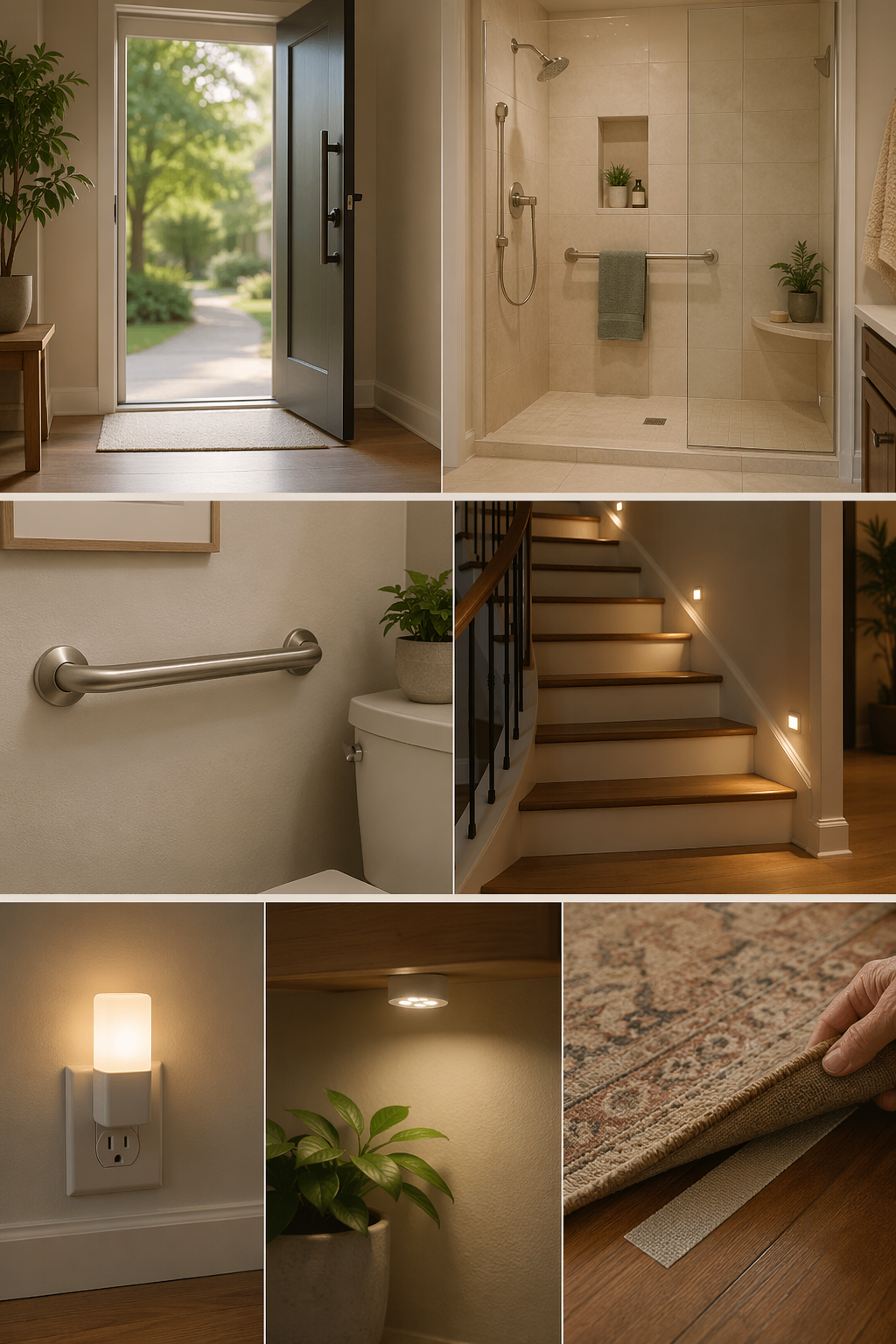
- Remove or secure throw rugs, especially near beds, favorite chairs, kitchens, and bathroom doors.
- Add motion-sensor night lights along the bedroom-to-bathroom path and near stairs.
- Replace slippery bath mats with non-slip mats that grip the floor and tub surface.
- Clear cords, low stools, stacked newspapers, pet bowls, and narrow walking paths.
- Install grab bars only where they can be properly anchored, not suction-mounted as a substitute for support.
- Add a raised toilet seat with arms if standing from the toilet has become slow, effortful, or unsteady.
The National Institute on Aging’s room-by-room fall prevention guidance emphasizes the same ordinary trouble spots families tend to walk past: floors, stairs, bathrooms, bedrooms, kitchens, and outdoor paths.[6] None of these fixes needs to be presented as a remodel. They are the home version of clearing ice from a step before someone slips.
A tiered way to stop turning one decision into twenty
Families often stall because every safety concern gets mentally bundled into one frightening project. The bathroom, stairs, lighting, entryway, insurance, siblings, contractors, and parent’s pride all arrive as one knot. Separating changes into tiers helps because it gives each decision the right size.
| Tier | Typical timing | Examples | Main decision |
|---|---|---|---|
| Weekend fixes under $500 | Start now | Rug removal, motion lights, non-slip mats, clutter clearing, raised toilet seat, properly anchored grab bars | What can reduce risk before the next fall-prone routine? |
| $1,000–$10,000 planned changes | Plan over the next 6–12 months | Walk-in shower conversion, stair lift, ramp, second stair handrail, lever-style handles | Which daily activity is becoming unsafe often enough to justify a project? |
| $10,000+ structural decisions | Plan before crisis forces the timeline | Doorway widening, full bathroom remodel, home elevator, major entry rework | Can this home realistically support aging in place? |
These ranges are planning categories, not promises. ElderLife Financial and NCOA both describe wide cost variation for common aging-in-place modifications, and actual prices depend on region, home construction, labor, materials, and whether a quick installation turns into repair work behind the wall.[7][8] A grab bar in a well-framed wall is a different job from a grab bar in a tiled shower with hidden water damage.
Tier 1: the changes that should not wait for consensus
Tier 1 is where families can break the delay cycle. If a parent is resisting, start with changes that can be described as convenience, lighting, or housekeeping. Better bulbs do not accuse anyone of being frail. A cleared walkway does not require a medical label. A non-slip mat can be bought before the family has solved the bathroom remodel question.
The bathroom deserves early attention because wet surfaces, transfers, and urgency combine there. But “bathroom safety” does not automatically mean tearing out the tub. It may begin with a real grab bar, a shower chair that fits the space, a handheld showerhead, a non-slip surface, and enough light to see the floor clearly. If the first purchase sits unused because it is flimsy, ugly, or hard to store, that is not success; it is clutter with good intentions.
After a fall or near-miss, do not wait for the larger family plan before correcting the obvious hazard. A time-based approach can help: the first 72 hours are for immediate hazards and medical follow-up, the first month is for assessment and routine changes, and the first year is for bigger home decisions. That sequence is laid out in the after-a-fall home modification triage guide.
Tier 2: when daily routines are asking for a project
Tier 2 begins when the same task keeps producing risk: stepping over the tub wall, climbing stairs with laundry, entering through a garage step with no rail, turning round knobs with stiff hands, or crossing a dim landing. These are not one-time annoyances. They are repeated exposure.
This is the point to slow down enough to avoid the wrong purchase. A stair lift may be exactly right for one home and a costly postponement in another if the bathroom, bedroom, and laundry are still divided across levels. A ramp can solve entry access, but only if slope, landing space, drainage, and door clearance work. A walk-in shower may be safer, but the family still needs to think about toilet access, floor traction, lighting, and where towels and soap are reached.
For these midrange changes, a home modification priority guide can keep the family from spending first on the most visible problem instead of the most dangerous routine.
Tier 3: the hard question about the house itself
Some homes are not one grab bar away from workable. A steep driveway, narrow interior doorways, a full bath only upstairs, uneven exterior steps, and no realistic first-floor sleeping option can make aging in place fragile even after money is spent. This is where families need to be honest early, before a hospital discharge or sudden mobility change turns every decision into an emergency.
Large structural projects can be the right choice when the home, budget, and likely care needs line up. Doorway widening, a full accessible bathroom remodel, or a major entry change may preserve independence for years. But these decisions should be made with eyes open. If the person would still be isolated, unable to reach a bedroom or bathroom, or dependent on one exhausted family caregiver after the renovation, the family may need to ask whether the safety gap is closable in that home.
That question is painful, but avoiding it does not protect anyone. It usually just delays the day when the options are fewer.
Bring in help before the family argument hardens
A professional assessment can change the tone in a resistant household. When an occupational therapist or qualified aging-in-place professional walks through the home, the conversation is no longer only between parent and child. The evaluator can connect hazards to specific daily routines: where the person reaches, where balance is lost, which doorway catches the walker, which step lacks a usable rail.
That outside view is especially useful when the adult child has become the family messenger for every unpleasant topic. A parent may reject a daughter’s warning and accept the same observation from a clinician because it feels less personal. The daughter still may be the one making calls and comparing estimates, but she no longer has to carry the whole argument alone.
For families ready for that step, start with a professional home safety assessment rather than jumping straight from worry to contractor bids. An assessment does not obligate the family to a remodel. It clarifies what matters first.
How to talk about changes without making home feel like a clinic
The best opening is often not “I’m worried you’ll fall.” It may be “I want it to be easier for you to get to the bathroom at night,” or “Let’s make the shower more comfortable before winter.” NIA and AARP-style guidance commonly frame home changes as comfort and usability improvements for everyone, which is closer to how many older adults are willing to accept them.
A useful conversation offers choice without pretending nothing needs to change. “Would you rather start with the hallway lights or the bathroom mat?” is better than “Do you want to make the house safer?” because the second question gives fear and pride room to say no to the whole category. Choice should sit inside a boundary: something is changing because the risk is real.
A hypothetical example shows the difference. Instead of telling a parent, “You can’t use that shower anymore,” a family might say, “The tub edge is the riskiest part of your morning. This week we can add a secure grab bar and a shower chair. Then we can decide whether the tub itself needs to change.” The parent still may dislike it. But the request is specific, immediate, and tied to one routine rather than to a global judgment about competence.
Funding helps, but it will not organize the work for you
It is reasonable to ask who pays, especially once the family moves beyond night lights and bath mats. But funding should not become the reason nothing happens this month. The smallest fixes are often private-pay purchases. Larger changes may involve Medicare Advantage supplemental benefits, Medicaid home- and community-based services waivers, VA grants, local programs, or home equity, but none of these should be treated as automatic.
Medicare Advantage coverage varies by plan and region. Medicaid waiver programs are state-specific and may have waitlists. VA grants have eligibility rules, including service-connected disability requirements for some programs. Contractor prices vary enough that national averages should be used for rough planning, not as a promise. If financing is becoming the main barrier, a dedicated guide to paying for aging-in-place home modifications is a better next stop than trying to solve coverage from memory.
When the gap may be too wide to close
The kindest answer is not always “stay home at any cost.” If falls are recurring, cognition is changing, medication mistakes are increasing, meals are being missed, or the home layout requires workarounds that depend on one family caregiver being constantly available, home modifications may not be enough. A safer home cannot replace all supervision, mobility support, or hands-on care.
Families who are unsure can use a broader aging-in-place safety warning signs framework to separate a fixable home hazard from a living arrangement that is no longer holding. That distinction matters. A loose rug is a weekend problem. A two-story home with no accessible bathroom, repeated falls, and no reliable caregiver coverage is a planning problem.
The goal is not to make one perfect decision. It is to stop waiting for certainty while hazards stay in place. Start with the safest low-friction changes. Use a checklist while standing in the actual rooms. Bring in assessment when the choices get bigger or the family argument gets stuck. And learn early whether the home safety gap can be closed, or whether love now means planning for a different setting before the next crisis decides for everyone.
References
- Aging in Place Statistics, Choice Mutual.
- Older Adults’ Preparedness to Age in Place, University of Michigan National Poll on Healthy Aging.
- Facts About Falls, Centers for Disease Control and Prevention.
- Healthcare spending for non-fatal older adult falls in the USA in 2020, Injury Prevention, 2024.
- STEADI Patient Resources, Centers for Disease Control and Prevention.
- Preventing Falls at Home: Room by Room, National Institute on Aging.
- How Much Do Home Modifications Cost for Aging in Place?, ElderLife Financial.
- How to Prevent Falls With Home Safety Modifications, National Council on Aging.
Related reading
Noticed something outdated or inaccurate on this page? Flag a correction. We review every report against CDC, NIA, and AARP HomeFit guidance before updating a page.
Part of the Fall Prevention section.