
STEADI: Intervene
Winter Weather Fall Prevention Tips for Michigan Seniors
Michigan winters turn ordinary fall risks into predictable hazards on icy steps, walkways, and driveways. This guide gives families a low-cost prep checklist — traction and de-icing, winter footwear, cane and walker attachments, shoveling help, and outdoor lighting — to ready an older adult's home and routine before the first storm.
The first icy Michigan morning usually does not look dramatic from the kitchen window. The porch is only a little shiny. The steps look “fine enough.” The driveway has one gray patch near the car door. That is exactly when winter fall prevention has to start—before an older adult steps out with a cane, a trash bag, groceries, stiff knees, or one hand already reaching for the railing.
For older adults, falls are not a small seasonal nuisance. More than one in four older adults falls each year, falls lead to about 3 million emergency department visits and 1 million hospitalizations, and about 37% of older adults who fall report an injury that needs medical treatment or restricts activity for at least a day.[1] CDC STEADI materials also note that about 41,000 older adults die from falls each year, and more than 95% of hip fractures are caused by falls.[2]
Those numbers are the reason to take the ordinary fixes seriously. In Michigan, the useful question is not “How can Mom be more careful this winter?” It is: has someone walked the exact outside route she uses and fixed the ice, traction, lighting, footwear, mobility aid, and snow-removal problem before the first storm?
Start with the route, not the weather report
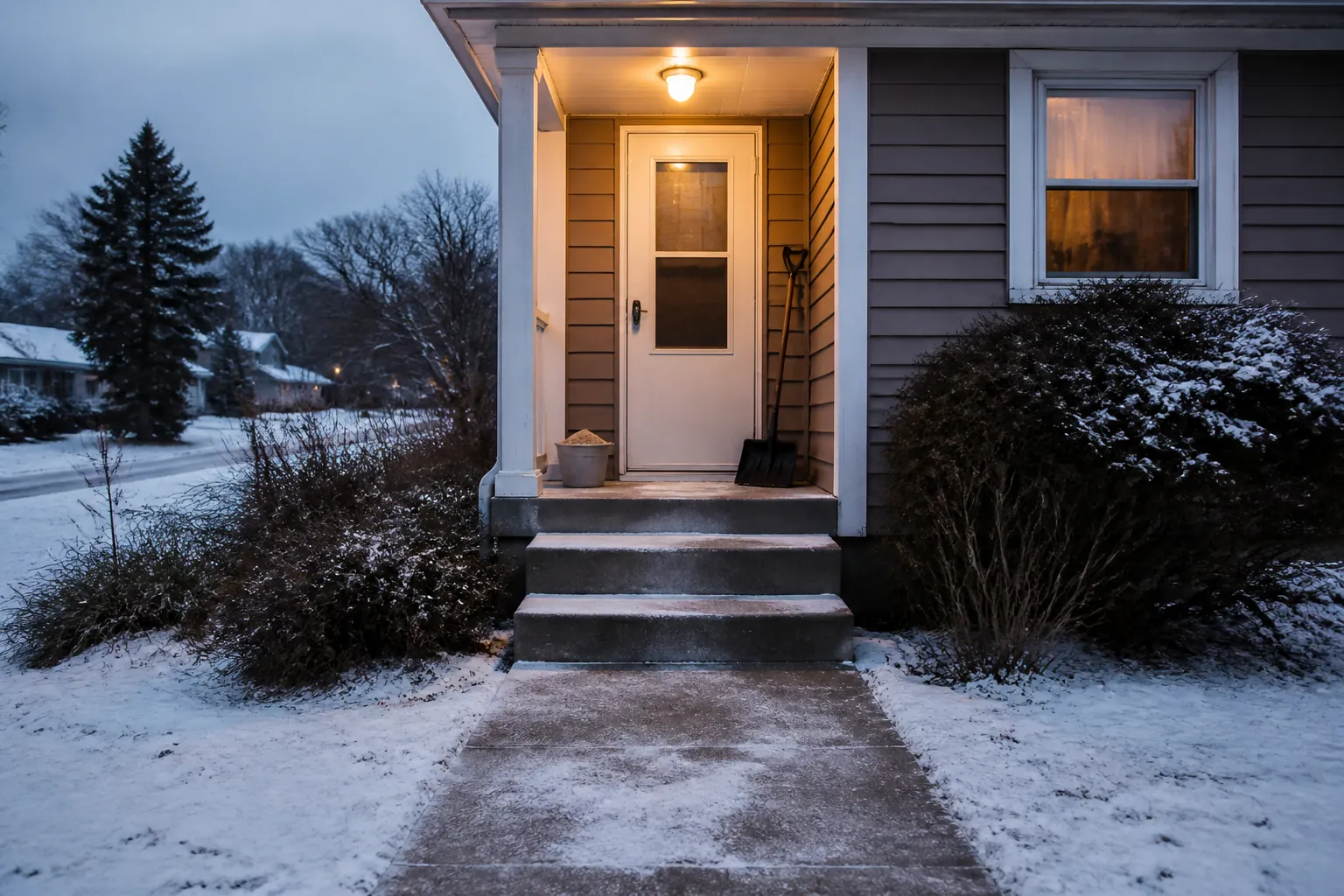
A useful pre-storm check begins at the place the older adult actually walks. Not the whole property. Not the decorative side path nobody uses. The route from the favorite parking spot to the door, from the door to the mailbox, from the garage to the kitchen, from the trash can to the steps.
Oakland County’s older-adult fall guidance is a good Michigan reminder because it names the plain winter hazards families see every year: snow and ice on outdoor surfaces, poor traction, cane tips that need winter help, lighting at stairways and thresholds, and practical traction materials such as cat litter.[3] That is more useful than advice that treats “winter” as one big mood.
| Part of the route | What to check before the storm | Who should own it |
|---|---|---|
| Porch and exterior steps | Ice melt or de-icer ready, traction material available, railing reachable, light working | Family member, neighbor, landlord, or chore service |
| Walkway to car or garage | Cleared width, sand or traction where water refreezes, no shovel left in the walking path | Whoever clears snow, not the older adult by default |
| Driveway edge and car door area | Packed snow removed, icy patches treated, room to stand with cane or walker | Snow-removal helper or household member |
| Boots, cane, walker, or wheelchair | Tread, tips, wheels, grip attachments, and drying spot just inside the door | Caregiver plus clinician or DME supplier when fit or safety is uncertain |
| After-dark entry | Porch light, motion light, threshold visibility, bulb replacement before storms | Family member, maintenance person, or landlord |
Bigger winter-storm decisions—whether to stay home, where supplies are kept, and what happens during a power outage—belong in a broader plan. For that, use a separate storm preparedness checklist and a plan for waiting safely for power restoration. Here, the job is narrower: make the outside walking route less likely to cause a fall.
Treat steps, walkways, and the driveway edge before anyone walks on them
Ice on steps is not a surprise after two freeze-thaw days. It is a maintenance problem waiting for the person with the least margin for error.
CDC winter-storm guidance says to keep steps and walkways free of ice by using rock salt or a chemical de-icer, and to use sand to reduce slipping.[4] That gives families a simple distinction: salt or de-icer is for melting or loosening ice; sand is for traction. Cat litter is also named in Oakland County’s older-adult winter fall guidance as a traction option.[3]
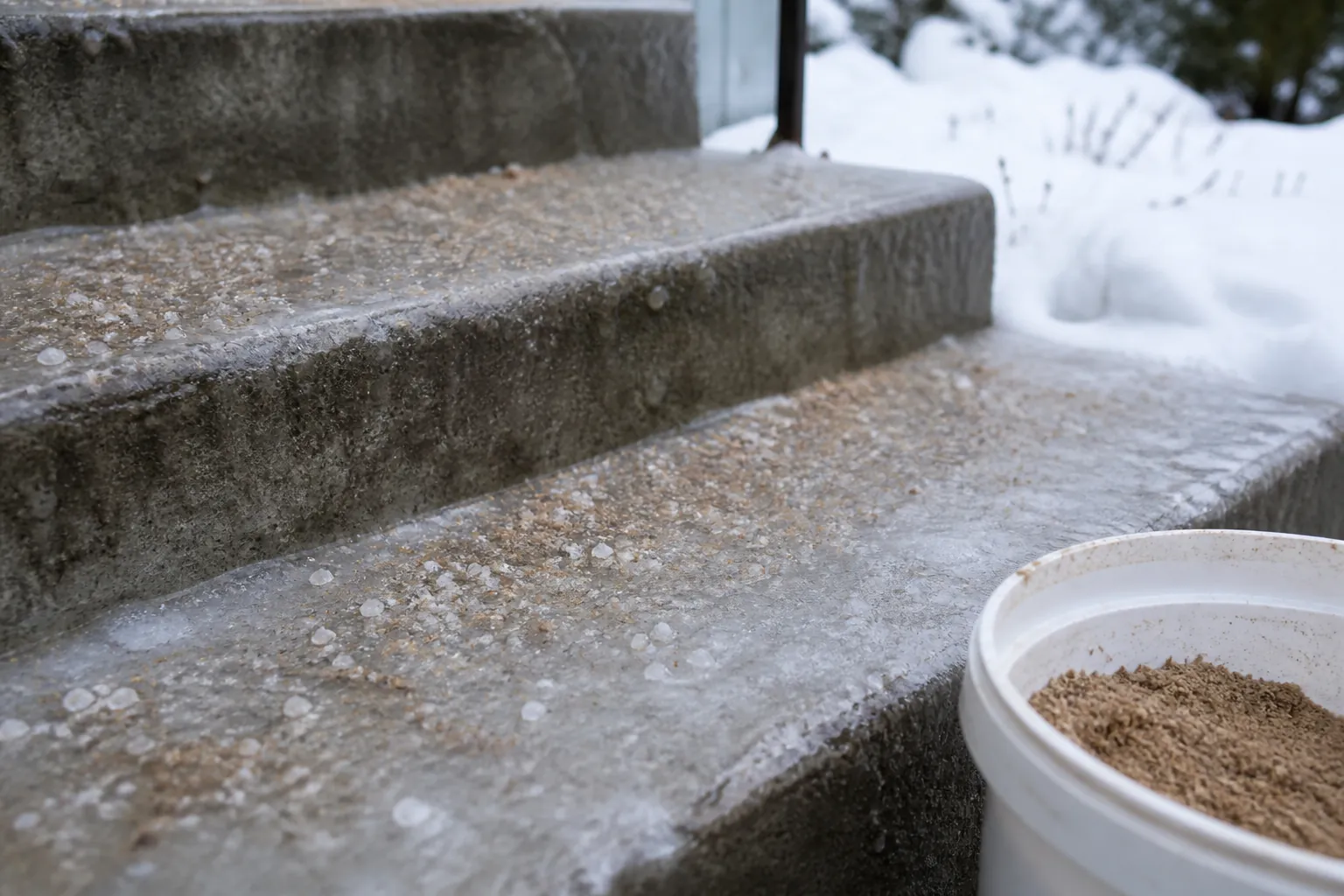
A practical setup near the main door includes one container for ice melt or de-icer and one for traction material. Keep a scoop inside the container so nobody has to carry an open bag across the porch. If the older adult has pets, concrete concerns, or a landlord’s rules, read the product label and choose accordingly. The goal is not to buy the strongest-looking bag in the store; it is to have the right material where the family will actually use it.
The worst patches are often not in the middle of the sidewalk. They are at the bottom step, where meltwater drips and refreezes; beside the car, where packed snow becomes polished; and on the porch threshold, where a boot crosses from wet outdoor grit to a smooth indoor floor. Those spots deserve attention before the long straight stretch of walkway.
- Clear first, then treat. De-icer works better when it is not buried under a ridge of snow.
- Add traction where the person places a foot: the bottom of steps, the turn toward the car, the porch landing, and the mailbox area if it is used.
- Do not leave the shovel, bucket, or bag in the walking lane. A fall-prevention tool becomes a trip hazard when it blocks the route.
- Check again after sun and shade move across the property. A walkway that looked wet at noon can be ice by dinner.
Ready.gov’s older-adult winter guidance also emphasizes sturdy steps with textured grip and a support network to help clear ice and snow.[5] That matters in Michigan because the hard part is rarely knowing that ice is slippery. The hard part is deciding before the storm who is responsible for clearing it.
Check the boots before checking the forecast again
Winter footwear is not a style issue for an older adult walking over ice. It is part of the fall-prevention setup, the same as a railing or a working porch light.
NCOA recommends rubber-soled winter shoes and spike-less ice-and-snow grip covers for shoe soles as winter fall-prevention equipment.[6] Health in Aging, from the American Geriatrics Society, similarly points to non-skid boots for older adults in winter.[7] Oakland County’s guidance also mentions ice cleats over boots.[3]
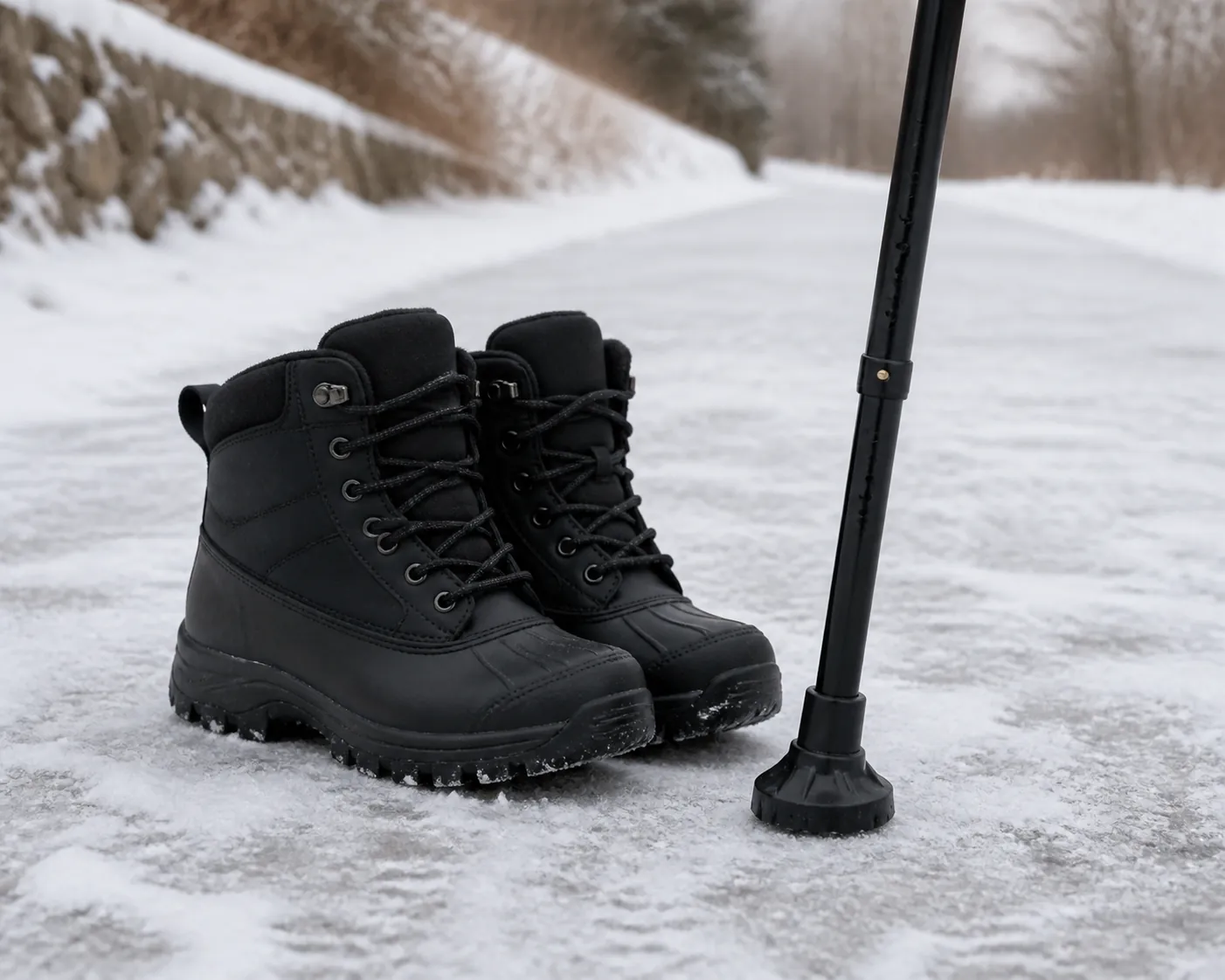
The inspection is simple. Turn the boot over. If the tread is smooth at the heel or ball of the foot, it is not ready for an icy porch. If the boot is hard to pull on, the older adult may avoid wearing it for “just a quick trip” to the mailbox. If the sole is stiff and slick, it may be warm but still poor for outdoor walking.
Removable grip covers or cleats can help on outdoor ice, but they are not magic. They must fit the shoe, stay attached, and come off when they create problems indoors. A traction device that helps on the driveway may be awkward on tile, wood, or polished floors. If the older adult has balance problems, neuropathy, a history of falls, or trouble bending to put devices on, ask a clinician, physical therapist, or durable medical equipment supplier before treating a shoe attachment as a simple add-on.
The “hands free” rule is just as important as the boot. A person cannot use both arms for balance while carrying grocery bags, a purse, a snow brush, and the mail. Use a crossbody bag, backpack, small cart only where surfaces are clear enough, or a two-trip rule. It may feel inefficient. It is still better than watching someone try to recover balance with both hands full.
Some fall-prevention programs teach a “penguin walk” on slick ground: small shuffling steps, feet slightly turned out, arms free, and hands out of pockets. Treat it as a balance cue for unavoidable slick spots, not as permission to walk over untreated ice. If a route can be cleared, treated, or avoided, that comes first.
Winterize canes, walkers, and wheelchairs without pretending a device removes the risk
A cane tip that was fine in September may be bald by January. That little rubber end is the part touching the ice, slush, wet tile, and porch grit. If it is worn smooth, cracked, loose, or hardened, it deserves attention before the first serious freeze.
Health in Aging advises replacing a cane’s rubber tip before it wears smooth and mentions ice-pick-style cane attachments for winter.[7] NCOA also lists ice-gripper cane tips that penetrate ice, and Oakland County includes an ice-gripper tip for canes in its winter fall-prevention guidance.[6][3]
The right question is not only “Should we buy an ice tip?” It is: will this attachment fit the cane, match the person’s gait, fold or remove when indoors if needed, and avoid catching on thresholds? A cane attachment that changes how the cane lands can change how the person walks. If there is any doubt, ask the physical therapist, prescribing clinician, or DME supplier.
Walkers need the same plain inspection. Check rubber tips, glides, wheels, brakes, and the person’s ability to lift or roll the walker over slush ridges. A walker that works well inside may become clumsy outside if the path is narrow, uneven, or only partly shoveled. That means the path has to be cleared for the device, not just for a healthy adult’s stride.
Ready.gov adds one detail families often miss: dry cane and walker wheels and tips before entering the home.[5] Wet rubber, slush, and grit can turn the entry floor into the next fall hazard. Put an absorbent mat, towel, or drying spot just inside the door, but keep it flat and secured so it does not bunch underfoot.
For wheelchair users, NCOA’s winter list includes winter tires and engaged wheel locks.[6] That does not mean every wheelchair needs the same attachment. It means winter travel should be discussed with the wheelchair supplier, clinician, or DME provider before snow and ice make transfers, ramps, and car-door areas harder. A cleared path must include enough width and turning room for the chair, not just a narrow shovel line.
Make snow removal someone’s assigned job
“Dad will shovel if he needs to” is not a snow plan. It is a way of leaving the decision to the person standing on the wrong side of the storm door.
Shoveling is also not just a fall issue. Health in Aging warns that shoveling can strain the heart and advises older adults with heart disease or osteoporosis to ask a healthcare provider before shoveling.[7] That clinician question belongs on the checklist, not after the driveway is already covered.
Delegating snow removal is fall prevention. It keeps the older adult from stepping onto untreated surfaces, lifting heavy snow, twisting on uneven ground, and rushing because a prescription, appointment, or trash pickup feels urgent. The family should decide who clears each part of the route and when: after overnight snow, after plow ridges form, after meltwater refreezes, and before the older adult’s usual departure time.
Michigan help varies by county and agency, so do not assume one statewide snow-removal benefit exists. Valley Area Agency on Aging lists chore services that can include snow shoveling for adults 60 and older.[8] Benzie Senior Resources describes a sliding-fee snow removal program that covers driveway, sidewalk, and main entrance snow removal.[9] Those are examples, not promises for every county.
If family cannot reliably cover the job, call the local Area Agency on Aging, 211, the township or city senior office, a faith community, or a vetted neighborhood service before the first storm. Ask specific questions: Does the service clear steps? Does it treat ice or only move snow? How soon after snowfall do they come? Is there a waitlist? Is the older adult eligible by age, income, disability, or location? Who handles the plow ridge at the end of the driveway?
A neighbor who says “call me if you need anything” may mean it. Still, turn that kindness into a plan. Which neighbor? Which entrance? Which storms? What if the neighbor is out of town? A fall-prevention plan cannot depend on everyone remembering at the same time.
Fix the light before dusk starts arriving early
Michigan winter does not wait until bedtime to get dark. A safe-looking front step at 2 p.m. can be a black patch by 5:30. If the porch light is weak, burned out, blocked by a storm door, or aimed at the siding instead of the steps, the older adult is guessing with their feet.
Ready.gov identifies low lighting as a major cause of falls and tells older adults to keep outdoor lighting adequate near walkways and stairs.[5] Oakland County also points to bright lights over stairways and thresholds.[3]
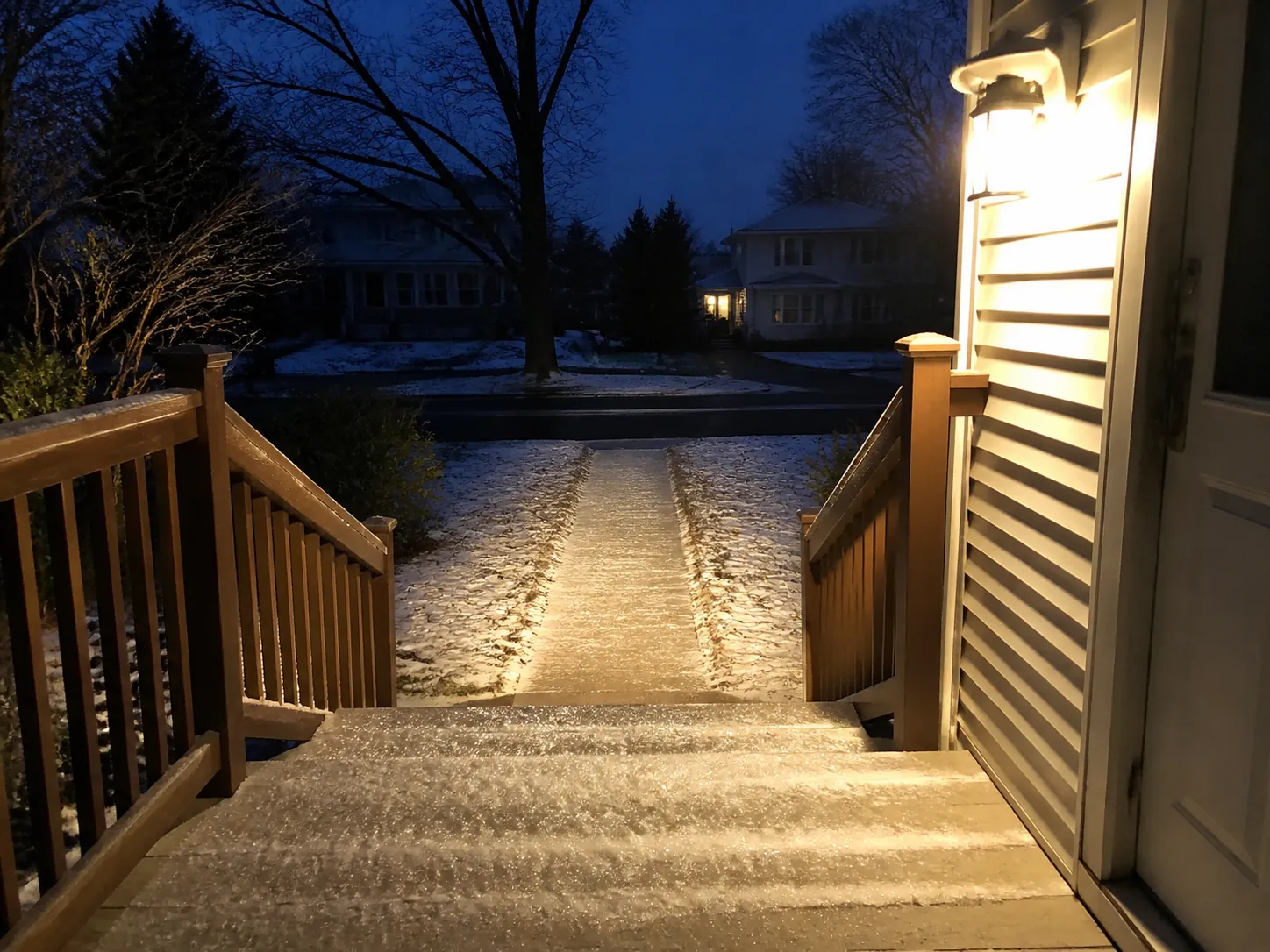
The lighting check should happen after dark, not while everyone is standing outside on a sunny Saturday. Turn on the porch light. Stand where the older adult parks. Walk the route toward the door. Look for the first place where the step edge disappears, the railing is hard to see, or ice blends into the concrete. That is where the fix belongs.
- Replace dim or burned-out bulbs before storms, not after someone notices in the dark.
- Aim light at the walking surface, step edges, handrail, and threshold.
- Consider motion lighting where switches are hard to reach, but test that it activates soon enough.
- Keep snow piles, wreaths, decorations, and stored items from blocking the light or narrowing the path.
- Check apartment or condo common entries early enough for maintenance to respond.
Lighting also affects confidence. When an older adult cannot see the bottom step clearly, they may lean, reach, pause awkwardly, or hurry because cold air is blowing through the open door. Better light does not guarantee safety, but it removes one unnecessary guess.
Do not skip vision and medication questions
Most of this winter checklist is home and routine work. A few issues belong with a clinician. CDC’s STEADI approach is built around screening, assessing, and intervening for fall risk, which is a better model than telling someone to “be careful” after risks are already visible.[2]
Oakland County’s guidance includes a yearly eye exam and single-vision distance glasses for outdoor activity.[3] That matters because multifocal lenses can make depth and step edges harder to judge for some people outdoors. Any change in glasses should be handled through the eye-care professional, but the family can still ask the practical question: what glasses does the older adult actually wear when stepping onto ice?
Medication side effects, dizziness, neuropathy, recent falls, osteoporosis, heart disease, and new weakness are not solved with sand. Those are reasons to involve the primary care clinician, pharmacist, physical therapist, eye-care professional, or relevant specialist. The outside route still needs to be fixed, but medical risk deserves its own review.
A Michigan pre-storm fall-prevention walkthrough
Before the first serious storm, pick one entrance and walk it slowly from both directions: from inside to the car, and from the car back to the door. Do it in the shoes the older adult wears most, with the cane, walker, wheelchair, purse, mail, or grocery bag they normally use. If the route only works when a healthy adult tests it empty-handed at noon, it is not ready.
- Steps and walkway: ice melt or de-icer is on hand, sand or cat litter is ready for traction, and the shovel is not stored in the walking lane.
- Footwear: winter boots have real tread, fit well enough to be worn every time, and any removable grip covers are tested for fit and indoor removal.
- Mobility aid: cane tips, walker tips, wheels, brakes, wheelchair tires, and any ice-grip attachment are inspected; questions go to the clinician, physical therapist, or DME supplier.
- Snow removal: one person or service is assigned to the porch, steps, walkway, car area, and plow ridge, with a backup if the first helper cannot come.
- Lighting: the route is checked after dark, bulbs work, the step edge is visible, and the threshold is bright enough to see wet or icy patches.
- Clinical questions: shoveling, dizziness, recent falls, vision changes, osteoporosis, heart disease, and equipment fit are sent to the appropriate professional rather than guessed at online.
For broader regional winter planning, it can also help to compare how winter hazards differ by place in senior winter safety by region. But for the parent standing at a Michigan door on an icy morning, the most useful preparation is close to the ground: the path is treated, the boots grip, the cane or walker is ready, snow removal is assigned, and the light over the steps actually shows where to put a foot.
References
- Facts About Falls, CDC.
- Patient & Caregiver Resources, CDC STEADI.
- How Older Adults Can Avoid Falls on Snow and Ice, Oakland County Blog, January 22, 2026.
- Safety Guidelines: During & After a Winter Storm, CDC.
- #WinterReady, Ready.gov.
- Winter Fall Prevention Tips for Older Adults, NCOA.
- Tip Sheet: Winter Safety for Older Adults, Health in Aging.
- Valley AAA Service List, Valley Area Agency on Aging.
- Benzie Senior Resources Snow Removal Program, Benzie Senior Resources.
Related reading
Noticed something outdated or inaccurate on this page? Flag a correction. We review every report against CDC, NIA, and AARP HomeFit guidance before updating a page.
Part of the Fall Prevention section.