
STEADI: Intervene
Stay or Go? The Older Adult's Storm Preparedness Checklist
Generic storm checklists hide the one decision that changes everything: stay or go. Five readiness questions route older adults and their caregivers to the matching track — a shelter-in-place supply list, an evacuation go-bag, or both — plus a shared support network and a six-month refresh drill.
The first item on an emergency preparedness checklist for an older adult during storm season is not water. It is the stay-or-go decision. A household riding out a storm needs enough food, water, medications, light, communication, and safe backup power to function at home. A household leaving needs a smaller, portable kit, transportation that can handle mobility equipment, a place to sleep, and a way to keep medications and medical devices going away from home.
That sounds obvious until the weather alert arrives and everyone discovers the walker does not fit in the trunk, the neighbor has no key, the oxygen concentrator depends on power, or the hotel bill is the real evacuation barrier. A CDC-published 2008 article estimated that about 80% of older adults had at least one chronic condition that could increase disaster vulnerability; that figure is dated, but the practical point still matters: for many older households, a storm plan is also a medication plan, a mobility plan, a power plan, and a communication plan. [1]

Preparedness surveys also show the gap between feeling ready and having a plan. AARP reported that among adults 50 and older, about 60% said they felt prepared for a disaster, while fewer than 3 in 10 had an actual emergency plan. The survey details available in the brief are limited, so treat that as a warning sign rather than a precise diagnosis of every household. [2]
Start with the fork: five questions before supplies
Sit down before storm season, not during the warning, and answer these five questions with the older adult who lives there. If the answer is uncertain, write “unknown” and fix that first. An unknown evacuation zone, unknown ride, or unknown power backup is not a small blank on a checklist. It is the part that fails when the rain has already started.
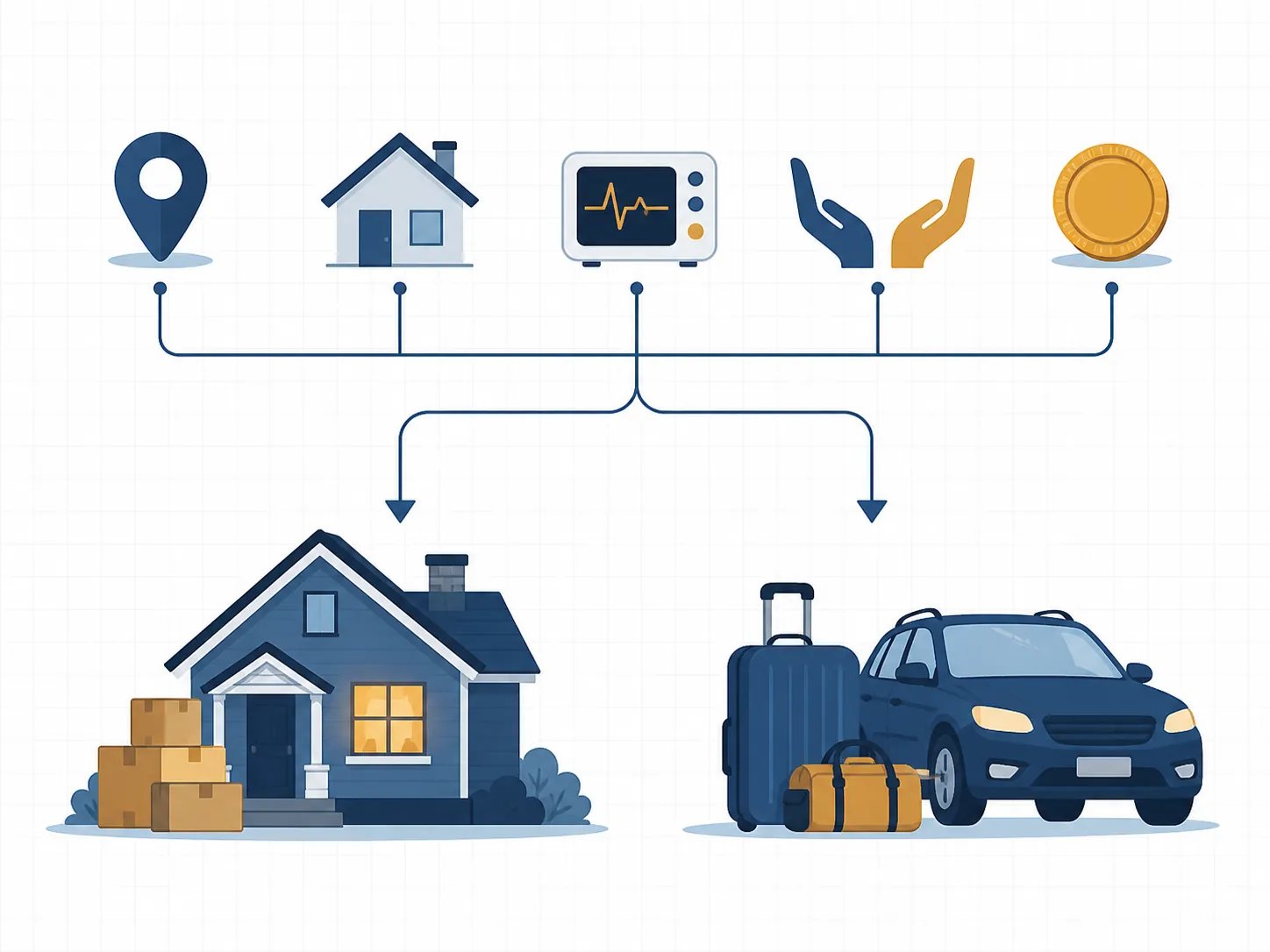
| Readiness signal | What to decide before a storm | What it changes on the checklist |
|---|---|---|
| Evacuation zone | Is the home in an official evacuation zone for the storm hazards common in the area? | If yes, the evacuation track cannot be optional. |
| Home safety | Is the home structurally suitable for the likely storm, or is it a manufactured home or otherwise unsafe for the forecast hazard? | If the home itself is not safe, stocking the pantry does not solve the main problem. |
| Electricity-dependent devices | Does the older adult use oxygen equipment, a powered mobility device, a CPAP, refrigerated medication, an electric bed, or another device that becomes a medical issue during an outage? | The plan needs backup power, manual backup equipment, charging steps, or earlier evacuation. |
| Evacuation help | Who can physically help the person leave, carry equipment, drive, or meet paratransit rules? | A go-bag is not enough if no one can get the person and the equipment out the door. |
| Cost of a week away | Can the household pay for lodging, food, transportation, pet boarding, replacement supplies, and medication gaps for several days away? | If not, the plan needs public resources, family cost-sharing, or a prearranged destination. |
The money question belongs in the same conversation as the flashlight. In a 2020 University of Michigan survey reported by PBS NewsHour, 24% of older adults said it would be difficult to afford staying somewhere else for a week. The same report found that among older adults using electricity-dependent medical equipment, only 25% had an alternative power source. [3]
Those two numbers explain why “just evacuate” can be as lazy as “just stay home.” If a parent cannot pay for a week away, cannot bring a powered scooter, and cannot sleep safely without an electrical device, the family needs a real route: who pays, who drives, what equipment goes, what gets replaced with a manual backup, and where the person can actually stay.
How to route the answers
Use the five answers to sort the household into one of three positions. Do not argue with the category just because it is inconvenient.
- Evacuation-first: the home is in an evacuation zone, the structure is unsafe for the expected hazard, electricity-dependent equipment has no safe backup, or the older adult cannot be safely supported at home.
- Shelter-in-place-first: the home is outside the relevant evacuation zone, structurally suitable for the likely hazard, and the household has a realistic way to manage power, medication, mobility, heat or cooling, food, water, and communication.
- Both tracks required: the household usually expects to stay home but has one fragile condition — power dependence, a flood-prone road, limited caregiver availability, a pet, or a cost barrier — that could force a late change.
Most older households should build both tracks at some level. The difference is where the heavier work goes. If the likely plan is staying home, build the household supply and power plan first, then keep a lean go-bag ready. If the likely plan is leaving, stop pretending the pantry is the plan and solve transportation, documents, medication continuity, pets, and lodging.
Shelter-in-place track: build for a home that may be cut off
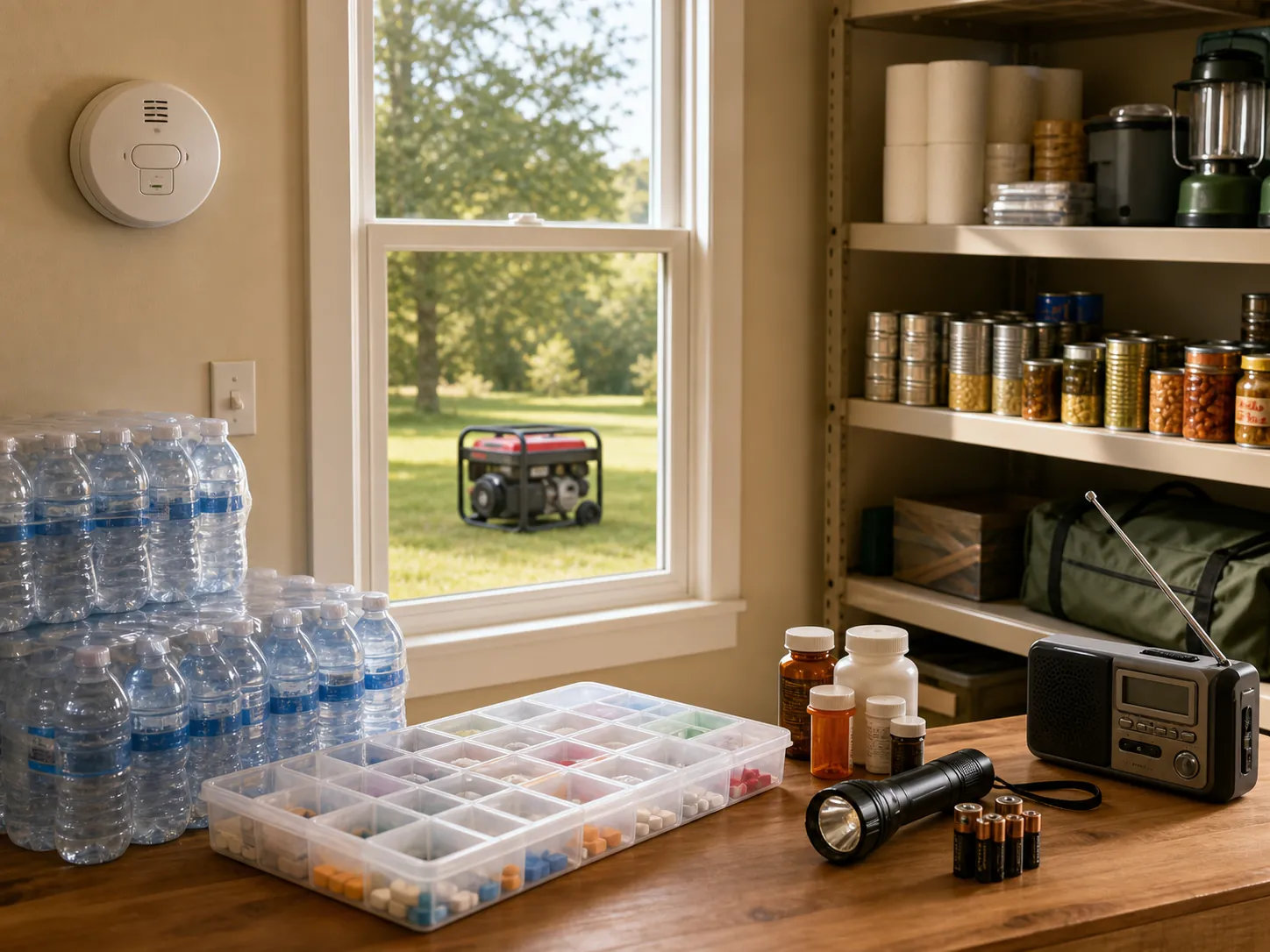
Sheltering in place is not “doing nothing.” It means the older adult can remain in a safe home while utilities, roads, stores, pharmacies, and caregivers may be disrupted. The American Red Cross advises older adults to plan for at least two weeks of supplies at home and to keep at least a 30-day supply of medications when possible. [4]
Water and food: two weeks at home
For the home track, use the Red Cross two-week target for water and food, not the smaller evacuation amount. Build it around what the older adult can actually open, chew, digest, lift, and prepare without full power. A case of food that requires a can opener the person cannot grip is not a supply. Neither is a shelf full of high-salt foods for someone whose clinician has told them to limit sodium, unless the family has discussed what is acceptable in an emergency. [4]
- Store water where the older adult can reach it without climbing, bending deeply, or carrying heavy containers across a dark room.
- Choose shelf-stable foods that match normal dietary needs as closely as possible.
- Include a manual can opener, disposable plates or bowls, and easy-clean utensils.
- Keep some food that can be eaten without cooking if the stove, microwave, or electric kettle cannot be used.
Medications: 30 days, plus the boring paperwork
Medication planning is where a storm checklist stops being a supply list and starts being a health plan. Keep a current medication list with drug names, dosages, prescribing clinicians, pharmacy phone numbers, allergies, and insurance information. If the older adult uses a pill organizer, keep the organizer and the prescription bottles aligned so someone else can verify what is being taken.
The Red Cross recommends keeping at least 30 days of medications, where possible. [4] In real life, insurance refill rules may make that harder, so this is a pre-storm errand: ask the prescriber or pharmacist how early refills, mail-order delays, refrigerated medications, oxygen supplies, and medical-device consumables should be handled before the local forecast becomes urgent.
Light, alerts, and communication
Dark rooms are not a minor inconvenience for someone using a cane, walker, oxygen tubing, or a bedside commode. Put flashlights or battery lanterns where transfers happen: bed, bathroom, hallway, kitchen, and the path to the exit. Avoid relying only on a phone flashlight; phones also need to stay charged for calls, alerts, and medical coordination.
Ready.gov’s older-adult guide recommends a NOAA Weather Radio and notes that the FEMA app can provide weather alerts for up to five locations. [5] That matters for adult children who monitor a parent’s county from work or from another city. Set the alerts ahead of time, then test whether the older adult can hear them, read them, and knows who to call when one arrives.
Assistive items: duplicate the things that make walking, seeing, hearing, and transferring possible
Storm preparation usually remembers batteries for flashlights and forgets batteries for hearing aids. Keep spares for hearing aids, glasses, denture supplies, incontinence supplies, cane tips, walker glides, wound-care items, and any other small item that quietly keeps the day safe. If the person uses a bedside commode, shower chair, transfer belt, or raised toilet seat, decide what still works if the power is out and the bathroom is dark.
This is also a fall-prevention issue. A storm changes the home: extension cords appear, rugs get moved, wet shoes come inside, buckets catch leaks, and furniture gets shifted away from windows. Before storm season, walk the usual routes with the older adult’s actual device. A path that works for a healthy visitor may not work for a parent using a walker at 2 a.m.
Power and carbon monoxide: do not improvise this during an outage
If electricity is tied to breathing, mobility, medication storage, communication, or a hospital bed, the power plan needs to be written down. List each device, how long its battery lasts, how it charges, whether it can run from a backup source, and who knows how to operate it. If the device is essential and there is no safe backup power, the stay-home plan may not be realistic.
Generator plans need carbon monoxide guardrails, not just fuel. Red Cross survival-kit guidance states that generators should be kept outside, at least 20 feet from doors, windows, and vents. [6] Put carbon monoxide detectors on the shopping list if they are missing or expired. A generator close to the house because “it is only for a little while” is not a workaround; it is a new emergency.
For a deeper device-by-device planning worksheet, use the power outage checklist for seniors on medical equipment. Use this page for the stay-or-go branch; use that one if equipment is involved.
Evacuation track: make the plan portable
Evacuation supplies should be lighter, faster, and more realistic than the home stockpile. The Red Cross distinguishes between at least two weeks of supplies at home and a three-day supply for evacuation. [4] That difference is the reason the stay-or-go decision belongs at the top. You do not pack a two-week pantry into a sedan with a rollator, oxygen equipment, a pet carrier, and two adults.
The go-bag: three days, not the whole house
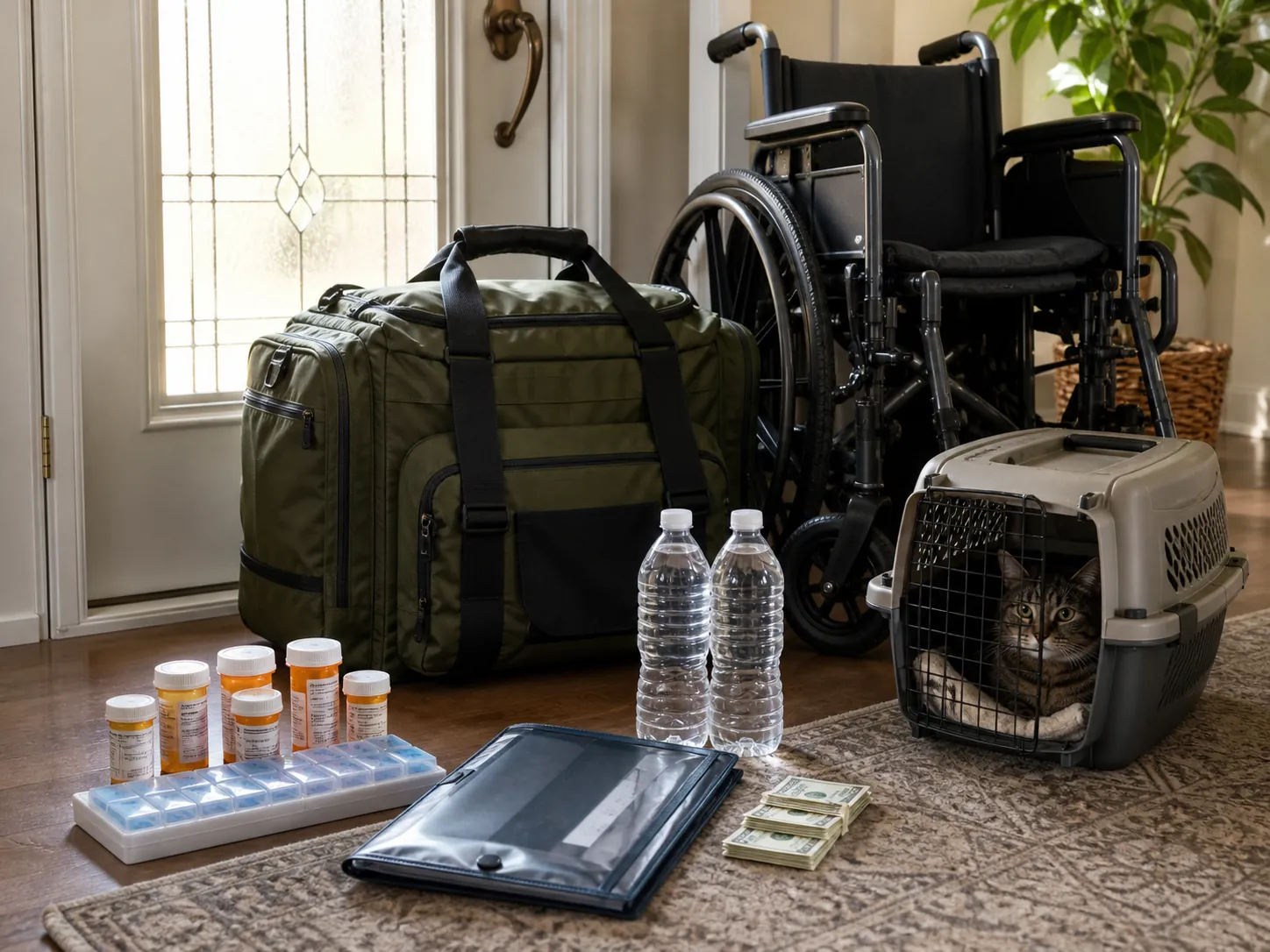
Pack a three-day evacuation supply that one helper can move without injuring themselves or leaving the older adult unsupported. Use a rolling bag, backpack, or divided bags depending on the person’s mobility and the vehicle. Label the outside with the older adult’s name and a phone number, but do not put sensitive medical information where strangers can read it. [4]
- Water and ready-to-eat food for the evacuation window
- A seven-day medication supply when possible, plus a current medication list
- Glasses, hearing-aid batteries, denture supplies, incontinence supplies, and basic hygiene items
- Phone chargers, power banks, charging cords for medical or mobility devices, and written instructions for unusual equipment
- A change of clothes, sturdy shoes, a light blanket, and any comfort item that helps the older adult sleep or remain calm
Documents: waterproof, current, and findable
Use a waterproof folder or pouch for copies of identification, insurance cards, Medicare or Medicaid cards, medication lists, advance directives if available, key medical contacts, emergency contacts, pet vaccination records, and a recent photo of the older adult. Add a printed map or written address for the planned destination. Phones fail, batteries die, and the person who ends up driving may not be the person who usually handles the details.
Keep some cash in small bills if the household can manage it. During a disruption, cards and apps may not be the easiest way to pay for a meal, parking, a small supply, or a tip for someone helping with luggage.
Mobility: plan for the device that actually leaves the house
Powered mobility is where evacuation plans often become fantasy. If the older adult uses a powered wheelchair or scooter, measure the device, the vehicle, the ramp, the doorway, and the destination entrance before a storm. Decide whether a manual wheelchair, transport chair, walker, or rollator is the backup for evacuation, and practice the transfer with the person who would help.
Do not assume a neighbor can lift what a trained aide usually handles. If the older adult cannot safely transfer into the available car, the evacuation plan needs accessible transportation, not more confidence.
Pets: include them or the plan may stall
Many older adults will not leave without a pet. Build the pet plan into the first version instead of treating it as a sentimental complication later. Pack food, water, medication, leash, carrier, vaccination records, waste bags or litter supplies, and a list of pet-friendly destinations. If the planned shelter, hotel, or relative’s home cannot take the pet, that is not the planned destination.
Transportation and lodging: name the ride and the destination
Write down the primary ride, backup ride, pickup location, destination, and what equipment must fit. If the older adult uses paratransit, a county transportation service, a senior center van, or a medical transport option, learn the registration and scheduling rules before storm season. Some services are not available on demand once conditions deteriorate.
If the family plan depends on a hotel, check the cost, pet rules, accessibility, elevator dependence, parking, cancellation policy, and distance from pharmacies or medical care. If the plan depends on relatives, ask about stairs, bathroom access, sleeping arrangements, backup power, pets, and how long the older adult can stay. A week away is not always a week of normal guest behavior; it may include medication refills, laundry, special food, disrupted sleep, and follow-up calls.
The shared layer that makes either track believable
After the household has a stay track, an evacuation track, or both, add the support layer. This is not a phone tree for appearances. It is the group of people and agencies that can still function when the adult child is in a meeting, the spouse is also older, or the neighbor is willing but locked out.
At least three local helpers, with permission and access
Choose at least three local helpers. They can be neighbors, relatives, friends, faith-community members, building staff, or paid aides. Each person should know what they are being asked to do: check in by phone, knock on the door, help move a walker, pick up medication, drive, bring a charged power bank, or call emergency services.
Good intentions do not open a locked door. Decide who has a key, where a lockbox is, or how emergency access works. Get the older adult’s permission and keep their dignity intact: they are not being “managed”; they are choosing who is allowed to help and under what circumstances.
Utility and local emergency registries
If the older adult uses electricity-dependent medical equipment, ask the utility about a medical-baseline, medical-needs, or critical-care registry. Names vary by location, and enrollment does not guarantee uninterrupted power or immediate restoration. The value is that the utility has the medical need on record and the family has learned the rules before the outage.
Also check the county or local emergency management office for a special-needs, access-and-functional-needs, or evacuation-assistance registry. These programs differ by county. Some help with transportation planning, wellness checks, shelter placement, or communications. Registration is not a substitute for a family plan, but it is a practical reinforcement.
Ready.gov’s older-adult guidance frames preparedness as assessing needs, creating a plan, and engaging a support network. [5] That sequence is useful because it keeps the family from collecting supplies before knowing what kind of help the older adult will actually need.
211 and local resource calls
Add 211 to the printed contact sheet if it is available in the area. It can be a starting point for local human-service referrals, including shelter, transportation, food, utility assistance, and other community resources. Do not wait until a mandatory evacuation is announced to learn whether the local 211 service can point to accessible transportation or senior services.
Use storm-specific checklists only after the branch is clear
This stay-or-go checklist works across storm types because the branch changes the supplies before the forecast details do. Once the branch is clear, use storm-specific guidance for the hazard in front of you.
- For hurricane planning, use what seniors need on a hurricane preparedness checklist.
- For fast-rising water, use the senior flash flood emergency kit checklist.
- For short-warning shelter decisions, use the tornado warning checklist for seniors.
- For a broader family planning pass, use a storm preparedness checklist built for elderly parents.
The six-month refresh drill
The Red Cross recommends reviewing the emergency plan every six months. [4] Put the refresh on the calendar, ideally before the local high-risk season and again halfway through the year. The drill does not need to be dramatic. It needs to catch the quiet changes that make last season’s plan untrue.
- Re-answer the five stay-or-go questions: evacuation zone, home safety, electricity-dependent devices, evacuation help, and the cost of a week away.
- Check food, water, batteries, power banks, flashlights, weather radio, carbon monoxide detectors, and generator supplies.
- Update the medication list, pharmacy information, clinician contacts, allergies, and refill plan.
- Confirm that the go-bag still fits the older adult’s current mobility, continence, vision, hearing, diet, and medication needs.
- Call or text the three local helpers and confirm phone numbers, keys, roles, and backup contacts.
- Review utility medical-baseline registration, county special-needs registry status, transportation options, and the planned evacuation destination.
- Practice one physical step: loading the walker, transferring into the car, starting the weather radio, finding the document pouch, or moving safely from bed to bathroom with backup lighting.
If the drill reveals that the home track no longer works, move weight to evacuation. If the evacuation track depends on a person who moved away, replace that person before the next storm watch. The useful checklist is the one that still matches the older adult’s body, home, helpers, devices, and budget when the forecast turns ugly.
References
- Disaster Preparedness and the Chronic Disease Needs of Vulnerable Older Adults — CDC STACKS — 2008
- Emergency Preparedness — AARP
- Why it can be more difficult to evacuate older adults in a disaster — PBS NewsHour
- Older Adults — American Red Cross
- Disaster Preparedness Guide for Older Adults — Ready.gov — September 2023
- Survival Kit Supplies — American Red Cross
Related reading
Noticed something outdated or inaccurate on this page? Flag a correction. We review every report against CDC, NIA, and AARP HomeFit guidance before updating a page.
Part of the Fall Prevention section.