
STEADI: Intervene
Winter Walking Safety for Older Adults in Canada
Learn how to walk safely on ice and snow during Canadian winters, from choosing the right traction gear and walking technique to knowing when to stay inside and how to respond if a slip happens.
Boots on, keys in hand, sidewalk half-shiny under yesterday’s snow: this is where winter safety tips for older adults in Canada either become useful or become noise. The first question is not whether an older adult should walk in winter. Many should, and many want to. The better question is whether this particular outing has enough traction, timing, route choice, and backup to make the walk reasonably safe.
Start with the uncomfortable gear fact. Lifeline Canada reports that a Toronto Rehabilitation Institute WinterLab test found only 8% of nearly 100 tested pairs of winter boots met the lab’s minimum slip-resistance standard.[1] That does not mean every untested boot is dangerous, and it does not name a magic brand. It does mean “they’re winter boots” is not a safety plan.
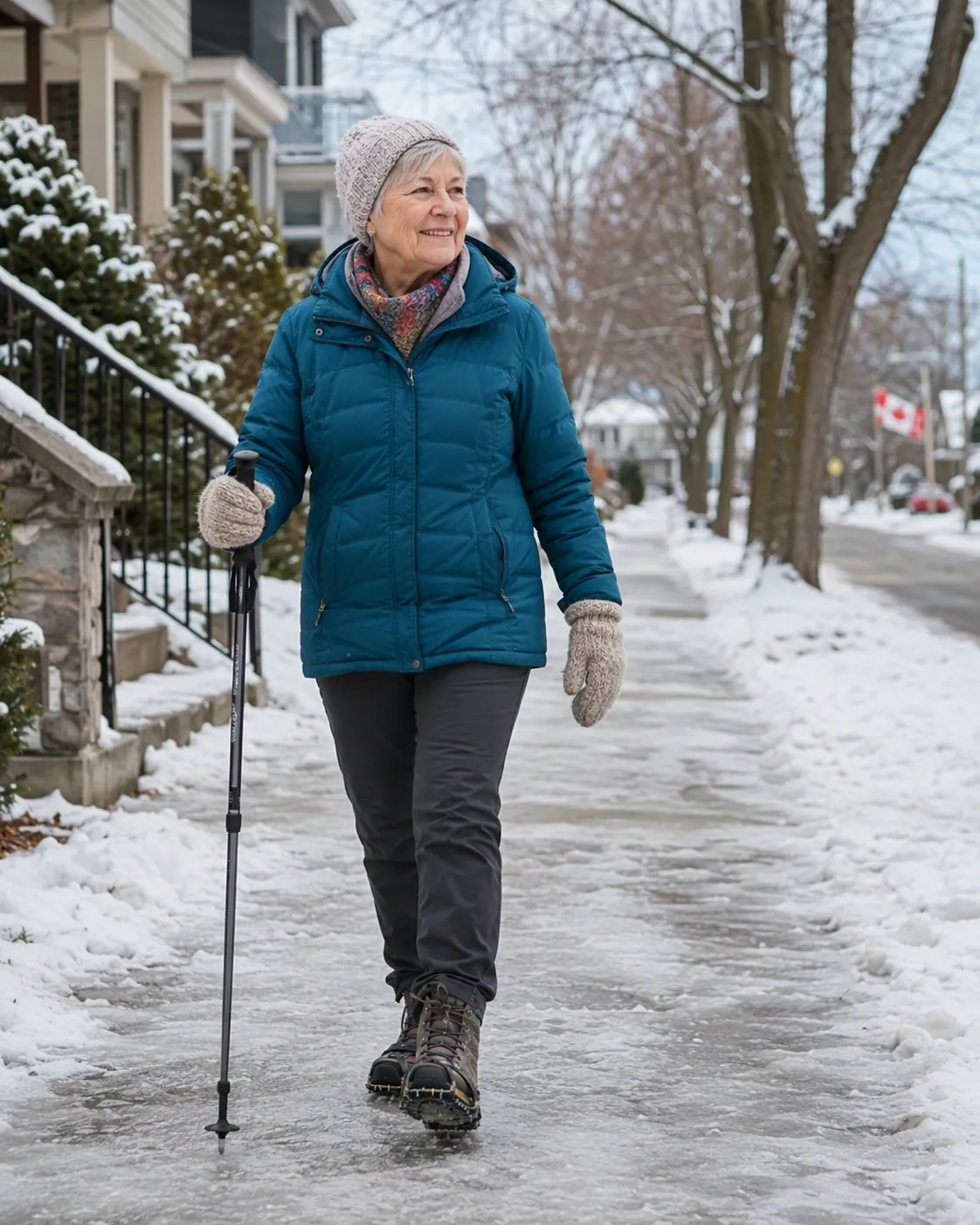
The answer is not to make winter into house arrest. Winnipeg Regional Health Authority’s fall-prevention guidance warns that staying indoors all winter can lead to deconditioning, which then raises fall risk.[2] That matters because falls are the leading cause of injury-related hospitalizations among older adults in Canada, and Parachute Canada identifies walking as a common circumstance for senior falls.[3][4] Safer winter walking is not a luxury outing. Done well, it is part of maintaining strength, balance, confidence, and normal life.
Make the walk mechanically safer before the first step
Traction is the part of winter walking that people overestimate most. A thick-looking sole, a warm lining, or a boot labelled for winter does not tell you how it behaves on wet ice, packed snow, slush over ice, or a polished curb cut. If a parent says, “I have boots,” the next question is not whether they are warm. It is whether the sole still grips, whether the tread is worn smooth, and whether extra traction is needed for the surfaces they actually meet.
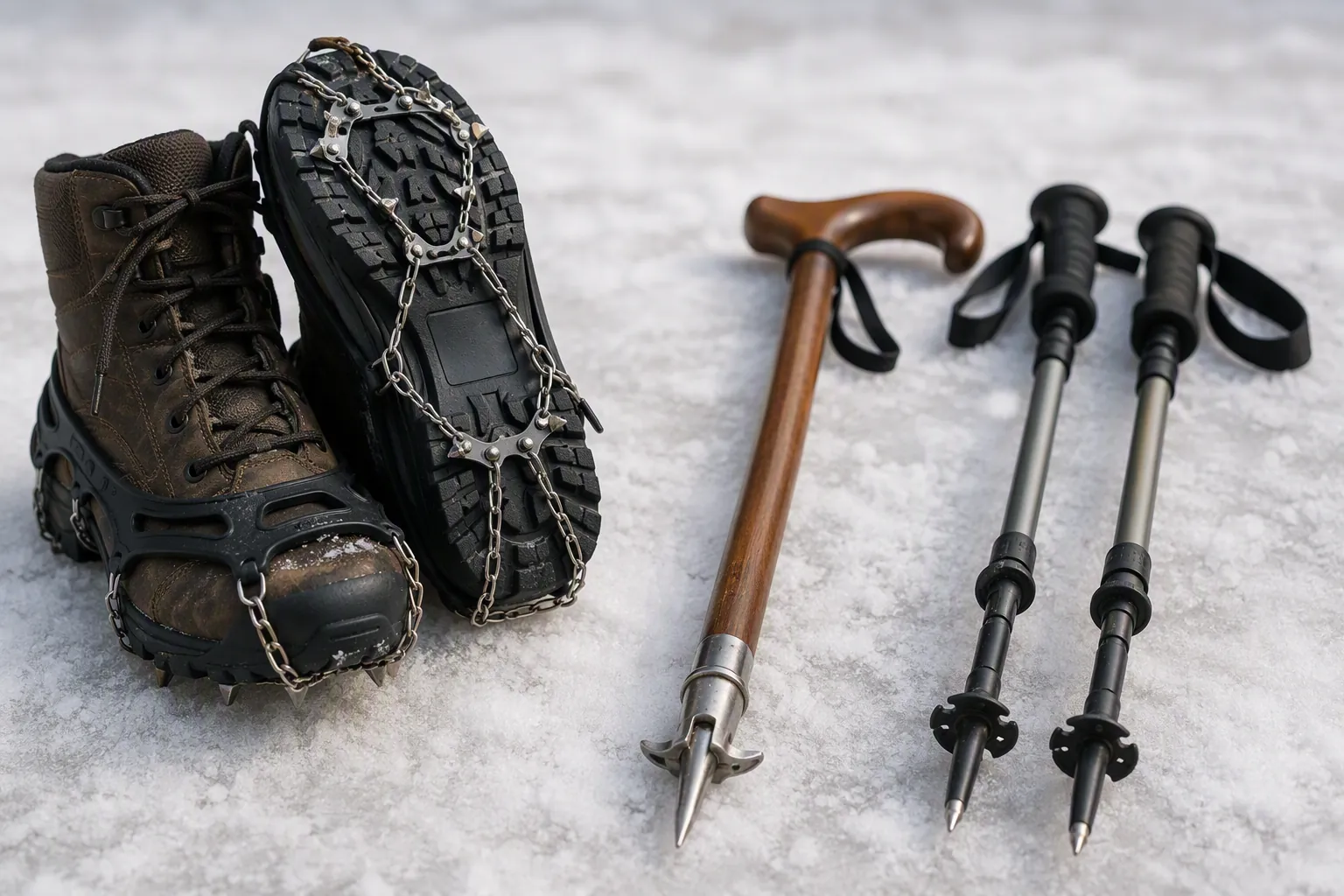
Think of winter gear as a matched set, not a single purchase. Boots carry the body. Ice grippers add bite. A cane ice-pick tip or trekking poles add points of contact. A phone, pocketed where it can be reached, adds a way out if the walk goes wrong. VHA Home HealthCare and the American Geriatrics Society’s Health in Aging guidance both emphasize practical, product-neutral winter choices such as appropriate footwear, assistive devices, and a way to call for help.[5][6]
| Gear | Best use | What to check before relying on it |
|---|---|---|
| Winter boots | Every outdoor winter outing, even short errands | Tread is not worn smooth; heel is stable; boot fits with winter socks; sole grips rather than sliding on packed snow or ice |
| Removable ice grippers | Icy sidewalks, parking lots, laneways, bus stops, and mailbox walks | They fit tightly on the boot; metal points or coils contact the ground; they are removed or used with care indoors on tile, stone, or smooth floors |
| Cane ice-pick tip | For someone who already uses a cane and needs extra bite on snow or ice | The attachment is secure; the cane height remains right; the user practises before depending on it outside |
| Trekking poles | Longer walks, uneven packed snow, parks, and routes where two extra points of contact help balance | Tips are appropriate for winter surfaces; poles are adjusted to the user; straps do not trap the hands during a fall |
For many older adults, removable ice grippers are the missing piece. They are especially useful on the short trips people underestimate: taking out garbage, crossing a parking lot, walking from the car to a clinic door, or stepping onto a bus stop pad that has been walked into a glaze. The caution is that grippers are for outdoor traction. On smooth indoor floors, they can create a different slipping hazard, so the routine should include a place to sit or steady oneself while removing them.
A cane ice-pick tip is not a decoration. It needs to be firmly attached, pointed down outdoors, and flipped or removed when it is no longer on ice or packed snow. If a cane already feels awkward, adding a tip will not fix the underlying problem. In that case, the better next step is a mobility or physiotherapy review, not simply buying another winter accessory.
Trekking poles can help people who are steady enough to coordinate them and who want extra contact with the ground. They are not a substitute for a walker when a walker is what the person needs. They also require free hands, so they do not pair well with carrying two grocery bags or pulling a stubborn wheeled cart through slush.
Use weather history, not just today’s forecast
The most misleading winter question is “Is it snowing right now?” Plenty of bad falls happen after the storm, when the sky looks harmless and the sidewalk has become a sequence of packed snow, meltwater, frozen footprints, and glare ice. This is where a little Canadian evidence changes the decision.
An 11-year Calgary study of 14,977 emergency department visits for falls on ice or snow from 2008 to 2018 found that January, February, and March accounted for over half of the year’s ice- and snow-related fall visits. The same study found that ice present up to 3 days earlier still independently predicted more fall presentations.[7] In Ontario winters from 2011 to 2015, snowfall of 0.2 cm or more was associated with a 5–8% increase in the odds of a fall-related emergency department visit that persisted up to a week; for adults 65 and older, elevated odds were seen 1–4 days after snow.[8]
The practical rule is simple: risk lingers. A cleared-looking sidewalk the morning after a thaw-refreeze cycle may be worse than a snowy sidewalk during the storm. January through March deserve extra suspicion, especially after mild afternoons, freezing nights, light snow over old ice, and streets where curb cuts, bus stops, and parking-lot edges are cleared last.
| Before going out | Safer decision |
|---|---|
| Snow fell today or yesterday | Assume risk may still be elevated, especially for adults 65+ in the 1–4 days after snow.[8] |
| Ice was present in the past few days | Treat the route as higher risk; Calgary data found ice up to 3 days earlier still mattered.[7] |
| Temperature moved above and below freezing | Watch for refrozen meltwater at driveways, curb cuts, shaded sidewalks, and building entrances. |
| The errand is flexible | Move it to daylight, after municipal clearing, or after someone has confirmed the walkway. |
| The route is uncleared and there is no traction aid | Postpone, choose a different route, ask for delivery, or have someone else handle that errand. |
This is not fearfulness. It is scheduling. A prescription pickup may need a neighbour, pharmacy delivery, taxi, or family member. A café walk may be better at noon than 8 a.m. A mailbox trip can wait until the super has salted the entrance. The more ordinary the errand, the easier it is to underestimate; the more ordinary the errand, the more it benefits from a rule made before anyone is standing on ice with keys in one hand.
Cold exposure is part of the same decision, but it does not need a lecture every time. Health Canada identifies a wind chill of -27°C or colder as a danger point for exposed skin.[9] When the wind chill is near that range, shorten the walk, move it to a warmer part of the day, arrange a ride, or choose an indoor walking option. The goal is not to prove toughness. It is to preserve the habit of moving without adding avoidable injury risk.
Choose the route like someone has to walk it, not just clear it
A winter route is not the shortest line between two doors. It is the path with the fewest transitions: fewer curb cuts, fewer sloped driveways, fewer polished building entrances, fewer parking-lot crossings, and fewer stretches where a person has to step from snowbank to roadway because the sidewalk disappears.
For an older adult who walks independently, the best route may look inefficient on a map. It may use the sunny side of the street, the building entrance with mats and railings, the bus stop with a shelter, or the block where homeowners reliably clear snow. For an adult child helping from a distance, this is a better conversation than “Please don’t go out.” Ask which entrance they use, where the ice forms, whether the mailbox area drains poorly, and which neighbour’s stretch is usually safe.
Home conditions matter at the beginning and end of the walk. If steps, railings, lighting, and salt storage are the weak points, pair this outdoor walking plan with Winter-Proof Your Parent's Home Room by Room. For wider seasonal planning, including supplies and weather preparation, use the El Niño Winter Safety Checklist for Older Adults as a companion rather than trying to solve home and sidewalk risk in one rushed morning.
Walk like a penguin, but understand why it works
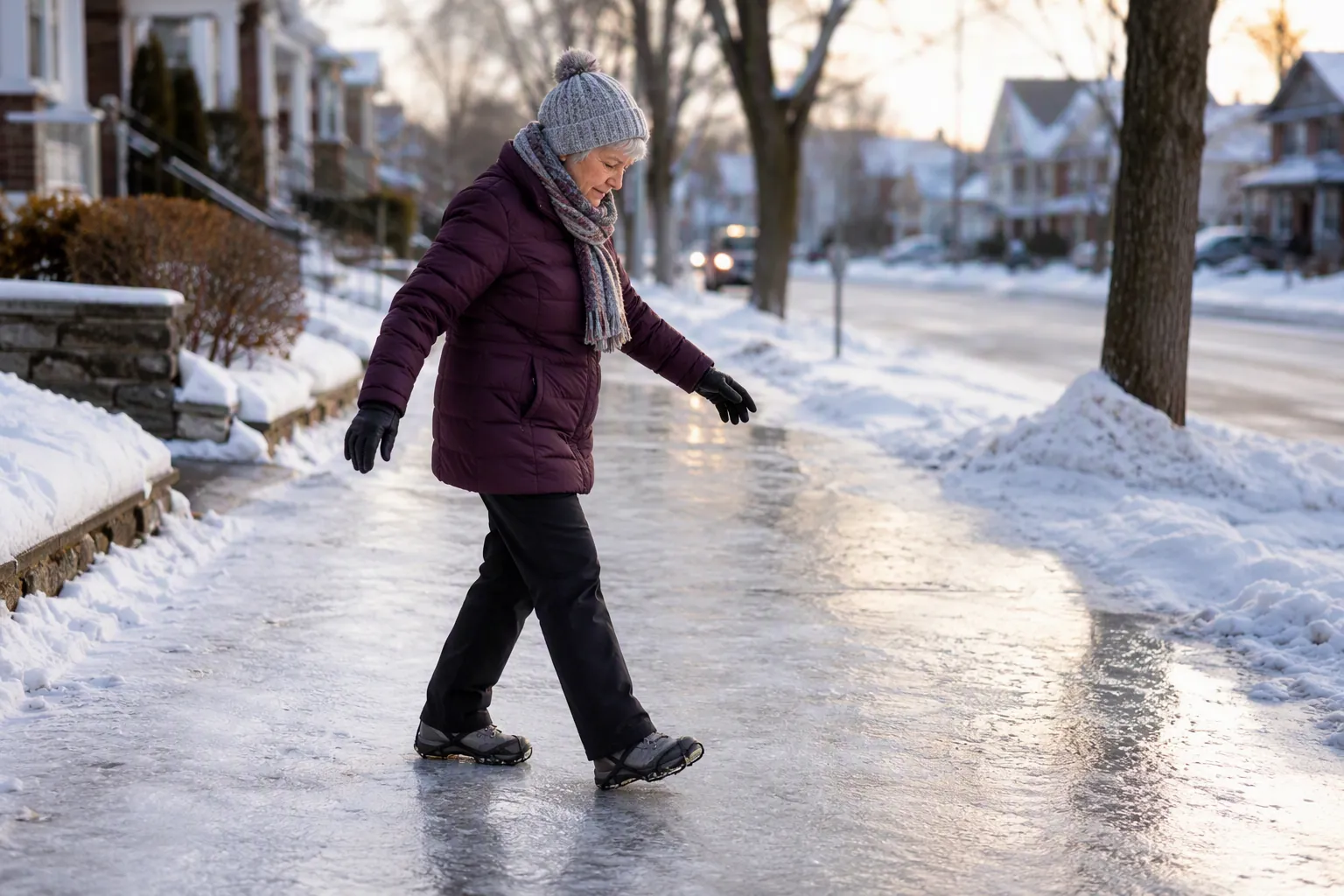
The “walk like a penguin” advice sounds almost silly until you watch someone avoid a fall with it. WRHA’s winter walking guidance describes small steps, feet pointed slightly outward, soft knees, and hands free for balance.[2] The point is to shorten the time spent balancing on one foot and to keep the body’s centre of gravity steadier over the feet.
- Take small, flat-footed steps instead of long strides.
- Point toes slightly outward, not dramatically, just enough to widen the base.
- Keep knees soft so the body can adjust to small slips.
- Keep hands out of pockets and available for balance.
- Pause before stepping off curbs, out of cars, or from cleared pavement onto packed snow.
Hands matter more than people admit. A purse in one hand and groceries in the other remove the body’s natural balancing tools. Use a small backpack, cross-body bag, delivery service, or two trips. If carrying something changes the way a person walks, it changes the safety of the outing.
Do not rush for a bus, a ringing phone, or a closing shop door. Winter walking has a different speed limit. If a crossing signal is too short to cross without hurrying, choose a different crossing or wait for help. If the bus is pulling away, let it pull away. The cost of missing it is smaller than the cost of landing on a hip, wrist, shoulder, or head.
Keep winter walking in the weekly routine
Some days, staying in is the right call. A freezing-rain morning, an uncleared hill, a wind chill near Health Canada’s danger threshold, or an errand that can wait are all good reasons to replan. The problem is when replanning quietly becomes three inactive months.
On unsafe outdoor days, replace the walk rather than deleting it. Walk in an indoor mall, apartment corridor, community centre, recreation facility, or large store at a quiet hour. Use balance and strength exercises at home if travel is not safe. If weekly movement has already slipped, the site’s CDC-Based Weekly Fitness Plan for Aging Adults can help rebuild a basic structure, and Do long walks help seniors' hearts more than short walks? is useful for families deciding whether several short walks are more realistic than one longer outing.
This is also where adult children can help without taking over. Offer to check one route after snow, install a brighter entrance light, arrange delivery for heavy items, or walk together on the first icy day of the season to test the gear. “Let’s make the walk safer” lands better than “You shouldn’t go out.”
Carry what changes the outcome
Winter pockets fill up quickly, but a few items are worth the space. Carry a charged phone where it can be reached without standing up. Keep identification and emergency contacts accessible. Wear mitts or gloves that still allow use of a phone or emergency button. Use reflective details or a light if walking near dawn, dusk, or traffic. If glasses fog badly under a scarf or mask, adjust before stepping onto ice rather than while walking.
Clothing should support balance. Long scarves, loose hems, and bulky bags can catch or shift weight. Warmth matters, but so does being able to see the ground, move the arms, and turn the head before crossing a street or driveway.
Rehearse the fall response before anyone needs it
A fall plan is not pessimism. It is the same idea as carrying keys: you hope not to need the extra step, but you do not want to invent it while scared, cold, and sore. VHA Home HealthCare and Health in Aging both advise older adults to pause, assess for injury, call for emergency help when needed, and use a sturdy object before trying to rise.[5][6]
- Stop and breathe. Do not jump up out of embarrassment. A few seconds of stillness can prevent a second injury.
- Check for serious injury. Severe pain, head impact, dizziness, confusion, trouble breathing, bleeding, a suspected fracture, or inability to move normally means calling 911.
- If alone and unsure, call for help. Use a phone, medical alert device, or loud voice. Being cold on the ground can turn a minor fall into a larger emergency.
- If there is no serious injury and standing seems possible, roll to one side and crawl or scoot to a sturdy object such as a bench, railing, heavy chair, or step.
- Rise slowly using the sturdy object. Sit down immediately afterward and reassess before continuing.
- Watch for delayed symptoms over the next days, especially pain, swelling, bruising, headache, dizziness, or new difficulty walking.
For families, the useful question is not only “Did you fall?” It is “Did you hit your head, can you bear weight, are you more confused or dizzy than usual, and are you warm and indoors now?” Those answers decide whether the next step is rest, a same-day medical call, urgent care, or 911.
Winter walking asks for small systems: traction chosen on purpose, routes judged after the weather has done its delayed work, hands kept free, steps shortened, and a fall response practised before panic. That is not giving up independence. It is protecting the ordinary independence of getting to the mailbox, the bus stop, the clinic, or the café under one’s own power.
References
- Winter Safety Tips for Seniors: Guide to Preventing Falls, Lifeline Canada
- Safe Winter Walking — Staying On Your Feet, Winnipeg Regional Health Authority / preventfalls.ca
- Falls among older adults in Canada, Health Infobase
- Fall Prevention for Seniors, Parachute Canada
- Winter Walking Safety Tips for Older Adults, VHA Home HealthCare
- Tip Sheet: Winter Safety for Older Adults, Health in Aging
- The Slip and Fall Index: Assessing the risk of slipping and falling on ice, Canadian Journal of Public Health, 2024
- Associations between meteorological factors and emergency department visits for unintentional falls during Ontario winters, 2021
- Extreme cold, Health Canada
Related reading
Noticed something outdated or inaccurate on this page? Flag a correction. We review every report against CDC, NIA, and AARP HomeFit guidance before updating a page.
Part of the Fall Prevention section.