
STEADI: Assess
Does Obesity Raise Fall Risk in Seniors?
Carrying extra weight raises an older adult's fall risk through balance, muscle weakness, joint pain, and fear of falling — yet obesity rarely shows up in fall-risk conversations. Here's the evidence on obesity and falls in seniors, plus practical, medically safe steps caregivers can take.
If you are wondering whether your parent’s weight belongs in a fall-risk conversation, the answer is yes. Not as a scolding session. Not as a lecture about appearance. And not as the only thing that matters. But among the obesity health risks in seniors, falling deserves more direct attention than it usually gets, because a fall can turn one shaky step into an ambulance ride, a hospital stay, or a long recovery that changes how a person moves through the rest of the year.
This is not a niche issue. In the NCHS August 2021–August 2023 cycle, 38.9% of U.S. adults age 60 and older had obesity; in the CDC’s 2017–March 2020 cycle, the figure was 41.5% for adults 60 and older. Those two survey cycles are not identical snapshots, but together they make one practical point hard to dodge: plenty of older adults are carrying extra weight while also navigating stairs, curbs, bathrooms, wet sidewalks, weak legs, painful knees, and the fear of losing their footing. [1][2]
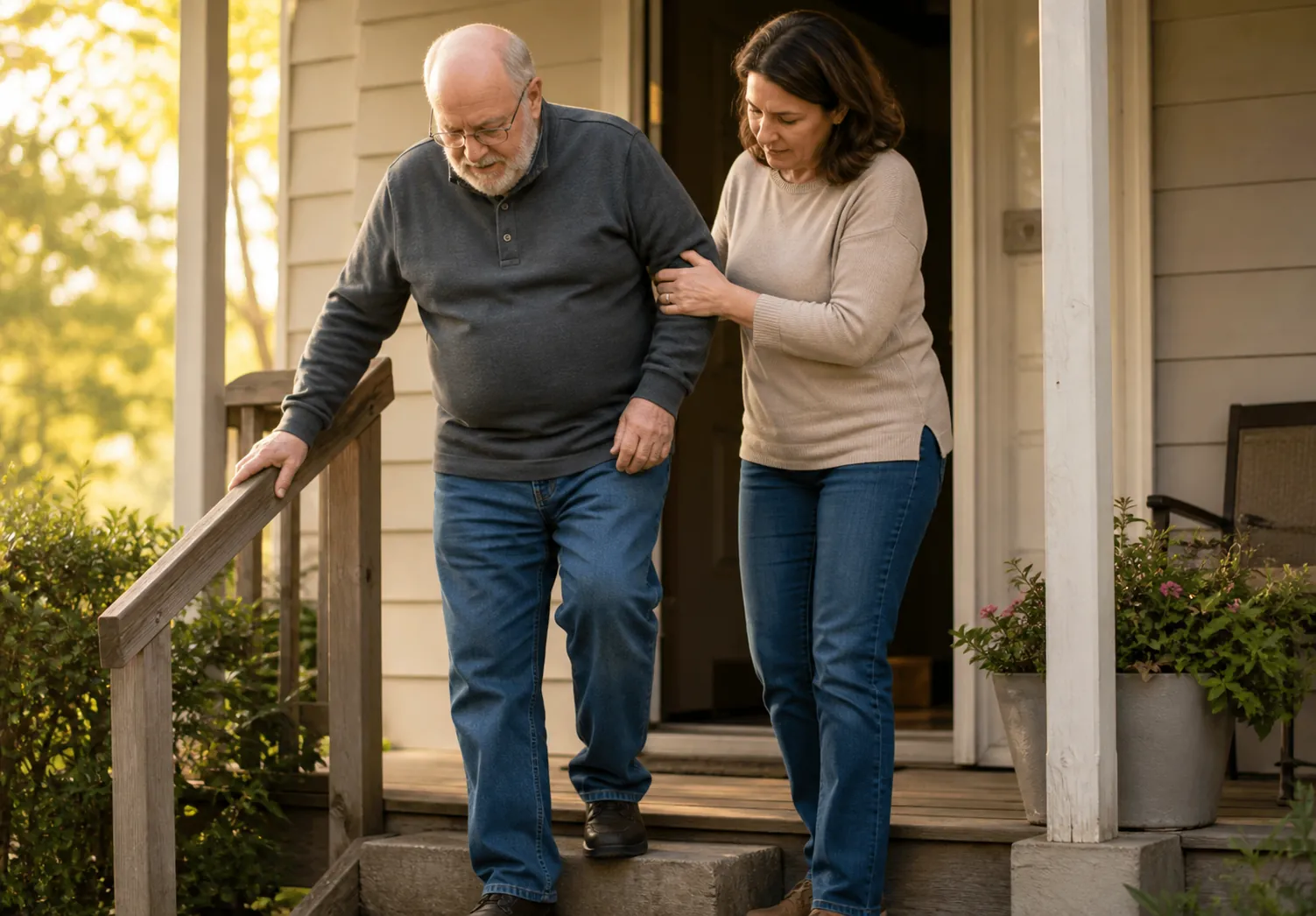
The fall-risk numbers are plain enough to take seriously
One of the clearest fall-specific signals comes from a 2008 study by Fjeldstad and colleagues. In that study, 27% of the obese group reported falling in the past year, compared with 15% of normal-weight peers. Ambulatory stumbling showed an even sharper split: 32% in the obese group reported stumbling while walking, compared with 14% of normal-weight peers. [3]
That stumbling number matters. Families often wait until there is a full fall before they treat balance as urgent. But stumbling is the warning light. It is the hand grabbing the counter. The pause before stepping off the curb. The “I’m fine” after a near-miss in the hallway. A person does not have to hit the floor before the household starts taking fall risk seriously.
Other evidence points in the same direction, though it should be read carefully. Harvard Health summarized an American Journal of Preventive Medicine study of about 3,400 adults age 65 and older in which central obesity was linked with a 37% higher two-year fall risk. The waistline detail is useful because it moves the conversation beyond a scale number and toward how body mass may affect balance and movement. [4]
The National Council on Aging has also summarized an older Mitchell et al. study as finding a 25% to 31% higher fall risk among people with obesity. That is not the same as saying every older adult with obesity will fall, or that weight alone explains a fall. It does say weight deserves a place in the same conversation as medications, vision, footwear, lighting, rugs, blood pressure changes, and leg strength. [5]
The guardrail is important: this body of evidence is observational, and the 2008 study was cross-sectional. It can show an association between obesity and falls or stumbling; it cannot prove that obesity directly caused those falls. In real life, the arrows may run several ways at once. Pain can reduce movement. Reduced movement can weaken muscles. Weakness can make activity feel unsafe. Fear can shrink a person’s walking range. Weight, strength, confidence, and balance can all get tangled together.
How extra weight can show up as fall risk in ordinary movement
The useful question is not “Is my parent’s BMI bad?” It is “What is happening when they stand, turn, walk, climb, step down, or recover from a stumble?” That is where weight becomes practical instead of personal.
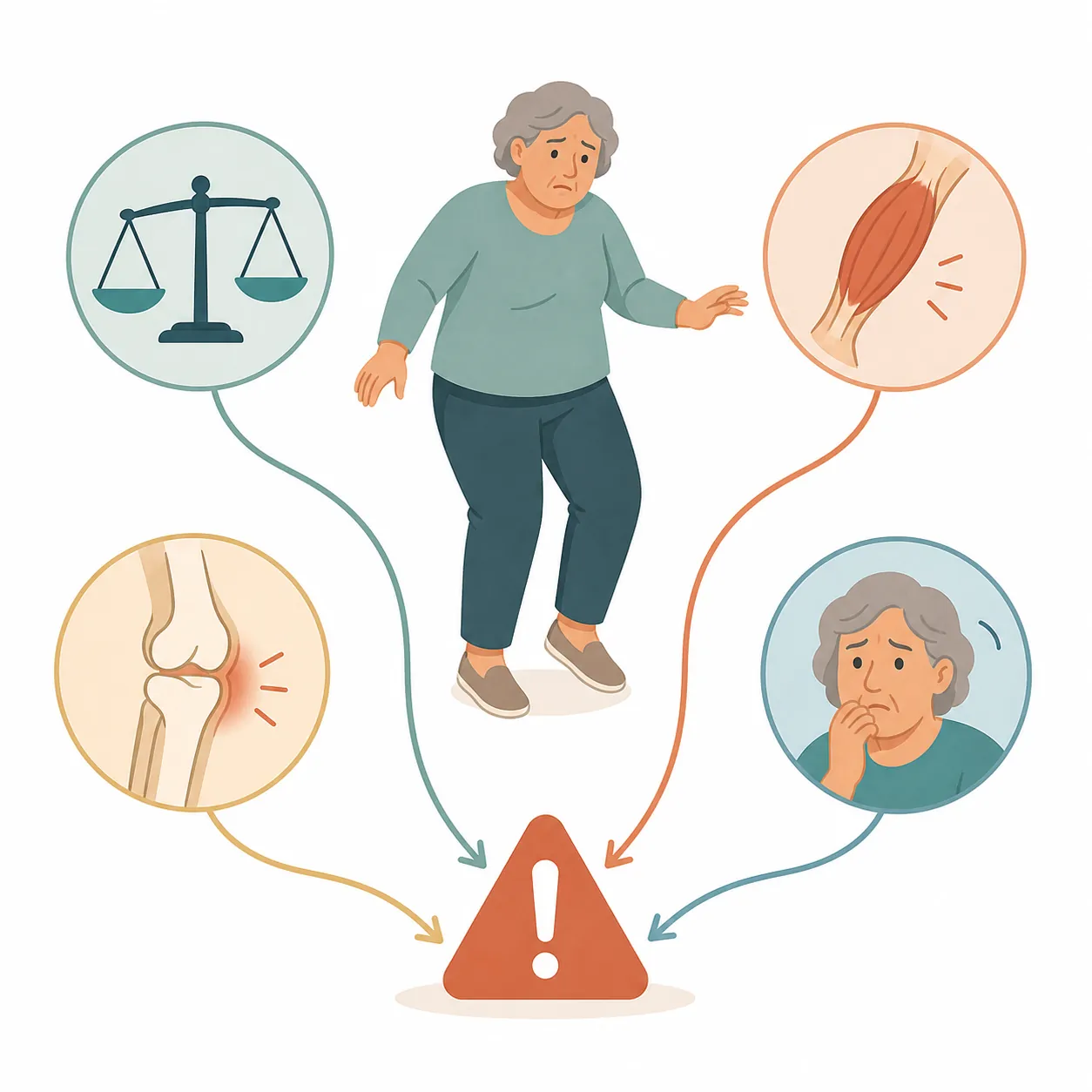
Balance has to work harder
A body with more mass has more to control during a shift in position. That shows up in small moments: rising from a low chair, turning in a narrow bathroom, stepping over a threshold, or correcting after one foot lands slightly wrong. The issue is not that a heavier person cannot balance. The issue is that the margin for recovery may be smaller when balance, reaction time, leg strength, pain, and confidence are already under pressure.
This is why caregivers should pay attention to movement transitions, not just walking distance. A parent may still make it around the grocery store but struggle with the first three steps after standing. They may walk fine on a flat hallway but look uncertain at the porch step. They may say they are “just being careful,” while their body is quietly narrowing the list of places it trusts.
Muscle strength may not match the load
Older adults can carry extra body fat and still have low muscle mass or poor muscle quality. That is one reason BMI is not the whole story. Sarcopenic obesity — the combination of excess fat and reduced muscle — is a related concern because it can leave someone with less reserve for standing, climbing, and catching themselves after a stumble. Batsis and Villareal describe sarcopenic obesity as a condition in which obesity and age-related muscle loss overlap, with consequences for physical function. [6]
This is also where weight-loss enthusiasm can get careless. If an older adult loses weight in a way that also strips muscle, fall risk may not improve the way the family hoped. The safer discussion is broader: What movement is safe? What strength work is appropriate? Is pain being treated? Is nutrition supporting muscle? A clinician, physical therapist, or dietitian can help keep the plan from becoming “eat less and hope for the best.”
Pain changes the way a person walks
Knee, hip, foot, and back pain do not stay neatly in the pain category. They change stride length. They change how much time a person spends on one leg. They make stairs feel like negotiations. The Cleveland Clinic Journal of Medicine’s 2025 discussion of obesity in older adults highlights the overlap among excess weight, sarcopenia, osteoarthritis, mobility disability, and functional decline. [7]
At home, pain often shows up as workarounds: using both hands to push out of a chair, avoiding the basement, stopping walks because the knees ache, leaning hard on a shopping cart, or choosing not to shower unless someone else is nearby. Those workarounds may keep the day moving, but they also tell you where the fall-risk plan needs attention.
Fear of falling can become its own risk
Fear is not weakness. It is often the brain remembering a near-miss. But fear can shrink movement until the body loses even more strength and confidence. An older adult who stops walking to the mailbox, stops visiting a neighbor, or stops going out when the pavement is wet may be trying to stay safe. The cost is that the world gets smaller, and the body gets less practice handling it.
That is why the practical target is not simply a lower number on the scale. It is steadier movement: stronger legs, less pain, better balance, clearer routes, safer transitions, and more confidence doing the ordinary things a person still wants to do.
How to bring weight into the fall-risk screen without humiliating anyone
Start with function. A useful opening sounds more like, “I noticed the front step seems harder lately. Can we ask the doctor about balance, knee pain, and strength?” It does not need to sound like, “You need to lose weight.” The first version names the shared problem. The second version makes a person defend their dignity before the real work even starts.
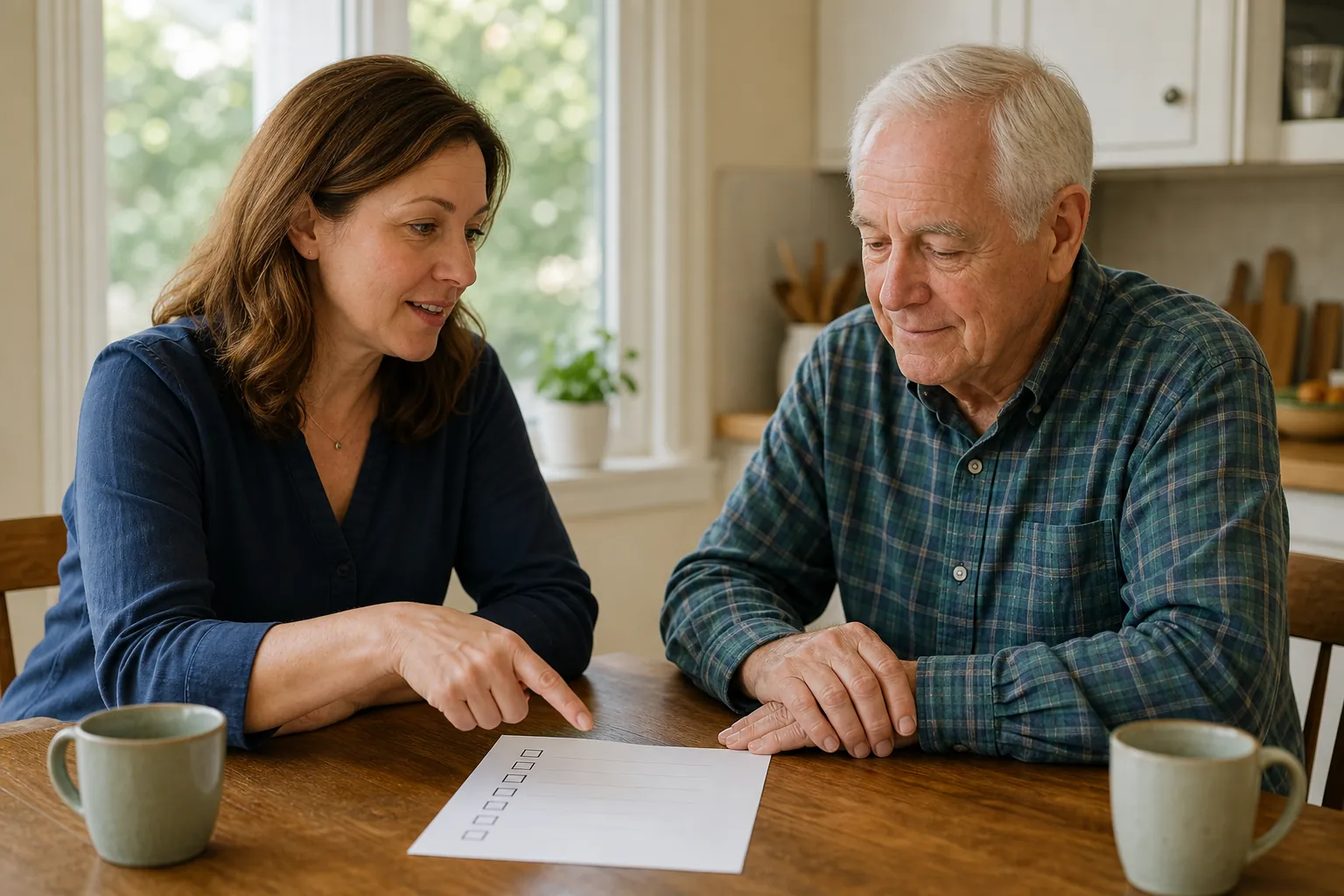
A fall-risk screen should include the basics: any falls in the past year, any near-falls or stumbling, feeling unsteady while standing or walking, worrying about falling, difficulty rising from a chair, slower walking, new use of furniture for support, and avoidance of stairs, curbs, or wet surfaces. If you want a broader list of observable changes, this guide to warning signs of decline in aging parents can help you put words to what you are seeing.
Then add weight to the same screen, not as a separate family argument. The wording can be simple: “Could weight, leg strength, pain, or balance be making falls more likely?” That gives the clinician room to assess the whole picture instead of treating weight as a moral problem or ignoring it because the subject feels awkward.
- Ask about balance and gait, especially if your parent has started hesitating at curbs, reaching for walls, or shortening walks.
- Ask about pain in the knees, hips, feet, or back, and whether pain is changing how they walk.
- Ask whether a physical therapy referral would be appropriate for strength, balance, transfers, and safe movement practice.
- Ask about nutrition, especially if weight loss is being discussed, so muscle is protected rather than accidentally sacrificed.
- Ask what activity is safe before starting a new exercise plan, especially if there is chest pain, severe joint pain, dizziness, neuropathy, recent surgery, or a recent fall.
For a quick way to frame the first conversation, the fall-risk questions in this STEADI-informed senior safety checklist are useful even if your parent is not planning a hike. The setting changes; the screening logic is the same.
Do not turn this into a crash weight-loss project
The goal is safer movement, not punishment. For some older adults, intentional weight loss may be part of a medical plan. For others, the more urgent first step may be treating knee pain, building leg strength, improving balance, correcting unsafe footwear, reviewing medications, or changing a route through the house. The right order depends on the person in front of you.
Muscle deserves special protection. If your parent is eating less, skipping meals, or trying to lose weight, bring protein and overall nutrition into the clinical conversation. For everyday meal ideas that are easier to build around protein, this page on easy chicken recipes for elderly parents may be a practical support, not a substitute for medical nutrition advice.
Be wary of shortcuts that promise rapid cleansing or dramatic weight change, especially if they cause dizziness, diarrhea, dehydration, medication interactions, or weakness. If you are already sorting through supplements or detox claims, this related explainer on herbal cleanse fall risk in older adults follows the same rule: modifiable risk factors belong in the fall-prevention plan, but they need to be handled safely.
Audit the routes your parent actually uses
A home-safety checklist is most useful when it follows real routes, not imaginary perfect rooms. Walk the path from bed to bathroom. Chair to kitchen. Front door to car. Porch to mailbox. Laundry to bedroom. If your parent carries more weight, has painful joints, or moves slowly, a small obstacle on those routes can demand more balance and recovery than it looks like it should.
- Where does your parent reach for a wall, chair, railing, counter, or doorframe?
- Where do they pause before stepping down, turning, or changing surfaces?
- Where is the lighting poor during the hours they actually move through the house?
- Where do rugs, cords, shoes, pet bowls, or clutter narrow the walking path?
- Which route becomes more dangerous when it rains, snows, or gets dark early?
Weather deserves its own look because many falls happen when a familiar route changes underfoot. A route-based rainy-day home safety checklist or rainy-weather fall-prevention checklist can help you check the thresholds, steps, mats, and outdoor paths that look harmless on a dry afternoon.
If a fall has already happened outside the home, do not wait for the next one before acting. The steps in what to do when a parent falls on a sidewalk are a better fit for that immediate, after-the-fall situation.
The next step is a safer plan, not a family lecture
Obesity belongs in fall prevention because it can sit right in the middle of balance demands, weak or low-quality muscle, joint pain, slower movement, and fear of falling. Leaving it out does not protect anyone’s feelings for long; it just leaves caregivers and older adults working around a risk factor without naming it.
Name it carefully. Screen for falls, near-falls, stumbling, pain, and confidence. Bring the pattern to the next clinician visit. Ask what strength, balance, nutrition, pain, and weight-management steps are safe for this specific person. Then make the home routes easier to use while that bigger plan is being built.
References
- Obesity and Severe Obesity Prevalence in Adults: United States, August 2021–August 2023 — National Center for Health Statistics
- Adult Obesity Facts — Centers for Disease Control and Prevention
- Obesity is associated with increased risk of falling in older women — Dynamic Medicine, 2008
- Fat at the waistline linked to increased fall risk — Harvard Health
- 4 Surprising Ways Obesity Affects Aging — National Council on Aging
- Sarcopenic obesity in older adults: aetiology, epidemiology and treatment strategies — Nature Reviews Endocrinology, 2018
- Obesity in older adults — Cleveland Clinic Journal of Medicine, November 2025
Related reading
Noticed something outdated or inaccurate on this page? Flag a correction. We review every report against CDC, NIA, and AARP HomeFit guidance before updating a page.
Part of the Fall Prevention section.