
STEADI: Intervene
Which Months Are Safest for Seniors Traveling to Japan?
A month-by-month Japan weather and safety calendar for older travelers and the family planning the trip. It identifies the safest travel windows, explains the specific risks of summer heat, rainy-season wet surfaces, typhoon season, and winter ice, and includes the warning signs and emergency numbers travelers need to plan around them.
The safest months, stated plainly
For most older travelers, the safest Japan travel windows are late March through May and October through November. If I had to choose one default month for a 70- or 80-year-old who wants culture, walking, regular meals, and a lower chance of weather turning the day unsafe, I would start with November. Japan Guide’s JMA-sourced weather tables describe October and November as among the most pleasant and mild months, and November is the driest, mildest default in the main city corridor. It also avoids the main cherry blossom rush, Golden Week, the worst summer heat, the rainy season, and the mid-August Obon travel crush.[1]
That does not make every November day perfect, and it does not make every summer trip impossible. It means the calendar should be judged first by heat tolerance, fall risk, service disruptions, rest time, and how easily a family can change plans. A month that looks beautiful in photographs can still be the wrong month for someone who overheats slowly, recovers poorly after a long station transfer, or cannot safely hurry down wet stairs.
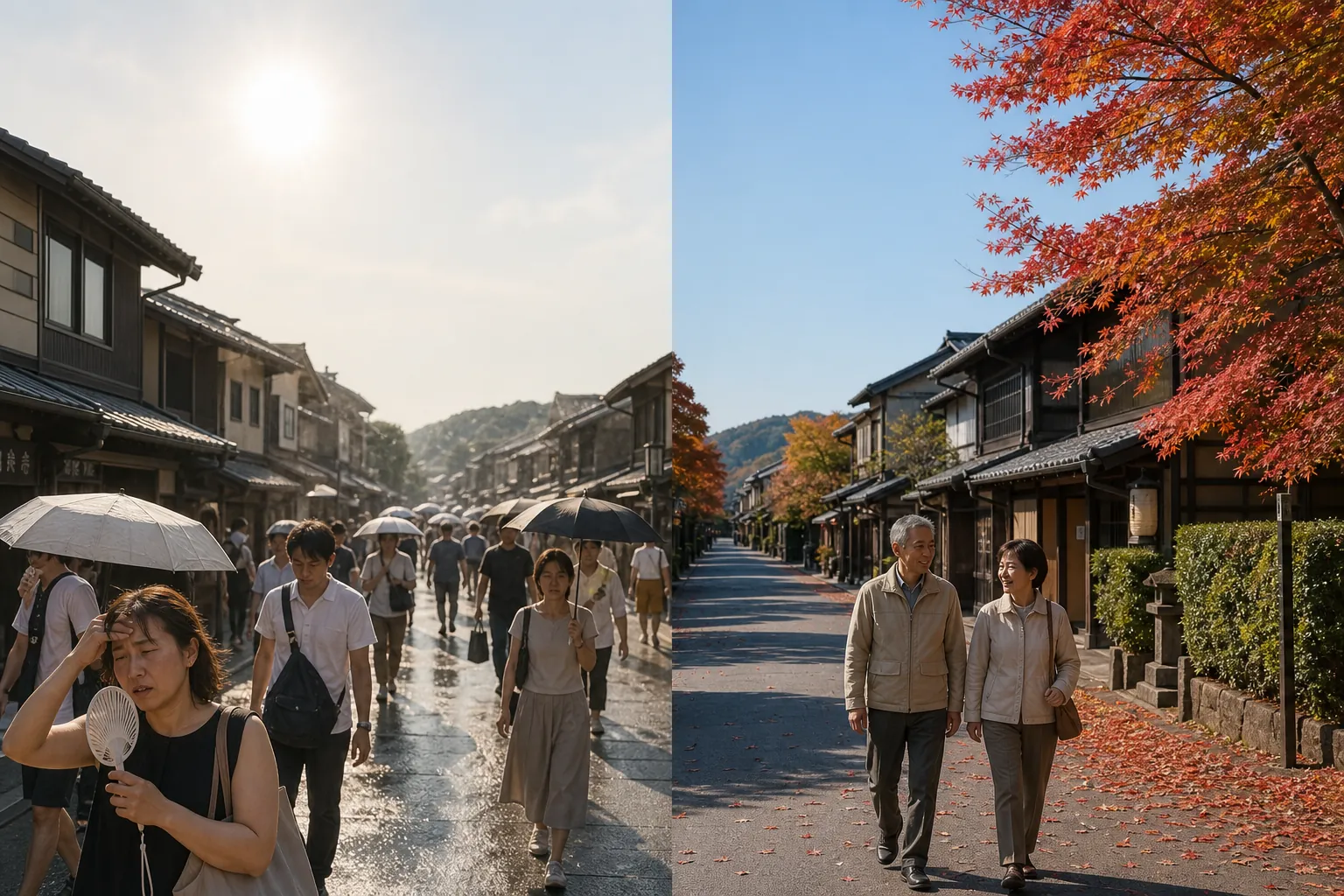
The least senior-friendly stretch is usually June through September, but for different reasons: June into mid-July brings rainy-season surfaces; July and August bring heat and humidity; August and September add typhoon disruption on top of summer fatigue. Winter is not automatically bad, especially in milder city itineraries, but northern travel and icy walking surfaces deserve the same respect you would give an outdoor fall hazard at home.
Month-by-month Japan weather and safety calendar for seniors
| Month | Senior travel judgment | What changes the safety decision |
|---|---|---|
| January | Go only with winter planning | New Year closures run from December 29 to January 4, and northern routes can involve snow or ice. A Tokyo–Kyoto city trip may be manageable; a Sapporo or northern itinerary needs ice footwear, taxi backup, and fewer walking assumptions.[1] |
| February | Go only with winter planning | Cold-weather fatigue and icy surfaces matter more than scenery. This is a better month for travelers who are steady on winter pavements and comfortable shortening outdoor days. |
| March | Go, preferably late March | Late March begins the safer spring window, but temperatures and crowds can vary. Cherry blossom season is attractive, yet it can increase standing time, hotel pressure, and crowded transit around popular parks.[1] |
| April | Go | April is widely considered one of the best times to visit Japan, with generally comfortable spring conditions. The tradeoff is crowds, especially around cherry blossoms and the lead-in to Golden Week.[1] |
| May | Go, with Golden Week caution | May can be very comfortable for seniors, but late April to early May overlaps Golden Week, one of Japan’s busiest domestic travel periods. After that rush, May is often easier to pace.[1] |
| June | Go with conditions; avoid if balance is poor | Rainy season begins around June 8 in Kanto, including Tokyo, and around June 6 in Kansai, including Kyoto and Osaka. Wet station stairs, temple stone, painted crossings, and umbrella use all raise fall risk.[2] |
| July | Avoid for heat-sensitive seniors | Rainy season often runs into mid-July in Tokyo and Kyoto/Osaka, then heat and humidity take over. Japan Guide lists July–August daytime highs around 29–33°C, or 84–91°F, with nighttime lows near 24–25°C, or 75–77°F.[1][2] |
| August | Avoid for most heat-sensitive seniors | August combines high heat, humid nights, Obon travel in mid-August, and typhoon-season disruption. This is the month when a prepaid schedule can become physically and logistically unforgiving.[1] |
| September | Only with typhoon flexibility and heat caution | September can still feel summery, and typhoon-related transport changes are a real planning issue. Build in refundable lodging, extra medication days, and no same-day long-distance transfer before a flight. |
| October | Go | October is one of the most pleasant and mild months in Japan. It is a strong choice for older travelers who want autumn color without choosing the coldest or busiest season.[1] |
| November | Best default month | November is the cleanest senior-friendly default: mild, generally the driest of the comfortable months in the major city corridor, outside Golden Week and Obon, and usually easier to pace than cherry blossom season.[1] |
| December | Go with conditions | Early December can work for city travel, but late December runs into New Year closures from December 29 to January 4. Northern and mountain routes need winter fall-risk planning.[1] |
This calendar is intentionally conservative. A very fit 62-year-old who hikes regularly and manages heat well can accept more seasonal rough edges than an 82-year-old with heart disease, neuropathy, poor balance, or medication timing that cannot be disrupted. The point is not to shrink the trip. It is to keep a wet staircase, a 2 p.m. shrine walk, or a canceled train from becoming the event that defines it.
Why November is the default I would book first
November wins because it removes several problems at once. The weather is mild enough for outdoor walking in the main tourist corridor, the heavy summer humidity has passed, rainy-season slickness is no longer the daily planning assumption, and the calendar is not boxed in by Golden Week, Obon, or New Year closures. Autumn leaves still draw visitors, but the physical demands are easier to control than during cherry blossom peaks, when popular viewing routes can mean slow shuffling, fewer places to sit, and crowded station exits.
For an older traveler, “mild” is not just a comfort word. It means the day can hold a little more margin: a later breakfast, a taxi if the knees are sore, a museum swapped in if rain appears, and a return to the hotel before dinner without feeling that the whole season was missed. That extra margin is often what keeps a family trip from becoming a string of small recoveries.
Spring is excellent, but not all spring weeks are equal
Late March through May is the other major comfort window. April is widely treated as one of Japan’s best travel months, and for many seniors it can be exactly that: mild, walkable, and rewarding without the medical seriousness of summer heat.[1] The caution is that spring’s appeal creates its own senior-safety problems. Cherry blossom crowds can increase standing time. Hotels near popular areas may push families into less convenient locations. A “short” walk to a blossom spot can become a slow, crowded, step-heavy outing.
May is often easier after Golden Week. Japan Guide flags late April to early May as Golden Week, one of the busiest travel periods, and that is exactly the sort of crowd overlay that matters when someone needs predictable seating, luggage help, and realistic transfer times.[1] If May is the target, I would rather book after the holiday rush than build a senior itinerary around packed domestic travel days.
Late March deserves a gentler hand. It can be a good choice, especially for travelers who want spring without pushing into the busiest April dates, but it should not be planned as if every day will be warm and effortless. Bring layers, avoid tight outdoor schedules, and treat the first two days as acclimation rather than proof that everyone can handle a full pace.
Rainy season: the fall risk is underfoot, not in the forecast icon
Rainy season, or tsuyu, is not identical across Japan. Japan Guide places it roughly from June 8 to July 20 in Kanto, including Tokyo, and from June 6 to July 19 in Kansai, including Kyoto and Osaka. Okinawa’s rainy season is earlier, roughly May 8 to June 23, while Hokkaido is least affected.[2]
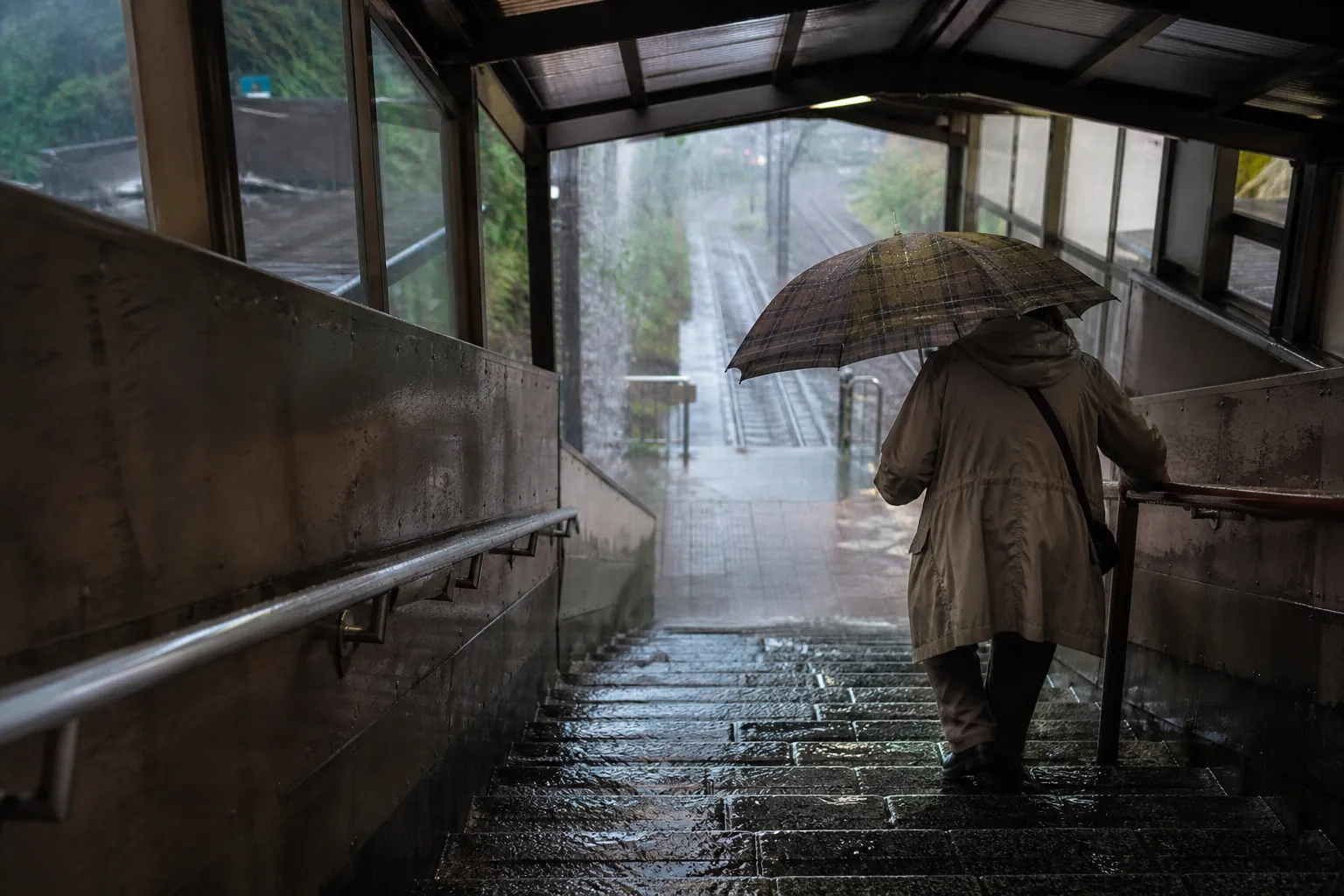
For a younger traveler, a rainy day may be an umbrella and a café. For an older traveler with slower balance recovery, rain changes the walking surface. Station stairs become slick. Smooth stone at temples and gardens can be unforgiving. Umbrellas occupy one hand that might otherwise be on a rail. Wet shoes track water into hotel lobbies and convenience stores. A small slip may not be small if the person is on blood thinners, has osteoporosis, or cannot easily get up from the ground.
If June or early July is the only possible time, plan as if the ground will be wet. Choose hotels within a short, simple taxi ride of major stations. Pack shoes with real wet-surface grip, not just comfortable soles. Do not make the older traveler carry both an umbrella and a shoulder bag on stairs. The same habits used in a rainy-day safety checklist for elderly parents apply here: reduce rushing, keep hands free, and assume the risky moment is the transition between places.
July and August heat is a medical planning issue
Japan’s summer heat is not just a matter of disliking hot weather. Japan Guide’s JMA-sourced city tables put July and August daytime highs around 29–33°C, or 84–91°F, with nighttime lows near 24–25°C, or 75–77°F.[1] Warm nights matter because the body gets less recovery time. Add humidity, station transfers, temple approaches, luggage, and jet lag, and a day that looked reasonable at breakfast can become unsafe by early afternoon.
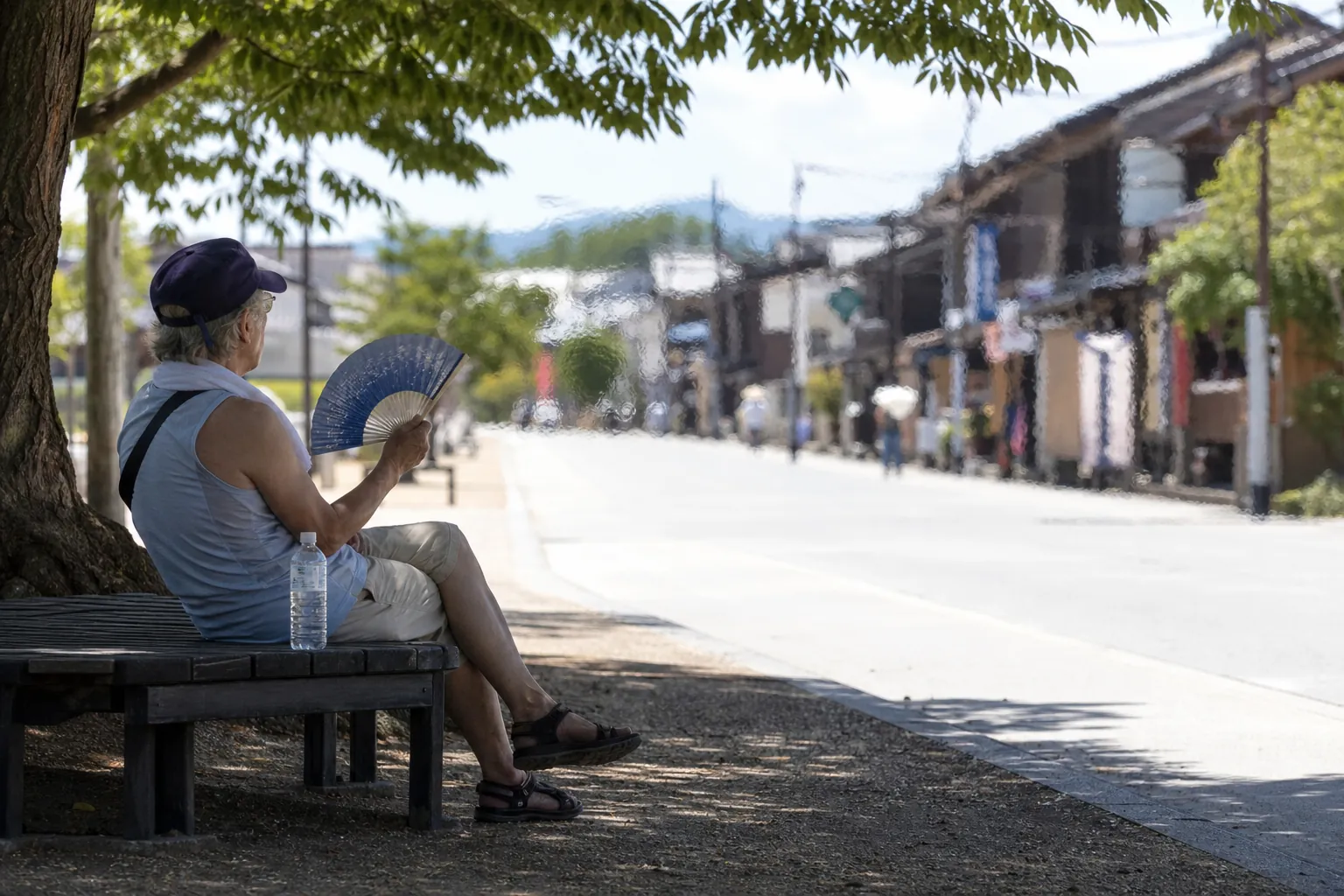
The CDC warns that older adults are among the travelers at higher risk for heat illness, and it defines heat stroke as a medical emergency in which body temperature can rise to 106°F or higher within 10 to 15 minutes.[3] That is why I would not describe July and August to families as merely “hot but doable.” They may be doable for some older adults, but they require a different kind of itinerary: short outdoor blocks, indoor recovery, no midday temple walks, and a willingness to cancel.
Japan also uses the Wet Bulb Globe Temperature, or WBGT, to issue heatstroke warnings. Nippon.com describes a Heatstroke Alert at WBGT 33 or higher and a Special Heatstroke Alert at WBGT 35 or higher, introduced from 2024, across 58 forecast areas; it also lists elderly people as an individual risk factor.[4] Kyoto’s official travel guidance similarly tells visitors to use cooling shelters and notes the WBGT 35-plus threshold response.[7]
Recent heat figures underline the point, though anyone planning a current trip should still check the latest official alerts rather than relying on last year’s numbers. An official Ministry of Health, Labour and Welfare estimate reported for June through September 2024 put heatstroke deaths at 2,033, and a July 2024 Greater Tokyo figure reported 123 heatstroke deaths, mostly among people age 60 and older where air conditioning was often unused.[5] CNN reported that Japan recorded about 90,000 heatstroke hospitalizations from May through August 2025 and described 2025 as Japan’s hottest summer on record.[6]
Heat warning signs that should stop the day
Do not wait for an older traveler to “push through” these symptoms. Stop the outing, move to shade or air conditioning, begin cooling, and seek emergency help if symptoms are severe or do not improve.
- Confusion, unusual agitation, slurred speech, or not acting like themselves
- Fainting, collapse, or inability to walk steadily
- Hot, red skin that may be dry or damp
- Severe headache, dizziness, nausea, or vomiting
- A fast, strong pulse or signs that the person is getting worse instead of recovering
These are consistent with CDC heat-stroke warning signs, and heat stroke should be treated as a medical emergency.[3] This article is travel-planning information, not medical advice; an older traveler with heart disease, kidney disease, diabetes, cognitive impairment, limited mobility, or heat-sensitive medications should ask their clinician how summer heat changes the trip.
Typhoon season is a schedule and medication problem
Typhoons do not need to hit your exact hotel to affect an older traveler. Heavy rain, wind, rail suspensions, flight changes, closed attractions, and delayed luggage can all matter if someone needs medication on time, a rest day after travel, or a hotel room that is easy to reach. JapanTravel’s guide reported that the 2025 season had 27 typhoons and 3 landfalls.[8] Remitly, citing JMA averages, gives a different but compatible planning lens: about 18 typhoons approach Japan per year, about 3 make landfall on the main islands, and Okinawa may be affected by 7 to 8.[9]
Those figures should not be blended into one dramatic number. “Approach,” “landfall,” and “affect Okinawa” are different things. For family planning, the practical lesson is simpler: August and September should not be booked with tight transfers, irreplaceable tours, or medication packed only for the exact number of trip days.
Before booking a late-summer or early-fall trip, check whether the hotel rate is changeable, whether a canceled train would strand the older traveler between cities, and whether the adult child or companion has authority to make decisions quickly. A beautiful itinerary that depends on every train running exactly as planned is not a senior-safe typhoon-season itinerary.
Winter can work, but ice changes the walking contract
January and February should not be dismissed automatically. A city-based itinerary with taxis, museums, short walks, and warm hotel access may be perfectly reasonable for a steady older traveler. The risk rises when the trip depends on northern streets, snowy town walks, outdoor viewpoints, or luggage transfers over icy pavement.
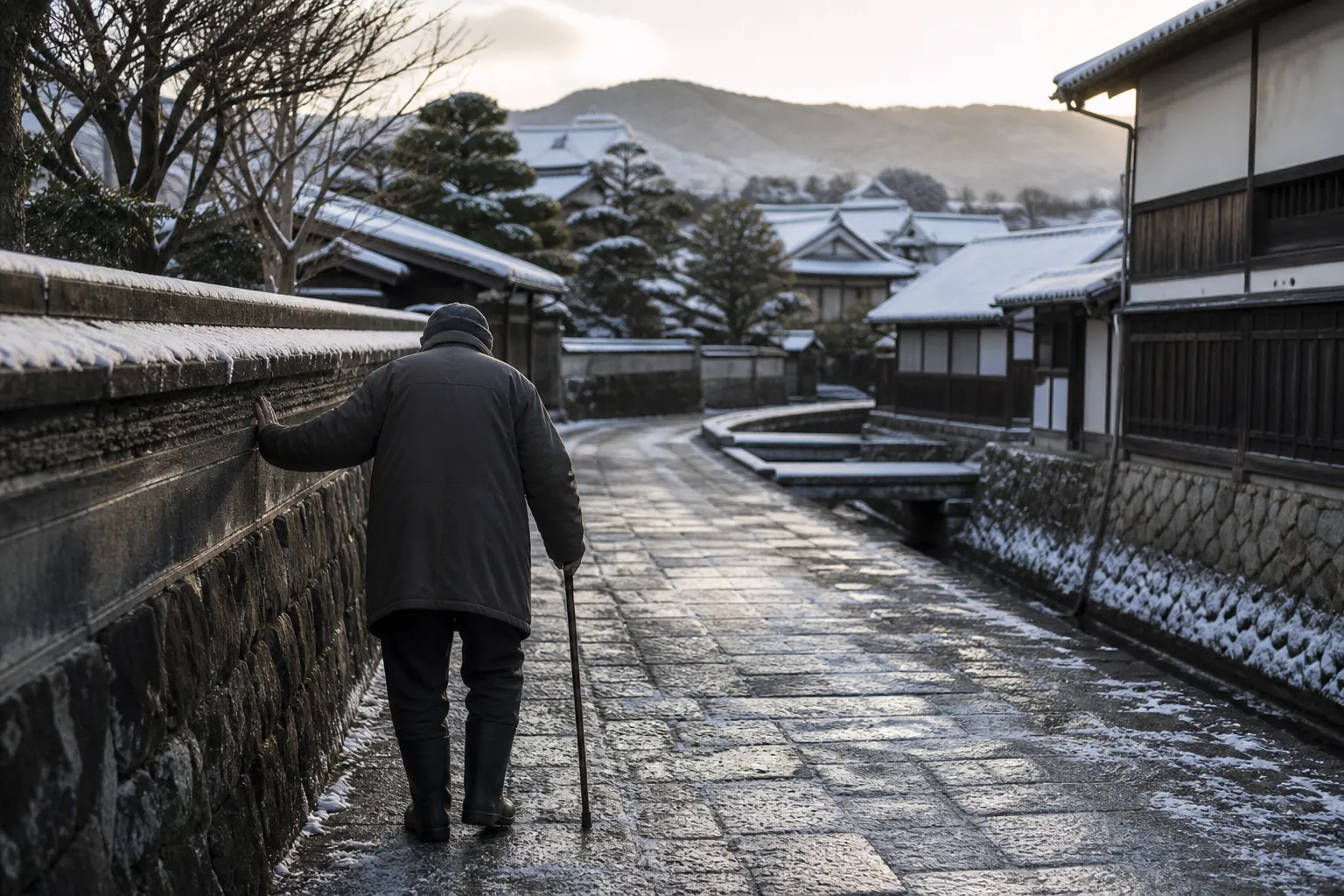
Ice is not just another weather inconvenience. It removes the small corrections people use to save themselves after a misstep. If winter is the right season for the traveler, use the same logic you would use to prevent falls on ice outdoors: keep the hands free, shorten the walking radius, avoid rushing for trains, and treat a cane or walking pole as balance support, not as permission to cross slick surfaces quickly.
Regional overrides: Okinawa and Hokkaido do not follow the same risk calendar
The main recommendation—late March through May and October through November—fits many first-time Tokyo, Kyoto, Osaka, and similar city itineraries. Okinawa and Hokkaido need separate thinking. Okinawa’s rainy season is earlier, roughly May 8 to June 23, and it is also more exposed to typhoon impacts than the main islands, with Remitly citing JMA averages of 7 to 8 typhoons affecting Okinawa per year.[2][9]
Hokkaido is least affected by Japan’s rainy season, so June may be less of a tsuyu problem there than it is in Tokyo or Kyoto.[2] That does not erase other risks. A winter Hokkaido trip should be planned around ice and snow; a summer Hokkaido trip still needs heat and fatigue judgment for the specific traveler. The region can change the answer, but it should not remove the health filter.
The booking test I would use before choosing flights
Before buying flights, run the month through a practical test. If too many answers are uncomfortable, change the month before you start improving the itinerary.
- Can the older traveler safely walk outside at the likely midday temperature, or would the day require indoor recovery from late morning through afternoon?
- If it rains, can the itinerary still work without long stair transfers, slippery stone paths, or umbrella-and-luggage balancing?
- If a train or flight is canceled, does the traveler have enough medication, money, phone battery, and stamina to wait?
- Can the first two days be deliberately slow, especially after a long-haul flight?
- Is there a taxi plan for the end of the day, not just for emergencies?
- Are the most important activities scheduled in the morning, when heat, crowds, and fatigue are usually easier to manage?
This is the same planning habit that makes any senior outing safer: book early, reduce standing, protect the recovery window, and leave room to stop. The logic applies whether you are planning a major international trip, a state fair visit with an older adult, or a senior-friendly holiday weekend itinerary. The destination changes; the body still needs pacing.
Morning-of checks once you are in Japan
A senior-safe Japan itinerary is not finished when the reservations are made. Each morning, check the weather, heat alerts, rail status, and whether the older traveler actually slept, ate, and recovered. If a heat alert is active, if rain is heavy enough to change footing, or if a typhoon is affecting transport, the correct plan may be the shorter plan.
JNTO lists 119 for fire, ambulance, and emergency rescue, the 24-hour Japan Visitor Hotline at 050-3816-2787, and the Safety Tips app for emergency information.[10] Put those in every adult traveler’s phone before the trip, not after someone is dizzy on a station platform.
A small emergency kit should travel with the person, not sit in the hotel room: medication list, extra medication days, water, a cooling towel or fan in summer, a light layer in spring or fall, portable battery, hotel address in Japanese, and emergency contacts. If the trip includes earthquakes, storms, or mobility limitations, borrow the same habit used in an earthquake preparedness checklist for seniors: assume help is easier when the essential information is already organized.
Final ranking for an older traveler’s Japan trip
- November — the best default for most senior travelers because it is mild, comparatively dry, outside the major holiday crushes, and easier to pace.
- October — an excellent comfort month, especially for travelers who prefer autumn but want to avoid colder conditions.
- May after Golden Week — strong weather choice once the domestic travel rush eases.
- April — often beautiful and comfortable, but crowds can raise fatigue and fall-risk exposure.
- Late March — a good spring option if the itinerary allows for variable weather and a slower first few days.
- Early December — possible for city travel, but watch the approach to New Year closures and colder walking conditions.
- January and February — reasonable only with winter-surface planning, especially outside the mildest city routes.
- June to mid-July — use caution because rainy-season surfaces can turn ordinary walking into a slip hazard.
- July and August — avoid for heat-sensitive older adults unless the trip is built around air conditioning, morning-only outdoor activity, and cancellation flexibility.
- September — only for travelers who can tolerate lingering heat and typhoon-related schedule changes.
Override that ranking when the person’s health or the region demands it. Hokkaido can make June more appealing than it would be in Kyoto. Okinawa needs earlier rainy-season and stronger typhoon thinking. A traveler with poor heat tolerance should treat July and August differently from someone who handles heat well. The safest Japan trip for an older adult is the one scheduled around body tolerance, alert systems, and recovery time, not the one optimized for photographs.
References
- When to travel to Japan – Travel Weather, Japan Guide
- Japan's Rainy Season (Tsuyu or Baiu), Japan Guide
- Heat Illnesses – Travelers' Health, CDC
- A Heatstroke Prevention and Treatment Guide for Japan's Humid Summers, Nippon.com
- 2024 Japan heatwaves, Wikipedia
- How the world's most elderly country is fighting heat in a deadly double crisis, CNN, 2025-09-19
- How to Avoid Heatstroke While Traveling in Japan, Kyoto City Official Travel Guide
- Guide to Typhoons in Japan, JapanTravel
- When Is Typhoon Season in Japan?, Remitly
- For Safe Travels in Japan, JNTO
Related reading
Noticed something outdated or inaccurate on this page? Flag a correction. We review every report against CDC, NIA, and AARP HomeFit guidance before updating a page.
Part of the Fall Prevention section.