
Room checklist
The Evidence for Aging-in-Place Remodels: 39% Fewer Falls, 42% Fewer Care Hours, and How to Make the Case
This article arms adult children and spousal caregivers with hard data from peer-reviewed studies to make the case for aging-in-place home modifications to a reluctant parent or to justify the investment. It translates key research into a practical persuasion framework, including a cost-comparison calculator and a conversation script.
The Numbers That Make the Case: 39% Fewer Falls, 42% Fewer Care Hours
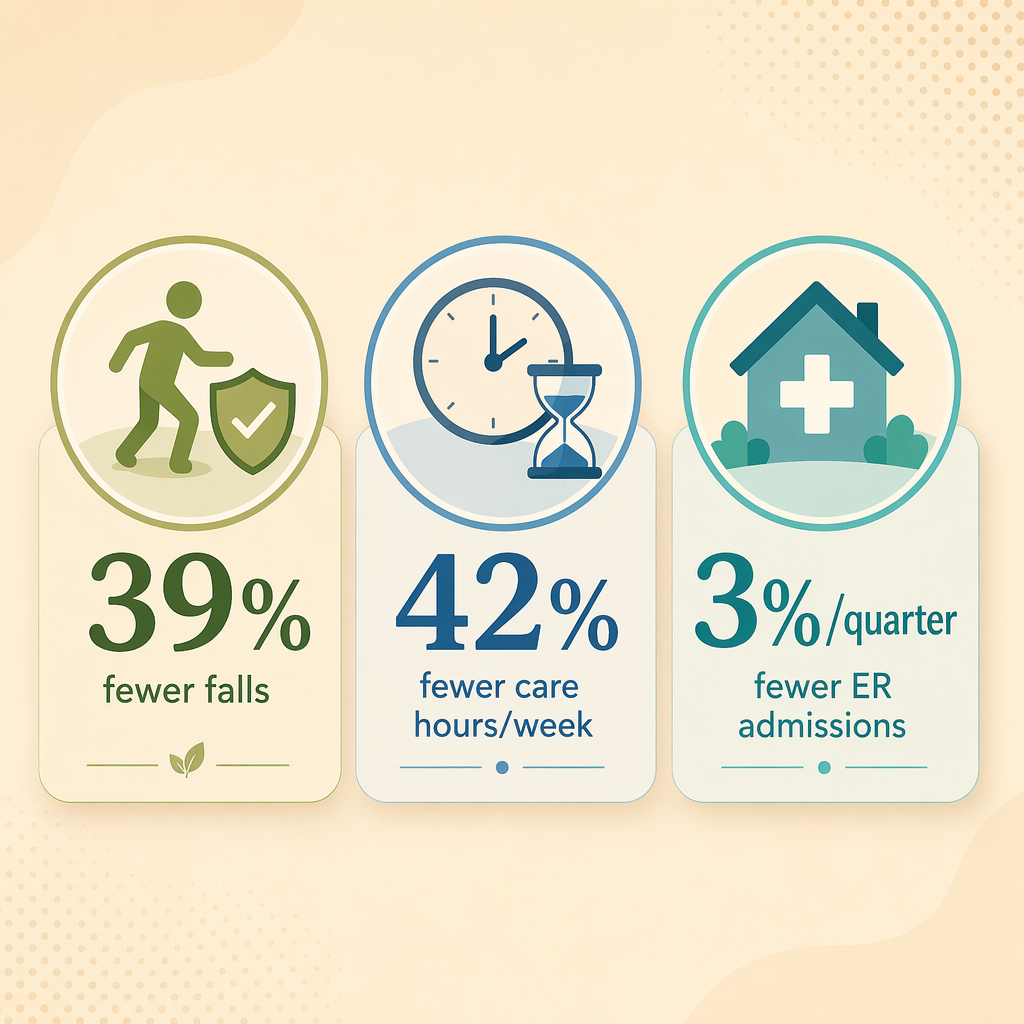
If you are trying to convince a parent — or yourself — that an aging-in-place remodel is worth the disruption and expense, start here: the evidence is not ambiguous. A 2025 systematic review of 20 studies published in PMC found that 13 of them (65%) confirmed that home modifications are effective at preventing falls, preserving independence, and saving money. But two numbers from that review do most of the heavy lifting in any family conversation.
The first comes from a 2017 randomized controlled trial by Stark and colleagues. Among 300 older adults with an average age of 77, those who received home modifications experienced a 39% reduction in falls compared to the control group. This was not a small pilot study — it was rated as "Excellent" quality on the PEDro scale, the gold standard for clinical trial rigor.
The second number addresses the question that keeps many adult children up at night: "How much longer can we manage this alone?" A 2019 pre-post study by Carnemolla and Bridge tracked 157 older adults before and after home modifications. The result: weekly care hours dropped by 42%. Informal care — the kind provided by family members — fell by 46%, while formal paid care dropped by 16%. That is not a marginal improvement. It is the difference between a family managing with occasional help and a family being pushed toward burnout.
What the Research Actually Says: Three Key Studies Every Caregiver Should Know
When you walk into a conversation with a contractor — or a reluctant parent — you need more than a headline number. You need to understand what the studies actually measured and whether the findings apply to your situation. Here are the three studies that matter most, translated into plain language.
| Study | Design & Population | Key Finding | Why It Matters for Your Remodel |
|---|---|---|---|
| Stark et al. (2017) | Randomized controlled trial; 300 older adults, mean age 77; rated 'Excellent' on PEDro scale | 39% reduction in falls in the modification group vs. control | This is the strongest evidence that modifications are a clinical intervention, not a convenience upgrade |
| Carnemolla & Bridge (2019) | Pre-post study; 157 older adults, mean age 72 | Weekly care hours dropped 42% overall; informal care down 46%, formal care down 16% | Modifications reduce the burden on family caregivers — not just prevent injuries |
| Hollinghurst et al. (2022) | National data-linkage study; 657,536 older adults in Wales | Fall-related emergency admissions reduced by 3% per quarter (OR = 0.97, p < 0.001) | At population scale, home adaptations keep people out of the ER — and reduce system costs |
The Hollinghurst study is worth pausing on because of its sheer scale. With more than 650,000 participants, it is not a small clinical trial — it is a national analysis of what happens when home adaptations are implemented across an entire population. The 3% per quarter reduction in fall-related emergency admissions may sound modest, but at a population level it translates into thousands of avoided hospital visits and millions in healthcare savings.
Taken together, these three studies tell a consistent story: home modifications reduce falls, reduce the burden on family caregivers, and reduce the strain on the healthcare system. The evidence is not coming from a single small trial — it is converging from multiple study designs, populations, and countries.
Why Bathroom Modifications Are the Most Impactful Single Intervention
If you can only afford to modify one room in the house, the data points squarely at the bathroom. According to the National Center for Injury Prevention and Control, bathrooms account for 35.7% of fall injuries among older adults. That is more than any other single room in the home. The combination of wet surfaces, hard tile, and the need to transition in and out of a bathtub or shower creates a perfect storm of fall risk.
The most effective single intervention in the bathroom is the grab bar. A 2021 study published in Human Factors found that grab bar users were 75% more likely to keep their balance when stepping from a slippery shower floor to a dry surface compared to those who did not have one. That is not a small advantage — it is the difference between a safe exit and a trip to the emergency room.
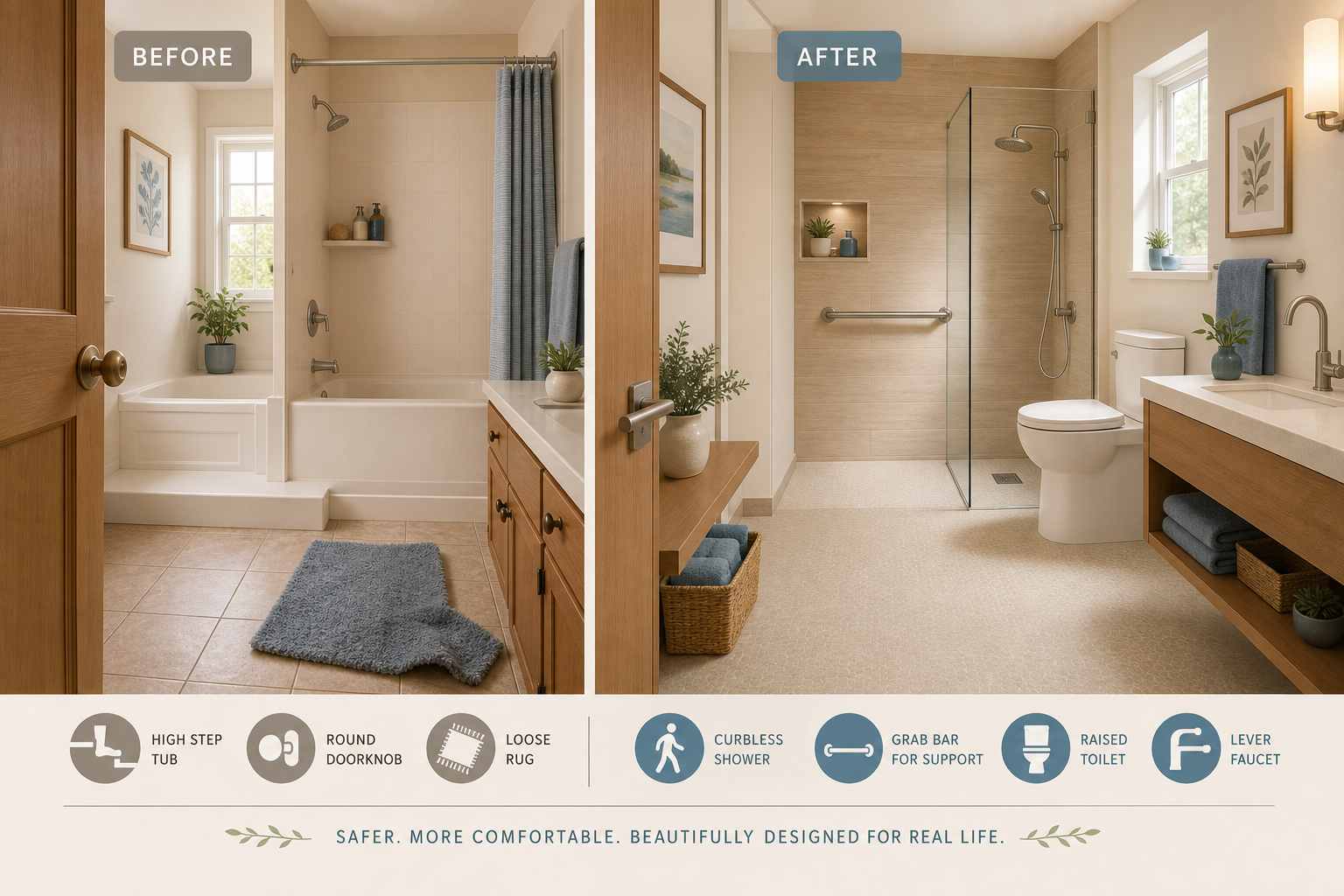
Here is a quick prioritization list for bathroom modifications, ranked by evidence of impact:
- Grab bars at the shower entry and next to the toilet — $15 to $80 per bar (unit cost), $100 to $400 professionally installed
- Non-slip flooring or anti-slip treatment on existing tile — reduces the surface hazard that makes bathrooms dangerous
- Curbless or low-threshold walk-in shower — eliminates the step-over movement that causes many falls; custom designs run $6,000 to $12,000
- Raised toilet seat or comfort-height toilet — reduces the distance and effort required to stand up, a common fall moment
- Lever-handle faucet — easier to operate than round knobs for hands with reduced grip strength
For a deeper room-by-room breakdown of what these modifications look like in practice, including timelines and contractor considerations, see our Bathroom Remodel for Elderly Parents: A Family Caregiver's Crisis Guide from Fall to Finish.
The Cost-Comparison Calculator: Remodel Cost vs. Fall-Related Hospitalization
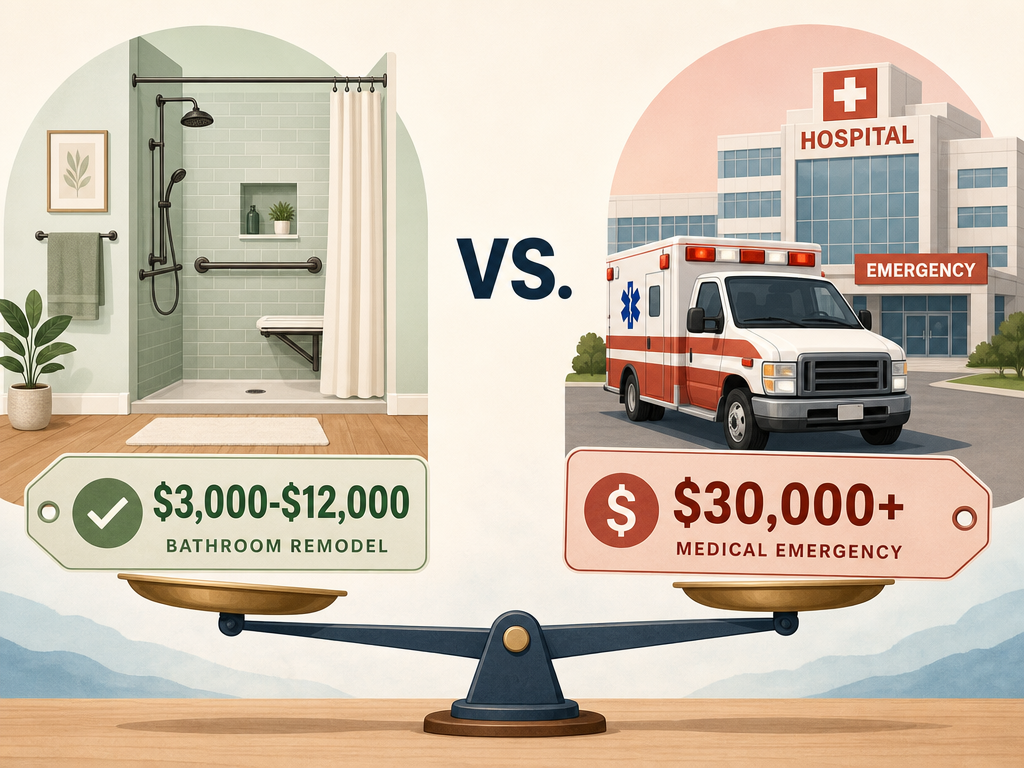
This is the calculation that often tips the scale in a family conversation. When a parent says, "I don't want to spend money on a bathroom remodel," the honest response is: "The question is not whether we spend money — it is whether we spend it on prevention or on an ER visit."
| Intervention | Typical Cost Range | What It Prevents | Cost of the Fall |
|---|---|---|---|
| Grab bar installation (2-3 bars) | $200 – $800 (installed) | A bathroom fall during shower exit | $30,000+ for a hip fracture hospitalization |
| Non-slip flooring + grab bars | $1,500 – $3,000 | Multiple fall types in the bathroom | $30,000+ per fall-related hospitalization |
| Curbless walk-in shower | $6,000 – $12,000 | Step-over falls during shower entry/exit | $30,000+ per fall-related hospitalization |
| Full bathroom safety remodel | $3,000 – $15,000 | Most bathroom fall scenarios | $30,000+ per fall-related hospitalization |
The math becomes even more compelling when you consider that a single fall often leads to a cascade of consequences: the initial hospitalization, rehabilitation, follow-up care, and a permanent loss of mobility and independence. The $30,000+ figure for a fall-related hospitalization does not include the cost of home health aides, physical therapy, or the unpaid caregiving hours that family members will need to provide during recovery.
If the cost of the remodel is the primary barrier, there are options. Our guide on How to Pay for Aging in Place Home Modifications covers VA grants, Medicaid HCBS waivers, USDA Section 504 loans, and other funding sources that can reduce or eliminate the upfront cost.
How to Talk to a Skeptical Older Adult Using Evidence, Not Opinion
The hardest part of any home modification project is often not the construction — it is the conversation. An older adult who has lived in the same home for 30 or 40 years may hear "let's remodel the bathroom" as "you are not safe here anymore." That emotional response can shut down any discussion, no matter how strong the evidence.
The key is to frame the conversation around independence and control, not around decline or danger. Here is a script that uses the evidence from this article to keep the discussion productive:
- "I want to talk about something that will help you stay in this house as long as you want to. A study of 300 older adults found that making a few changes to the bathroom reduced falls by 39%. That is not my opinion — that is what the research shows."
- "I am not suggesting we turn the house into a hospital. I am suggesting we make a few smart changes — like a grab bar and a different shower floor — so you can keep using your own bathroom without worrying about slipping."
- "The average cost of a fall that sends someone to the hospital is over $30,000. A bathroom remodel costs a fraction of that. This is not about spending money — it is about spending it wisely so you avoid the hospital entirely."
- "Another study found that after homes were modified, family caregivers spent 42% less time providing hands-on help each week. That means I can spend more time just being with you and less time worrying about whether you are safe."
Notice what this script does not do: it does not say "you are getting older and unsafe." It does not frame the remodel as a concession to decline. Instead, it frames the modifications as tools that preserve the older adult's ability to live independently — which is exactly what the research shows they do.
For a deeper exploration of communication strategies — including how to handle resistance, what to do if the conversation gets emotional, and how to involve other family members — see our guide on How to Talk to Your Aging Parent About Fall Risk and Home Safety Without Damaging Their Independence.
From Evidence to Action: Your Next Steps
You now have the evidence, the cost comparison, and the conversation script. Here is how to turn that into action:
- Start with a bathroom safety assessment. Walk through the bathroom and identify the three highest-risk areas: the shower entry, the floor surface, and the toilet transfer zone. These are the places where the 35.7% of bathroom fall injuries happen.
- Use the cost-comparison framework to prioritize. A $200 grab bar installation that prevents a $30,000 hospitalization is the highest-ROI intervention you can make. Start there, then work up to larger projects.
- Have the conversation using the evidence, not opinion. Use the script above as a starting point. Keep the focus on independence and control, not on decline or danger.
- Consider consulting a CAPS-certified specialist. A Certified Aging-in-Place Specialist can conduct a professional home assessment and recommend modifications tailored to your parent's specific mobility needs and home layout. See our guide on How an Aging-in-Place Specialist Prevents Falls for what to expect.
- Explore funding options. If cost is a barrier, the funding guide covers VA grants, Medicaid waivers, and other programs that can help. You do not have to pay for the entire remodel out of pocket.
The evidence is clear. The cost comparison is favorable. The conversation script is ready. The only remaining step is to start.
Related reading
Need a professional assessment?
Find a CAPS-credentialed professional or local aging services through our outbound resource list — we never name or rank individual contractors.
Find Local HelpNoticed something outdated or inaccurate on this page? Flag a correction. We review every report against CDC, NIA, and AARP HomeFit guidance before updating a page.