
STEADI: Intervene
How to Choose a Safe Summer Walking Route for Seniors
Choosing a safe summer walking route for an older adult means verifying each block in advance: smooth, non-slip surfaces; curb cuts and marked crossings; shade, water, and rest stops; and a time of day that avoids peak heat. Use this checklist to weigh outdoor fall risks and heat risks before the walk begins.
To choose safe summer walking routes for seniors, start with the actual blocks underfoot, not the destination. A park, pharmacy, mailbox, or coffee shop can be a good reason to go outside, but the route is only as safe as the cracked slab, curb cut, crossing, shade gap, and rest stop between here and there.
The two summer risks overlap: an older adult can trip on a lifted sidewalk while trying to reach shade, or become overheated because the only bench is after the difficult crossing. In one Northern California Kaiser Permanente study of adults age 45 and older, sidewalks, curbs, and streets were frequent outdoor fall locations; walking was the most common fall-related activity; and about 73% of outdoor falls were attributed to environmental causes such as uneven surfaces, tripping, or slipping. That study used self-reported recall from a specific regional sample, so it should not be treated as a national estimate. It still points to the part of the walk that families often skip: inspecting the environment before the walk begins.[1]
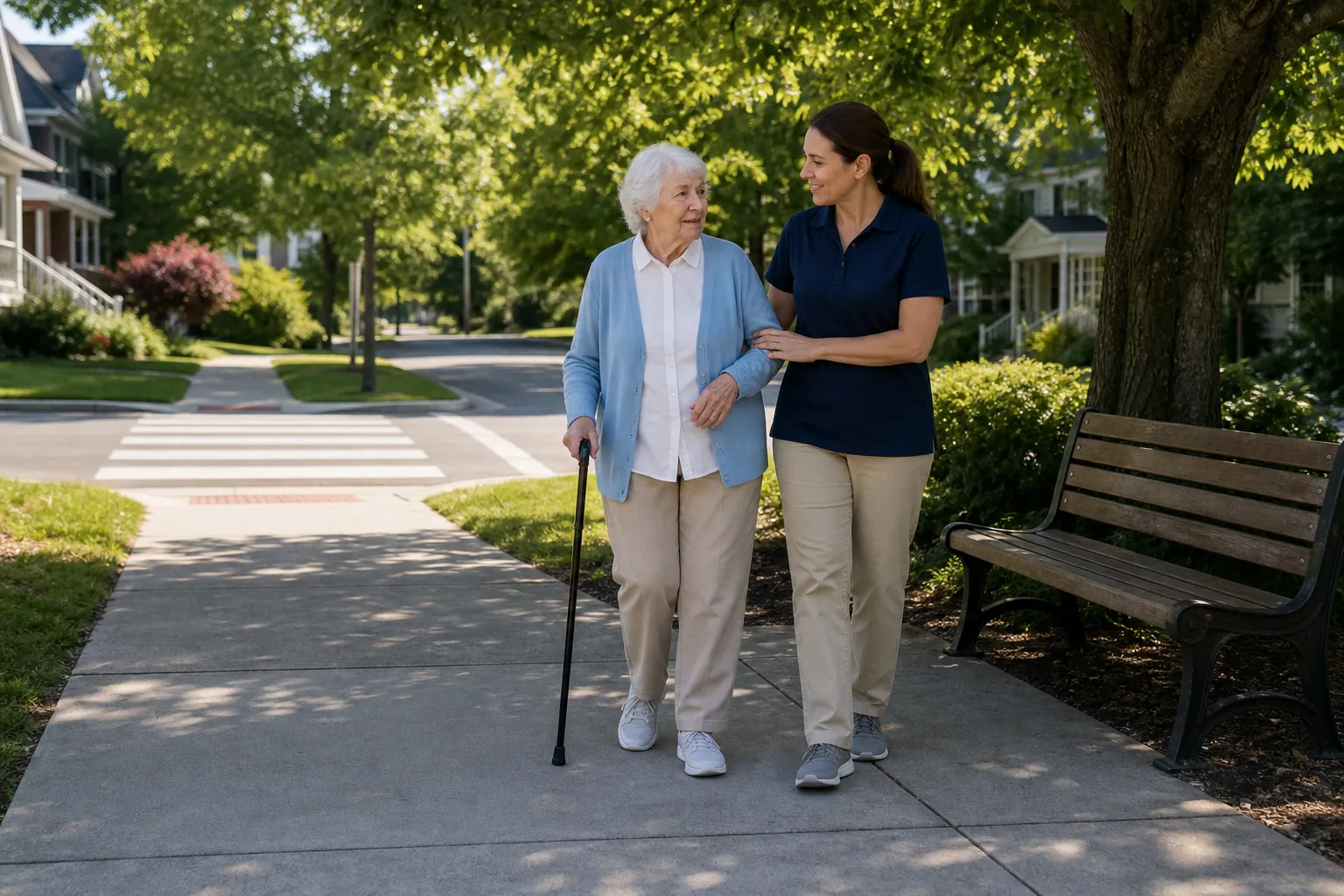
Pick the safest blocks, then decide how far to go
A useful walking route is a chain of acceptable blocks. If one link is bad enough — a missing curb cut, a fast unmarked crossing, a long unshaded stretch, a broken sidewalk with no easy way around it — the route needs to change even if the destination looks close.
Before shoes go on, choose one proposed loop or out-and-back route and walk or drive it with inspection in mind. The goal is not to find the prettiest path. It is to find a route that can be repeated without surprises: even surface, predictable crossings, places to pause, shade where the sun is strongest, water access, and a cooler indoor option if the walk needs to stop.
| Route feature | What to verify before the walk |
|---|---|
| Surface | Smooth, non-slip sidewalk or path; no major cracks, holes, loose gravel, tree-lifted slabs, or obstacles |
| Curb and crossing | Curb cuts, accessible ramps, marked crossings, adequate crossing time, and low traffic exposure |
| Rest | A bench, low wall, indoor lobby, or other safe pause point before fatigue sets in |
| Heat protection | Shade on each stretch, water access, and a cooler exit such as a library, store, community center, or home |
| Decision point | A planned place to shorten, turn around, or switch indoors without improvising under stress |
This is the outdoor version of a home hazard check. If you already use a room-by-room fall prevention routine, treat the sidewalk the same way: scan the surface, remove what you can control, avoid what you cannot, and decide in advance where the walk stops. For a broader plan-ahead companion, see The Complete Fall Prevention Handout for Seniors and Their Caregivers.
Inspect the first block like it is part of the care plan
The first block matters because it sets the standard. Stand at the door, driveway, or building entrance and look ahead before anyone starts walking. Check the surface from the first step to the first corner: cracks, holes, uneven concrete, tree roots pushing slabs upward, loose gravel, puddled water, sprinkler runoff, construction plates, sign posts, trash bins, and cars blocking the sidewalk.
The National Council on Aging’s neighborhood falls checklist specifically calls out looking ahead for cracks, holes, tree-pushed sidewalk slabs, and sign posts; using curb cuts; and moving slowly across grassy or uneven surfaces.[2] Those are not small details when someone uses a cane, has slower reaction time, has low vision, or tires easily in heat.
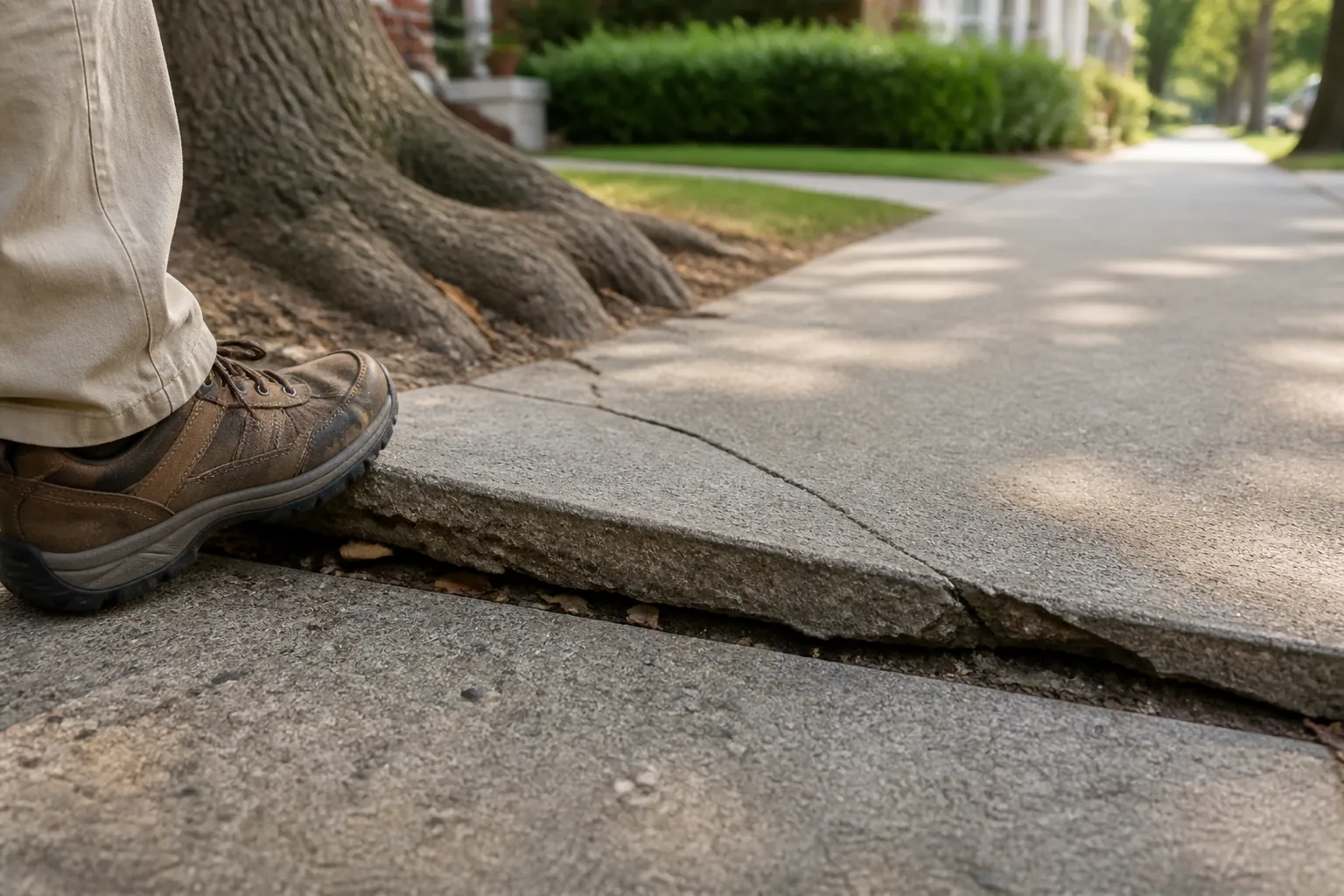
A block is not acceptable just because there is some walkable pavement somewhere on it. Ask whether the older adult can stay on the safest line without stepping into grass, tilting sideways around a pole, crossing a driveway blind spot, or squeezing past a hedge. A wide, unobstructed sidewalk is different from a technically present sidewalk that forces constant adjustments.
Senior-safe route guidance from Weymouth, Massachusetts, names features worth looking for: wide unobstructed sidewalks, smooth non-slip surfaces, high-contrast grade changes, accessible curb ramps, and extended crossing timers.[3] Even if your town uses different design standards, those features translate well into a caregiver’s route check because they are visible from the sidewalk.
Mark a block unacceptable when the workaround is the hazard
A broken slab may look manageable to a younger adult who can step wide without thinking. For an older walker, the workaround may require stepping into grass, crossing a driveway apron at an angle, walking near moving traffic, or holding a caregiver’s arm while both people navigate the same narrow spot. That is not a safe route feature. That is a warning to reroute.
- Choose the side of the street with fewer driveway crossings, fewer obstacles, and more shade.
- Avoid routes that require stepping off the sidewalk to pass a hazard.
- Prefer boring, even pavement over a scenic route with roots, glare, or loose surfaces.
- If a walker, cane, or rollator is used, confirm there is enough width to use it without turning sideways.
- Check the return route too; the safer side of the street may change with sun, traffic, or sidewalk condition.
Treat every curb as a decision point
Crossings deserve their own pause. The curb is where a small route problem can become a fall problem: stepping down without a curb cut, hurrying because a signal is short, turning the body while scanning traffic, or navigating a ramp with a steep lip.
At each crossing, verify the curb cut before choosing that corner. Look for an accessible ramp, a smooth transition from sidewalk to street, a marked crosswalk, and enough visibility for both the older adult and drivers. If the crossing has a signal, watch one full cycle before relying on it. The question is not whether a healthy adult can make it across. The question is whether this older adult can start, cross, and clear the street without rushing.
High-contrast grade changes can help people notice where the surface changes; extended crossing timers and accessible curb ramps are specifically included in senior-safe route design guidance.[3] If those supports are absent, the crossing may still be possible, but it should not be treated as automatically safe.
- Use marked crossings instead of cutting across mid-block.
- Avoid corners where parked cars, hedges, signs, or utility poles block sight lines.
- Skip crossings that require stepping from curb to street without a ramp or curb cut.
- Watch for glare on asphalt or painted lines, especially when the sun is low.
- Build the route so the hardest crossing happens early, not after heat and fatigue have accumulated.
Build shade, water, and rest into the route itself
Heat planning belongs on the same map as fall planning. A route with perfect pavement can still be a poor summer route if it has a long exposed stretch, no bench, no water, and no indoor place to cool down. The safer choice may be a shorter loop with shade and a rest stop instead of a longer path that looks healthier on paper.
The CDC notes that older adults adjust less well to sudden temperature changes, are more likely to take medicines that affect temperature control or sweating, and should not rely on thirst as the only signal to drink.[4] That means a summer route should not depend on the older adult feeling thirsty, asking to rest, or recognizing heat strain early.
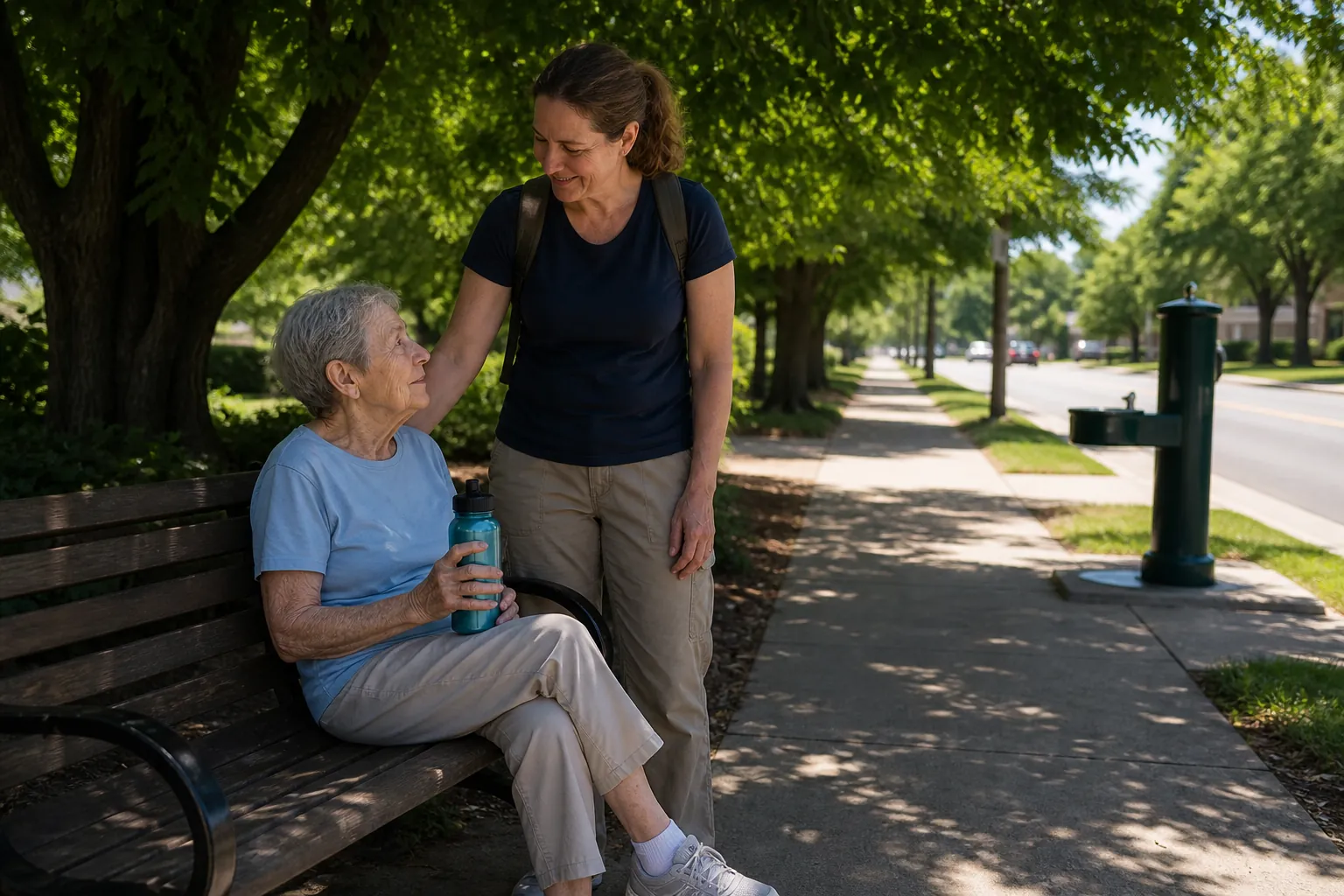
Walk the proposed route at the same time of day you plan to use it. Shade at 8 a.m. may disappear by late morning. A bench that is comfortable in spring may be in full sun in August. A drinking fountain may be present but shut off, blocked, or farther from the path than expected.
| Heat check | Route-level standard |
|---|---|
| Shade | There is shade on each meaningful stretch, not only at the destination. |
| Water | The older adult carries water, and the route has a reliable refill or stopping point when possible. |
| Rest | A bench, seat, wall, lobby, or shaded pause point appears before fatigue is likely. |
| Cooling option | There is an air-conditioned place nearby, or the route stays close enough to home to stop quickly. |
| Timing | The walk avoids the hottest part of the day and can be shortened without losing the way back. |
This is also where the route should get smaller if needed. A shaded two-block loop with a bench may be better than a half-mile route to a park that has no safe cooling option along the way. Summer walking is not improved by discovering the problem at the farthest point from home.
Use heat alerts as a caution, not as the whole plan
There is no single temperature number that makes every route safe below it or unsafe above it. Heat-index recommendations vary by source, and the CDC points people toward its HeatRisk approach rather than one universal cutoff.[4] For route planning, the practical question is more concrete: at the chosen time, can this route provide shade, water, rest, and a cooler exit before the older adult is in trouble?
The reason for extra caution is not theoretical. In CDC mortality data for 2004 through 2018, adults age 65 and older had the highest heat-related death rate, about 0.7 per 100,000, and accounted for about 39% of heat-related deaths.[5] Those figures do not tell you whether today’s sidewalk loop is safe. They do explain why an older adult’s summer walk deserves more planning than “bring a bottle and go early.”
If the forecast is concerning, the older adult has had recent illness, the route lacks shade, or medications may affect sweating or temperature control, shorten the route or move the walk indoors. If the concern is a broader heat emergency at home, such as loss of air conditioning or power during a heat wave, use a heat-specific plan such as How to Keep Seniors Safe in a Heat Wave Power Outage.
Match the route to the person walking today
The same sidewalk can be reasonable for one older adult and wrong for another. Recent falls, dizziness, neuropathy, vision changes, arthritis pain, medication changes, fear of falling, and use of a mobility aid all change the route decision. So does the day itself: poor sleep, dehydration, a new prescription, or a hotter-than-usual morning can make yesterday’s loop too much today.
For someone working on balance and confidence, uneven outdoor terrain should be introduced carefully. Outdoor activities can support strength and routine, but the route should not start with loose gravel, sloped grass, or a root-filled path. For related outdoor-balance considerations, see How Golf Helps Seniors Prevent Falls and Stay Safe.
If falls, near-falls, dizziness, medication side effects, or walking endurance are active concerns, bring them into a clinical visit rather than solving them only with route choice. The Medicare wellness visit can be one place to discuss fall risk screening; see Why Seniors Should Use Their Free Medicare Visit for Fall Prevention. If this route question follows a recent fall, start with recovery and monitoring basics first: Your Parent Just Fell: A Caregiver's Guide to the First 72 Hours.
Make the pre-walk decision before anyone is tired
After the block-by-block check, choose one of four decisions: walk the route as planned, shorten it, reroute it, or stay indoors. Make that call before the older adult is already hot, halfway across a difficult crossing, or standing at a broken curb with no good option.
- Walk as planned if every block has acceptable surface, crossings, shade or heat protection, rest options, and a clear return.
- Shorten the route if the safe features are present only for the first few blocks.
- Reroute if one crossing, curb, sidewalk segment, or shade gap creates the main risk.
- Move indoors if heat, fatigue, symptoms, air quality, or route conditions make outdoor walking a poor choice today.
A good route also has an exit plan. Decide where to turn around, which shaded bench is the first stop, where water is available, and what indoor place can be used if the walk needs to end. Carry a phone, identification, water, and any needed mobility aid. Wear stable shoes with good traction, not loose sandals or worn soles.
Damaged sidewalks, missing curb cuts, unsafe crossings, blocked pedestrian paths, or crossing timers that are too short can often be reported to local public works departments or 311 where available. Reporting does not fix today’s walk, so reroute now and report afterward.
CareWise Guide articles are educational and are not a substitute for medical advice, diagnosis, or treatment. Articles involving fall risk and heat safety follow the site’s reviewer practice; individualized concerns about symptoms, medications, mobility, hydration, or safe activity levels should be discussed with a clinician.
References
- Outdoor Falls Among Middle-Aged and Older Adults: A Neglected Public Health Problem, American Journal of Public Health, 2006
- 5 Steps to Avoid Falls in Your Neighborhood, National Council on Aging
- Safe Routes for Seniors, Town of Weymouth MA
- Heat and Older Adults (Aged 65+), Centers for Disease Control and Prevention
- Heat-Related Deaths — United States, 2004–2018, Centers for Disease Control and Prevention, Morbidity and Mortality Weekly Report
Related reading
Noticed something outdated or inaccurate on this page? Flag a correction. We review every report against CDC, NIA, and AARP HomeFit guidance before updating a page.
Part of the Fall Prevention section.