
STEADI: Intervene
Senior Dog Adoption Benefits Depend on a Fall-Safety Plan
Adopting a senior dog can bring older adults real benefits — less loneliness, more regular walking, and daily purpose — but those benefits hold only when the household plans for leash-walking fall risk, home tripping hazards, pet-care costs, and backup care. This guide helps older owners and adult-child caregivers weigh the evidence and build that safety plan before adoption.
A senior dog can be a very good match for an older adult aging in place. The dog may already know how to live in a house, sleep through the night, walk without puppy-level chaos, and settle near a chair while someone reads or watches television. That is the part many families are right to want: more company in the home, more rhythm in the day, and a living creature who expects breakfast, a walk, and a good-night routine.
The safety question is just as real. Senior dog adoption benefits for elderly owners do not come from the word “senior” by itself. They come from the match: the dog’s size, pulling strength, toileting habits, health needs, and daily care plan have to fit the owner’s balance, stamina, budget, home layout, and backup support. The older adult may be picturing companionship. The adult child may be picturing a leash wrapped around a wrist, a water bowl in the hallway, or a vet bill that arrives the same month as a medication copay. Both are looking at the same decision.
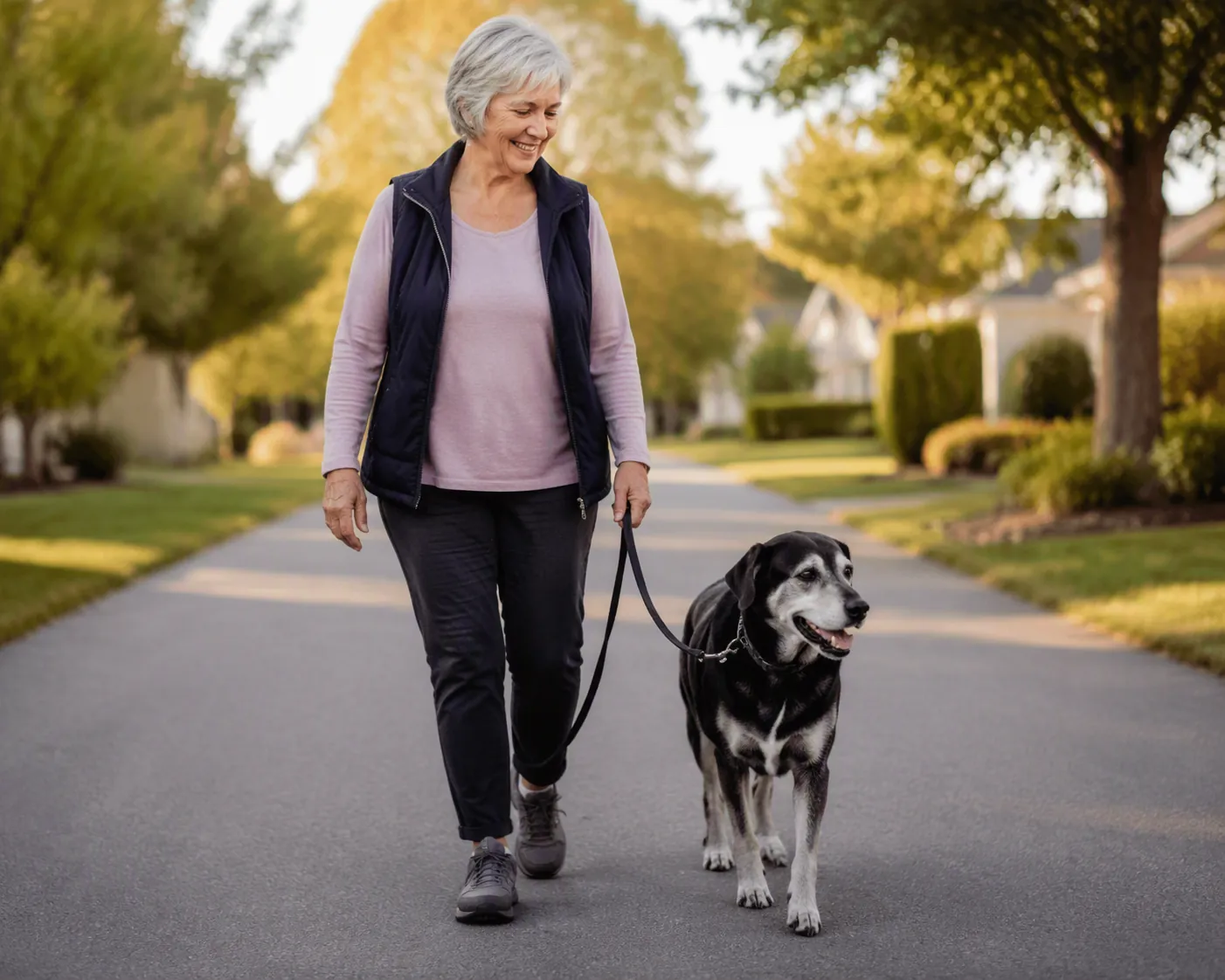
Why an older dog is often the safer starting point
“Senior dog” is not one fixed age. Size matters. PetMD describes senior status as roughly age 7 for many medium and large dogs, about age 11 for small dogs, and about age 5 for giant breeds.[1] That matters because an 11-year-old small terrier and a 6-year-old giant breed may have very different strength, life expectancy, medical needs, and walking demands.
For many older owners, the practical advantages of adopting an older dog are not sentimental extras. They are safety features. A mature dog’s adult size is known. Its shelter or foster caregivers may already have seen whether it pulls on leash, guards food, startles at doorbells, tolerates handling, soils indoors, or panics when left alone. AARP and PetMD both point to common fit advantages in older dogs: they may be calmer, already housebroken, past the most destructive puppy stage, and easier to assess for temperament than a young puppy.[1][2]
There is also a humane reason to look at them first. Best Friends reports that senior dogs are adopted at lower rates than younger dogs, with about 25% of senior shelter dogs adopted compared with about 60% of younger dogs.[3] For the right household, that overlooked gray muzzle may be the better match precisely because it is not starting life at full speed.
Still, a calmer dog is not automatically a safe dog. A 70-pound senior dog who lunges at squirrels can be more dangerous on a sidewalk than a small puppy carried to a training class. A small dog who sleeps in dark hallways can still become a nighttime trip hazard. The safer starting point becomes truly safer only after the household checks the walk, the floor, the money, and the backup plan.
The benefits are real, but they are mostly associations
The best evidence for pet ownership in later life should be read with care. Much of it is observational, and several of the most relevant studies are cross-sectional. That means they can show that pet ownership or dog walking is associated with better outcomes, but they do not prove that adopting a dog caused those outcomes. A dog is not a medical treatment, a fall-prevention device, or a substitute for physical therapy, vision care, medication review, or home safety work.
With that limit stated, the findings are still useful. In a study of 830 adults age 60 and older, Stanley and colleagues found that pet owners had 36% lower odds of reporting loneliness, with the strongest relevance for people living alone; the study was cross-sectional.[4] That is the kind of finding that fits what families often see in real homes: the chair is less empty, the day has more small appointments, and there is someone waiting near the door.
The National Poll on Healthy Aging also helps explain the “shape of the day” benefit. Among older pet owners, companionship, purpose, and routine were prominent themes, and those themes are especially important for someone who lives alone.[5] Feeding the dog, opening the curtains, taking a short walk, and noticing whether the water bowl is full can pull a person into a steadier daily pattern.
That daily pattern is where senior dog adoption intersects with fall prevention. The question is not only whether a dog makes someone feel better. It is whether the dog helps the owner move more regularly without creating a new fall event.
Walking more and walking safely are not the same thing
The walking evidence is the center of the decision. In a 2025 analysis from The Irish Longitudinal Study on Ageing, regular dog walking, defined as at least 4 days per week, was associated with faster Timed-Up-and-Go performance, about 40% lower odds of unexplained falls, and about 20% lower fear of falling. The study was cross-sectional, so it does not prove that dog walking caused those differences.[6]
Those findings make sense in a practical way. A dog can turn “I should get out today” into “the dog needs to go out now.” Regular walking can support leg strength, balance confidence, and endurance when the route, pace, and conditions are appropriate. For older adults trying to maintain steadiness, walking is not a decorative benefit. It is part of remaining mobile, especially when paired with the basics covered in a broader fall-prevention plan and with attention to strength and nutrition.
But the same walk can also be the fall. Safety+Health Magazine reported on a JAMA Surgery study finding that dog-walking fractures among adults age 65 and older more than doubled, from 1,671 in 2004 to 4,396 in 2017. Women accounted for 78% of the injuries, and about 17% were hip fractures.[7] Those numbers do not mean older adults should avoid dogs. They mean the leash deserves the same seriousness as the shower grab bar, the stair rail, and the rug edge.
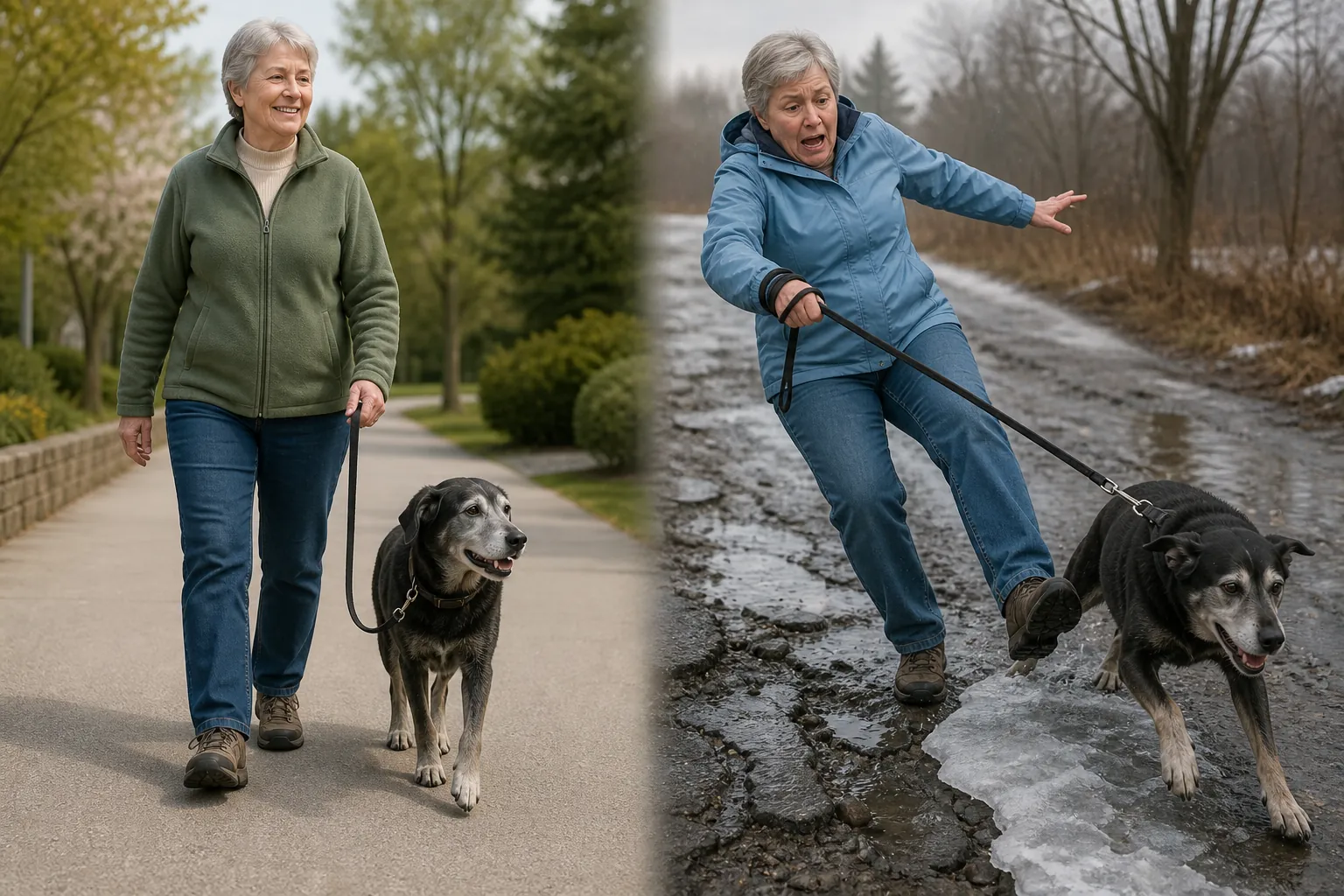
The pre-adoption walk test
Before adoption, the older adult should walk the actual dog, not just meet it in a kennel or read a flattering profile. If possible, a caregiver or shelter staff member should watch the walk from the side. The useful question is not “Is this dog sweet?” A dog can be sweet and still too strong at the end of a leash.
| What to watch | Why it matters for falls |
|---|---|
| Does the dog start calmly at the door? | Doorway excitement can make the owner step backward, twist, or hurry before balance is set. |
| Does the leash stay loose most of the time? | A steady low-pull walk is very different from being pulled toward people, dogs, cars, or squirrels. |
| Can the owner turn, stop, and restart without being dragged? | Falls often happen during transitions, not only during straight-line walking. |
| Can the owner manage the leash while keeping posture upright? | Leash handling should not require wrapping the leash around the wrist or leaning away from the dog. |
| Does the dog’s bathroom pace fit the owner? | A dog who must rush outside repeatedly may create unsafe trips in poor weather or darkness. |
A low-pull senior dog is usually a better candidate than a powerful dog who “only pulls for the first block.” For an older adult with arthritis, neuropathy, poor vision, dizziness, or a prior fall, the first block may be exactly where the injury happens. If the shelter, rescue, or foster home cannot describe the dog’s leash behavior clearly, ask for another supervised walk in a quieter area before deciding.
Make the route boring on purpose
A safe dog-walking route is not the most scenic route. It is the route with the fewest surprises: smooth pavement, good lighting, predictable traffic, places to rest if needed, and no routine need to cross icy patches, muddy grass, steep driveways, broken sidewalks, or crowded curbs. The best route may be shorter than the owner hoped at first. That is fine. A short, repeatable walk done safely is more useful than an ambitious loop that becomes a test of luck.
Footwear belongs in the dog plan. So does timing. Walk before the sidewalk gets slick, before the neighborhood becomes poorly lit, and before heat makes dizziness or dehydration more likely. In hot weather, a dog’s need to go out can collide with the owner’s heat risk; the household may need a morning-and-evening schedule, shaded route, or helper plan. For older adults who already struggle in heat, a heat-safety walking checklist is part of the adoption discussion, not an afterthought.
Leash setup should keep the owner’s body free to recover balance. Do not wrap the leash around the wrist. Avoid carrying groceries, mail, or a large bag during the walk. If the owner uses a cane, walker, or trekking pole, the leash plan needs professional or trainer input before adoption, because the dog cannot be allowed to compete with the mobility aid for hand control. Some households solve this by assigning longer walks to a neighbor, family member, dog walker, or volunteer while the owner handles only short yard or hallway outings.
This is the hinge: the same dog walk that supports routine and steadiness can become the fall event if the plan is vague. The benefit depends on choosing a dog whose movement does not overpower the owner’s movement.
Walk through the home as if the dog already lives there
Indoor risk is quieter than leash risk, but it is where the dog will be every day. Before adoption, walk from the bedroom to the bathroom, from the favorite chair to the kitchen, and from the front door to the dog’s likely sleeping area. Then picture the dog, bowls, toys, bed, gates, leash, and nighttime bathroom trip added to that path.
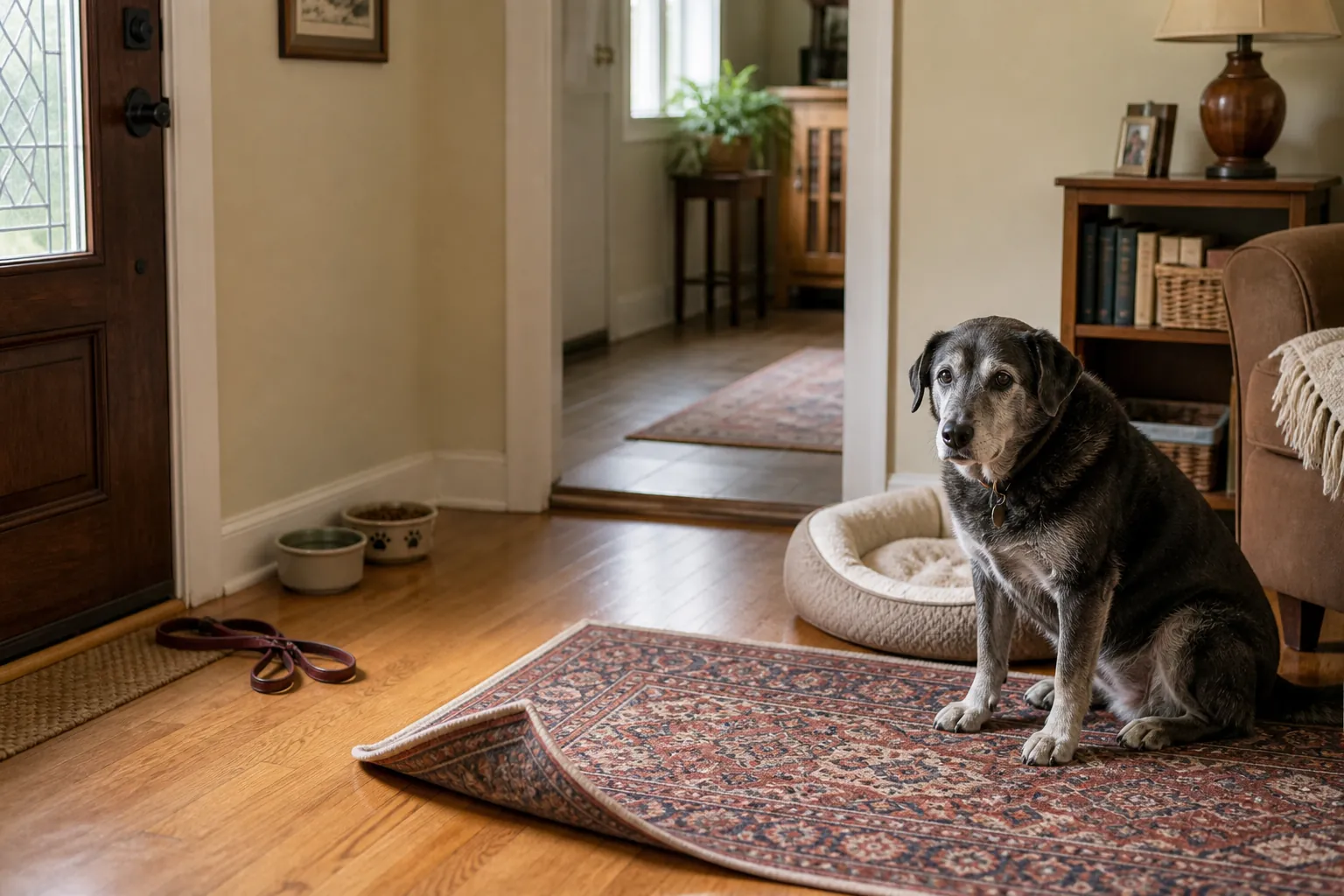
- Place food and water bowls off the walking path, not between the chair and bathroom or in a narrow kitchen passage.
- Choose a dog bed location that gives the dog a quiet corner without forcing the owner to step over it.
- Keep toys in a bin or defined area, especially if the owner walks at night or has low vision.
- Hang the leash at hand height near the door instead of leaving it coiled on the floor.
- Remove or secure scatter rugs, curled rug edges, and mats that slide when a dog trots across them.
- Check thresholds, baby gates, and pet gates carefully. A gate that protects one area can become a fall hazard if the owner has to step over it.
- Plan for door excitement. The dog should not be able to rush the owner’s legs when visitors, deliveries, or family members arrive.
This does not require turning the house into a kennel. It requires treating dog items as part of the walking surface. A basic home fall-safety handout can help families do the first pass, then repeat it with the dog’s belongings in mind.
The budget has to survive the adoption
Money is a safety issue when it affects vet care, grooming, food, parasite prevention, transportation, or the ability to hire help after an illness. In the National Poll on Healthy Aging, 26% of pet owners reported that pet care put a strain on their budget.[5] That figure should be discussed before adoption, not after the first dental estimate or emergency visit.
Senior dogs may have known medical needs. That can be an advantage because the household is not guessing blindly, but it is still a cost. Ask the shelter or rescue for known diagnoses, medications, diet needs, dental history, mobility limitations, and the most recent veterinary records available. If the dog needs regular grooming, ask what that costs locally and whether the owner can transport the dog safely.
Cost-reduction programs can help, but they are not universal. Pets for the Elderly describes a network of 53 partner shelters in 31 states and more than 100,000 adoptions supported through its work.[8] Local senior-to-senior adoption discounts, veterinary partnerships, and food banks can change, so the family should verify what is available in the owner’s ZIP code before relying on it. A household already stress-testing retirement costs should include pet expenses in the same exercise, alongside housing, health care, and transportation; a healthcare and housing budget stress test is a reasonable place to add this line item.
Backup care is not optional for an older adopter
Every adopter should think about backup care. Older adopters need it in writing because hospitalization, rehab stays, sudden illness, and death are not abstract possibilities. Whole Dog Journal’s guidance for senior adopters emphasizes blunt planning for who will care for the dog if the owner cannot, including arrangements that may involve family, friends, legal planning, or a trust.[9]
The first backup question is immediate: who can get into the home today if the owner is taken to the hospital? That person needs a key or access code, feeding instructions, medication instructions, the veterinarian’s number, the dog’s hiding places, and permission to make practical decisions. The second question is longer-term: who will keep or rehome the dog if the owner cannot return home?
A verbal promise made at Thanksgiving is not a care plan. Write down the primary caregiver, secondary caregiver, veterinarian, medication list, feeding routine, walking limits, and financial arrangement. If the dog will pass to a specific person or if funds will be set aside for care, the owner should discuss legal options with an attorney. This article is decision support, not legal, financial, or medical advice.
There is also the grief reality. A senior dog may offer a wonderful few years rather than a decade. Some older adults prefer that; others will find the shorter horizon painful. The adoption is kinder to both owner and dog when everyone has said that out loud.
If the owner already has an aging-in-place plan, the dog belongs inside it. If there is no plan yet, the adoption discussion is a good time to start one, including who helps with errands, transportation, dog walking, and home access during illness. A written aging-in-place home care plan can keep the dog from becoming one more emergency task for whoever answers the phone first.
Health precautions should be simple and consistent
Most older adults can enjoy pets safely, but age changes the risk calculation for infections passed between animals and people. CDC healthy-pets guidance notes that adults 65 and older are among the groups more likely to get sick from germs animals can carry.[10] The practical response is not fear. It is routine: handwashing after handling waste or food bowls, regular veterinary care, parasite prevention, safe cleanup supplies, and asking a clinician or veterinarian about extra precautions if the owner is immunocompromised.
This is another reason to avoid a vague adoption. A dog with uncontrolled diarrhea, untreated skin disease, unknown vaccination history, or difficult handling may be the wrong first choice for an older adult with fragile health, even if the dog is lovable. The better question is whether this particular dog can be cared for cleanly, calmly, and consistently in this particular home.
The four questions to answer before the leash comes home
- Walking: Can this owner safely walk this dog on the real routes, in the real weather, at the real times the dog will need to go out?
- Indoor hazards: Have bowls, beds, toys, rugs, gates, thresholds, leashes, and nighttime paths been placed or changed so they do not create tripping hazards?
- Money: Can the owner afford food, routine veterinary care, medications, grooming, transportation, and a realistic emergency cushion, with any discounts verified locally?
- Backup care: Who feeds, walks, transports, and ultimately keeps or rehomes the dog if the owner is hospitalized, enters rehab, moves, or dies?
If those answers are weak, wait, choose a different dog, or build more support first. If the answers are solid, a senior dog can be more than the safer alternative to a puppy. For many older adults, the right older dog is a better aging-in-place companion because the household planned for the risks before the leash came home.
References
- What to Know Before Adopting a Senior Dog, PetMD
- A Doggone Good Match, AARP
- 8 reasons to adopt a senior pet, Best Friends Animal Society
- Pet Ownership May Attenuate Loneliness Among Older Adult Primary Care Patients Who Live Alone, Aging & Mental Health, 2013
- How Pets Contribute to Healthy Aging, National Poll on Healthy Aging
- Dog walking, mobility, falls and fear of falling in older adults: findings from The Irish Longitudinal Study on Ageing, The Journals of Gerontology: Series A, 2025
- Dog-walking injuries on the rise among seniors, study shows, Safety+Health Magazine
- Our Work, Pets for the Elderly
- Straight Talk for Senior Adopters, Whole Dog Journal
- About Healthy Pets, Healthy People, Centers for Disease Control and Prevention
Related reading
Noticed something outdated or inaccurate on this page? Flag a correction. We review every report against CDC, NIA, and AARP HomeFit guidance before updating a page.
Part of the Fall Prevention section.