
STEADI: Intervene
Fall-Safe Tornado Preparedness Checklist for Seniors
Standard tornado checklists don't account for walkers, 30-day medication supplies, or medical devices that fail when power goes out. This fall-safe, senior-specific checklist covers pre-season shelter-route fall-proofing, getting to shelter during a warning, and the fall risks that follow a storm.
A tornado warning at 2:17 a.m. is not the same problem for everyone. For an older adult, the warning may begin with a phone alert that is hard to hear, glasses on the nightstand, shoes across the room, a walker parked in the hallway, and a shelter route that includes a throw rug, a dark stairwell, or a tight doorway. A standard checklist that says “go to your safe place” skips the part where many injuries happen: getting there.
A tornado emergency preparedness checklist for seniors has to be built around fall prevention, mobility, medication continuity, and power-dependent equipment before it adds the usual water, food, flashlight, and radio. Those ordinary supplies still matter. They just do not solve the problem of a parent who cannot safely descend basement stairs, breathe without powered oxygen equipment, or find a hearing aid battery in the dark.
The reason to rebuild the list is not theoretical. In the April 2011 southeastern tornado outbreak, adults 65 and older accounted for about 32.5% of the 338 tornado fatalities reported by CDC, and the same report noted that some indirect deaths came after the tornadoes, including medical equipment failure during power outages and falls or injuries during cleanup.[1] People with disabilities are also reported to be 2–4 times more likely to die or be injured in disasters than people without disabilities.[2] Yet only 40% of adults ages 50–80 had discussed evacuation plans with family, and fewer than half had signed up for emergency alerts in the University of Michigan National Poll on Healthy Aging cited by AARP.[3]
The quick fall-safe tornado checklist
Print this part first. The detailed sections below explain how to make each item work for an older adult who may be alone when the warning arrives.
| When | What to have ready | Fall-safe detail that is easy to miss |
|---|---|---|
| Before tornado season | Choose the safest accessible shelter; sign up for alerts; practice the route; prepare the kit. | Remove throw rugs and clutter along the shelter path, add night-lights, test whether the walker fits through every doorway, and stage shoes, glasses, and mobility aids where they are actually needed. |
| Before tornado season | Build a senior-specific kit. | Include medication supplies and copies, medical-device power plans, spare sensory aids, incontinence supplies, closed-toe shoes, goggles, gloves, and a helmet stored in or beside the shelter. |
| During a warning | Move to shelter using the practiced route. | Do not stop to gather scattered supplies. Put on staged shoes if they are within reach, take the staged mobility aid, protect the head, and sit in the safest stable position available. |
| After the storm | Wait for safe conditions before leaving shelter or cleaning. | Assume debris, wet flooring, darkness, unstable stairs, downed lines, and power outages have created new fall risks. |
| Every 6 months | Practice the plan and refresh supplies. | Time the route, check batteries, update medication lists, and confirm who is called if the older adult cannot reach help. |
Start with the route, not the supply bin
Tornado guidance often assumes there is enough time to hear the warning, stand up quickly, grab shoes, move through the house, and get low in a basement or interior room. CDC’s report on the 2011 outbreak noted a mean tornado warning lead time of about 22 minutes, but some warnings provide only minutes.[1] For a senior using a walker, oxygen tubing, a cane, low vision, or poor balance, “minutes” is not a planning margin. It is the reason the route must already be solved.
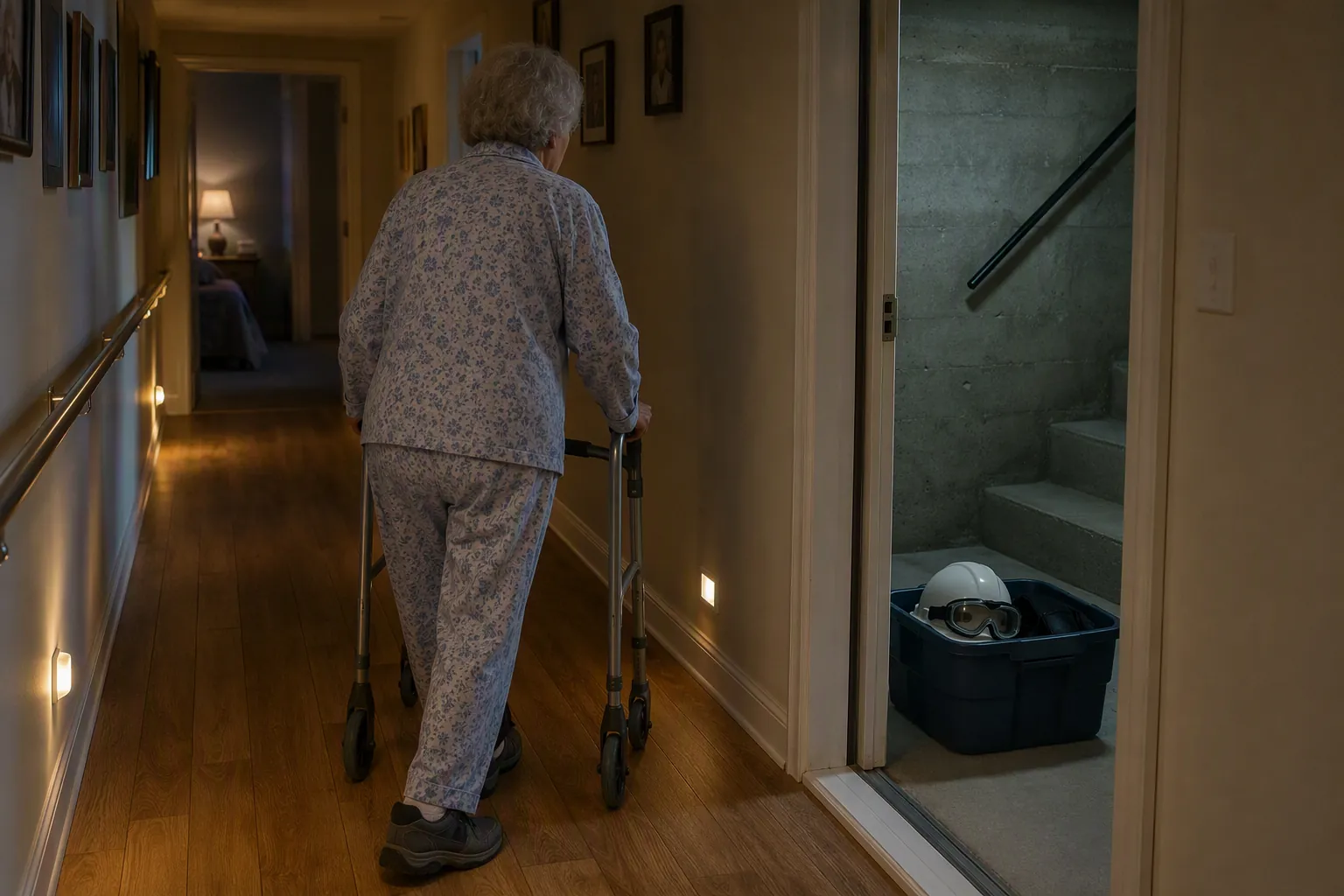
Walk the exact path from the bed, favorite chair, bathroom, and kitchen to the tornado shelter. Do it at night. Do it with the walker, cane, rollator, wheelchair, oxygen tubing, or transfer belt that would be used during a real warning. If a caregiver lives elsewhere, the route has to work before that person arrives.
- Remove throw rugs, loose mats, cords, baskets, pet bowls, and low furniture from the shelter route.
- Add night-lights from the bedroom and bathroom to the shelter, including near the first stair or threshold.
- Make sure flooring is non-slip and that wet shoes or socks will not turn the route into a slide.
- Check that the walker or wheelchair fits through the shelter doorway without turning sideways.
- Move the walker, cane, or rollator out from behind recliners, side tables, and tight corners.
- Stage closed-toe shoes, glasses, hearing aids, and a flashlight where the older adult can reach them from bed or the main chair.
- If hand support is needed along a hall or stair, use properly installed grab bars or railings, not towel bars or decorative hardware.
CDC fall-prevention materials emphasize removing throw rugs, improving lighting, clearing clutter, and using safer flooring or support in the home.[4] Those recommendations become more urgent on a tornado route because the older adult is moving under stress, possibly in darkness, and may be wearing hearing aids, bifocals, or shoes that were not chosen for traction.
If you are adding support along a hallway, bathroom-adjacent route, or shelter entrance, treat it like fall-prevention equipment. A towel bar is not a grab bar; it is not designed to catch body weight during a stumble. For the difference, see Can a Towel Bar Be Used as a Grab Bar? before installing anything a parent may rely on during a warning.
Basement, interior room, or safe room: choose what the person can reach
A basement is often the strongest available option in a house, but it is not automatically the safest option for a person who cannot manage the stairs. Reporting from tornado-prone areas has documented a common accessibility problem: many tornado shelters use steep stairs, leaving people with ambulatory disabilities without a shelter they can actually enter.[5]
If the basement route is unsafe, plan for the most protected accessible place available: a small interior room on the lowest reachable floor, away from windows, with a place to sit or get low without dropping suddenly to the floor. If the home can be modified, an above-ground safe room built to FEMA P-320 or P-361 criteria may be an accessibility option for wheelchair users or people who cannot do stairs, but that decision belongs with local code officials, a qualified contractor, and FEMA safe-room guidance—not guesswork.[6]
The practical test is simple: the older adult should be able to enter the shelter with the mobility aid they use on a bad day, close or secure the door as planned, sit without losing balance, and keep essential equipment within reach.
Build the kit around the person, not the disaster aisle
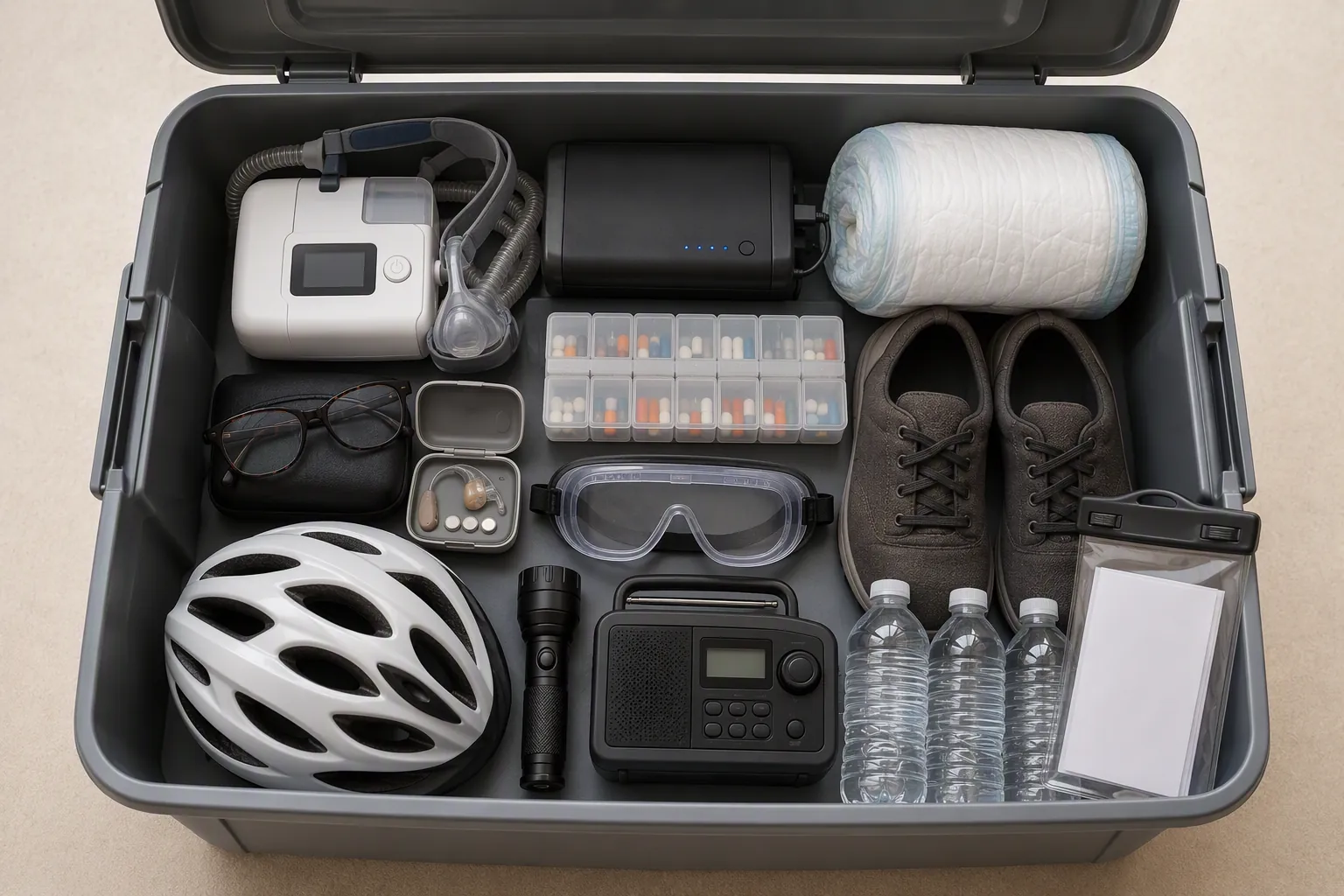
A senior tornado kit still needs the familiar supplies: water, ready-to-eat food, flashlight, extra batteries, battery or hand-crank radio, phone charger, first-aid supplies, sanitation items, cash, and copies of important documents. The Red Cross recommends at least 2 weeks of stay-at-home supplies for older adults and a 1-month supply of medications in a child-proof container.[7]
For medications, do not improvise around prescription rules. Ask the physician or pharmacist what extra supply is allowed, how to rotate it, whether any medications require temperature control, and what to do if the pharmacy is closed after a storm. AgingCare also recommends asking a doctor for an extra week’s supply of prescriptions as part of emergency planning.[8]
Medication and medical information
- A current medication list with drug names, doses, schedules, prescribing clinicians, pharmacy phone number, allergies, and major diagnoses.
- Copies of insurance cards, Medicare or Medicaid information, advance directives if used, emergency contacts, and caregiver phone numbers sealed in a waterproof pouch.
- A labeled medication supply approved by the physician or pharmacist, with a calendar reminder to rotate before expiration.
- A written plan for refrigerated medications, oxygen suppliers, dialysis contacts, home health agencies, or pharmacy delivery interruptions.
Keep copies where a caregiver can find them without searching through drawers after a roof leak, power failure, or evacuation. A sealed pouch in the shelter kit and a duplicate with the adult child or trusted neighbor are both reasonable if the older adult agrees.
Power-dependent equipment
If the older adult uses oxygen, CPAP, a nebulizer, powered mobility equipment, a lift chair, an adjustable bed, refrigerated medication, or a phone-based medical alert device, the tornado kit is not complete until the power plan is written down and tested. CDC’s 2011 outbreak report recorded 3 of 20 indirect deaths from medical equipment failure during power outages.[1]
- Ask the equipment provider which battery backup is compatible with the device and how long it runs under normal use.
- Keep charging cables, wall adapters, and labeled backup batteries in one place.
- If the person uses oxygen, ask the supplier about emergency cylinders, delivery disruptions, and utility medical-priority programs.
- If the person uses a power chair, consider a manual mobility backup when feasible; AgingCare specifically recommends a manual wheelchair backup for power-chair users.[8]
- Write down what fails if the power goes out: lift chair, stair lift, garage door, landline, internet phone, refrigerator, bed controls, or medical alert base station.
Do not wait for an outage to learn whether the backup battery works. Charge it, unplug the device during a calm day, and confirm the older adult and caregiver understand the alarm sounds, run time, and recharge method. For deeper outage planning after severe weather, use What Seniors Should Do If Power Is Still Out After a Storm.
Mobility, sensory, and personal-care supplies
- Closed-toe, sturdy shoes beside the bed and another pair near or inside the shelter.
- A spare cane, walker tips, wheelchair charger, transfer belt, or other mobility accessory the person already knows how to use.
- Spare glasses, magnifier, hearing aid batteries, hearing aid case, and any communication card needed if speech or hearing is limited.
- A whistle attached to a cane, walker, or lanyard; AgingCare suggests attaching a whistle to an extra cane for visually impaired seniors.[8]
- Incontinence briefs or pads, wipes, disposable bags, hand sanitizer, toilet paper, and skin-protection supplies.
- Work gloves, a warm layer, blanket, and a change of socks in case the shelter area is damp or cold.
Head, eye, and foot protection
Do not store the helmet in a closet upstairs. CDC notes that head injuries cause about 22% of tornado-related deaths and recommends protecting the head with items such as a helmet, while also warning that looking for a helmet should not delay getting to shelter.[9] The answer is to store the helmet in the shelter area before the season starts.
- A bicycle, sports, or other protective helmet that fits the older adult.
- Safety goggles to protect eyes from dust, insulation, glass, or debris.
- Sturdy closed-toe shoes or boots that can be put on quickly.
- A heavy coat or padded jacket stored near the shelter if it can be reached without delay.
United Spinal Association also lists items such as a bike helmet, safety goggles, heavy winter coat, and sturdy closed-toe shoes for tornado preparedness.[2] Those items are especially important for an older adult because they reduce the need to walk through broken glass, dust, or debris unprotected after the storm.
During a tornado warning: use the plan you already made
The warning is not the time to pack. It is the time to move along the route that has already been cleared and practiced.
- Put on the staged closed-toe shoes if they are within immediate reach. If reaching for them creates a fall risk or delay, move to shelter.
- Take the mobility aid that is already positioned for the route: walker, cane, rollator, wheelchair, or transfer support.
- Use the pre-cleared path. Do not cut through cluttered rooms or try unfamiliar stairs because they seem faster.
- Go to the accessible shelter location: basement if safely reachable, otherwise the planned interior room or safe room.
- Sit on the prepared chair, bench, cushion, or stable low position. Avoid dropping suddenly to the floor if getting back up would be unsafe.
- Protect the head with the helmet or other covering already stored there.
- Use the phone, medical alert device, or whistle only after reaching shelter unless help is needed to get there.
- Stay sheltered until the warning has passed and local alerts indicate it is safe to leave.
If the older adult lives alone, the contact plan should be specific: who calls first, who checks if there is no answer, who has a key or lockbox code, and when emergency services should be contacted. For broader severe-weather planning beyond tornadoes, see Severe Weather Safety Checklist for Seniors Living Alone.
After the storm, the house has changed
A familiar hallway can become a fall hazard after a tornado: insulation on the floor, water near a threshold, glass in carpet, a door that sticks, a missing handrail, or a stair tread loosened by impact. CDC’s report on the 2011 outbreak recorded 2 of 20 indirect deaths from falls or injuries during cleanup.[1]
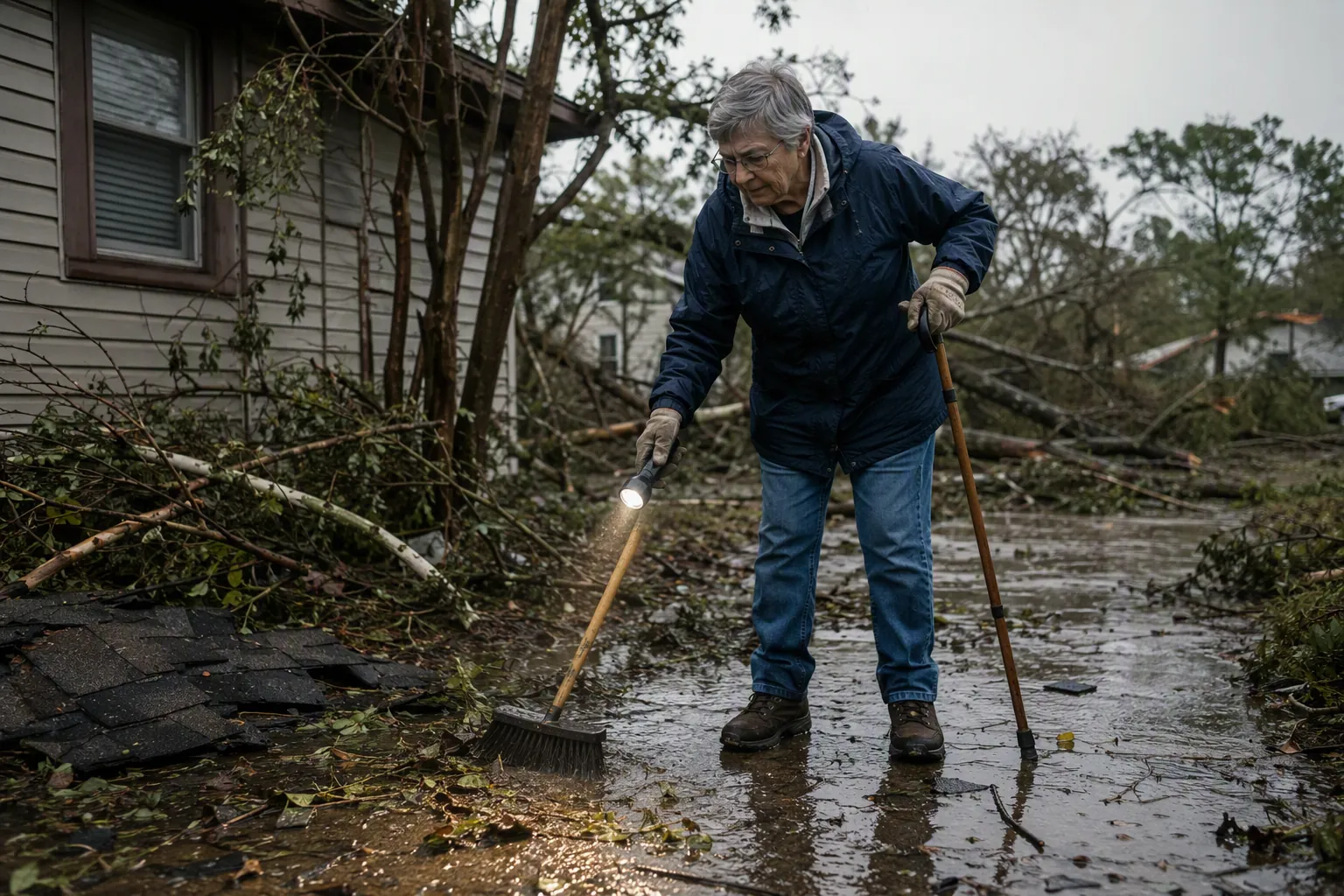
- Do not walk through debris in slippers, socks, or open-back shoes.
- Use a flashlight before stepping out of shelter, especially if power is out.
- Assume wet flooring, mud, insulation, leaves, and broken shingles are slippery.
- Avoid stairs until they have been checked for damage, water, and loose railings.
- Do not move heavy branches, furniture, or wet carpet alone.
- Keep using the walker, cane, or rollator; do not abandon it because debris makes the path inconvenient.
- If oxygen, CPAP, refrigeration, phone service, or mobility charging is interrupted, switch to the written backup plan and contact the designated helper or supplier.
Cleanup is where many families relax too early. The tornado has passed, but the older adult may now be moving through worse lighting, worse footing, and fewer working devices than before the warning. If power remains out, use What Seniors Should Do If Power Is Still Out After a Storm rather than trying to solve generator safety, refrigerated medication, food safety, and device charging in the middle of the outage.
Practice the plan every 6 months
The Red Cross recommends practicing emergency plans every 6 months.[7] For an older adult, that practice should be physical, not just a conversation at the kitchen table.
- Walk from the bed to the shelter using the normal nighttime setup.
- Walk from the main chair, bathroom, and kitchen to the shelter.
- Confirm the walker, wheelchair, oxygen tubing, or cane fits the route.
- Replace flashlight batteries, radio batteries, hearing aid batteries, and expired supplies.
- Update medication lists, emergency contacts, pharmacy information, and device-provider numbers.
- Check that shoes, helmet, goggles, gloves, glasses, and the phone charger are still in the planned location.
- Practice the call tree: older adult, adult child, neighbor, caregiver, and emergency contact.
If you are building a full disaster binder for a parent, it can help to keep other fall-prevention disaster checklists nearby, including an earthquake evacuation checklist for elderly parents and wildfire safety guidance for older adults.
Before the next tornado season, answer the question without optimism: if no caregiver is present, can the older adult reach the shelter, sit safely, communicate, breathe, see, hear, take medication, and avoid cleanup falls after the warning has passed?
References
- Tornado-Related Fatalities — Five States, Southeastern United States, April 25–28, 2011 — CDC MMWR, July 20, 2012
- Disaster Preparedness — United Spinal Association
- Extreme Weather and Older Adults — AARP
- Check for Safety: A Home Fall Prevention Checklist for Older Adults — CDC
- Many People With Disabilities Lack Accessible Tornado Shelters — KCUR, February 2020
- Safe Rooms — FEMA
- Disaster Preparedness for Older Adults — American Red Cross
- Emergency Preparedness for Seniors — AgingCare
- Staying Safe During a Tornado — CDC, February 2024
Related reading
Noticed something outdated or inaccurate on this page? Flag a correction. We review every report against CDC, NIA, and AARP HomeFit guidance before updating a page.
Part of the Fall Prevention section.