
Protect Seniors from Falls During Heavy Rain Warnings
Warm-season heavy rain warnings pose a surprising fall risk for older adults. Learn why rain-soaked surfaces in summer can be as dangerous as winter ice, and get a step-by-step caregiver action plan for before, during, and after a storm.
A heavy rain warning in July deserves more respect than many families give it. In a Johns Hopkins cohort of older adults with glaucoma, every 10°C increase in daily temperature was associated with 24% higher odds that a fall was injurious, and during summer an injurious fall was 2.69 times more likely to happen outdoors than during winter.[1] Those numbers do not mean every warm storm causes a fall. They do mean that “it’s only rain” is a weak safety plan for an older adult who still takes the trash out, checks the mail, moves a planter, or steps onto wet grass because the errand feels too small to postpone.
The same study found that 49% of all falls occurred outdoors, and among outdoor injurious falls, wet ground and uneven surfaces were the most common contributors.[1] That should change how caregivers respond to warm-season alerts. Winter ice gets named as danger. Summer rain often gets treated as inconvenience, even though the older adult may be more active outside, the light may fail during a storm, and the path from the doorway to the walkway may become slick before anyone feels alarmed.
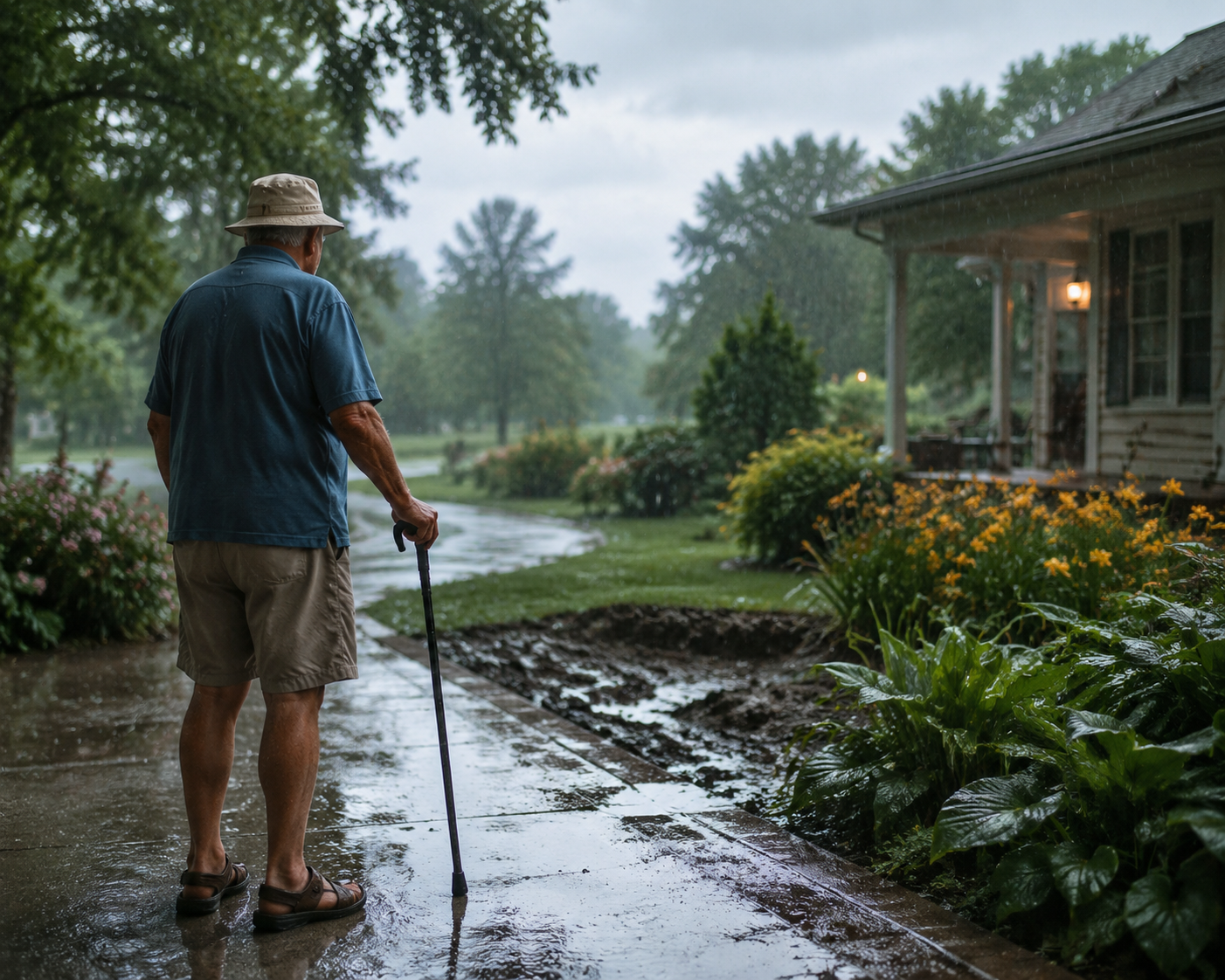
The Johns Hopkins findings need a careful reading. The participants were older adults with glaucoma, so vision-related risk was part of the setting. The data came from one regional catchment area, and the study shows associations rather than proving that temperature itself caused each injury.[1] Still, the practical lesson is strong enough for caregiving: when a heavy rain warning arrives in warm weather, outdoor fall risk deserves the same timed response families usually reserve for ice.
Why warm rain catches caregivers off guard
Older adults do not usually step onto winter ice casually. They test the porch, wait for salt, hold the rail, or accept a ride to the mailbox. Warm rain does not trigger the same caution. A parent may say they are “just going out for a second,” and the caregiver may hear that as reasonable because the temperature is comfortable and the errand is familiar.
That is the blind spot. Warm weather increases the chance that someone is already outdoors or willing to go outdoors. The task may be ordinary: bringing in cushions, moving a bin, checking a garden, retrieving a delivery. When rain starts hard, the movement changes. A person who normally walks slowly may hurry. A cane tip lands on wet pavement. A shoe moves from grass to tile. The fall risk is not only the storm; it is the small acceleration the storm creates.
The Ohio Department of Aging makes the comparison plainly: “mud can be as slippery as snow and ice,” and storm debris can hide trip hazards on outdoor walkways.[2] That sentence is useful because it gives caregivers language that does not sound dramatic. It is easier to say, “Let’s treat the mud like ice until I check the path,” than to argue over whether rain is dangerous.
Heavy rain also brings an indoor problem. Wet shoes cross a threshold. Water collects near a mat. A light flickers, then fails. The older adult who avoided the front walk may still be moving through a dim entryway on a slick floor. If your family has not already prepared for that darkness hazard, use a power outage fall prevention checklist before storm season, not after the first outage.
What a heavy rain warning should trigger
The CDC estimates that more than 1 in 4 older adults falls each year.[3] That baseline is why heavy rain warnings should become a caregiving cue rather than background noise. The alert gives the family something valuable: time. Not much time, sometimes, but enough to interrupt the chain from outdoor errand to hurried movement to wet surface to injury.
| Timing | Caregiver focus | Fall-risk question |
|---|---|---|
| Before the rain | Delay outdoor tasks, prepare lighting and footwear, reduce loose hazards | What can be handled now so the older adult does not need to hurry later? |
| During the warning | Keep movement indoors, control wet thresholds, avoid last-minute retrievals | Where might rain pull the person toward a slick or dim surface? |
| After the storm | Inspect paths, mud, debris, branches, grass, and assistive-device traction | What changed outside before the older adult resumes a routine? |
This is not about turning a parent’s home into a supervised facility. It is about making the next hour less negotiable. A warning gives the caregiver permission to act before the parent feels unsafe.
Before the rain: remove the reason to step outside
The most useful call happens before the rain becomes visible. A long-distance caregiver can call and say, “The heavy rain warning starts soon. Please leave the bins, mail, plants, and packages until I check back.” The wording matters. Asking an older adult to “be careful” leaves the decision open. Naming the specific tasks to postpone makes the plan easier to accept.
- Move routine outdoor tasks earlier or delay them: trash bins, mail, newspapers, pet items, garden tools, patio cushions, deliveries, and porch plants.
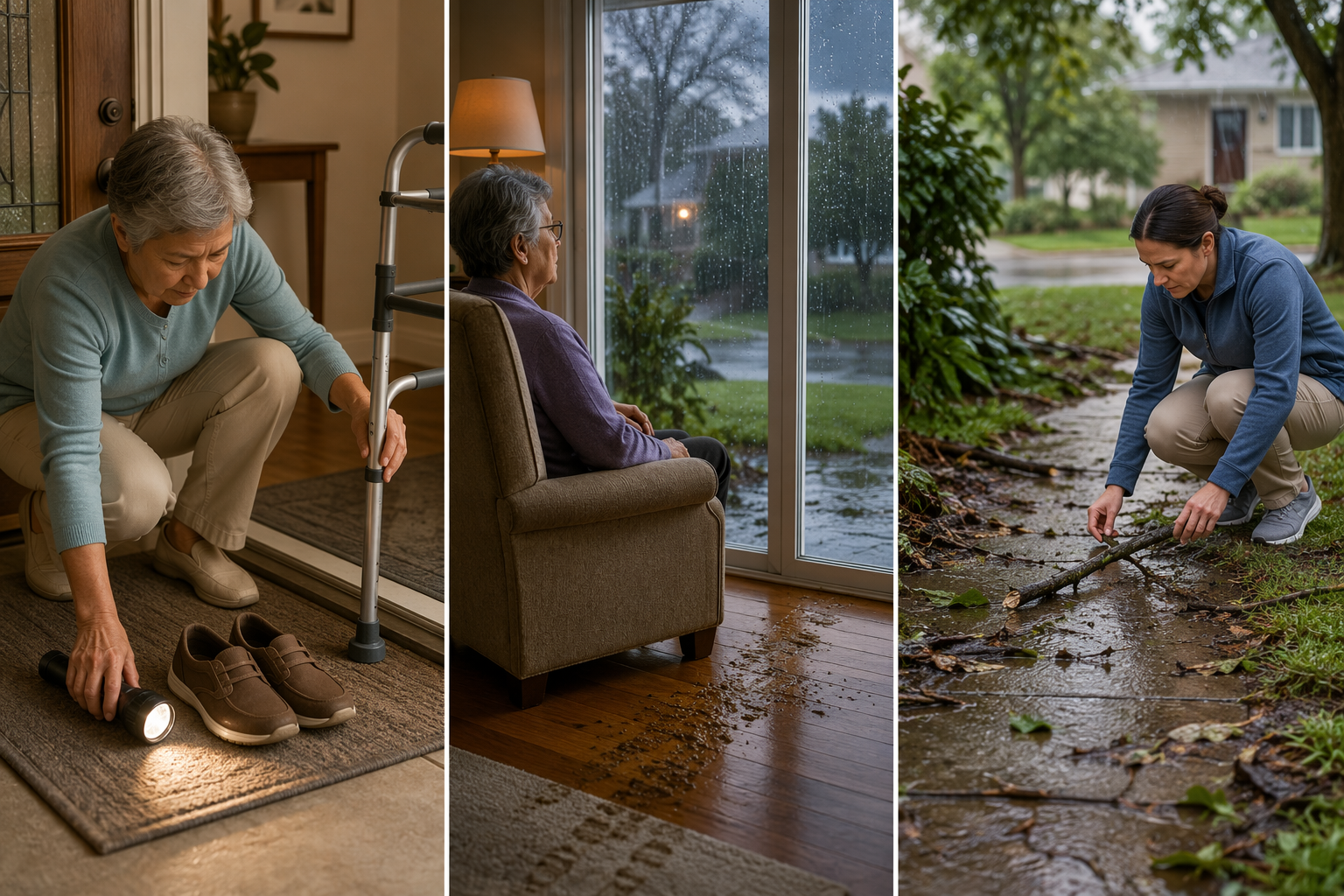
- Place a flashlight within reach of the main sitting area and the entry used most often, not in a drawer the person has to search in the dark.
- Put non-slip shoes or secure house shoes near the door so wet-soled outdoor shoes are not the default.
- Check whether the cane or walker tips still grip. Worn tips that seem acceptable indoors can lose usefulness on wet pavement.
- Clear loose objects from the porch and walkway before wind and rain move them into a path.
If you are doing a seasonal home walk-through anyway, connect this storm routine to a broader fall-prevention review. The CDC STEADI home fall prevention checklist is a better place for the full home scan. For a heavy rain warning, keep the focus narrower: doors, thresholds, exterior paths, lighting, shoes, and assistive devices.
Equipment should support the routine without becoming the whole answer. Non-slip mats, brighter portable lights, grab bars near entries, and better footwear can help, but only if they are placed where the storm will create movement. For product-neutral help choosing those items, see home safety products for seniors.
During the warning: keep the plan small
During heavy rain, the safest plan is usually the least complicated one: stay indoors and let outdoor items wait. The branch can stay where it fell. The lid can blow across the yard. The package can sit on the porch. The caregiver’s job is not to make the older adult afraid of rain; it is to make the errand feel less urgent than the fall risk.
If the older adult has already come inside, the threshold becomes the priority. Wet footprints should be treated as a hazard, not as housekeeping. A towel, a stable chair near the door, and a place to remove wet shoes can prevent the next risky step. Avoid asking the person to carry items while also managing a cane, walker, umbrella, or wet railing.
Emergency-preparedness organizations give broader advice for older adults, including planning around mobility needs, medications, communication, and support networks.[4][5][6] For fall prevention during heavy rain, pull only what changes movement right now: reachable lighting, a charged phone, a caregiver check-in, and a clear decision that no one goes outside to retrieve loose items while surfaces are wet.
After the storm: inspect before routines restart
The warning may expire before the fall risk does. That is especially true when an older adult’s normal routine resumes quickly: walking to the mailbox, feeding outdoor animals, checking the garden, taking a short walk, or moving the trash bin back. The surface may still be slick even after the sky clears.
- Walk the route the older adult actually uses, not only the front path visitors see.
- Look for mud on slopes, slick grass beside paved areas, puddles near uneven edges, and leaves stuck to concrete.
- Remove branches, blown containers, loose mats, and debris that could hide a step change or catch a cane tip.
- Check railings and handholds before relying on them, especially if wind or fallen branches may have shifted anything nearby.
- Have the older adult wait until the path is cleared and footwear is dry before resuming outdoor routines.
This is where the Ohio warning about mud and hidden debris becomes most useful.[2] After a storm, the danger is often ordinary-looking. A path can look passable from the doorway and still have a slick patch where runoff crossed it. A cane can land well on dry concrete and then slide when it reaches wet leaves.
How to talk about it without starting a fight
Many older adults resist being told to stay inside because the instruction sounds like a loss of independence. It helps to make the storm, not the parent, the problem. “The mud is acting like ice today” is different from “You can’t go out.” “Let me check the walkway first” is different from “You’re not safe.” The goal is to narrow one risky window, not renegotiate every household rule.
Caregivers can also borrow a pattern from other weather-alert routines. When air quality alerts arrive, the fall-prevention issue is not only breathing; it is how fatigue, changed plans, and indoor movement affect safety. Heavy rain warnings work the same way: the alert is a prompt to change behavior before the problem becomes visible. If that model helps your family, the related guide on how to protect seniors from falls when air quality alerts arrive may make the routine easier to generalize.
A heavy rain warning is a caregiver cue, not just a weather notice. The practical work is small and timed: postpone the errand, put the light where a hand can find it, keep wet shoes off slick floors, and inspect the path before the first trip back outside. Those ordinary actions can interrupt the chain that turns warm rain into hurried movement, wet surfaces, and an injury that did not need to happen.
References
- The Impact of Weather and Seasons on Falls and Physical Activity among Older Adults with Glaucoma: A Longitudinal Prospective Cohort Study — PMC8156454
- Falls Prevention in Every Season — Ohio Department of Aging
- Facts About Falls | Older Adult Fall Prevention | CDC — CDC
- What Older Adults Can Do If Disaster Strikes — NCOA
- Older Adults Emergency Preparedness — American Red Cross
- Older Adults — Ready.gov
Related reading
Noticed something outdated or inaccurate on this page? Flag a correction. We review every report against CDC, NIA, and AARP HomeFit guidance before updating a page.
Part of the Fall Prevention section.